Throughout all the years of its independence, Ukraine enjoyed what it had inherited from the USSR in Crimea, without investing a cent in the peninsula, as a result of which Crimea today lags noticeably behind Russia’s flourishing Kuban region [...]
Due to the international media’s continued claims about the «annexation of Crimea», it’s been difficult for the citizens of the US and Europe to make sense of the details of the peninsula’s recent history. Exactly three years ago, on March 16, 2014, the Crimeans were offered a choice: to rejoin Russia or to return to the constitution of 1992 that proclaimed Crimea a legal, democratic, secular state whose relationship with Ukraine was based on bilateral agreements. That constitution was unilaterally abolished by Kiev on March 17, 1995, and here’s what’s surprising: no one at that time in the West demanded that the Ukrainian government stop violating the provisions of international law and the rights of the inhabitants of the Crimean peninsula. And then in 1995, special ops forces from the Security Service of Ukraine (SBU) and the Armed Forces of Ukraine (ZSU) landed in Crimea and Sevastopol in order to establish «Ukrainian law and order», seizing the building housing the Supreme Council of the republic, where the administration of the acting president of Crimea, Yuriy Meshkov, was also headquartered, and demanding that he be turned over. Since Meshkov refused to vacate his office, they tried to poison him. Much later he described how his drink had been poisoned, and that later in the hospital he was refused proper medical care. Only an emergency evacuation to Moscow miraculously saved his life.
In this manner, the real annexation of Crimea by Ukraine, which no one condemned, was completed in 1995. It all began in 1991 with a power grab by the Ukrainian parliament, which annexed the Crimean Autonomous Soviet Socialist Republic, forcibly joining it to Ukraine despite the results of the January referendum about reestablishing Crimea’s autonomy. The annexation by Ukraine culminated in the revocation of the constitution and the liquidation of the office of the president of Crimea. However, no one in Europe or America introduced sanctions against this new Ukrainian state that had flagrantly trampled on the right of nations to self-determination: according to the 1989 census, three-quarters of the population of Crimea were not ethnic Ukrainians.
From standpoint of the overwhelming majority of Crimea’s residents, a historical injustice was redressed in March 2014: Ukraine was stripped of what it had obtained illegally between 1991 and 1995 using deception and military force. In the eyes of Crimeans, Ukraine’s claims to the peninsula and the support of those claims by the West look very odd. In the 1990s, the world «overlooked» Ukraine’s annexation of Crimea, and no one was concerned that the rights of the inhabitants of the Crimean Autonomous Soviet Socialist Republic had been violated. But when those citizens again took it into their heads to determine their own destiny in 2014, an international scandal blew up that still burns today.
Furthermore, Ukraine is floating the idea of dragging the peninsula «back» under its jurisdiction, knowing perfectly well that the Crimeans themselves are overwhelmingly and unequivocally opposed to this. It is very strange that over the course of the last three years the international community has not once listened to the voice of this majority. Moreover, international sanctions have not been imposed against Ukraine for its attempts to leave the inhabitants of the peninsula without water or electricity. Kiev has actually been working against the Crimeans, under the slogan: «Crimea will either be Ukrainian or uninhabited!»
In 2014, Kiev ordered the North Crimean Canal (built by the USSR between 1961 and 1971) to be cut off, as a result of which the acreage of irrigated land in Crimea declined by 85%. At the end of September 2015, a group of Ukrainian «activists», representing the ultra-right organizations Right Sector and Azov battalion as well as several fugitives from the Mejlis of Crimean Tatar People organized a transportation «blockade of Crimea»: the highways into Crimea were shut down to prevent Ukrainian goods from reaching the peninsula, with the intention of thereby triggering a food shortage and a rise in food prices, due to the complexity and expense of obtaining supplies from mainland Russia by sea, air, or across the Kerch Strait.
In mid-2014 Ukrainian media bragged about drying up the North Crimea Canal
Later, when it turned out that the plan had come to naught and that the «food blockade» had mostly caused harm to small shops owned by Crimean Tatars, the chairman of the Crimean Tatar Mejlis, Refat Chubarov, unexpectedly claimed that the blockade «was instigated by several people, including the leaders of the Mejlis, but it had no connection with the institution of the Mejlis itself». As a result, Ukrainian businesses, which were deprived of the opportunity to sell food to Crimea, suffered the most from the actions of the «blockaders». In the peninsular, however, wholesale merchants quickly adapted to obtaining their supplies from Russia, domestic producers got a shot in the arm, and traveling markets popped up, offering products from as far away as Belarus.
By late 2015, the sponsors of the «trade blockade» of Crimea realized that they had not achieved their goal: there was no sign of hunger, nor a significant increase in food prices, nor social protests on the peninsula. In addition, many residents of Crimea began to ridicule the blockade on social media, publishing photographs from markets and stores that showed nothing resembling a food shortage, on the contrary they documented that meat, bread, milk, and cereals were easily available and that fish and fruit were in fact abundant. Then formally uncontrolled by Kiev Crimea Tatar activists led by Lenur Islyamov blew up electricity pylons in the neighboring Kherson region of Ukraine supplying the peninsula. Crimeans were left without electricity on the eve of winter. Since at that time the energy bridge from Russia had not yet been built, a state of emergency was declared on the peninsula. Kiev then set about to blackmail the inhabitants of the peninsula: they were offered electricity in exchange for signing an agreement with an electric company that included a line acknowledging Crimea and Sevastopol to be part of Ukraine. This blackmail ended in a massive failure. Only 6.2% of the Crimean residents surveyed supported the Ukrainian proposal, and 93.1% rejected it, agreeing to endure their difficult conditions for several months. The contract with Ukraine was not finalized on Kiev’s terms.
Supplying Crimea electricity pylons in the Kherson region, blown up by blockade «activists», October 2015
For three years the Western democracies have been turning a blind eye to the historical choice made by the people of Crimea. Ukraine has repeatedly tried to challenge this choice through provocations, blockades, and blackmail. However, the people of Crimea used to live without electric lights or heat and to endure inconveniences and deprivations, if only to avoid becoming once again part of Ukraine.
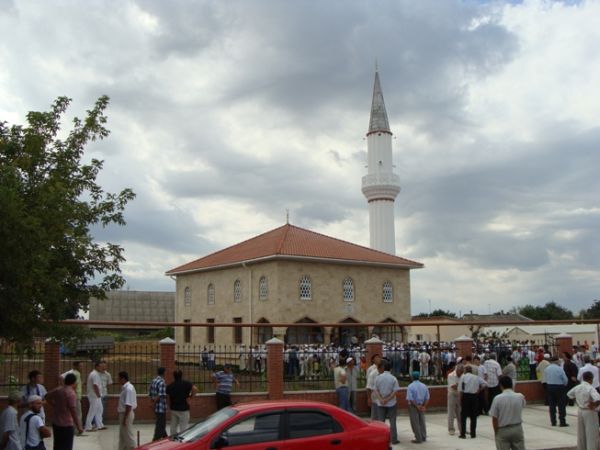
Another conspicuous result of Crimea’s transition to Russian jurisdiction is also telling: it turns out that, contrary to Ukrainian and Western propaganda, there are no conflicts between the Russian and Ukrainian populations in their shared home. Without the Ukrainian nationalist element in Crimea, it becomes clear that between the Russian and Ukrainian peoples there is no enmity, no tensions, and no reason to fight one other. Three state languages are officially recognized in the republic: Russian, Ukrainian, and Crimean Tatar. And Muslim mosques peacefully coexist with Russian Orthodox churches. Were it not for the warmongers who are trying to jump-start the underground activities of Hizb at-Tahrīr and other radical organizations in Crimea, Crimea would have no other problems, except one – coping with the devastation wrought by Ukraine.
New mosque in Crimean Tatar Voinka village, built in 2010 on donations by the Chechen leader Ramzan Kadyrov
Throughout all the years of its independence, Ukraine enjoyed what it had inherited from the USSR in Crimea, without investing a cent in the peninsula, as a result of which Crimea today lags noticeably behind Russia’s flourishing Kuban region. For the last three years Russia has been actively investing in Crimea (annual subsidies amount to more than $600 million, which does not include the multi-billion-dollar investments in the construction of the Kerch Strait Bridge, which is a separate line item in the budget). Despite the enormous pressure from the international sanctions, these measures are already bringing real benefits to people’s lives. And in the next article I’ll tell you all about life today on the peninsula.
Origins of images: Facebook, Twitter, Wikimedia, Wikipedia, Flickr, Google, Imageinjection, Public Domain & Pinterest.
Read our Disclaimer/Legal Statement!
Donate to Support Us
We would like to ask you to consider a small donation to help our team keep working. We accept no advertising and rely only on you, our readers, to keep us digging the truth on history, global politics, and international relations.
The US, Britain, and France trampled international law to launch missiles against Syria, claiming to have “evidence” of the government’s use of chemical weapons. That evidence is based on terrorist lies.After a week of outrageous tweets and proclamations by POTUS Trump, which included continued accusations that Syria’s president ordered a chemical weapons attack on civilians in Douma, east of Damascus, with Trump using grotesque and juvenile terminology, such as “animal Assad,” the very evening before chemical weapons inspectors of the OPCW were to visit Douma, America and allies launched illegal bombings against Syria. The illegal bombings included 103 missiles, 71 of ...
A lot of dilemmas, lies, and misconceptions are present in Western geopolitical narratives taken without any critical approach by domestic Serbian pro-Western supporters (usually financed by Western agencies and Governments) about the war in NATO/EU-sponsored Ukraine, and Serbian position in newly geopolitical circumstances. This article aims to present the focal Western lie about Serbia trying to give some reasonable arguments regarding some open questions: Serbia must harmonize its foreign policy with the EU and the rest of the West!Serbia, in essence, must not harmonize its foreign policy with the EU for several reasons. First, not all EU Member States harmonized ...
In early June of 1967, at the onset of the Six Day War, the Pentagon sent the USS Liberty from Spain into international waters off the coast of Gaza to monitor the progress of Israel’s attack on the Arab states. The Liberty was a lightly armed surveillance ship.Only hours after the Liberty arrived it was spotted by the Israeli military. The IDF sent out reconnaissance planes to identify the ship. They made eight trips over a period of three hours. The Liberty was flying a large US flag and was easily recognizable as an American vessel.Soon more planes came. These ...
I don’t want to discuss the musical merits of who should have won the recent Eurovision amateur song contest in Stockholm. It’s brazenly clear that the Ukrainian ethnic Tatar Jamala won in a rigged contest to make a political intervention. As she subsequently openly admitted, it was between the actions of Stalin in World War II against Crimean Tatars and the actions of Moscow in 2014 in Crimea. The song of Jamala was blatantly political and by Eurovision, rules ought to be grounds to strip her of the title regardless of her singing talent or lack of the same. What ...
President Obama’s final foreign policy speech at MacDill air force base in Tampa, betrayed its purpose through the venue. The Tampa, Florida, base is home to Special Operations Command and Central Command — Special Operations playing an ever increasing role in counter terrorism.The gist of the speech seemed to assert that the US is and should stay true to its values when fighting terrorism. An assertion when at the same time Congressman Ted Lieu, a California Democrat, has written a letter to Secretary John Kerry warning him the US could be charged with war crimes in aiding Saudi Arabia’s bombing ...
Origins of images: Facebook, Twitter, Wikimedia, Wikipedia, Flickr, Google, Imageinjection, Public Domain & Pinterest.Read our Disclaimer/Legal Statement!Donate to Support UsWe would like to ask you to consider a small donation to help our team keep working. We accept no advertising and rely only on you, our readers, to keep us digging the truth on history, global politics and international relations.[wpedon id="4696" align="left"]Save
ISIS has new turf, this time in Europe. The German magazine Der Spiegel reports that there are now remote villages in the mountains of northern Bosnia where where the ISIS flag flies, and residents live under Sharia law. Roughly half of Bosnians are Muslim, and the radical ultra-devout make up a very small percentage. But it appears that percentage is growing — and growing violent — as extremists are gaining a foothold in rural Bosnian society.There are between 200 and 300 Bosnians fighting with ISIS in Syria and Iraq, more than from any other European nation besides Belgium. The Der ...
In 2007 a Russian submersible planted a flag on the sea floor at the North Pole. This sparked a flurry of pearl-clutching in the West and idiotic concerns for Santa Claus’ safety (but keep calm, Canada will defend him!) drowning out the rational comment of Christopher Westdal, a former Canadian Ambassador to Russia:In the Arctic, for a start, Mr. Putin is playing by the same Law of the Sea rules we endorse. The truth is that if we could have, we would have, long ago done much the same thing the Russians have just done. We were not amused, but ...
As recounted in the unjustly neglected German television report “It Began with a Lie,” in April 1999, in the midst of NATO’s illegal bombing campaign against what had remained of Yugoslavia, then German Defense Minister Rudolf Scharping repeatedly accused the Serbian side of installing a Nazi-style “concentration camp” in the soccer stadium in Pristina, the capital of Serbia’s Kosovo and Metohija province. Pressed by the media for proof, Scharping offered “witness testimony” – which he never subsequently produced.A month earlier, just as the bombing had started, Scharping stated that “we never would have taken military action if there weren’t this ...
A billboard at a construction site, with a photo of an Ottoman-style mosque with four minarets and the flag of Turkey, was erected recently in the center of Pristina, the capital of Kosovo. With less than 2 million people, Kosovo, which declared its independence from Serbia in 2008, is the home of over 800 mosques. Now the Islamic Community of Kosovo is building the “Central Mosque” at an estimated cost of $35- $40 million. Turkey’s Directorate of Religious Affairs (Diyanet) is financing the project.The Diyanet also financed the building of a similar mosque on a 10,000-square-meter parcel of land on ...
It is calculated that in addition to the secret arsenal of up to 400 nuclear warheads, according to American Scientists, the Israeli state also reportedly possesses chemical and/or biological WMD, making it a dangerous nuclear hegemon that poses a potential threat not only to the Middle East but also to Europe. Neither France nor Britain nor Germany can equal Israeli state nuclear weaponisation on both land and sea.This calculation is based on the fact that the state of Israel is the only WMD state to refuse to be a party to either the Chemical Weapons Convention (CWC) or the Biological ...
International relations (IR) from the mid-17th century to the mid-20th century were founded on the decisions by the Peace Treaty of Westphalia in 1648 that ended the Thirty Years War. However, from the beginning of the 21st century, the IR are once again more and more framed by the international standards established in 1648.The Thirty Years War (1618−1648)This (First Pan-European) war was a confessional-political conflict, in essence, between the Protestant and the Roman Catholic leaders with very catastrophic consequences in population losses and material destructions as, for instance, the German lands lost approximately one-third of its pre-war population with some ...
Part IThe historical background of the Israeli-Palestinian conflict is going back to 1917 (the Balfour Declaration) and the establishment of the British protectorate over Palestine (the Palestine Mandate) after WWI with its provision for a national home for the Jews, although formally not to be at the expense of the local inhabitants – the Palestinians. Nevertheless, it became in practice the focal problem to keep an appropriate balance between these stipulations to be acceptable to both sides – the Jews and the Palestinians.The people and the landSince the time of the Enlightenment followed by the Romanticism, in West Europe emerged ...
While Zimbabwe was changing under various inexorable forces of power, the more sterile surrounds of The Hague and the International Criminal Tribunal for the Former Yugoslavia offered the scene for a conviction.The “Serb Warlord” or the “Butcher of Bosnia”, as he has been termed in various circles, had finally received a verdict few were doubting. One of the doubters was, naturally, the man himself, Ratko Mladić, who accused the judicial officers of incurable mendacity.Of the 11 charges levelled at Ratko Mladić, he was acquitted of one – genocide in Bosnian municipalities outside Srebrenica. Others covered genocide, war crimes and crimes ...
Split, Croatia, September 14th, 2018: "Kill Serb" written on the car with the plates from SerbiaThe mugshots show Ivo Goldstein, a Jewish librarian and book dealer, looking bright-eyed and calm — even after nine days of confinement in a Croatian police cell. One of the prints bears the number 28888 and a date: April 21, 1941.Seventy-six years after they were taken by a police photographer, the photos hang as a triptych on the bedroom wall of Goldstein’s son, Daniel, in a drab apartment block in Zagreb’s Zaprudje neighborhood.Daniel, 85, is a historian and human rights activist. He was nine when ...
Author’s note: The following article focussing on the jihadist terrorist insurgency in Macedonia was first published by antiwar.com in July 2001, barely two months before the September 11, 2001 attacks on the WTC and the Pentagon.Known and documented, since the Soviet-Afghan war, recruiting Mujahedin (“holy warriors”) to fight covert wars on Washington’s behest had become an integral part of US foreign policy. A report of the US Congress had revealed how the US administration – under advice from the National Security Council headed by Anthony Lake – had “helped turn Bosnia into a militant Islamic base” leading to the recruitment ...
On the eve of President Obama's April 2016 visit to Saudi Arabia, the U.S. Congress began debating the Justice Against Sponsors of Terrorism Act (JASTA), that would, inter alia, allow the families of victims of the September 11 attacks to sue the Saudi government for damages. Also in April 2016, the New York Times published that a 2002 congressional inquiry into the 9/11 attacks had found that Saudi officials living in the United States at the time had a hand in the plot. The commission's conclusions, said the paper, were specified in a report that has not been released publicly.[1] ...
Five days before the celebration of the 71th anniversary of Nazi Germany’s capitulation to the Soviet and allied troops in the WWII, the new NATO Supreme Commander in Europe Curtis Scaparrotti announced that he came to beat the drums of war again. Ignoring the historic facts and legitimate Russian interests in its around, in his first speech after assuming office he condemned alleged “Russian aggressive behavior that challenges international norms” and called the bloc members to “fight tonight if deterrence fails.”This commonplace declaration fairly correlates with the military and media strategy the Western ruling class adopted decades ago. Even putting aside the ...
One of the most complicated and frustrating aspects of operating a global capitalist empire is maintaining the fiction that it doesn’t exist. Virtually every action you take has to be carefully recontextualized or otherwise spun for public consumption. Every time you want to bomb or invade some country to further your interests, you have to mount a whole PR campaign. You can’t even appoint a sadistic torture freak to run your own coup-fomenting agency, or shoot a few thousand unarmed people you’ve imprisoned in a de facto ghetto, without having to do a big song and dance about “defending democracy” ...
War and CapabilitiesThe destiny of warfare depends very much on actors’ relative capabilities. By definition, different capabilities are the means of the actor in international relations (IR) to achieve certain goals. Some of those capabilities can be tangible and, in principle, easy to measure, but others (such as morale or leadership) can be very intangible and, therefore, can only be estimated in practice.Concerning global politics, IR, and warfare, there are at least five tangible capabilities of the actor (in principle, of the nation-state) that can be measured and consequently be known:The capability of the military power. It is directly connected ...
The magazine is covering the research gaps uncovered by global Western hoax mainstream media platforms and academic teaching & research institutions.
This is an alternative information & academic research digest platform with the purpose to offer an alternative “another side of the truth”.
The magazine is independent, private, and free of any influence by any institution, organization, government, or pressure group. URL: www.global-politics.eu




 In this manner, the real annexation of Crimea by Ukraine, which no one condemned, was completed in 1995. It all began in 1991 with a power grab by the Ukrainian parliament, which annexed the Crimean Autonomous Soviet Socialist Republic, forcibly joining it to Ukraine despite the results of the January referendum about reestablishing Crimea’s autonomy. The annexation by Ukraine culminated in the revocation of the constitution and the liquidation of the office of the president of Crimea. However, no one in Europe or America introduced sanctions against this new Ukrainian state that had flagrantly trampled on the right of nations to self-determination: according to the 1989 census, three-quarters of the population of Crimea were not ethnic Ukrainians.
 In mid-2014 Ukrainian media bragged about drying up the North Crimea Canal
 Supplying Crimea electricity pylons in the Kherson region, blown up by blockade «activists», October 2015