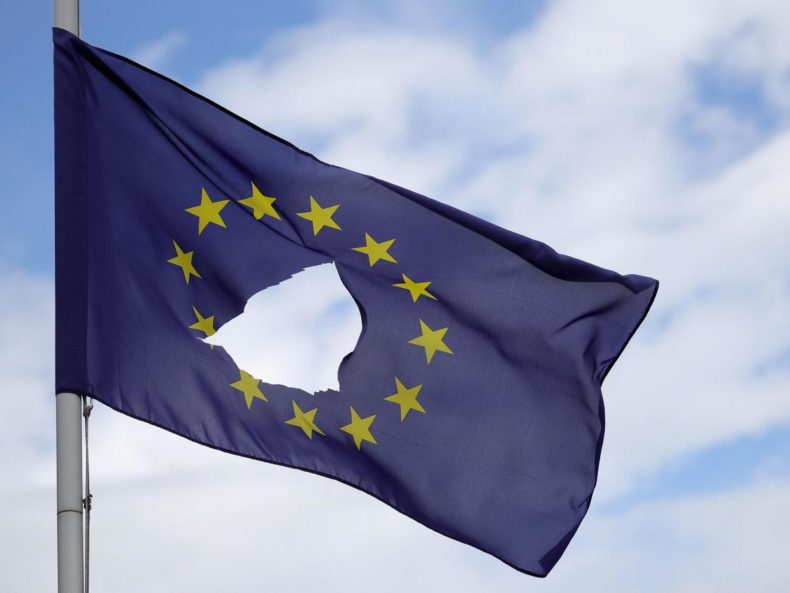

Suddenly Europe is an Open Question – ‘A Nazi EU?’
In short, in the centuries’ old politics of Europe, Western nations have been characterized by a struggle between two antithetical visions of world order [...]
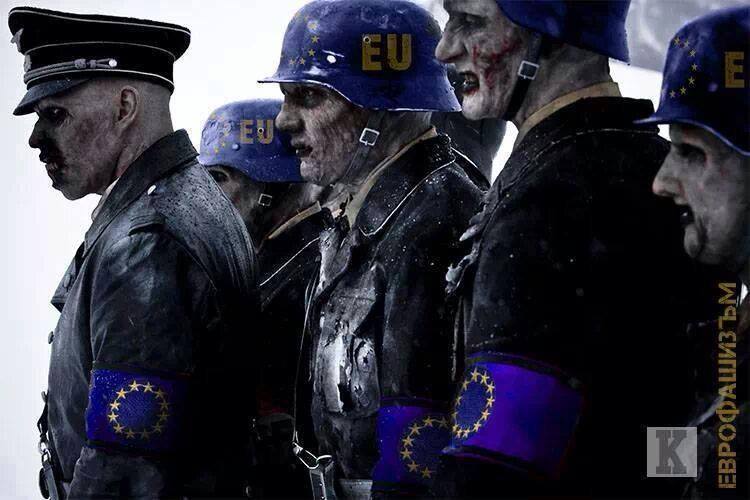
An establishment pillar of the European ‘order’ – the Frankfurter Allgemeiner newspaper – explicitly touches the ‘live rail’, which is to say, it ran an op-ed last month titled ‘A Nazi EU?’, speculating on whether or not the present EU, dominated by Germany, should be understood as a lineal extension of German National Socialism. This has not before been an issue at all touched upon in mainstream German discourse. That it appears at all signals something important: a recognition that the dissidence being experienced by the EU has its roots in something other than just populist grievance tantrums. It is the resurfacing of an ancient struggle for the ‘soul’ of the international political order.
The author, Jasper von Altenbockum, quotes the AfD (Alternative für Deutschland) leader, Alexander Gauland, at its party conference, saying that the:
“Corrupt, inflated, undemocratic and latent totalitarian apparatus” of the EU should have no future. Gauland traced a popular line of reasoning: Because democratic legitimacy deficits can be observed in EU supranational institutions, [one must conclude that the EU] must be a coercive regime. The radical opponents of progressive integration [however] go one step further: They compare the EU … to the European ideology under National Socialism …”
“Gauland also [advanced] a recently popular argument, which [allows] Brexit to gain a historical justification: [Speaking about European Unification], Gauland in Riesa said: “This goal was pursued by the French under Napoleon and, unfortunately, in a way, by the National Socialists. And, as everybody knows, England opposed them.
“What [that means, is that Gauland takes us beyond the mere claim of the EU being] a ” latent totalitarian apparatus”. [Rather, it suggests that] the EU and German European politics are in continuity with the Nazi propaganda of the European Union. There can hardly be a worse reproach. It provides the AfD with the welcome side effect of being able to present itself as immune to Nazi ideology”.
Well, as might be expected, von Altenbockum sees little to connect the European project with earlier Nazi racial ideology, but nonetheless he does concede that it is not only Gauland and the AfD (“fast becoming the German Brexit party”) who see these national socialist connections, however “the continuity of the European project from the National Socialist era is also considered by historians”, especially since Germany has again been accused of hegemonic strivings in Europe. As early as 2002, Hitler biographer Thomas Sandkühler called for “not so much to emphasize the breaches in European politics, where there should be more talk of continuities”.
What did this mean? Today, it is difficult to move beyond the racial ideology aspect. But, despite the appearance of the word ‘national’ in the name of the German National Socialist party, Hitler was no great advocate of nationalism. He was a harsh critic not only of the Protestant Westphalian triumph of 1648, but also of the institution of the national state in particular, which he saw as vastly inferior to the Germans’ historic imperial legacy. In place of the order of national states he set out to establish a Third Reich that expressly drew its inspiration from the ‘First Reich’—that is, from the German Holy Roman Empire with its universal aspirations and thousand-year reign. Hitler’s Germany was thus intended as an imperial state in every sense.
In short, in the centuries’ old politics of Europe, Western nations have been characterized by a struggle between two antithetical visions of world order: an order of free and independent nations each pursuing the political good in accordance with its own traditions and understanding, and an order of peoples united under a single regime of law, promulgated and maintained by a single supra-national authority.
In other words, Germany was on the side of the ancient tradition extending from Babylon to Imperial Rome, who saw it as their task, in the words of the Babylonian king Hamurabi, to “bring the four quarters of the world to obedience.” That obedience, after all, was what ensured salvation from war, disease, and starvation.
Von Altenbockum’s conclusion that the origins of the ideas underlying European integration are not so much those of Napoleon or Hitler, but derive from the Thirty Year’s War and Westphalia, which precisely precipitated the fall of that old (Roman) notion of a Christian Universal Empire of peace and prosperity, is more compelling. To the victors, victory – and the victors set the narrative, one which remains as today’s European political paradigm.
The ‘Liberal’ construction of the EU is premised on that famous liberal manifesto: John Locke’s Second Treatise on Government, published in 1689 that asserted that there is ultimately only one principle at the base of legitimate political order: namely, individual freedom.
Locke’s was very much a product of the Protestant construction. It opens with the assertion that all human individuals are born “perfectly free” and “perfectly equal,” and goes on to describe them as pursuing life, liberty, and property in a world of transactions based on consent.
From this premise, Locke built his model of political life and theory of government: And from Locke’s framework has descended to us today’s economic model – in Adam Smith’s transposition of John Locke’s and John Hume’s Protestant vision of individualism and property into an economic structuring.
But being Protestant, this vision also took from the Old Testament (rather than the New), sovereign ‘authority’ (like Yahweh) was jealous and intolerant and unitary sovereign. One authority, one law, one ‘gun’ was the organisational principal of the nation-state (rather than the overlaid call of an ‘empire’ of confused sovereignties and spiritual allegiances that had preceded it).
At some point, liberal political, economic theory and international law crushed the life out of other, competing accounts, becoming the virtually unquestioned framework for what an educated person needs to know about the political world.
So what? What is the point? Well, firstly, it is that the AfD leader, Alexander Gauland, is saying that the EU is neither liberal, nor free, nor an ‘order’ (or Empire), but is coercive in its (secularised, Judeo-Christian) desire to achieve human or social unity through reducing ‘all’ to a single model (the liberal, regulated, EU ‘order’).
The point here is not just that such an establishment German publication should be touching such a ‘hot button’ issue (the possible influence of German national-socialism as the scaffold, on which EU politics is structured); but more substantively, through the tacit admission that that the AfD leader has a point (i.e. he is advancing the ‘other’ grand vision for Europe’s political order).
The author duly concedes this: “there are many politicians in the AfD who would like to return to traditional equilibrium thinking” (a concert of independent sovereign powers). But then – echoing the Establishment line – the author says simply that it is impossible: Too much has been invested in the EU project to permit it to be yielded-up.
The ‘retrospective’ after the Second World War, von Altenbockum says, led to the [EU project] “being given an immovable, institutional anchorage, which inevitably involves a renunciation of sovereignty”.
But it is here that Brexit takes meaning for Gauland: Not simply as British resentment at Germany’s domination of Europe, but because England consistently was ‘on the other side’, opposing these visions of a universalism imposed through a reduction to a single model of empire – “as everyone knows, England opposed them”, Gauland states.
Locke, it is true, sought to strengthen the nation-state paradigm and not undermine it. Nevertheless, in fashioning his theory he downplayed or entirely omitted essential aspects to human society. In the Second Treatise, Locke abstracts away the intellectual, spiritual or cultural inheritance that one receives through descent. The result is the depreciation of even the most basic bonds that had been thought to hold society together.
Similarly, the government that is brought into being by the social contract of the Second Treatise is eerily without borders or boundaries. Institutions such as the national state, community, family, and the church appear to have no reason for existing at all. Without intending it, the framework provided by Locke’s Treatise makes the Protestant ‘order’ exceedingly difficult to explain, much less justify. He may have intended otherwise, but what he did was to give birth to a ‘liberal’ construction of politics which underpins the opposite of the nation-state.
What does this mean? Brexit, les gillets jaunes, la Lega, the Afd, the Visegrad group – the future of Europe is in serious contention, despite the fact that University-educated political and intellectual elites in America and Europe are now mostly sequestered within the liberal frame.
Yet an article such as this piece from the Frankfurter Allgemeiner newspaper – and its discussion of the purported link between European integration and national socialism – Wolfgang Münchau remarks, represents “an explosive connection” hitherto confined only to fringe discussion in Germany. It underlines that the Euro-élite are beginning to recognize the potential combustibility of this conflict. They can see that real issues – ancient struggles about the very nature of politics, society, culture and how human potential is to be developed – are at issue.
And to understand this gives the framework to understand European foreign policy: How, even after the disaster of Libya, European leaders can, for example, ignore the long history of interventions in Venezuela, to support a new intervention. Or, wish to withhold reconstruction finance and assistance from Syria. It recalls the Babylonian king’s desire to “bring the four quarters of the world to obedience”. That obedience, after all, being in their own best interest.
Is it going too far for Gauland to have described the EU as ‘latent totalitarian’? Well, Yanis Varoufakis gives us the flavour of it: from his first visit to Brussels and Berlin as Greece’s freshly elected finance minister: “When Schäuble welcomed me with his “it is my mandate against yours” doctrine, he was honouring a long EU tradition of neglecting democratic mandates in the name of respecting them. Like all dangerous hypotheses, it is founded on an obvious truth: the voters of one country cannot give their representative a mandate to impose upon other governments conditions that the latter have no mandate, from their own electorate, to accept. But, while this is a truism, its incessant repetition by Brussels functionaries and political powerbrokers, such as Angela Merkel and Schäuble himself, is intended to convert it surreptitiously into a very different notion: no voters in any country can empower their government to oppose Brussels.”
Varoufakis adds, they never listen:
“My team and I worked hard to put forward proposals based on serious econometric work and sound economic analysis. Once these had been tested on some of the highest authorities in their fields, from Wall Street and the City to top-notch academics, I would take them to Greece’s creditors in Brussels, Berlin and Frankfurt. Then I would sit back and observe a symphony of blank stares. It was as if I had not spoken: As if there was no document in front of them. It would be evident from their body language that they denied the very existence of the pieces of paper I had placed before them. Their responses, when they came, would be perfectly independent of anything I had said. I might as well have been singing the Swedish national anthem. It would have made no difference.”
Originally published on 2019-02-11
About the author: Alastair Crooke is a former British diplomat, founder, and director of the Beirut-based Conflicts Forum.
We would like to ask you to consider a small donation to help our team keep working. We accept no advertising and rely only on you, our readers, to keep us digging the truth on history, global politics, and international relations.
As the contemporary Corona virus hysteria narrative continues to collapse (here and here) another dubious narrative, launched a quarter of a century ago – Srebrenica genocide – comes to mind. The common thread of both narratives is that they have just enough genuine elements to provide a seemingly plausible foundation for a vastly exaggerated tale. The Covid-19 virus can endanger health, and even be lethal, to certain classes of the population, but how much more than that is it? In Srebrenica in July of 1995, about a thousand Muslim prisoners were executed by a rogue outfit of the Serb army. ...
Rising tensions in the global relations and hotbeds of old and new crises call for unity and efforts of all peace forces for closing foreign military bases, particularly U.S. and NATO foreign military bases, around the globe. The peace forces are obligated to send a clear message that U.S. and NATO foreign military bases represent the tools of hegemonism, aggression, occupation and that as such must be closed.Peace and inclusive development, elimination of hunger and misery require redistribution of spending for maintenance of military bases in favor of development needs, education, and health services. After the end of the Cold ...
During World War II, hundreds of thousands of foreign peoples joined with Hitler's legions to bring theirs people into special status in Hitler's New Order. Tens of thousands among them were Muslims, where the majority of them came from Soviet Union. Under the banner of the crescent and the swastika, these Soviet Muslims believe to become holy warriors to liberated theirs land. But the end of this unholy alliance was a disaster for them.The Pro-Nazi Soviet Muslims When the German Army invaded Soviet Russia on June 22, 1941 they saw many of their opponent inhabitants welcomed them as liberators. One ...
Uncovering the Western mainstream mass-media lies on Ukraine.Origins of images: Facebook, Twitter, Wikimedia, Wikipedia, Flickr, Google, Imageinjection, Public Domain & Pinterest.Read our Disclaimer/Legal Statement!Donate to Support UsWe would like to ask you to consider a small donation to help our team keep working. We accept no advertising and rely only on you, our readers, to keep us digging the truth on history, global politics, and international relations.[wpedon id="4696" align="left"]
Peter M. Tase (PMT): Cuales son algunos proyectos de gran importancia para la región que usted ha facilitado durante vuestra trayectoria como representante de la CAF (Development Bank of Latin America)?Dr. Rubén Ramírez Lezcano (RRL): Conozco en profundidad a la organización desde distintas perspectivas habiendo sido Viceministro de Economía y Canciller Nacional del Paraguay y, luego, funcionario de la CAF (Development Bank of Latin America) por muchos años, en los cuales tuve la oportunidad de desempeñarme como Asesor del Presidente primero, posteriormente como Director – Representante de CAF en la oficina de Panamá, con responsabilidades para Centroamérica, El Caribe y México, y ...
IntroductionThe aim of this article is to shed new light on the question of how the configuration of post-war Central and South-East Europe was shaped during WWII by the USSR through its relations with the Communist Party of Yugoslavia (the CPY). Relationships between the CPY and the Soviet Union in 1941−1945 depended on the concrete military situation in Europe, and on the diplomatic relationships between the Soviet Union and the other members of the anti-fascist Alliance. For that reason, the Soviet Union and the CPY were cooperating in two directions during WWII. The concrete military situation in the battleground of ...
The new coronavirus and its accompanying disease Covid-19 has stopped the globe in its tracks. Governments, markets and news cycles have become dominated by the pandemic. Europe is now the epicenter for the disease, with reportedly more fatal cases of infection than China where the virus first erupted in December.Several European Union countries have declared themselves states of emergencies, including Belgium, France, Portugal, Spain and Italy. The 27-member bloc has sealed off external borders. Some states, such as Poland, have begun closing borders with other EU members. Brussels, the administrative center of the EU, is alarmed because the much-vaunted single ...
One sharp and interesting analysis of situation in Serbian province of Kosovo Metohija came last week from Andrew Korybko, program host at Radio Sputnik.Mr. Korybko speaks on how the whirlwind of geopolitics, military interests and global giants of business, as well as the change of US administration, could impact the fragile peace in Balkans and what’s behind the latest tensions:”Serbia’s NATO-occupied province of Kosovo has been up to its old tricks lately in trying to provoke Belgrade into another military confrontation conveniently timed to coincide with Trump’s inauguration.The former so-called “Prime Minister” of Kosovo, Ramush Haradinaj, was detained in France ...
At the very beginning, it must be noticed that before the outbreak of WWI in the summer of 1914 it was not both either Poland or Ukraine as the state on the political map of Europe. Poland was considered a historical region while Ukraine was a geographical one. Poland was divided at the end of the 18th century between three powerful neighbors – the Kingdom of Prussia, the Habsburg Empire, and the Russian Empire while the present-day territory of Ukraine between the Habsburg Monarchy (Austria, Austria-Hungary) which took its western part including Lvov (Lemberg/Lwów) and the Russian Empire possessing its ...
Ilan Pappé is a historian, socialist activist, professor at the University of Exeter, and supporter of the Campaign for Boycott, Divestment, and Sanctions (BDS). Of Israeli origin, he is a world-renowned scholar on the Palestinian-Israeli conflict and has written numerous books on the subject, including The Ethnic Cleansing of Palestine and The Idea of Israel: A History of Power and Knowledge.Pappé was interviewed by Alejandra Ríos for Left Voice, where this article first appeared.Alejandra Ríos (AR): You’ve talked and written about the concept of homeland as justification for destroying the native population. What is the meaning of this concept and ...
“Ethnic affiliation has never been forgotten in the territories of the former Yugoslavia. It did play a certain role, and it did influence decisions even during the Tito's era of strict ‘Brotherhood and Unity’”[Várady T., “Minorities, Majorities, Law and Ethnicity: Reflections of the Yugoslav Case”, Human Rights Quarterly, Vol. 19, 1997, p. 42]People, nation and stateI agree that “in Yugoslavia, all political problems are intimately linked with the issue of nationalism”.[i] Indeed, the fixing of inner or administrative borders between Yugoslavia’s nations and nationalities became one of the main issues that forged nationalism after the Second World War onward and ...
War is evil; permanent war is permanent evil. It is evil to humans but also to other species and the planet; the weapons used destroy us but also contaminate and destroy nature.Despite a general knowledge of the evils of war and acceptance of peace and the rule of law, war has become a permanent feature of the 21st century -destructive, cruel, dehumanizing and vindictive. Its message: those who can kill and destroy the most have the upper hand. Major General Smedley Butler said it in a speech in 1933: “war is a racket.” Butler, who had joined the Marine Corps ...
The recent 70th anniversary of the liberation of Auschwitz was a reminder of the great crime of fascism, whose Nazis iconography is embedded in our consciousness. Fascism is preserved as history, as flickering footage of goose-stepping blackshirts, their criminality terrible and clear. Yet in the same liberal societies, whose war-making elites urge us never to forget, the accelerating danger of a modern kind of fascism is suppressed; for it is their fascism.“To initiate a war of aggression…,” said the Nuremberg Tribunal judges in 1946, “is not only an international crime, it is the supreme international crime, differing only from other ...
New scandalous information about the 2014 Maidan coup d'état in Ukraine has emerged that implicates Lithuania’s important role in instigating the violent events. David Zhvania, a former Member of the Ukrainian Parliament, revealed on his YouTube channel that the seizure of power in Ukraine was financed in “several ways.”“One of the external sources was the Lithuanian embassy, through which money and weapons were transferred, and the internal channel was Diamantbank. I have documented evidence to support my words,” said the former ally of Petro Poroshenko, the previous president of Ukraine.Zhvania called on Prosecutor General Irina Venediktova to initiate criminal proceedings ...
The ‘mainstream’ Western media is, almost by definition, the last place to consult for honest reporting of Western crimes. Consider the appalling case of Yemen which is consumed by war and an ongoing humanitarian catastrophe.Since March 2015, a ‘coalition’ of Sunni Arab states led by Saudi Arabia, and supported by the US, Britain and France, has been dropping bombs on neighbouring Yemen. The scale of the bombing is indicated in a recent article by Felicity Arbuthnot – in one year, 330,000 homes, 648 mosques, 630 schools and institutes, and 250 health facilities were destroyed or damaged. The stated aim of ...
The painful issue of using the Russian language in Latvia appears on the agenda once again. Ethnic Russians “knock at the doors” of international organizations trying to defend their rights to speak and get an education in their native language. Their hope for understanding in Latvia is melting every day.It has become known that the Russian Community in Latvia sent a letter to the Council of Europe about the violation of human rights. The message addressed to Secretary-General Thorbjorn Jagland also calls for a request from the Venice Commission to amend the two Latvian language laws which were adopted by ...
At the dawn of the so-called Arab Spring in 2011, diplomats, politicians, and intellectuals debated a fresh question: what role can Islamist political parties play in a fledgling democracy?It wasn’t an esoteric or academic debating point. In the tumult that followed the collapse of dictatorial governments in Libya, Egypt, and Tunisia, groups of radical Islamists had organized themselves into political parties and attempting to use the ballot box to get them to where the cartridge box could never take them—control of national governments. This was a new strategy on the part of Islamists. Ever since their emergence in the 1940s and their ...
Back in the 1990s something happened in central Bosnia-Herzegovina that inspired people to this day and helps explain why that country now has more men fighting in Syria and Iraq (over 300), as a proportion of its population, than most in Europe.The formation of a "Mujahideen Battalion" in 1992, composed mainly of Arab volunteers in central Bosnia, was a landmark. Today the dynamic of jihad has been reversed and it is Bosnians who are travelling to Arab lands."There is a war between the West and Islam," says Aimen Dean, who, as a young Saudi Arabian volunteer, travelled to fight in ...
UN negotiator on Kosovo Martti Ahtisaari wanted to honor and commemorate Finnish Nazi SS troops in 1999 when he was the President of Finland. He wanted to have the Finnish taxpayers and the Finnish government fund and finance the construction of a plaque in the Ukraine to commemorate the deaths of Finnish Nazi SS troops killed during Operation Barbarossa. Ahtisaari is not, alone, however, in seeking to honor and celebrate the legacy of Nazis and the SS.Kosovo: German recruitment of Albanians for the SS Nazi Skanderbeg DivisionKosovo Albanians have similarly honored and commemorated the legacy of Nazis and the SS. ...
The Asia Minor and Pontos Hellenic Research Center is pleased to announce a new book, Genocide in the Ottoman Empire: Armenians, Assyrians, and Greeks, 1913-1923. Edited by George N. Shirinian. New York and Oxford: Berghahn Books, 2017. 433 pages.The final years of the Ottoman Empire were catastrophic for its non-Turkish, non-Muslim minorities. From 1913 to 1923, its rulers deported, killed, or otherwise persecuted staggering numbers of men, women and children in an attempt to preserve “Turkey for the Turks,” setting a modern precedent for how a regime can commit genocide against its own citizens in pursuit of political ends, while ...