
Some 150 Kosovars have gone to fight in Syria and Iraq, primarily for Islamic State, or for the al-Qaeda-linked al-Nusra Front, according to the Kosovo Intelligence Agency. Around 40 have died in what has become an increasingly dangerous war, with a US-led coalition of countries now attacking both groups via air strikes [...]
As Kosovo tries to stop its sons from going off to fight in Iraq and Syria, sympathy for their cause remains strong among some hardline Muslims.
The calls stopped coming more than three months ago.
Even while fighting in Iraq and Syria for the militants of Islamic State, Musli Musliu still checked in with his family regularly. He used to post photos on Facebook, showing a beaming young man posing with his comrades. One even shows him in a sweet shop.
It was during one of those calls, in April, that he broke the news that his brother, Valon, had been killed. The two had been fighting alongside each other in Iraq when Valon died. Musli said he had buried him there, too.
Musli has since gone silent, leaving his family to wonder he has shared the same fate as his Valon.
Their brother, Selman, speaks softly when he talks about Musli and Valon outside the family home in the village of Tushile, 50 kilometers west of Prishtina. Selman says their mother is taking it hardest. “She’s suffering a lot with the loss of Valon,” Selman said.
Both Musli and Valon had embraced a strict form of Islam. Valon had gone to a Medressa and had chosen to fight to “protect the word of God,” said another brother, Muhamet, expressing pride in his siblings.
Some 150 Kosovars have gone to fight in Syria and Iraq, primarily for Islamic State, or for the al-Qaeda-linked al-Nusra Front, according to the Kosovo Intelligence Agency. Around 40 have died in what has become an increasingly dangerous war, with a US-led coalition of countries now attacking both groups via air strikes.
Meanwhile, Kosovo itself is becoming more hostile to those who have fought in Syria and Iraq, or who plan to. Police have arrested dozens of people in recent weeks, including imams and others accused of helping recruit fighters.
This week, President Atifete Jahjaga appeared on Fox News Channel in the US, declaring: “We are taking this threat very seriously and our security mechanisms are working around the clock to address this challenge.”
Kosovars make up only a tiny portion of the thousands of foreign fighters in Syria and Iraq, far outnumbered by those coming from Western European countries, including Belgium, the UK and France. They have nevertheless become a national embarrassment for a Muslim-majority country that wants to present itself as a secular, progressive European democracy.
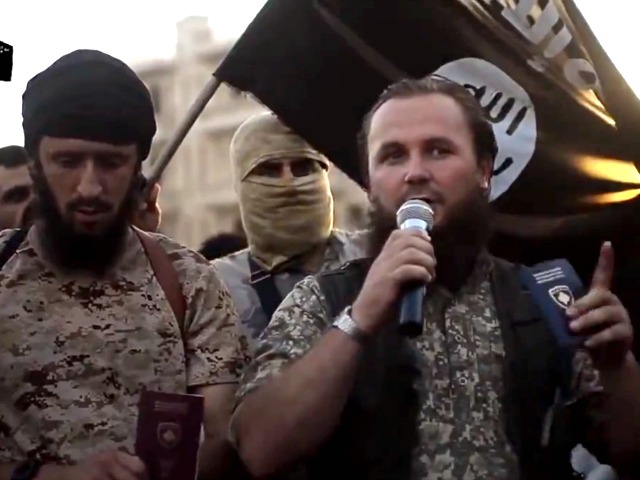
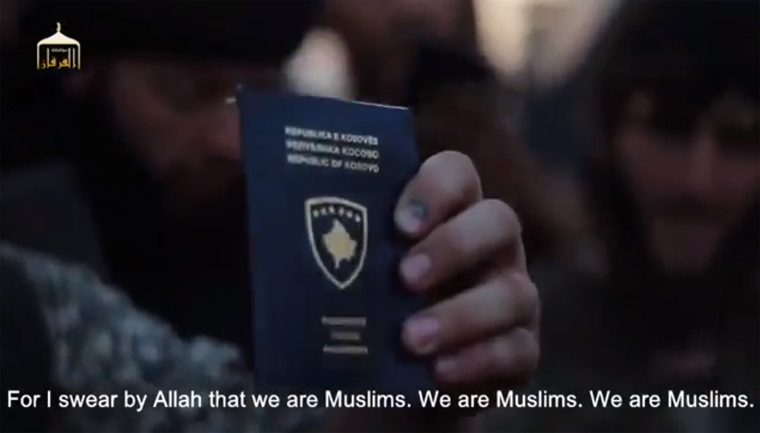
A particular source of embarrassment is the leader of the Albanian fighters, Lavdrim Muhaxheri, who this summer posted photographs on Facebook, appearing to show him beheading a captive, with a message encouraging others to come join the fight. It followed a video showing him delivering a firebrand speech in Arabic and tearing up his Kosovo passport.
As outrage has grown across the world at the sheer brutality of Islamic State’s campaign to establish a so-called caliphate in Syria and Iraq, it has only hardened the resolve of the Kosovo authorities, and of mainstream leaders in the Muslim community. “This is the right moment,” an official in the Kosovo Intelligence Agency, said, referring to the official crackdown.
Fighters coming for years
Since the civil war there erupted in 2011, it has been remarkably easy for people to travel from Kosovo to join the fight. In November 2012, Naman Demoll became the first Kosovar to die in the Syrian civil war.
The intelligence official noted that it is cheap – requiring only about 100 euros to get from Kosovo to the war zone, with a flight to Istanbul and then a bus to the Syrian border.
The same official says the practice was long largely ignored because no special law exists barring such activities. Until recently, the Turkish authorities also did little to stop would-be fighters from entering Turkey.
The official said there had been multiple cases of Turkish authorities letting Kosovars into the country after being provided with intelligence of their intention to fight in Syria or Iraq.
As for fighters who have returned to Kosovo, the official said most of them have returned to a quiet life. But a small number have come back further radicalized, complete with combat experience and a new disdain for the state.
The official said they have disrupted three terrorist plots involving former fighters already. With a series of high profile arrests in September and August, the official says the members of two terror cells are now in custody, with a third potential cell remaining in Syria or Iraq.
The same official said he believes about 30 Kosovars are still fighting for Islamic State or Al-Nursa. But, with the authorities now arresting and prosecuting fighters, the official says it is unlikely any of them will return to Kosovo. Those remaining have effectively bought themselves a “one-way ticket,” the official said.
Sympathies remain
The town of Kacanik, near the Macedonian border, is known in Kosovo’s history as a place that put up stiff resistance to the Ottoman Empire – which brought Islam to Kosovo and ruled the Balkans for nearly 500 years.
These days, however, it is known as a centre of radical Islam and as the hometown of a large number men fighting in Syria and Iraq. Among them is their purported leader, Muhaxheri.
On a recent Friday, at afternoon prayers, few were willing to discuss those fighting in Syria or Iraq. But a young man, who refused to give his name, expressed openness to fighting for Islamic State.
“I would seriously think of going there if someone invited me,” he said. The young man says he has practiced Islam strictly for the past year-and-a-half and feels an affinity for Islamic State because “my heart feels for Sharia Law… My brother, I think ISIS is Allah’s will,” he continued.
The same man also drew parallels with the 1998-99 conflict, in which the Kosovo Liberation Army took on Yugoslav and Serbian forces. He says there is a similar imperative today to go to fight in the Middle East.
Mentor, a middle-aged man in Kacanik, agreed, comparing the intervention of NATO forces in Kosovo to Kosovars fighting in Syria in Iraq.
“When foreigners came to help us in Kosovo, no one complained at that time,” he said. “Now the Kosovars are doing the same thing. They are going to help liberate a people,” he said.
The Kosovo intelligence official agreed that the legacy of the war is one factor driving young Kosovars to fight abroad today.
“Most were very young when the Kosovo war happened. They want to try war – and feel it,” the official said, adding, however, that, based on the Intelligence Agency’s interviews, many come away disappointed.
For years, the leader of Kosovo’s Islamic Community, Naim Ternava, has drawn accusations of turning a blind eye to rise of extremism in the country’s mosques. Since the end of the war, strict forms of Islam, imported from and funded by the Middle East, have proliferated.
While the hardliners remain a minority among Kosovo’s Muslims, they have nevertheless become a visible and vocal presence. One of those arrested by police in September was Shefqet Krasniqi, the imam of the Grand Mosque, the largest in Prishtina.
In the wake of the arrests, however, Ternava has sharpened his rhetoric against the hardliners.
In a recent interview on Klan Kosova, Ternava warned of the rise of hardline Islam, brought in by people from outside Kosovo, “who have sown a sort of a seed of trouble.
“Now, that seed has somewhat grown up and is present. For instance, we have people who say the Kosovo Mufti is a nonbeliever because he does not grow beard,” he said. “This is not in line with real Islam; there are individuals who want to interpret Islam in very narrow terms, and to misinterpret Islam,” he added.
Skender Perteshi, of the Kosovar Center for Security Studies, blames a bad economy and a poor education system, as well as radicalised Islam, for creating the conditions that have sent Kosovars off to fight in Syria and Iraq.
He said recent police actions are encouraging. “It sends a message that the state is capable of coping with all the threats against the state, including terrorism,” he said.
It remains to be seen, however, if the crackdown stems the flow of fighters in the long term.
Muhamet Musliu remains proud of two of his brothers who went to fight in Iraq and Syria, even with one dead and another missing.
“They went to fight for Allah, to defend the words of Allah,” he said. “I wish I could go there but the moment of destiny has not come yet.”
Originally published on 2014-09-26
Authors: Nektar Zogjani, Petrit Collaku and Nate Tabak
We would like to ask you to consider a small donation to help our team keep working. We accept no advertising and rely only on you, our readers, to keep us digging the truth on history, global politics and international relations.
Save... and many more pictures!Origins of images: Facebook, Twitter, Wikimedia, Wikipedia, Flickr, Google, Imageinjection, Public Domain & Pinterest.Read our Disclaimer/Legal Statement!Donate to Support UsWe would like to ask you to consider a small donation to help our team keep working. We accept no advertising and rely only on you, our readers, to keep us digging the truth on history, global politics and international relations.[wpedon id="4696" align="left"]
The president of Turkey, Recep Tayyip Erdogan, speaking at a conference entitled the “The Spirit of Turkey’s New Security,” referring to the Treaty of Lausanne, said:“The Turkish Republic is the last state that we founded with whatever was left over from all the self-sacrifices we were able to make... We are heirs of a nation that saw its territory expand to 22 million kilometers. Shortly before the Republic was founded, we had 3 million kilometers which kept diminishing until all we had left was 780,000 kilometers. Some may be offended at my mention of Lausanne. But why does it bother ...
Back in the 1990s something happened in central Bosnia-Herzegovina that inspired people to this day and helps explain why that country now has more men fighting in Syria and Iraq (over 300), as a proportion of its population, than most in Europe.The formation of a "Mujahideen Battalion" in 1992, composed mainly of Arab volunteers in central Bosnia, was a landmark. Today the dynamic of jihad has been reversed and it is Bosnians who are travelling to Arab lands."There is a war between the West and Islam," says Aimen Dean, who, as a young Saudi Arabian volunteer, travelled to fight in ...
The U.S. military base in Kosovo was constructed in 1999 without consulting with the government of Serbia and is the largest U.S. military base built outside of the U.S. since the Vietnam War. The site was apparently used for extraordinary renditions and has been referred to as a “little Guantanamo”. This is a very little known fact as NATO, the U.S., the European Union and the West are in the process of forcing Serbia to effectively give up Kosovo, and indicates the real motive for the West’s support of the Kosovo Liberation Army which it had deemed a terrorist organization ...
The DEBKA website, close to Israeli military intelligence, knows well all the behind the curtain details of regional politics. A few days ago it reported about basically new turns of the way the events unfold in Syria. According to it, the Syrian extremists received a load of heavy weapons for the first time since the war started. The senders are the groups from Kosovo and the Republic of Bosnia and Herzegovina linked to Al Qaeda. The package includes Kornet and Fagot anti-tank systems delivered by the Soviet Union to former Yugoslavia in the past. The weapons ended up in the ...
Twenty-five years commemoration of NATO’s military intervention against the Federal Republic of Yugoslavia (the FRY) in March−June 1999 once again opened the question of the Western foundation for Kosovo’s secession from Serbia and its unilateral proclamation of a quasi-independence in February 2008. Kosovo became the first and only European state today that is ruled by the terroristic warlords as a party’s possession – the (Albanian) Kosovo Liberation Army (the KLA). This article aims to investigate the nature of NATO’s war on Yugoslavia in 1999 which has as an outcome the creation of the first terroristic state in Europe – the ...
IntroductionBelow are TENC's October 1999 interviews with three Serbian women from the Kosovo town of Orahovac. They recount how, prior to the June 1999 NATO-UN takeover of Kosovo, they believed NATO's promise that it would institute multi-ethnic harmony. They discovered too late that for NATO multi-ethnic meant rule by the Kosovo Liberation Army (KLA).In September, TENC had published its first interview with an eye-witness to the NATO-UN Kosovo takeover: Cedomir Prlincevic, President of the Jewish community and Chief Archivist in Pristina, capital of Kosovo.Mr. Prlincevic described how he and the rest of the small Jewish community were driven from their ...
“Religion is the sigh of the oppressed creature, the heart of a heartless world, and the soul of soulless conditions. It is the opium of the people.” So Karl Marx wrote in 1843. For three generations over the course of the 20th century his atheist disciples violently sought to break their subjects of this “opium” addiction.They failed. In many though not all parts of the former communist bloc Christianity not only survived but provided the impetus for national and social revival. In some countries, like Poland, Hungary, and Lithuania, this meant Roman Catholicism. In others, like Russia, Ukraine, Serbia, and ...
The same arguments used to justify a western ‘humanitarian intervention’ in Kosovo in 1999 could be used to support a Russian intervention in Ukraine.This article originally appeared at IrrussianalityYesterday, I gave a talk on ‘The Folly of Military Intervention’ at McGill University. Afterwards, one of the students asked me a question about parallels between the wars in Kosovo in 1999 and Ukraine in 2014/15. As I answered, I found myself thinking about the scale of the humanitarian crises in both cases and what this means for supporters of so-called ‘humanitarian intervention’.In 1999, NATO aircraft bombed Yugoslavia for three months. The aim, ...
From the onset of NATO’s aggression from March 24 to June 11, 1999, the North Atlantic Treaty Alliance (NATO) flew over 35,000 combat missions over the Federal Republic of Yugoslavia. Over 1,000 warplanes (among others F-15, F-16, F-117) and 206 helicopters were used in the air strikes. More than 20,000 laser or satellite-guided weapons were launched and over 79,000 tons of explosives were dropped, including 152 containers with 35,450 cluster bombs, thermo-visual and graphite bombs, which are prohibited under international conventions.1The NATO forces justified the bombing of civilian targets as either “mistakes” or essential to the destruction of Milosevic and ...
The reason Hillary Clinton was crushed in the electoral college during this election is because she lost Wisconsin, Michigan, and Pennsylvania . The reason behind the unprecedented loss can be summed up in two sentences. We will not forget. We will not forgive.These three states are home to the Serbian-American community. For most of them, their traditionally Democratic ticket vote turning Republican was a clear repudiation of Hillary Clinton's role in the Balkan genocide."An American Serb generally doesn't vote FOR anyone, but AGAINST a Biden, a Clinton, a McCain, against whoever Madeleine Albright supports, against whoever bombed Serbia, recognized Kosovo... Wait, was Dubya a ...
Or Yugoslavia’s for that matter. The level of western cynicism on “territorial integrity” is far greater than you probably know. The Kosovo-Crimea discrepancy is just the tip of the icebergEarlier this month Obama gave an earful to Putin (from a G7 meeting held 2,000 kilometres away from Moscow) complaining that this day and age you just can’t go around violating the “territorial integrity” and “sovereignty” of other countries:“Does he continue to wreck his country’s economy and continue Russia’s isolation in pursuit of a wrong-headed desire to recreate the glories of the Soviet empire? Or does he recognize that Russia’s greatness does not ...
Origins of images: Facebook, Twitter, Wikimedia, Wikipedia, Flickr, Google, Imageinjection, Public Domain & Pinterest.Read our Disclaimer/Legal Statement!Donate to Support UsWe would like to ask you to consider a small donation to help our team keep working. We accept no advertising and rely only on you, our readers, to keep us digging the truth on history, global politics and international relations.[wpedon id="4696" align="left"]SaveSave
One of rock's greatest albums is Pink Floyd's 1973 Dark Side of the Moon.This somber, surrealistic album paints a picture of what society has become, both 44 years ago and now. Such is this present American Empire, replete with our phony wars, excessive militaristic mindset and of course the drive for super wealth by greedy corporations and equally greedy individuals.Those of us who "knew better" foresaw the economic bubble burst of 2008 years before it occurred. So many of our friends and neighbors cared not a damn about the phony wars on Iraq and Afghanistan, and later on against Libya and now proxy ...
PrefaceKosovo (Serb. Kosovo-Metochia, Alb. Kosova) is a square-shaped province of the Republic of Serbia of 10,877 sq. kilometres that is approximately the size of the USA state of Connecticut. The province is situated in the southern interior of the Balkan Peninsula in South-East Europe.[1] For most of the 20th century-history, this province was part of Serbia like in the Middle Ages but from 1455 to 1912 it was occupied by the Ottoman Empire. After the 1998‒1999 Kosovo War the province is an autonomous territory under the formal administration of the UNO but, in fact, USA’s colony. Officially, the province has ...
Prof. Djordje Jankovic, Ph.DFaculty of PhilosophyBelgrade UniversityMiddle Ages in Noel Malcolm’s Kosovo: A Short History and Real FactsBefore presenting the interpretations of the mediaeval past of Kosovo and Metohija in Noel Malcolm’s work, one should be aware of the tasks set by the author before writing the book. That way, the acrobatic handling of the evidence which he uses or does not use will become clearer. In the introductory text, ten pages long, he clearly presents his political and ideological position. They are as follows (p. XXXIV-XXXV): “Kosovo” is one of the cultural crossroads of Europe – which is wrong; ...
Video documentary movie on the first ISIS in Europe in the Islamic Caliphate of Bosnia-Herzegovina, 1992-1995.This movie is made by the British SKY NEWS after the civil war in Bosnia-Herzegovina.Similar documentary movies on the ISIS Bosnia-Herzegovina made by the Bosnian Serbs were never shown to the Western audience.The duration of the movie is 8 min. and 17 sec.In the movie are presented and future Al-Qaeda Mujahedeen holy fighters.From the movie is clear what was the real nature of the civil war in Bosnia-Herzegovina in the 1990s.All copyrights reserved by the SKY NEWS.Origins of images: Facebook, Twitter, Wikimedia, Wikipedia, Flickr, Google, ...
An eerily familiar sense of regional unease has crept over all the former republics of Yugoslavia.Slovenian Prime Minister Miro Cerar echoed the Balkan zeitgeist when he warned at a press conference this week that:“If the migrant crisis is not adequately controlled as agreed at the summit in Brussels there is a possibility of conflict situations between the states of the Western Balkans. It is possible that a small conflict would initiate a wider reaction because of the very difficult recent history (of the region), which is why it is very important that we solve this crisis together as no country can solve this problem by itself.”It seems like everybody knows that ...
While the numbers are not as high as Auschwitz or Treblinka, Jasenovac was notorious for its cruelty and the high number of young children who were victims.April 22 is a date that binds two groups of people who shared the same tragic fate. It is the date that commemorates the revolt of the prisoners of Jasenovac, the death camp that claimed the lives of hundreds of thousands of Jews, Serbs and Roma.While the numbers are not as high as Auschwitz or Treblinka, Jasenovac was notorious for its cruelty and the high number of young children who were victims. The saddest ...
Kosovo Albanian Muslims and their unthinking and duped supporters in the US are denying the Holocaust when they claim that Albanians rescued 100% of the Jews in Kosovo and in Albania. Albanian Muslims are Holocaust deniers like Mahmoud Ahmadinejad, yet Albanians are not ostracized. Why? Why are Albanian Muslims and their lackeys and stooges in the US allowed to get away with denying the Holocaust, with falsifying their role in the destruction of European Jews?The ignorance of the Albanian lobby is appalling. Albanian Muslims played a role in the Holocaust. Who claims this?Raul Hilberg, the founder of Holocaust studies and ...