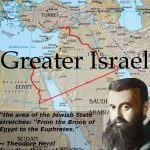
Israel: The Ghetto of the Middle East: History of the Political Zionist Movement
The political Zionist movement, envisaged in 1896 by Theodor Herzl, an Austro-Hungarian journalist and political activist, and described in his book ‘Der Judenstaat’, was a genuine attempt to resolve the age-old social problem of, predominately European anti-Semitism [...]
Diaspora families living worldwide, the vast majority in New York with smaller communities in Paris, London and other major conurbations, are taught from an early age to believe that the modern State of Israel is their homeland. Not merely a biblical place of ‘milk and honey’, military might, innate intelligence and integrity but a place of final security; a sanctuary to which they can flee to escape the apparently insidious rise of anti-Semitism in the various land(s) of their birth. An ultimate insurance policy in case of need. That is how it is ‘sold’ to the average Jewish family in Manhattan, New York or Golders Green in London.
What is deliberately omitted is the documented fact that to immigrate to the State of Israel is, arguably, to live in one of the most dangerous places on the planet for ordinary civilian life, under a corrupt political system.
Whilst terrorism is now globally endemic to a limited degree in most areas of high population, in Israel, which forcibly (and illegally) occupies Arab territory, the incidence of terror attacks from those kept either in confinement or restriction, is seemingly a continuing daily occurrence. On public transport, on the streets, in the home or hotel, Israelis and visitors alike live in the full realisation that they are an unwanted presence in a majority Muslim region and are reviled for their role as the hated illegal occupier of land that had been continuously settled by the indigenous Arab for over a thousand years.
The political Zionist movement, envisaged in 1896 by Theodor Herzl, an Austro-Hungarian journalist and political activist, and described in his book ‘Der Judenstaat’, was a genuine attempt to resolve the age-old social problem of, predominately European anti-Semitism.
The Israeli state was subsequently established, by force, in 1948, in the midst of Muslim Palestine and against the vehement opposition of the indigenous population and all of the neighbouring states who would be adversely affected and who voted against the Resolution for Partition proposed by a completely unrepresentative UN Assembly, in 1947.
Consequently there was war, which was won unexpectedly by the fledgling Israeli defence forces with, it must be admitted, considerable assistance from interested parties in both America and Europe. The consequence was the eventual expropriation of huge tracts of Arab land upon which over 600,000 Israelis to date have been induced by their government to illegally settle in order to establish so called ‘facts on the ground’ – a deliberate euphemism for criminal activity.
The result is an inherently unstable and corrupt political entity kept afloat by American arms and funding together with a brutal occupation designed to intimidate the indigenous population and to eventually forcibly transfer millions of former Palestinian Arabs to adjoining territories.
This neo-colonialism of the 21st century cannot, in the final analysis, succeed because the international community, the EU and the UN, will not allow it. That could mean a possible nuclear war in the region. In that circumstance, the State of Israel would, unfortunately, then cease to exist – but not without huge damage to both the Middle East and Europe – radiation recognising no geographical or political boundaries.
A ghetto is not the retirement centre of choice in 2017 and certainly not an unstable, nuclear-armed one where corruption is endemic. All of which is presumably why tens of thousands of savvy Israelis live and work abroad.
But it bodes not well for the future of the Middle East and the GCC states, because heavily-armed Israel under an allegedly corrupt administration has made itself a flashpoint for a future nuclear conflict.
We would like to ask you to consider a small donation to help our team keep working. We accept no advertising and rely only on you, our readers, to keep us digging the truth on history, global politics and international relations.
It is true that every story about the Balkan Peninsula begins with the ancient Illyrians.[1] Historians believe that these Indo-European people were one of the largest European populations to inhabit the western portion of the Balkans from the coasts of the Ionian Sea and the Adriatic Sea to the Alps about 1000 B.C. Their eastern neighbours were also Indo-European peoples – the Thracians. The demarcation line between their settlements and their cultural and political influence was the Morava river in present-day Serbia (in Latin Margus, located in the Roman province of Moesia Superior) and the Vardar river in present-day FYR ...
Most of former Ukraine is now (since 2014) occupied by nazis/fascists and rasists/extreme nationalists. In some cases they are disguised within other political parties but, make no mistake, their ideology does not change just because they change name or party organisation. As is well known, when the nazis made their coup in 2014 (directed and assisted by the CIA), the first "law" they forcefully passed through the rump and unconstitutional rest-parlament was the prohibition of the russian language (the majority language!) from all official institutions, schools, administration and so on.The second "law" they passed was the legalisation of the nazi ...
This is definitely an unusual book, as heralded by its title and three subtitles, whose lengthy wording evokes that of several learned tomes of the 18th and early 19thcentury.Its author is a well-known personality in Switzerland. Guy Mettan is a prominent journalist, formerly editor-in-chief of Tribune de Genève; he once presided over the Great Council, the Geneva parliament, of which he is still a representative, elected on the Christian Democrat Party list; he heads the Swiss Press Club and has written several books on Switzerland and international Geneva.As he explains in his foreword, his interest for Russia came by happenstance: ...
After the first decade after the Cold War, it became obvious that an idea of global governance is going to be impossible primarily due to an aggressive US foreign policy as Washington intended to become the world hegemon and global policeman. A turning point in the post-Cold War IR became the Kosovo War of 1998−1999, which resulted in the NATO’s occupation of the south-western region of Serbia based on an idea of „Just War“,[1] but in practice for the creation of the mafia state of the Kosovar Muslim Albanians.[2] As a direct consequence of the NATO’s aggression on Serbia and ...
Controlling the DiscourseIsrael has been brilliant over the years in shaping and misdirecting the public discourse on the future of Palestine. Among its earliest achievement along these lines was the crucial propaganda victory by having the 1948 War known internationally as the ‘War of Independence.’ Such a designation erases the Palestinians from political consciousness, and distorts the deeper human and political consequences of the war. Language matters, especially in vital circumstances where there are winners and losers, a reality that applies above all to a war of displacement.It took decades for the Palestinians to elevate their experience of the 1948 ...
A study by a Toronto-based consulting and research company has revealed that over the past fifty years mainstream reporting about Israel has been distorted to portray the Jewish state in positive terms while ignoring the plight of the Palestinians under Israeli occupation. The media study, based on a computer analysis of 50 years of data, found that major U.S. newspapers have provided consistently skewed, pro-Israel reporting on Israel-Palestine. The slanting in news coverage included subtle manipulations like using word associations favorable to Israel and derogatory to Palestinians as well as the persistent publication of stories praising Israel while also avoiding reporting ...
Author’s noteThe following article focussing on the jihadist terrorist insurgency in Macedonia was first published by antiwar.com in July 2001, barely two months before the September 11, 2001 attacks on the WTC and the Pentagon.Known and documented, since the Soviet-Afghan war, recruiting Mujahedin (“holy warriors”) to fight covert wars on Washington’s behest had become an integral part of US foreign policy. A report of the US Congress had revealed how the US administration – under advice from the National Security Council headed by Anthony Lake – had “helped turn Bosnia into a militant Islamic base” leading to the recruitment through ...
PrefaceIn the area where the multilingual state of Belgium is located, the main political mark today is the general openness for the expression of different attitudes and policies. Therefore, there are almost unlimited options in drawing political boundaries. That is unlike, for example, as well as with multilingual Switzerland, where the mountains create natural areas for the four different language districts and many political-administrative cantons. The physical openness of the area also causes Belgium to be more open for influences from outside and therefore sensitive to changes in the European policies.One way to look at the situation in Belgium is ...
As the recent PBS documentary on the American War in Vietnam acknowledged, few American officials ever believed that the United States could win the war, neither those advising Johnson as he committed hundreds of thousands of U.S. troops, nor those advising Nixon as he escalated a brutal aerial bombardment that had already killed millions of people.As conversations tape-recorded in the White House reveal, and as other writers have documented, the reasons for wading into the Big Muddy, as Pete Seeger satirized it, and then pushing on regardless, all came down to “credibility”: the domestic political credibility of the politicians involved ...
Editor's note: Originally posted on 2016-01-11Serbia entered on December 14th, 2015 a final stage of negotiations with Brussels on the EU's membership. It is known, however, that the EU gave an informal ultimatum to Serbia to recognize Kosovo’s independence for the exchange of becoming a full Member State of the EU. The western (the USA/EU) client Serbia’s Government is currently under the direct pressure from Brussels to recognize an independence of the narco-mafia Kosovo’s quasi state or to give up an idea to join the EU. It is only a question when a western colony of Serbia has to finally ...
What is conflict about? The Zionist Israeli-Arab Palestinian conflict today is one of if not the most significant global security problems to be dealt with.[1] However, this conflict is historically not much old as it is a pretty modern issue, dating, in fact, since the First Zionist Congress in 1897. The focal question is: What is conflict about? In other words: What are those two different groups fighting for?At first glance, it can be understood that behind the conflict reasons is a confession as those two peoples are of different denominations: the Jews are predominantly Judaists while the Palestinian predominant confession ...
Origins of images: Facebook, Twitter, Wikimedia, Wikipedia, Flickr, Google, Imageinjection & Pinterest.Read our Disclaimer/Legal Statement!Donate to Support UsWe would like to ask you to consider a small donation to help our team keep working. We accept no advertising and rely only on you, our readers, to keep us digging the truth on history, global politics and international relations.
On October 20, 2011, Libya’s Muammar al-Gaddafi was brutally murdered by a mob of NATO-backed ‘rebels’, after first being beaten and violated in the most barbaric fashion. History leaves no doubt that not only was the Libyan leader murdered on this day but Libya itself.The regime-change crew who dominate Western governments have a long indictment sheet against their names. Since 9/11 they have wrought havoc and human misery on a grand scale in their determination to reshape and own a world that has never been theirs to own. Afghanistan, Iraq, Libya – Syria currently embroiled in a pitiless conflict for ...
Western culture is clearly obsessed with rules, guilt, submissiveness and punishment.By now it is clear that the West is the least free society on Earth. In North America and Europe, almost everyone is under constant scrutiny: people are spied on, observed, their personal information is being continually extracted, and the surveillance cameras are used indiscriminately.Life is synchronized and managed. There are hardly any surprises.One can sleep with whomever he or she wishes (as long as it is done within the ‘allowed protocol’). Homosexuality and bisexuality are allowed. But that is about all; that is how far ‘freedom’ usually stretches.Rebellion is ...
During the early 1960s, apartheid South African diplomats were increasingly concerned their country’s plummeting reputation would affect relations with America. In one notorious incident, of March 1960, South African police shot dead 69 black protesters in Sharpeville, a township about 40 miles from Johannesburg.Such atrocities sparked protests against the racist regime on the streets of England, America’s great ally, which surely did not go unnoticed in Washington. Aware of the changing climate, South Africa’s dignitaries pleaded with their American counterparts for continued assistance. They need not have worried that the earth’s dominant power would desert them.As long as the United ...
Save... and many more pictures!Origins of images: Facebook, Twitter, Wikimedia, Wikipedia, Flickr, Google, Imageinjection, Public Domain & Pinterest.Read our Disclaimer/Legal Statement!Donate to Support UsWe would like to ask you to consider a small donation to help our team keep working. We accept no advertising and rely only on you, our readers, to keep us digging the truth on history, global politics and international relations.[wpedon id="4696" align="left"]
The origins of Czechoslovakia (1918−1920)Czechoslovakia gained its independence from the Austro-Hungarian Empire in 1918. Even though the Austrian-Hungarian Empire was one political entity, the Austrian part and the Hungarian part existed under a Dual Monarchy. Each half of the empire had a large amount of control over their area independent of the other half of the country. The differing policies of the Austrians and the Hungarians had a strong impact on the state of what is now the Czech Republic and the Slovak Republic. In particular, the Czech industry was developed, while Slovakia remained a mostly agrarian area managed by ...
Could global warming pose the greatest threat to the future of life on the planet? Quite possibly, if we believe the international (and scientific) consensus, despite a widening stratum of debunkers, deniers, and skeptics. What about the prospects of thermonuclear war between the United States and Russia, two countries armed to the max and seemingly moving toward the brink of military conflict? Where does that rate? If the question is asked of most any Beltway denizen, the response might be something along lines of “sounds frightening, but right now we have other priorities, and we can’t lose sight of the ...
As Europe’s longest ruler, it is a surprise that Milo Djukanovic is only 58. He has served as prime minister or president of various iterations of Montenegro since 1991 – spanning the collapse of Yugoslavia and across and beyond independence of the nation in 2006.What is the secret to Mr Djukanovic’s success? The answer is depressingly predictable: clientelism and the buying – or, depending on your perspective, stealing – of power.The beauty of Montenegro hides this ugly truth. Most know it as a tourist idyll with pristine beaches, crystal lakes and picturesque mountains. But holidaymakers rarely realize they enter less ...
With a general election looming in the United Kingdom and Spain possibly following Greece’s revolt against austerity later this year, we need to think, not just who or what we are voting for, but why we should vote at all.People are suffering from a deficiency which is as unbalancing as a hormone or vitamin deficiency. What we are severely lacking in is democracy. Many of those pondering on the state of politics feel unhappy and somehow depleted. They haven’t yet realised it is democracy that’s lacking because they have believed what so many politicians have told them, over and over ...
The magazine is covering the research gaps uncovered by global Western hoax mainstream media platforms and academic teaching & research institutions.
This is an alternative information & academic research digest platform with the purpose to offer an alternative “another side of the truth”.
The magazine is independent, private, and free of any influence by any institution, organization, government, or pressure group. URL: www.global-politics.eu