
The Thaci dependence on US and NATO good graces insures Thaci’s government will do what it is asked. That, in turn, assures the US a major military gain consolidating its permanent presence in the strategically vital southeast Europe. It is a major step in consolidating NATO control of Eurasia, and gives the US a large swing its way in the European balance of power. Little wonder Moscow has not welcomed the development, nor have numerous other states. The US is literally playing with dynamite, potentially as well with nuclear war in the Balkans […]
US-NATO military control of Kosovo serves several purposes for Washington’s greater geo-strategic agenda. First it enables greater US control over potential oil and gas pipeline routes into the EU from the Caspian and Middle East as well as control of the transport corridors linking the EU to the Black Sea.
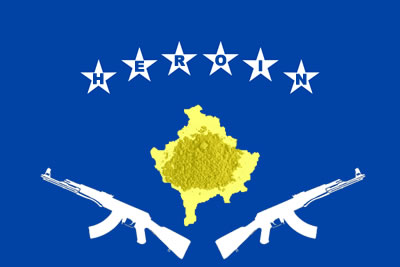
It also protects the multi-billion dollar heroin trade, which, significantly, has grown to record dimensions in Afghanistan according to UN narcotics officials, since the US occupation. Kosovo and Albania are major heroin transit routes into Europe. According to a 2008 US State Department annual report on international narcotics traffic, several key drug trafficking routes pass through the Balkans. Kosovo is mentioned as a key point for the transfer of heroin from Turkey and Afghanistan to Western Europe. Those drugs flow under the watchful eye of the Thaci government.
Since its dealings with the Meo tribesmen in Laos during the Vietnam era, the CIA has protected narcotics traffic in key locations in order partly to finance its covert operations. The scale of international narcotics traffic today is such that major US banks such as Citigroup are reported to derive a significant share of their profits from laundering the proceeds.
One of the notable features of the indecent rush by Washington and other states to immediately recognize the independence of Kosovo is the fact that they well knew its government and both major political parties were in fact run by Kosovo Albanian organized crime.
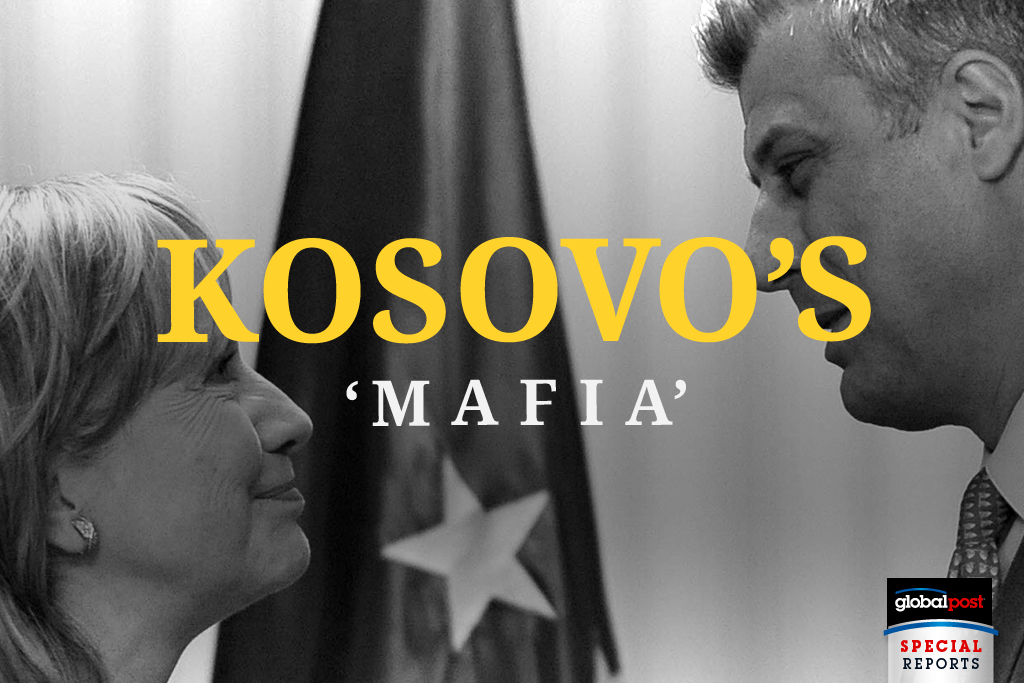
Hashim Thaci, Prime Minister of Kosovo and head of the Democratic Party of Kosovo, is the former leader of the terrorist organization which the US and NATO trained and called the Kosovo Liberation Army, KLA, or in Albanian, UCK. In Kosovo crime circles he is known as Hashim “The Snake” for his personal ruthlessness against opponents.
In 1997, President Clinton’s Special Balkans Envoy, Robert Gelbard described the KLA as, “without any question a terrorist group.” It was far more. It was a klan-based mafia, impossible therefore to infiltrate, which controlled the underground black economy of Kosovo. Today the Democratic Party of Thaci, according to European police sources, retains its links to organized crime.
A February 22, 2005 German BND report, labeled Top Secret, which has since been leaked, stated, “Über die Key-Player (wie z. B. Haliti, Thaci, Haradinaj) bestehen engste Verflechtungen zwischen Politik, Wirtschaft und international operierenden OK-Strukturen im Kosovo. Die dahinter stehenden kriminellen Netzwerke fördern dort die politische Instabilität. Sie haben kein Interesse am Aufbau einer funktionierenden staatlichen Ordnung, durch die ihre florierenden Geschäfte beeinträchtigt werden können.“ (OK=Organized Kriminalität). (Translation: “Through the key players—for example Thaci, Haliti, Haradinaj—there is the closest interlink between politics, the economy and international organized crime in Kosovo. The criminal organizations in the background there foster political instability. They have no interest at all in the building of a functioning orderly state that could be detrimental to their booming business.”
The KLA began action in 1996 with the bombing of refugee camps housing Serbian refugees from the wars in Bosnia and Croatia. The KLA repeatedly called for the “liberation” of areas of Montenegro, Macedonia and parts of Northern Greece. Thaci is hardly a figure of regional stability to put it mildly.
The 44 year old Thaci was a personal protégé of Clinton Secretary of State Madeleine Albright during the 1990s, when he was a mere 30-year old gangster. The KLA was supported from the outset by the CIA and the German BND. During the 1999 war the KLA was directly supported by NATO. At the time he was picked up by the USA in the mid-1990s, Thaci was founder of the Drenica Group, a criminal syndicate in Kosovo with ties to Albanian, Macedonian and Italian organized mafias. A classified January 2007 report prepared for the EU Commission, labeled “VS-Nur für den Dienstgebrauch” was leaked to the media. It detailed the organized criminal activity of KLA and its successor Democratic Party under Thaci.
A December 2010 Council of Europe report, released a day after Kosovo’s election commission said Mr Thaci’s party won the first post-independence election, accused Western powers of complicity in ignoring the activities of the crime ring headed by Thaci: “Thaci and these other ‘Drenica Group’ members are consistently named as ‘key players’ in intelligence reports on Kosovo’s mafia-like structures of organised crime,” the report said. “We found that the ‘Drenica Group’ had as its chief – or, to use the terminology of organised crime networks, its ‘boss’ – the renowned political operator … Hashim Thaci.”
The report stated that Thaci exerted “violent control” over the heroin trade. Dick Marty, the European Union investigator, presented the report to European diplomats from all member states. The response was silence. Washington was behind Thaci.
The same Council of Europe report on Kosovo organized crime accused Thaci’s mafia organization of dealing in trade in human organs. Figures from Thaçi’s inner circle were accused of taking captives across the border into Albania after the war, where a number of Serbs are said to have been murdered for their kidneys that were sold on the black market. In one case revealed in legal proceedings in a Pristina district court in 2008 organs were said to have been taken from impoverished victims at a clinic known as Medicus – linked to Kosovo Liberation Army (KLA) organ harvesting in 2000.
The question then becomes, why are Washington, NATO, the EU and inclusive and importantly, the German Government, so eager to legitimize the breakaway Kosovo? A Kosovo run internally by organized criminal networks is easy for NATO to control. It insures a weak state which is far easier to bring under NATO domination. Combined with NATO control over Afghanistan where the Kosovo heroin controlled by Prime Minister Thaci originates, the Pentagon is building a web of encirclement around Russia that is anything but peaceful.
The Thaci dependence on US and NATO good graces insures Thaci’s government will do what it is asked. That, in turn, assures the US a major military gain consolidating its permanent presence in the strategically vital southeast Europe. It is a major step in consolidating NATO control of Eurasia, and gives the US a large swing its way in the European balance of power. Little wonder Moscow has not welcomed the development, nor have numerous other states. The US is literally playing with dynamite, potentially as well with nuclear war in the Balkans.
Originally published on 2012-04-12
About the author: F. William Engdahl is author of Full Spectrum Dominance: Totalitarian Democracy in the New World Order. He may be contacted via his website, www.engdahl.oilgeopolitics.net
Source: Global Research
Read our Disclaimer/Legal Statement!
Donate to Support Us
We would like to ask you to consider a small donation to help our team keep working. We accept no advertising and rely only on you, our readers, to keep us digging the truth on history, global politics and international relations.
Genocide accusations are, it would seem, the latest fashion spreading out of the Balkans. On December 5, a former minister in the “government” of NATO occupied and administered Kosovo, Ivan Todosijević, who happens to be an otherwise occupation friendly and cooperative ethnic Serb, was sentenced to a two-year prison term. The court found him guilty of making what it considered the outrageous claim that the so-called genocidal “Račak massacre,” which in 1999 triggered NATO aggression against Yugoslavia, was an imposture. Since the trial began just two days before, by Balkan standards the swiftly reached verdict was remarkably expeditious, suggesting the ...
IntroductionThe goals of this article are: 1) to investigate the role of the revived Patriarchate of Peć in Serbian and Balkan history?; and 2) to explore and present the results of investigation of the problems with respect to: a) the role of the Serbian Church during the first decades of the Ottoman occupation of Serbian lands in the process of the creation of a Serbian national identity; b) Serbian-Turkish relations in the second half of the 16th century; and c) the reasons for Serbian disloyalty towards the Ottoman government at the turn of the 17th century.The article addresses the reasons ...
Six Years Later, Kosovo Still WrongIn the early hours of March 24, 1999, NATO began the bombing of what was then the Federal Republic of Yugoslavia. For some reason, many in the targeted nation thought the name of the operation was “Merciful Angel.” In fact, the attack was code-named “Allied Force” – a cold, uninspired and perfectly descriptive moniker. For, however much NATO spokesmen and the cheerleading press spun, lied, and fabricated to show otherwise (unfortunately, with altogether too much success), there was nothing noble in NATO’s aims. It attacked Yugoslavia for the same reason then-Emperor Bill Clinton enjoyed a ...
Because the request for its membership is a serious breach of the international law, the Constitution of UNESCO, the legally binding UN Security Council resolution 1244 (1999) and the Charter of the UN whose Article 25 says that „The Members of the UN agree to accept and carry out the decisions of the Security Council in accordance with the present Charter”.Because according to the UN Security Council resolution 1244, which reaffirms the sovereignty and territorial integrity of the Federal Republic of Yugoslavia (now Serbia), Kosovo and Metohija is an integral part of the Republic of Serbia, under the administration of ...
The first thing you hear is the slow-moving clatter of a wheelchair. Then comes his voice. Fetah Rudi survived an attempted assassination which left him paralysed for life, and has spent more than 17 years suffering the consequences.Kosovo Liberation Army - A Balkan Islamic fundamentalist terrorist organizationIn June 1999, Rudi was one of the Kosovo Albanians who was detained and tortured in a Kosovo Liberation Army, KLA prison.A few months later in December 2000, Rudi - a member of the Democratic League of Kosovo, LDK, which at the time was President Ibrahim Rugova’s party - became a target during the ...
It seems that the recent developments in Europe, and in particular the rising secessionism (Catalonia, Flandreau, Corsica, Veneto, Scotland), rings a bell, or rather is reminiscent of certain events. The ensuing ones are shedding more light on the roles of the EU (EEC), the USA, Great Britain and Germany. One wonders to what extent those democracies have been guided by the principles of international law and democracy pertaining to the Kosovo crisis.How much did they appreciate the reports of their (expensive) missions in Kosovo and Metohija (КDОМ, КVМ, ЕCMM) depicting the realities on the ground?To what extent have they been ...
The former Yugoslavia was engulfed by many conflicts and ethnic and religious differences tore away at the very fabric of this nation. Like all wars, atrocities took place on all sides but the mass media in general focused on Serbian atrocities, while neglecting brutal crimes committed against the Serbian community. This certainly applies to the glossing over of war crimes done by the Kosovo Liberation Army (KLA).However, more and more evidence is coming to light about brutal KLA death camps and killing people for organs. Therefore, will former KLA members be charged with war crimes and will the “real truth” ...
In this exclusive interview, Prof Peter Kuznick speaks of: the atomic bombings of Hiroshima and Nagazaki; US crimes and lies behind the Vietnam war, and what was really behind that inhumane invasion; why the US engaged a Cold War with the Soviet Union, and how that war and the mainstream media influences the world today; the interests behind the assassinations of President Kennedy; US imperialism towards Latin America, during the Cold War and today, under the false premise of War on Terror and War on Drugs.Edu Montesanti: Professor Peter Kuznick, thank you so very much for granting me this interview. In ...
After February 2008 when Kosovo Albanian-dominated Parliament proclaimed Kosovo independence (without organizing referendum) with obvious US diplomatic support (unilateral recognition) with the explanation that the Kosovo case is unique in the World (i.e., it will be not repeated again) one can ask the question: is the problem of the southern Serbian province of Kosovo-Metochia really unique and surely unrepeatable in some other parts of the World as the US administration was trying to convince the rest of the international community?[1]Domino effect in international relationsThe consequences of recognition of Kosovo independence by a bigger part of the international community are already ...
Former slogan that has been so thunderously shouted within pre-election debates, and that was the last glimmer of declarative patriotism, dear both to politicians and football fans, by the development of the situation these days gets quite a different meaning.Kosovo is Serbia sometimes means that the Serbs, if not otherwise, at least in their souls will not give up the holy Serbian land. However, it might sound completely different today. Columns of Albanians from Kosovo carrying everything they own, leave Kosovo, pushing to catch last buses for a better life, moving towards Subotica, in order to try to reach some ...
South-East Serbia's province of Kosovo-Metochia (KosMet) is an autochthonous Slavic, in particular Serb, land. Now, the focal question became how this province became “disputed land”, and, in particular, what it has to do with ethnic-Albanians? In the following text, this issue is going to be considered in more details, from the geographical, (pre)historic, anthropologic, religious, and political points of view. We start with the geography, in particular, the physical geography of West Balkans.Kosovo Liberation Army, August 1998, Klechka village, KosMetThe region of Dinaric Alps It is known that physical and mental structures of a particular population are determined by many ...
Aleppo has become synonymous with destruction and “Syrian state-generated” violence among those whose perception of the situation in the war-torn nation is contained within the prism of mainstream media narratives.The NATO-aligned media maintains a tight grip on information coming out of this beleaguered city, ensuring that whatever comes out is tailored to meet State Department requirements and advocacy for regime change. The propaganda mill churns out familiar tales of chemical weapons, siege, starvation, and bombs targeting civilians–all of which are attributed to the Syrian government and military, with little variation on this theme.The purpose of this photo essay and my ...
Serbian girl Jovana was only 11 years old when Albanian terrorists captured, beaten and detained her together with rest of the family.They were taken in a camp in the village of Klecka, Lipljan, along with her mother and grandmother. The camp was under direct rule and control of Fatmir Limaj (acquitted by the Hague cangaroo court) and Hashim Thaci.Hasim Taci used to visit the camp. One day little Jovana was taken by the Albanian KLA bandits, Luan and Bekim Mazrreku, who, before the eyes of her mother and grandmother raped the eleven years old girl.They tortured her, cutting her body ...
The brutal destruction of ex-Yugoslav Federal state-system was in a form of the civil wars or, in another word, a chain of violent conflicts from 1991 to 1995. From the spring of 1992, the SFRY already did not exist as a state and, therefore, the conflicts were turned into the Wars of the Yugoslav Succession.The Yugoslav civil wars can be comprised of the three closely related armed conflicts:1) War in Slovenia in 1991.2) War in Croatia from 1991 to 1995.3) War in Bosnia-Herzegovina from 1992 to 1995.[i]In the year of 1990, the real potential for the armed conflict became quite ...
Prof. Djordje Jankovic, Ph.DFaculty of PhilosophyBelgrade UniversityMiddle Ages in Noel Malcolm’s Kosovo: A Short History and Real FactsBefore presenting the interpretations of the mediaeval past of Kosovo and Metohija in Noel Malcolm’s work, one should be aware of the tasks set by the author before writing the book. That way, the acrobatic handling of the evidence which he uses or does not use will become clearer. In the introductory text, ten pages long, he clearly presents his political and ideological position. They are as follows (p. XXXIV-XXXV): “Kosovo” is one of the cultural crossroads of Europe – which is wrong; ...
What you can see here, as the example: Serbian shrine Bogorodica Ljeviška (Virgin Mary of Ljevishka) is a cathedral church in the city of Prizren in the western part of Kosovo & Metohija region. The city was a capital of medieval Serbia. This church is built by Serbian king Milutin between 1307-1309. This church belongs to one of four masterpieces of Serbian sacral architecture in the Middle Ages in Kosovo & Metohija that was a central part of Serbian medieval state. The video is in the Serbian language.Rachak Village in Kosovo 1999- Lies and the truth from Vladislav B. Sotirovic ...
Back in the 1990s something happened in central Bosnia-Herzegovina that inspired people to this day and helps explain why that country now has more men fighting in Syria and Iraq (over 300), as a proportion of its population, than most in Europe.The formation of a "Mujahideen Battalion" in 1992, composed mainly of Arab volunteers in central Bosnia, was a landmark. Today the dynamic of jihad has been reversed and it is Bosnians who are travelling to Arab lands."There is a war between the West and Islam," says Aimen Dean, who, as a young Saudi Arabian volunteer, travelled to fight in ...
President Bill Clinton’s favorite freedom fighter just got indicted for mass murder, torture, kidnapping, and other crimes against humanity. In 1999, the Clinton administration launched a 78-day bombing campaign that killed up to 1500 civilians in Serbia and Kosovo in what the American media proudly portrayed as a crusade against ethnic bias. That war, like most of the pretenses of U.S. foreign policy, was always a sham.Kosovo President Hashim Thaci was charged with ten counts of war crimes and crimes against humanity by an international tribunal in The Hague in the Netherlands. It charged Thaci and nine other men with ...
Origins of images: Facebook, Twitter, Wikimedia, Wikipedia, Flickr, Google, Imageinjection & Pinterest.Read our Disclaimer/Legal Statement!Donate to Support UsWe would like to ask you to consider a small donation to help our team keep working. We accept no advertising and rely only on you, our readers, to keep us digging the truth on history, global politics and international relations.
The most useful parable about progressives is that offered by Bernard Sanders, self-styled “socialist-progressive-independent” rep from Vermont. Sanders owes his political career to rage against the Vietnam War among radicals, many of whom moved into the state in the early 1970s. They forthwith planned a long-term, carefully organized, assault on Vermont’s two-party structure. Sanders linked his political ambitions to this effort to organize a third force, the Progressive Alliance. He became mayor of Burlington and, later, congressman.At a rapid clip the emphasis moved from party-building to Sanders-building. By 1994, it was apparent that the only movement B. Sanders was interested in ...
The magazine is covering the research gaps uncovered by global Western hoax mainstream media platforms and academic teaching & research institutions.
This is an alternative information & academic research digest platform with the purpose to offer an alternative “another side of the truth”.
The magazine is independent, private, and free of any influence by any institution, organization, government, or pressure group. URL: www.global-politics.eu