
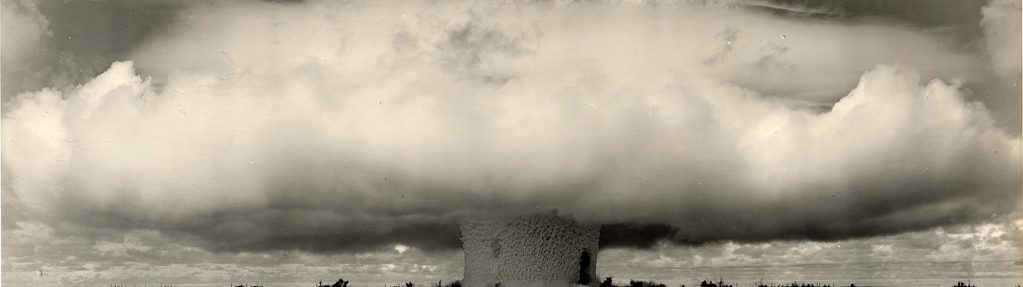
With rare exception, the question of whether the atomic bombs were necessary to end World War Two is debated only deep within the safety of academic circles [...]
With rare exception, the question of whether the atomic bombs were necessary to end World War Two is debated only deep within the safety of academic circles.
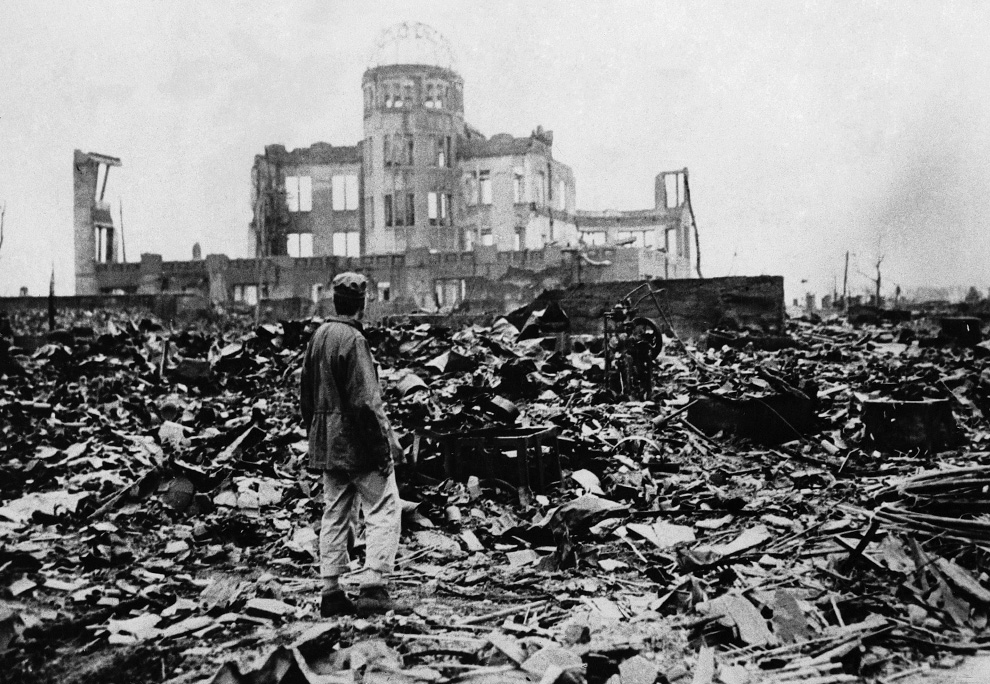
Could a land invasion have been otherwise avoided? Would more diplomacy have achieved the same ends without the destruction of two cities? Could an atomic test on a deserted island have convinced the Japanese? Was the surrender instead driven primarily by the entry of the Soviets into the Pacific War, which, by historical accident, took place two days after Hiroshima—and the day before Nagasaki was immolated?
But it is not only the history of the decision itself that is side stepped. Beyond the acts of destruction lies the myth of the atomic bombings, the post-war creation of a mass memory of things that did not happen.
The short version of the atomic myth, the one kneaded into public consciousness, is that the bombs were not dropped out of revenge or malice, immoral acts, but of grudging military necessity. As a result of this, the attacks have not provoked or generated deep introspection and national reflection.
The use of the term “myth” is appropriate. Harry Truman, in his 1945 announcement of the bomb, focused on vengeance, and on the new, extraordinary power the United States alone possessed. The military necessity argument was largely created later, in a 1947 article defending the use of the atomic bomb, written by former Secretary of War Henry Stimson, though actually drafted by McGeorge Bundy (later an architect of the Vietnam War) and James Conant (a scientist who helped build the original bomb). Conant described the article’s purpose at the beginning of the Cold War as
“You have to get the past straight before you do much to prepare people for the future.”
The Stimson article was a response to journalist John Hersey’s account of the human suffering in Hiroshima, first published in 1946 in the New Yorker and later as a book. Due to wartime censorship, Americans knew little of the ground truth of atomic war, and Hersey’s piece was shocking enough to the public that it required that formal White House response. Americans’ general sense of themselves as a decent people needed to be reconciled with what was done in their name. The Stimson article was quite literally the moment of creation of the Hiroshima myth.
The national belief that no moral wrong was committed with the atomic bombs, and thus there was no need for reflection and introspection, echoes forward through today (the blithe way Nagasaki is treated as a historical after thought – “and Nagasaki, too” – only drives home the point.) It was 9/11, the new Pearl Harbor, that started a series of immoral acts allegedly servicing, albeit destructively and imperfectly, the moral imperative of saving lives by killing. America’s decisions on war, torture, rendition and indefinite detention are seen by most as the distasteful but necessary actions of fundamentally good people against fundamentally evil ones. Hiroshima set in motion a sweeping, national generalization that if we do it, it is right.
And with that, the steps away from the violence of Hiroshima and the shock-and-awe horrors inside the Iraqi prison of Abu Ghraib are merely a matter of degree. The myth allows the world’s most powerful nation to go to war as a victim after the tragic beheadings of only a small number of civilians. Meanwhile, the drone deaths of children at a wedding party are seen as unfortunate but only collateral damage in service to the goal of defeating global terrorism itself. It is a grim calculus that parses acts of violence to conclude some are morally justified simply based on who held the knife.
We may, in fact, think we are practically doing the people of Afghanistan a favor by killing some of them, as we believe we did for tens of thousands of Japanese that might have been lost in a land invasion of their home islands to otherwise end World War Two. There is little debate in the “war on terror” because debate is largely unnecessary; the myth of Hiroshima says an illusion of expediency wipes away any concerns over morality. And with that neatly tucked away in our conscience, all that is left is pondering where to strike next.
Japan, too, is guilty of failing to look deep into itself over its own wartime atrocities. Yet compared to the stunning array of atrocities during and since World War Two, the world’s only use of nuclear weapons still holds a significant place in infamy. To try and force the Japanese government to surrender (and no one in 1945 knew if the plan would work) by making it watch mass casualties of innocents, and then to hold the nation hostage to future attacks with the promise of more bombs to come, speaks to a cruelty previously unseen.
For President Obama to visit Hiroshima without reflecting on the why of that unfortunate loss of lives, acting as if they occurred via some natural disaster, is tragically consistent with the fact that for 71 years no American president felt it particularly important to visit the victimized city. America’s lack of introspection over one of the 20th century’s most significant events continues, with 21st century consequences.
We would like to ask you to consider a small donation to help our team keep working. We accept no advertising and rely only on you, our readers, to keep us digging the truth on history, global politics and international relations.
Barack Obama was the only U.S. President who at the United Nations defended nazism — racist fascism — and Holocaust-denial. It received almost no reporting by the press at the time (or subsequently). But his successor President Donald Trump could end up being removed from office because he said that racist fascists are just the same as are people who demonstrate publicly against them. Trump’s politically stupid (not to say callous) remark became viral, and apparently the press (which had ignored Obama’s defense of nazism at the U.N.) just won’t let go of Trump’s statement unless and until he becomes ...
In British mainstream commentary, the 1999 NATO bombing campaign against Slobodan Milosevic’s Yugoslavia is seen as a ‘humanitarian intervention’. Tony Blair still receives much praise for coming to the defence of the ethnic Albanians in Kosovo, whose plight was surely serious as they were subject to increasingly brutal abuses by the Yugoslav army towards the end of 1998 and early 1999. Yet the NATO bombing that began in March 1999 had the effect of deepening, not preventing, the humanitarian disaster that Milosevic’s forces inflicted on Kosovo. The bulk of the atrocities committed by Yugoslav forces took place after the NATO ...
The superhighway to disaster is already being paved.From Donald Trump’s first days in office, news of the damage to America’s international stature has come hard and fast. As if guided by some malign design, the new president seemed to identify the key pillars that have supported U.S. global power for the past 70 years and set out to topple each of them in turn. By degrading NATO, alienating Asian allies, cancelling trade treaties, and slashing critical scientific research, the Trump White House is already in the process of demolishing the delicately balanced architecture that has sustained Washington’s world leadership since ...
March 24, 2018, marks the 19th anniversary of NATO illegal and illegitimate bombing of Yugoslavia, Serbia and its Kosovo, province during 78 days. It has – one is tempted to say: of course – been conveniently forgotten by the West itself.It was masterminded by the United States under Bill Clinton and Secretary of State Madeleine Albright after the so-called negotiations between Serbs and Albanians in Rambouillet outside Paris (the parties never met face-to-face).While Clinton may be best remembered for his relations with Monica Lewinsky and his wife, Hillary Clinton, some of us also remember him (and Albright) for bombing Afghanistan, ...
When I saw the media in Serbia reporting about Donald Trump’s alleged condemnation of the 1999 NATO attack on then-Yugoslavia, also known as the Kosovo War, I shrugged it off as disinformation. Most of them, I’m sad to say, are almost entirely dedicated to gaslighting the general populace, and as likely to spread confusion and cognitive dissonance as actual news.It turns out that Donald Trump did talk to Larry King about Kosovo – but everyone is leaving out that this took place in October 1999. That is sort of important, though: by that point, the Serbian province had been “liberated” ...
Due to the international media’s continued claims about the «annexation of Crimea», it’s been difficult for the citizens of the US and Europe to make sense of the details of the peninsula’s recent history. Exactly three years ago, on March 16, 2014, the Crimeans were offered a choice: to rejoin Russia or to return to the constitution of 1992 that proclaimed Crimea a legal, democratic, secular state whose relationship with Ukraine was based on bilateral agreements. That constitution was unilaterally abolished by Kiev on March 17, 1995, and here’s what’s surprising: no one at that time in the West demanded that the Ukrainian ...
Some of those currently advocating bombing Syria turn for justification to their old faithful friend “humanitarian intervention”, one of the earliest examples of which was the 1999 US and NATO bombing campaign to stop ethnic cleansing and drive Serbian forces from Kosovo. However, a collective amnesia appears to have afflicted countless intelligent, well-meaning people, who are convinced that the US/NATO bombing took place after the mass forced deportation of ethnic Albanians from Kosovo was well underway; which is to say that the bombing was launched to stop this “ethnic cleansing”. In actuality, the systematic forced deportations of large numbers of people from Kosovo ...
“Kosovo: Can You Imagine?” is a documentary film by Canadian film maker Boris Malagurski, about the Serbs that live in Kosovo and the lack of human rights that they have today, in the 21st century.Most of the Kosovo Serbs have been ethnically cleansed by the Albanians who make up the majority of Kosovo.Kosovo has been under UN administration since 1999 when NATO bombed Serbia for 78 days to halt a crackdown on ethnic Albanian separatism in its province of Kosovo.In the years following the war, thousands of Serbs were expelled from their homes, kidnapped and killed. Their houses, cultural and ...
On November 8th, Britain’s Daily Mail bannered “NATO tells Europe to prepare for ‘rapid deployment’:” and sub-headed “Defence chiefs say roads, bridges and rail links must be improved in case tanks and heavy vehicles need to be quickly mobilised” (to invade Russia, but the newspaper’s slant was instead that this must be done purely defensively: “In October, NATO accused Russia of misleading them, saying that Moscow had deliberately violated international rules of military drills”).The article continued:Secretary General Jens Stoltenberg called for the infrastructure update across Europe as NATO is set to overhaul its command structure for the first time since ...
The role of Jewish figures and that of the State of Israel in the Ukrainian crisis has not gone unnoticed considering that this community represents less than 1 percent of the population. However, a secret report in the hands of the Netanyahu administration confirms that Ashkenazi Jews do not originate from the Levant, but are the descendants of the Khazars. This little-known population founded a Jewish empire in the tenth century on the banks of the Black Sea. Therefore, some Zionists see in Ukraine a possible second Israel.The Times of Israel, an independent Israeli newspaper that counts among its staff ...
Origins of images: Facebook, Twitter, Wikimedia, Wikipedia, Flickr, Google, Imageinjection, Public Domain & Pinterest.Read our Disclaimer/Legal Statement!Donate to Support UsWe would like to ask you to consider a small donation to help our team keep working. We accept no advertising and rely only on you, our readers, to keep us digging the truth on history, global politics and international relations.[wpedon id="4696" align="left"]Save
Sultan Abdul Hamid II, in the face of a rising secular nationalism in the late 1800s, that culminated in the Young Turk movement, tried to restore the influence of the Ottoman Empire among Islamic nations and the Empire’s many peoples by stressing the importance of Islam and the Ottoman Caliphate, of the role of the Ottomans as the protectors of Islam and, in the modern world, a bulwark against western colonialism.Over a hundred years after he left power, after the Empire was broken up by the western powers after the First World War, after the Turkish nationalists under Mustafa Kemal, ...
America is a warrior state, a serial aggressor, unaccountable for unparalleled high crimes against peace because of public ignorance and indifference.Americans are sublimely unaware of their nation’s history. Its so-called war of independence substituted new management for old. Everything changed but stayed the same.Civil war had nothing to do with freeing slaves, everything to do with keeping the nation intact, maintaining business as usual.Imperial America enslaved Black Africans, exterminated its native people, stole their land and resources, stole half of Mexico, followed by Cuba, the Philippines, Guam, Samoa, Hawaii, Haiti, the Dominican Republic, Canal Zone, Puerto Rico and other territories.Peace ...
The US sanctions against Venezuela, signed into law by President Barack Obama on December 18, 2014, resulted from charges of protestors’ rights being violated by the socialist government of President Nicolás Maduro.The sanctions allow the Obama administration to deny visas and freeze the assets of Venezuelan officials accused of violating the rights of anti-government groups. These groups, comprised mainly of the right-wing opposition, have been leading violent protests in Caracas since last February. US leaders blame the Venezuelan leadership, headed by the United Socialist Party of Venezuela, for the deaths of 43 people during such demonstrations, which included both government ...
Since the disintegration of Yugoslavia in the nineties, its former constituent republics have been mired in a state of perpetual conflict.Nowhere is this more apparent than the contested state of Kosovo.In 1998, Albanian separatists in the Serbian province of Kosovo i Metohija began a campaign of attacks, with the express objective of creating a unified, ethnically homogenous, Greater Albanian state. Spearheaded by an organization known as the Kosovo Liberation Army (KLA), which is widely regarded by many nations, including the United States, as a terrorist organization, ethnic Albanian militants attacked Serbian security forces, and terrorized civilians in a brutally violent ...
With American military personnel now entering service who were not even alive on 9/11, this seems an appropriate time to reexamine the events of September 11, 2001 – the opaque motives for the attacks, the equally opaque motives for the counter-offensive by the United States and its allies known as the Global War on Terror, and the domestic fall-out for Americans concerned about the erosion of their civil liberties on the homefront.Before venturing further, it’s worth noting that our appraisal is not among the most common explanations. Osama bin Laden, his lieutenants at Al-Qaeda, and the men who carried out ...
I stated some months ago, while assembling a criminal dossier against the NATO powers for the ultimate war crime of aggression, that the build-up of NATO forces in Eastern Europe, particularly American, concentrated on the Baltic states and Ukraine, presaged hybrid war operations against Russia leading to a general war. This build up of forces and ancillary developments I termed Operation Barbarossa II in light of the remarkable similarities to the build up of forces by Nazi Germany for the invasion of the USSR in 1941 which the Germans code-named Operation Barbarossa. Events have only confirmed my views.The degradation of ...
Because this article states so many things that might be likely to contradict what most people in Western countries have been led to believe, readers here are especially strongly encouraged to click onto any allegation which seems at all questionable, in order to get to the sources behind any given questionable allegation. And wherever a clicked-onto source turns out to be another article, one is encouraged similarly to do the same there, so that the reader will be able, in this way, to probe down to the ultimate sources, which are the sources upon which this article is finally based.After ...
"Welcome to Nulandistan: Propaganda and the Crisis in Ukraine" (2014)This full length GRTV documentary looks at the fictitious land of Nulandistan that has been constructed out of Ukraine.The GRTV documentary deconstructs Nulandistan and the propaganda of the Obama Administration [...], the US Department of States, US officials, and their allies about the crisis in Ukraine and takes a look at their growing frustration towards the Russian media, particularly RT, for challenging their account of the events on the ground in what they have declared is an intensifying information war.The full length documentary starts by looking at the self-benefiting description of ...
The presidential campaign has mortified millions of Americans in part because the presidency has become far more dangerous in recent times. Since 9/11, we have lived in a perpetual emergency which supposedly justifies trampling the law and Constitution. And the illegalities will not end after Tuesday’s vote count. Both Donald Trump and Hillary Clinton have signaled that they will perpetuate power grabs in the next four years.For generations, politicians have touted voting as a magical process which almost automatically protects the rights of everyone within a 50 mile radius of the polling booth. But the ballots Americans have cast in ...