
The 1938 Munich Agreement – How Europe forced Czechoslovakia to commit suicide
On September 22, 1938, Hitler demanded the immediate cession of Czechoslovakia's territory, the Sudetenland, to Germany and the evacuation of the Czechoslovak population by the end of the month [...]
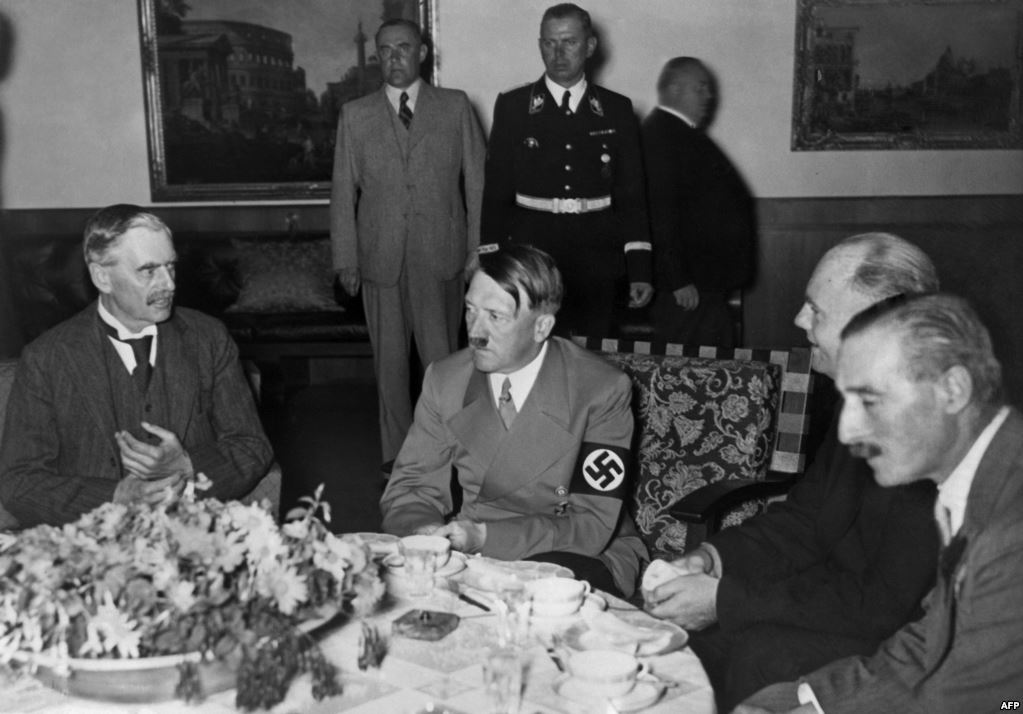
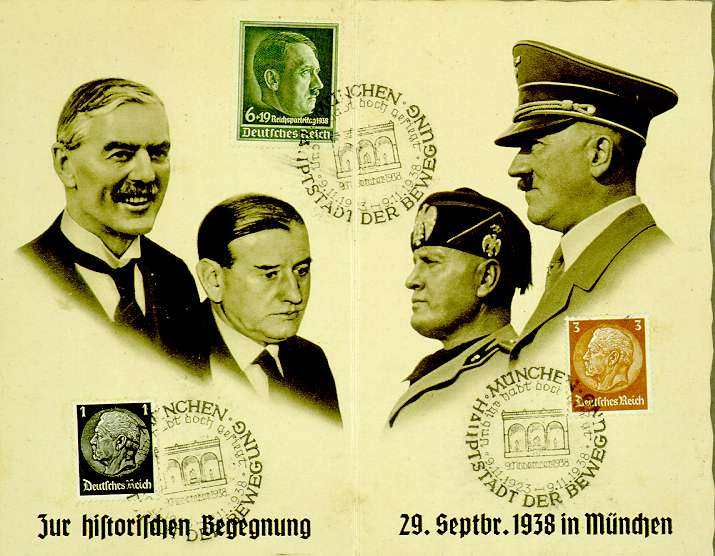
On September 22, 1938, Hitler demanded the immediate cession of Czechoslovakia’s territory, the Sudetenland, to Germany and the evacuation of the Czechoslovak population by the end of the month. The next day, Czechoslovakia ordered troop mobilization. War seemed imminent, and France even began a partial mobilization on September 24. The British Prime minister Nevile Chamberlain and French Prime Minister Daladier, unprepared for the outbreak of hostilities, in a last-minute effort to avoid war, proposed that a four-power conference (Italy, France, Germany, and the UK) to be convened in Munich immediately to settle the dispute. Hitler agreed, and on September 29, Hitler, Chamberlain, Daladier, and Italian dictator Benito Mussolini met in Munich, where Mussolini introduced a written plan that was accepted by all as the Munich Agreement. Many years later it was discovered that the so-called Italian plan had been prepared in the German Foreign Office.
According to the plan, the German army was to complete the occupation of the Sudetenland by October 10, and an international commission would decide the future of other disputed areas. The Czechoslovakian president, Edvard Beneš, who was excluded from the negotiations, was threatened and bullied by France and the UK to submit to the plan, which basically called for Czechoslovakia to commit suicide as a state. At the time Czechoslovakia was allied by treaty with France, and Great Britain was in turn allied with France, so both countries would be obliged to help Czechoslovakia if it was attacked. The German army was at that time weak and not ready to take on Czechoslovakia, which had a modern army, a very strong defensive line, and almost 50 army divisions all properly equipped and trained. All it would have taken was the faintest sign from UK and France that they would support the Czechoslovakian people if it came to a war with Germany for Hitler to back down. Instead, when Beneš refused to sign the agreement he was presented with an ultimatum and was informed by Britain and France that if he would not sign the agreement and submit to the prescribed annexation he would be left facing the German army alone. Benes and the Czechoslovak government chose to submit and signed the agreement.
By giving over the Sudetenland, the Allies immediately gave away most of Czechoslovakia’s fortifications and war industry. This soon led to the takeover of all of Czechoslovakia, which gave Germany enough weaponry to arm about half of the then Wehrmacht. In early November 1938, under the First Vienna Award, which was a result of the Munich agreement, Czechoslovakia (and later Slovakia) was forced by Germany and Italy to cede southern Slovakia (one-third of Slovak territory) to Hungary, while Poland retook the small territorial Polish region of Zaolzie. In the case of Poland, Zaolzie was part of Poland in 1920 when Czechoslovakia used the fact that the Polish state was fighting for its life against the Red Army to invade Poland and occupy the Polish region. This would prove a tragic mistake for both Czechoslovakia and Poland, for the Czech occupation of Zaolzie poisoned diplomatic relations between the two countries. An alliance between Czechoslovakia and Poland would have been enough to deter Germany from invading both countries and might have changed the course of European and world history. The Polish government indicated multiple times (in March 1936 and May, June, and August 1938) that it was prepared to fight Germany if the French decided to help Czechoslovakia, their ally. However, the French declined, opting instead to sell out Czechoslovakia to Hitler as they would do with Poland in September 1939.
Both Daladier and Chamberlain returned home to jubilant welcoming crowds relieved that the threat of war had passed, and Chamberlain told the British public that he had achieved “peace with honor. I believe it is peace for our time.” His words were immediately challenged by his greatest critic, Winston Churchill, who declared, “You were given the choice between war and dishonor. You chose dishonor and you will have war.” Indeed, Chamberlain’s policies were discredited the following year, when Hitler annexed the remainder of Czechoslovakia in March and then precipitated World War II by invading Poland in September. The Munich Agreement became a byword for the futility of appeasing expansionist totalitarian states, and of western betrayal and is considered a key event on the road to WW2.
Bibliography:
Norman Davies, “Europe.”
A.J.P. Taylor, “Origins of the Second World War.”
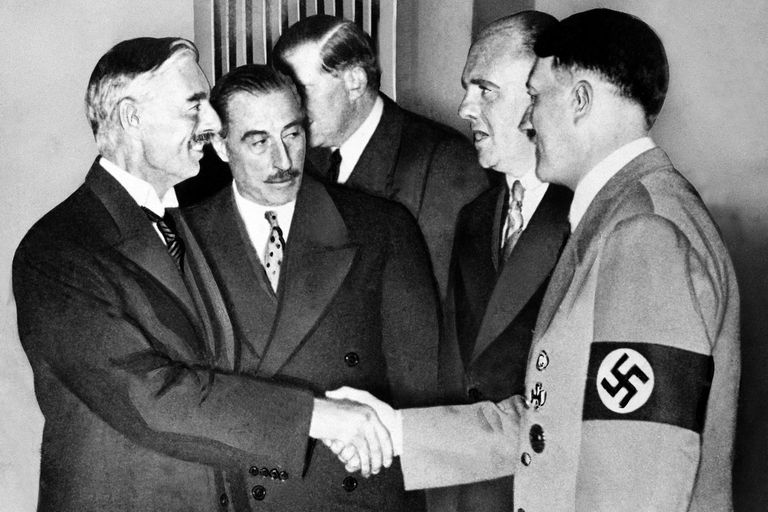
The Munich Agreement of September 29, 1938
Originally published on 2019-09-30
Source: Dispropaganda.com
Origins of images: Facebook, Twitter, Wikimedia, Wikipedia, Flickr, Google, Imageinjection, Public Domain & Pinterest.
Read our Disclaimer/LegalStatement!
DonatetoSupportUs
We would like to ask you to consider a small donation to help our team keep working. We accept no advertising and rely only on you, our readers, to keep us digging the truth on history, global politics, and international relations.
Last year, antifascists in Poland commemorated the country’s international brigades on the eightieth anniversary of the Spanish Civil War. Their gathering came under attack and a smoke grenade was thrown through the door. Inscribed on the projectile was the phrase “ha pasado,” “we have passed,” Franco’s retort to Dolores Ibárruri’s “no pasarán” on the day the Republic fell.Another iconic turn of phrase associated with the civil war owed much to Poland’s influence. “A las Barricadas,” the anthem of the anarcho-syndicalist CNT federation, became the war’s most famous song — but it wasn’t exactly an original. Its tune had been written by ...
Historical research into the Nazi era rarely throws up many surprises any more. German historian Stefan Ihrig, however, is an exception to this rule. By studying long-published sources, he has uncovered the fascination that Ataturk's modern Turkey held for the German far right, which has been seriously underestimated until now and which set an example for Hitler and the National Socialists.From a right-wing viewpoint, what Ataturk had achieved was an unattainable goal for Weimar-era Germany. Using force of arms, he had managed to reverse the Treaty of Sevres, which had been forced on his country by the Entente in 1920, ...
While the typical narrative of American history positions the United States as a supporter of democracy and opponent of fascism which helped to defeat the Nazis, key figures in Washington also supported dangerous dictators in Italy and Germany in their early days of power.Noam Chomsky, the renowned political philosopher, historian and scholar, examined the flip side of U.S. opposition to dictatorship in a conversation with Zain Raza, a senior editor at the independent media outlet acTVism Munich. An excerpt from the conversation was published Sept. 30 as part of acTVism Munich’s “Reexamining History” series.Speaking to Raza about Italian dictator Benito ...
More than six decades after Berlin’s capitulation which capped World War II, the war is still raging, now in the form of revisionist attempts to cast a shadow over the memory of Soviet soldiers who fought in it. Among other things, the efforts aimed at equating fascism – a monster nurtured by the West in the 1930s-1940s – and Russia’s XX century wartime past are supposed to divert attention from the continuity between the Anglo-Saxon imperialism and the German national socialism. The nature and key traits of the continuity are exposed in “From Imperialism to Fascism: Why Hitlers’ India was ...
On September 22, 1938, Hitler demanded the immediate cession of Czechoslovakia's territory, the Sudetenland, to Germany and the evacuation of the Czechoslovak population by the end of the month. The next day, Czechoslovakia ordered troop mobilization. War seemed imminent, and France even began a partial mobilization on September 24. The British Prime minister Nevile Chamberlain and French Prime Minister Daladier, unprepared for the outbreak of hostilities, in a last-minute effort to avoid war, proposed that a four-power conference (Italy, France, Germany and the UK) to be convened in Munich immediately to settle the dispute. Hitler agreed, and on September 29, ...
Read our Disclaimer/Legal Statement!Origins of images: Facebook, Twitter, Wikimedia, Wikipedia, Flickr, Google, Imageinjection, Public Domain & Pinterest.Donate to Support UsWe would like to ask you to consider a small donation to help our team keep working. We accept no advertising and rely only on you, our readers, to keep us digging the truth on history, global politics and international relations.
"If we see that Germany is winning we ought to help Russia and if Russia is winning we ought to help Germany, and that way let them kill as many as possible…”Harry S. Truman, 33rd POTUS, 1941Since the end of the Second World War, the bourgeois historiography has tried to distort various incidents in order to vilify Socialism and the USSR. One of these incidents- which has been a “banner” of imperialism’s apologists and other anticommunists- is the so-called “Molotov-Ribbentrop Pact“* which was signed in 1939. In it’s unscientific, unhistorical effort to equate Communism with Nazism, the bourgeois propaganda presents ...
On February 2nd, 1943, the 6th German Army, under the command of Field Marshall Von Paulus, and elements of the 4th Panzer Army, surrendered to the Red Army at Stalingrad. This stunning victory is considered the turning point in the war in Europe, heralding the defeat of fascist Germany.That defeat came on May 2ndth 1945, when the German forces in Berlin, the capital of the Third Reich, surrendered to the forces of the Red Army that had captured the city. On May 9th the official act of surrender of the German government and military forces took place in Berlin when ...
Seventy-five years ago Adolf Hitler launched the biggest and most destructive military campaign in history when three million German and allied troops invaded the Soviet Union along a 1,000-mile front.Operation Barbarossa – the codename for the German invasion of Russia - was no ordinary military campaign: it was an ideological and racist war, a war of destruction and extermination that aimed to kill Jews, enslave the Slavic peoples and destroy communism. The result was a war in which 25 million Soviet citizens died, including a million Jews, executed by the SS in 1941-1942 – an action which became the template ...
The Independent State of Croatia (NDH) was a World War II puppet state of Germany and Italy, which was established in parts of Axis-occupied Yugoslavia. The NDH was founded on 10 April 1941, after the invasion of Yugoslavia by the Axis powers.A poster from the WWII Nazi Ustashi Independent State of Croatia with the state flag (Source: Instagram)The NDH consisted of modern-day Croatia and most of Bosnia and Herzegovina, as well as some parts of modern-day Serbia and Slovenia. The regime targeted Serbs, Jews, Roma people and anti-fascist or dissident Croatians and Muslims, as part of a large-scale genocide campaign ...
Against the backdrop of US aggression against North Korea, NATO is intensifying its preparations for war with Russia, the world’s second largest nuclear power. A report in the German news magazine Der Spiegel (Issue 43/2017) based on a secret NATO document indicates how far plans for war have progressed. The news magazine concludes:“In plain language: NATO is preparing for a possible war with Russia.”In the document entitled “Progress report on the Alliance’s Enhanced Deterrence and Defence Disposition,” leading military figures call for a major boost to military capabilities in order to conduct a so-called “Major Joint Operation Plus.” The abstruse ...
Despite claims made during NATO Summit Warsaw 2016, that “NATO remains a fundamental source of security for our people, and stability for the wider world,” it is clear that the threats and challenges NATO poses as existing to confront are in fact threats of its own, intentional creation and continued perpetuation.From the ongoing refugee crisis triggered by NATO’s own global-spanning and ongoing military interventions, invasions, and occupations, to its continued expansion along Russia’s borders – violating every convention and “norm” that existed during the Cold War to keep it “cold,” NATO has proven that it is to the populations it poses as protector over, ...
State frontiers are established by human beingsand may be changed by human beings.Adolf Hitler. Mein KampfDiplomacy, with all the conventions of its forms,recognizes only real facts.Charles de GaullePart OneAll of Adolf Hitler’s actions, from the time he rose to power in 1933 until 1939, could be described as one triumph after another. He met each challenge he faced: he took over as head of the country, returned Germany’s lost territories without a struggle, and was given permission from England and France to rearm. But one further task lay before him, and failure now would make his previous achievements almost pointless. ...
The recent resolution of the parliamentary Assembly of the OSCE fully equalizes the role of the Soviet Union and Nazi Germany at the outbreak of the Second World War, except that it had the purely pragmatic purpose of extorting money from Russia on the contents of some of the bankrupt economies, intended to demonize Russia as the successor state to the USSR, and to prepare the legal ground for the deprivation of her right to speak out against revision of results of war. But if we approach the problem of responsibility for the war, then you first need to answer the ...
The US has been threatening Iran for more than 20 years. Already during the Clinton administration, US Central Command (USCENTCOM) had formulated “in war theater plans” to invade both Iraq and Iran. This posting which includes selected articles from our archives was originally published by Global Research 12 years ago in May 2005. In the wake of the war on Iraq (2003), the Bush administration officially identified Iran and Syria as the next stage of “the road map to war”. Bush’s National Security doctrine contained in the Project for the New American Century (PNAC) was a continuation of Clinton’s “strategy of ...
Throughout the past decade, the UN General Assembly Third Committee has adopted the resolution: “Combating Glorification of Nazism, neo-Nazism and other practices that contribute to fueling contemporary forms of racism, racial discrimination, xenophobia and related intolerance.”Every year the resolution is adopted by an overwhelming majority of UN member states, while the European Union, which, as the battleground of Nazism should have supported the resolution, merely abstains, and their fence-straddling raises disturbing questions about their actual tendencies. Japan’s abstention raises equally disturbing questions. The United States has consistently, and shockingly, opposed this resolution.The resolution is sponsored by the Russian Federation, which ...
Yesterday marked the 80th anniversary of the Munich Agreement, one of the most shameful and tragic chapters in the history of the foreign policies of Britain and France and one that constituted a pivotal factor in the outbreak of the second world war, the most destructive conflict in the history of mankind, in which the Holocaust occurred.This is not to castigate the governments of Neville Chamberlain and Edouard Daladier for wanting to avoid another world war.The traumas of the Great War were ingrained in the minds of British and French statesmen and this should not be overlooked or downplayed.Nor should the ...
Albin Kurti is on the verge of becoming the next Prime Minister of Kosovo after he and opposition chairman Isa Mustafa confirmed last week that the two rival political parties had made progress to create a coalition government. Mustafa said that Kurti can rightfully become the next Prime Minister if he can convince the three remaining parliamentarians, representing the Bosniak, Turkish and Roma minorities to enter a coalition – and it appears they will.What does the accession of Albin Kurti mean for the future of Kosovo?Kurti does not recognize the flag and anthem of Kosovo, as well as the Kosovar ...
A scholar shares the true story of two men who stood up and spoke out against the murder of American Indians, and how they are celebrated today. Native American tribal members pay their respects at the headstone of Union Officer, Capt. Silas Soule, at the Riverside Cemetery Dec. 03, 2014 in honor of the 150th Anniversary of the Sand Creek Massacre.Every Thanksgiving weekend for the past 17 years, Arapaho and Cheyenne youth lead a 180-mile relay from the Sand Creek Massacre National Historic Site to Denver.The annual Sand Creek Massacre Spiritual Healing Run opens at the site of the Sand ...
In your book, "Islam and Nazi Germany's War", you write about the policies of the Nazis towards Islamic political entities. What form did they take?David Motadel: At the height of the war in 1941-1942, when German troops entered Muslim-populated territories in the Balkans, North Africa, Crimea and the Caucasus and were approaching the Middle East and Central Asia, Berlin began to see Islam as politically significant. Nazi Germany made significant attempts to promote an alliance with the "Muslim world" against their alleged common enemies – the British Empire, the Soviet Union, America and Jews.In the war zones, Germany engaged with ...
The magazine is covering the research gaps uncovered by global Western hoax mainstream media platforms and academic teaching & research institutions.
This is an alternative information & academic research digest platform with the purpose to offer an alternative “another side of the truth”.
The magazine is independent, private, and free of any influence by any institution, organization, government, or pressure group. URL: www.global-politics.eu