
Views: 219
The statehood of Ukraine like Ukrainian ethnolinguistic identity is one of the most problematic research topics. Ukraine herself has, in addition, extremely artificial state borders from very historical and political points of view. Even the name of the country and nation is very unusual and even unnatural as the Slavonic term “Ukraine” means in English “borderland” while “Ukrainians” are simply “people from borderland”. A focal question, therefore, became: How the country with such a name can be independent as the term “borderland” politically simply means the end land (like the German “mark” from the time of the Frankish Kingdom) of some country? Nevertheless, Ukrainian statehood has its own (short) historical background.
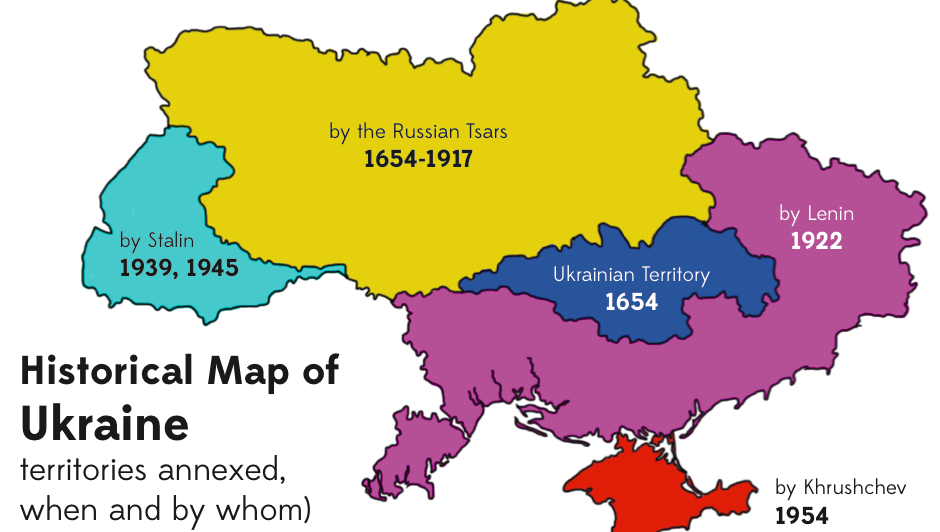
The German occupation forces were those who have been the first to create and recognize a short-lived state’s independence of Ukraine in January 1918 during the time of their own inspired and supported anti-Russian Bolshevik Revolution of 1917−1921. As reoccupied by the Bolshevik Red Army, the eastern and southern parts of the present-day territory of (a Greater) Ukraine joined in 1922 the USSR as a separate Soviet Socialist Republic (without Crimea). According to the 1926 Soviet census of Crimea, the majority of its population were Russians (382.645). The second largest ethnic group was the Tartars (179.094). Therefore, a Jew V. I. Lenin has to be considered the real historical father of Ukrainian statehood but also of contemporary nationhood. Ukraine was the most fertile agricultural Soviet republic but was particularly catastrophically affected by (Georgian) Stalin’s economic policy in the 1930s which neglected agricultural production in favor of the speed industrialization of the country. The result was a great famine (Holodomor) with around seven million people dead but the majority of them were of ethnic Russian origin. A territory of present-day Ukraine was devastated during WWII by the Nazi German occupation forces from 1941 to 1944 which have been supported by puppet and criminal groups around S. Bandera (1900−1959) under which genocide on Poles, Jews, and Russians was committed [on Stepan Bandera, see: Grzegorz Rossoliński-Liebe, Stepan Bandera: The Life and Afterlife of a Ukrainian Nationalist. Fascism, Genocide, and Cult, Stuttgart, ibidem, 2014]. For instance, the Ukrainian militia (12.000) directly participated in the 1942 holocaust of some 200.000 Volhynian Jews together with 140.000 German policemen. The Ukrainian mass killers learned their job from the Germans and applied their knowledge as well as on the Poles [Timothy Snyder, Tautų rekonstrukcija: Lieuva, Lenkija, Ukraina, Baltarusija 1569−1999, Vilnius: Mintis, 2009, 183].
After the war, J. V. Stalin, supported by the Ukrainian party cadre N. Khrushchev, deported about 300.000 Ukrainians from their homeland as they have been accused of collaborating with the Nazi regime during the war and participating in genocide done by S. Bandera’s armed nationalists. However, after the war, the Ukrainians have been and directly rewarded by Moscow for their collaboration with the Germans and participation in S. Bandera’s organized genocide as the lands of Transcarpathia, littoral Moldova (Bessarabia), Polish Galicia, and part of Romania’s Bukovina in 1945 followed by Crimea in 1954 became annexed by the Soviet Socialist Republic of Ukraine. These territories, which never have been part of any kind of Ukraine and overwhelmingly not populated by ethnolinguistic Ukrainians were included in Soviet Ukraine primarily due to the political activity by the strongest Ukrainian cadre in the USSR – N. Khrushchev, a person who inherited Stalin’s throne in Moscow in 1953. On this place, a parallel with Croatia is absolute: for the Croat committed genocide on the Serbs, Jews, and Roma by A. Pavelić’s regime (a Croat version of S. Bandera) during WWII on the territory of the Independent State of Croatia a post-war (the Socialist Republic of) Croatia was awarded by a Croat-Slovenian dictator of Yugoslavia J. B. Tito with the lands of Istria, Adriatic islands, and Dubrovnik – all of them never have been in any kind of the state of Croatia before WWII.
M. Gorbachev’s policy of deliberate dissolution of the USSR from the time of Reykjavik bilateral meeting with Ronald Reagan in 1988 caused a revival of the ethnic nationalism of the Ukrainians who proclaimed independence on August 24th, 1991 (confirmed on a referendum on December 1st, 1991 only by those who did not boycott it) in the wake of anti-Gorbachev’s military putsch in Moscow (mis)using the political situation of the paralyzed central government in the country. The state’s independence of Ukraine was proclaimed and later internationally recognized within the borders of a Greater Stalin-Khrushchev’s Ukraine with at least 20% of the ethnic Russian population living in a compact area in the eastern part of the country and as well as making a qualified (2/3) majority of Crimea’s population. The coming years saw the rifts with neighboring Russia with the main political task by Kiev to commit as much possible as to the Ukrainization (assimilation) of ethnic Russians (similar to the policy of the Croatization of ethnic Serbs in Croatia orchestrated by the neo-Nazi government in Zagreb led by Dr. Franjo Tuđman in the 1990s). At the same time, the Russian majority in Crimea constantly required the peninsula’s reunification with mother Russia but getting only an autonomous status within Ukraine – a country that they never considered as their natural-historical homeland. The Russians of Ukraine were becoming more and more unsatisfied with the conditions in which they have been leaving from the time when in 1998−2001 the Ukrainian taxation system collapsed which meant that the central government in Kiev was not able to pay the salaries and pensions to its own citizens. A very weak Ukrainian state became, in fact, unable to function normally (“failed state”) and as a consequence, it did not have the power to prevent a series of politically motivated assassinations followed by popular protests which had been also very much inspired by the economic decline of the country [on the history of Ukraine and the Ukrainians, see more and compare with: Andrew Wilson, The Ukrainians: Unexpected Nation, New Heaven: Yale University Press, 2009; Serhii Plokhy, The Gates of Europe: A History of Ukraine, New York: Basic Books, 2015; Anna Reid, Borderland: A Journey Through the History of Ukraine, New York: Basic Books, 2015].
As a matter of fact, it has to be stressed that the Ukrainian historiography of their own history of the land and the people is extremely nationalistic and in very cases not objective like many other national historiographies. It is basically politically colored with the main task to present the Ukrainians as a natural ethnolinguistic nation who have been historically fighting to create a united independent national state and unjustifiably claiming certain territories to be ethnohistorical the “Ukrainian”. A typical example of a such tendency to rewrite the history of East Europe according to the nationalistic and politically correct framework is, for instance, the book by Serhy Jekelčyk on the birth of a modern Ukrainian nation in which, among other quasi-historical facts based on the self-interpreted events, is written that the USSR in 1939−1940 annexed from Poland and Romania the “West Ukrainian land” [Serhy Jekelčyk, Ukraina: Modernios nacijos gimimas, Vilnius: Baltos lankos, 2009, 17]. However, this “West Ukrainian land” never was part of any kind of Ukraine before WWII as Ukraine as a state or administrative province never existed before V. I. Lenin created a Soviet Socialist Republic of Ukraine (in 1923) within the USSR but at that time without the “West Ukrainian land” as it was not a part of the USSR. Moreover, the Ukrainians were either not leaving or being just a minority on this land which means that Ukraine even did not have ethnic rights over the biggest part of “West Ukraine”. Even today around half of Ukraine’s state’s territory is not populated by the Ukrainians as a majority of the population. Moreover, in some regions, there are no Ukrainians at all. Therefore, the cardinal question became: On which principles the Ukrainian borders are formed?
Another example of the Ukrainian historiographic nationalistic misleading, we can find in an academic brochure on Bukovina’s Metropolitan’s residence, published in 2007 by the National University of Chernivtsi. In the brochure is written that this university is “…one of the oldest classical universities of Ukraine” [The Architecturial Complex of Bukovynian Metropolitan’s Residence, Chernivtsi: Yuriy Fedkovych National University of Chernivtsi, 2007, 31] that is true only from the present-day rough political perspective but not and from a moral-historic point of view. Namely, the university is located in North Bukovina which in 1775 the Habsburg Monarchy had obtained. The land was since 1786 administrated within the Chernivtsi district of Galicia and one hundred years after the affiliation of Bukovina to the monarchy, the Franz-Josephs-Universität was inaugurated on October 4th, 1875 (the name day of the emperor). In other words, the university’s origin as a whole Bukovina has nothing to do with any kind of both historical Ukraine or/and ethnic Ukrainians as before 1940 it was outside of the administrative territory of Ukraine when the whole of North Bukovina on August 13th, became annexed by the USSR according to the Hitler-Stalin Pact (or the Ribbentrop-Molotov Pact) signed on August 23rd, 1939 [Ibid.]. Therefore, two notorious bandits (one Nazi and another Bolshevik) decided to transfer North Bukovina to the USSR and the land became after WWII part of a Greater (Stalin’s) Ukrainian SSR. Nevertheless, while the Ukrainian nationalists claim that “Russia” (in fact anti-Russian USSR) occupied Ukraine, the annexation of the North Bukovina and other territories from Poland, Czechoslovakia, and Romania in 1940 is for them a legitimate act of historical justice done by the same “Russia” (i.e., the USSR). Here, we have to notice that according to the same pact, the territories of the independent states of Lithuania, Latvia, and Estonia are as well as annexed by the USSR that is considered by their historians and politicians as “occupation”, which means the (illegal) act of aggression that is breaking international law and legitimate order. Nevertheless, they never accused Ukraine of doing the same concerning occupied lands from its three western neighbors in 1940/1944 [see, for instance: Priit Raudkivi, Estonian History in Pictures, Tallinn: Eesti Instituut, 2004 (without numeration of the pages); Arūnas Gumuliauskas, Lietuvos istorija (1795−2009), Šiauliai: Lucilijus, 2010, 279−295].
Political assimilation of certain separate Slavonic ethnolinguistic groups in Ukraine was and is one of the standardized instruments for the creation and maintenance of the Ukrainian national identity in the 20th century. The most brutal case is of the Ruthenians (Rusyns) who are simply proclaimed as historical Ukrainians known under such name till WWII. Their land, which was in the interwar period part of Czechoslovakia, that was annexed by the USSR at the end of WWII and included into a Greater Soviet Ukraine is simply renamed from Ruthenia into the Sub-Carpathian Ukraine. However, the Ruthenians and the Ukrainians are two separate Slavonic ethnolinguistic groups as such officially recognized, for example, in Serbia’s Autonomous Province of Vojvodina where the Ruthenian (Rusyn) language is even standardized and studied together with Ruthenian philology and literature at a separate department at the University of Novi Sad. Unfortunately, the Ruthenian position in Ukraine is even worst in comparison with the Kurdish position in Turkey as the process of Ruthenian assimilation is much speedier than that of the Kurdish case.
From the current perspective of the Ukrainian crisis and in general from the point of solving the “Ukrainian Question” it has to be noticed a very historical fact that a part of present-day East Ukraine became legally incorporated into the Russian Empire in 1654 as a consequence of the decision by the local hetman of Zaporozhian territory Bohdan Khmelnytsky (c. 1595−1657) based on a popular revolt against the Polish-Lithuanian (the Roman Catholic) occupation of Ukraine which broke out in 1648 [Alfredas Bumblauskas, Senosios Lietuvos istorija, 1009−1795, Vilnius: R. Paknio leidykla, 2007, 306; Jevgenij Anisimov, Rusijos istorija nuo Riuriko iki Putino: Žmonės. Įvykiai. Datos, Vilnius: Mokslo ir enciklopedijų leidybos centras, 2014, 185−186]. It means that the core of present-day Ukraine (Ukraine proper) voluntarily joined Russia, therefore escaping from the Roman Catholic Polish-Lithuanian oppression. Subsequently, B. Khmelnytsky’s ruled territory has to be considered from a historical point of view as the motherland of all present-day Ukraine – the motherland which already in 1654 chose Russia.
 Dr. Vladislav B. Sotirovic
Ex University Professor
Research Fellow at Centre for Geostrategic Studies
Belgrade, Serbia
www.geostrategy.rs
vsotirovic@yahoo.com
© Vladislav B. Sotirović 2022

Personal disclaimer: The author writes for this publication in a private capacity which is unrepresentative of anyone or any organization except for his own personal views. Nothing written by the author should ever be conflated with the editorial views or official positions of any other media outlet or institution.
Originally published on 2022-10-22
Origins of images: Facebook, Twitter, Wikimedia, Wikipedia, Flickr, Google, Imageinjection, Public Domain & Pinterest.
Read our Disclaimer/Legal Statement!
Donate to Support Us
We would like to ask you to consider a small donation to help our team keep working. We accept no advertising and rely only on you, our readers, to keep us digging the truth on history, global politics, and international relations.