Who are the Ukrainians? Some Basic Remarks on the National Identities of the People Living in Ukraine with Short Historical Background
The rulers of the Roman Catholic Grand Duchy of Lithuania (the GDL) from the very time of Lithuania’s baptizing in 1387−1413 by the Vatican had a plan to Catholicize all Orthodox believers of the GDL among whom overwhelming majority were the Slavs. As a consequence, the relations with Moscow became very hostile as Russia accepted a role of the protector of the Christian Orthodox believers and faith and therefore the Church Union of Brest was seen as a criminal act by Rome and its client-state of the Republic of Two Nations (Poland-Lithuania) [...]
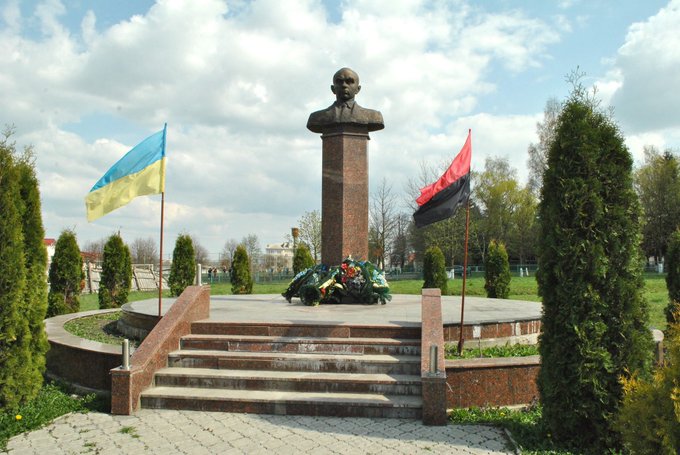
Stepan Bandera's monument in Buchach, Ukraine with the flag (right) of a neo-Nazi Ukrainian political organization

Views: 3066
A Father of the Nation
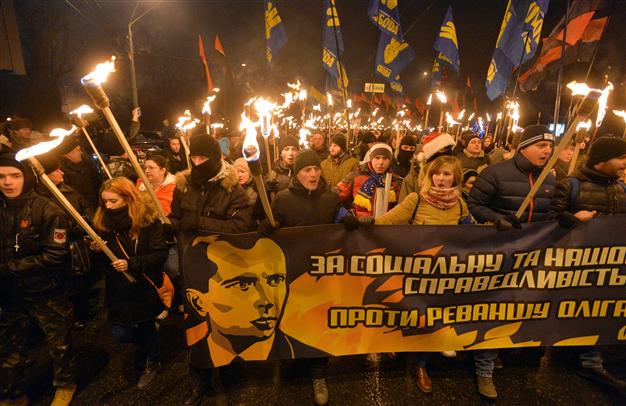
Ukraine is an East European territory which was originally forming a western part of the Russian Empire from the mid-17th century. That is a present-day independent state and the separate ethnolinguistic nation as a typical example of Benedict Anderson’s theory-model of the “imagined community” – a self-constructed idea of the artificial ethnic and linguistic-cultural identity. According to Anderson, the nation is an abstract and firstly subjective social construction that defy simple, objective definition yet has been for the last two centuries the crucial basis of conflict in world politics and international relations, through the assertion of their expressed nationalism.[i] However, nationalism is a quite broad ideology that can be easily transformed into a political movement that became the case, for instance, exactly with the Ukrainian self-imagined ethnonational identity. Acting politically, in principle by all means, on behalf of its own nation usually encompass pretty much a large scale of political ideas and practices including and ethnic cleansing or/and genocide on particular other national groups that happened, for example, in the WWII Ukraine when the Poles, Russians, Jews, and Gypsies (Roma) experienced the genocide committed by the Ukrainian Nazi-Fascist nationalists (the Banderists).
The 2014 Euromaidan protesters in Kiev with the picture of Stepan Bandera – a leader of the WWII Nazi-Fascist movement in Ukraine
Before 2014 Ukraine was a home of some 45 million inhabitants of whom, according to the official data, there was around 77 percent of those who declared themselves as the Ukrainians. Nevertheless, many Russians do not consider the Ukrainians or Belarus as “foreign” but rather as the regional branches of the Russian nationality. It is a matter of fact that, differently to the Russian case, the national identity of Belarus or the Ukrainians was never firmly fixed as it was always in the constant process of changing and evolving.[ii] The process of self-constructing identity of the Ukrainians after 1991 is basically oriented vis-à-vis Ukraine’s two most powerful neighbors: Poland and Russia. In the other words, the self-constructing Ukrainian identity (like the Montenegrin or Belarus) is able so far just to claim that the Ukrainians are not both the Poles or the Russians but what they really are is of great and endless debate. Therefore, the existence of an independent state of Ukraine, nominally as a national state of the Ukrainians, is of a very doubt indeed from both historical and ethnolinguistic perspectives.
The Slavonic term Ukraine, for instance, in the Serbo-Croat case Krajina, means in the English language a Borderland – a provincial territory situated on the border between at least two political entities: in this particular historical case, between the Kingdom of Poland and the Grand Duchy of Lithuania as the Republic of Both Nations (1569−1795) and the Russian Empire.[iii] The term is mostly used from the time of the treaty (truce) of Andrussovo in 1667 between these two states. In other words, Ukraine and the Ukrainians as a natural objective-historical-cultural identity never existed as it was considered only as a geographic-political territory between two other natural-historical entities (Poland and Russia). All (quasi)historiographic mentioning of this land and the people as Ukraine/Ukrainians referring to the period before the mid-17th century is quite scientifically incorrect but, however, in many (pro)Western academic writing cases it is politically inspired and colored with the purpose to present them as something crucially different from the historical process of ethnic genesis of the Russians.[iv]
Historically speaking, it was a Roman Catholic Vatican that was in fact beyond the process of creation of the “imagined community” of the Ukrainian national identity for the very confessional-political purpose to separate the people from this borderland territory from the Orthodox Russian Empire. Absolutely the same, as a matter of comparison, was done by Vatican’s client-state Austria-Hungary in regard to the national identity of Bosnian-Herzegovinian population when this province was administered by Vienna-Budapest from 1878 to 1918 as it was the Austria-Hungarian government who created totally artificial and very new ethnolinguistic identity – the Bosnians, just not to be the (Christian Orthodox) Serbs, who was at that time a strong majority of the provincial population.[v] Therefore, to be a Bosnian meant not to be a Serb with a final consequence to become a Roman Catholic what means the Croat. Similarly, in the case of Ukraine, to be a Ukrainian means primarily not to be a Christian Orthodox Russian.
A creation of ethnolinguistically artificial Ukrainian national identity and later on a separate nationality was a part of a wider confessional-political project by the Vatican in the Roman Catholic historical struggle against the Eastern Orthodox Christianity (the Eastern “schism”) and its churches within the framework of Pope’s traditional proselytizing policy of reconversion of the “infidels”. One of the most successful instruments of a soft-way reconversion used by the Vatican was to compel a part of the Orthodox population to sign a Union Act with the Roman Catholic Church and recognized at such a way a supreme power by the Pope and dogmatic filioque (“and from the Son” – the Holy Spirit proceeds and from the Father and from the Son). Therefore, the ex-Orthodox believers who now became the Uniate Brothers or the Greek Orthodox believers became in a great number later on a pure Roman Catholics who as well as changed their original (from the Christian Orthodox time) ethnolinguistic identity. It is, for instance, very clear in the case of the Christian Orthodox Serbs in Zhumberak area of Croatia who passed the way from the Christian Orthodox Serbs to the Greek Christian Orthodox believers but later became the Roman Catholics and finally, today are the Croats. Something similar occurred and in the case of Ukraine. On October 9th, 1596, it was announced by Vatican a Brest Union with a part of the Orthodox population within the borders of the Roman Catholic Lithuanian-Polish Commonwealth (today Ukraine).[vi] The crucial issue in this matter is that today Ukraine’s Uniates and the Roman Catholics are mostly anti-Russian oriented having at the same time strong Ukrainian national feelings. Basically, both the Ukrainian and the Belarus present-day ethnolinguistic and national identities are historically founded on the anti-Christian Orthodox policy of the Vatican within the territory of ex-Polish-Lithuanian Commonwealth that was, in essence, an anti-Russian policy.
The Lithuanian historiography writing on the Church Union of Brest in 1596 clearly confirms that:
“… the Catholic Church more and more strongly penetrated the zone of the Orthodox Church, giving a new impetus to the idea, which had been cherished since the time of Jogaila and Vytautas and formulated in the principles of the Union of Florence in 1439, but never put into effect – the subordination of the GDL Orthodox Church to the Pope’s rule”.[vii]
In other words, the rulers of the Roman Catholic Grand Duchy of Lithuania (the GDL) from the very time of Lithuania’s baptizing in 1387−1413 by the Vatican had a plan to Catholicize all Orthodox believers of the GDL among whom the overwhelming majority were the Slavs. As a consequence, the relations with Moscow became very hostile as Russia accepted the role of the protector of the Christian Orthodox believers and faith, and therefore the Church Union of Brest was seen as a criminal act by Rome and its client-state of the Republic of Two Nations (Poland-Lithuania).
Today, it is absolutely clear that the most pro-Western and anti-Russian part of Ukraine is exactly the West Ukraine – the lands that were historically under the rule by the Roman Catholic ex-Polish-Lithuanian Commonwealth and later on by the former Habsburg Monarchy (Austria-Hungary). It is obvious, for instance, from the presidential elections voting results in 2010 as the pro-Western regions voted for Y. Tymoshenko while the pro-Russian regions of East Ukraine did it for V. Yanukovych. It is a reflection of the post-Soviet Ukrainian identity dilemma between Europe and Eurasia – a dilemma that is of common nature for all Central and East European nations who historically played a role of a buffer zone between the German Mittel Europa project and the Russian project of a pan-Slavonic unity and reciprocity.
The fact is that the western territories of present-day Ukraine are mainly populated by the Roman Catholics, the East Orthodox, and the Uniates. This part of Ukraine is mostly nationalistic and politically pro-Western oriented. East Ukraine is in essence a Russophone territory and subsequently “tends to look to closer relations with Russia”.[viii] By the Vatican policy of signing the union with the Christian Orthodox believers in present-day West Ukraine from 1596 the necessary preconditions for de-Russification and Ukrainization of the local inhabitants were founded. At the course of time, as a consequence of such a policy by the Roman Catholic Church, Ukraine became sharply divided by confession, national feelings, economic development, linguistic identity, and geopolitical orientation to such extent that Ukraine today is an example of the “failed state”.[ix] By scholarly definition, “a failed state is a state that is unable to perform its key role of ensuring domestic order by monopolizing the use of force within its territory”.[x]
The 1994 Presidential election results in Ukraine according to historical regions
According to the 2001 census, out of Ukraine’s 45 million inhabitants, 17,3 percent were the Russians but 30 percent were speaking the Russian language. Subsequently, a great part of those who identified themselves as the Ukrainians recognized that their native language is, in fact, the Russian. In addition, there were 83 percent of Ukraine’s inhabitants in 2008 for whom Russian was a chosen language as a lingua franca. There is as well as a mixture of the Russian language and the Ukrainian language with a predominant Russian vocabulary spoken in the countryside – the Surzhik.[xi]
The Ukrainian authorities up today did not properly solve the problem of the official language in the country as it is officially fixed to be the Ukrainian that is spoken in the western regions of the country while the Russian is spoken in the eastern provinces of Ukraine and even used as a lingua franca by the majority of the population. Therefore, official bilingualism would be a matter of a real solution to many current ethnopolitical problems in Ukraine. If Belgium can be officially bilingual state, there is no obstacle for Ukraine to be the same.
Dr. Vladislav B. Sotirović
Ex-University Professor
Vilnius, Lithuania
Research Fellow at the Center for Geostrategic Studies
Personal disclaimer: The author writes for this publication in a private capacity which is unrepresentative of anyone or any organization except for his own personal views. Nothing written by the author should ever be conflated with the editorial views or official positions of any other media outlet or institution.
Endnotes:
[i] Benedict Anderson, Imagined Communities: Reflections on the Origin and Spread of Nationalism, Revised edition, London: Verso, 2016.
[ii] On the Ukrainian self-identity construction, see [Karina V. Korostelina, Constructing the Narratives of Identity and Power: Self-Imagination in a Young Ukrainian Nation, Lanham, Maryland: Lexington Books, 2014].
[iii] A German historical term for Ukraine would be a mark – a term for the state’s borderland which existed from the time of the Frankish Kingdom/Empire of Carl the Great.
[iv] For instance, Alfredas Bumblauskas, Genutė Kirkienė, Feliksas Šabuldo (sudarytojai), Ukraina: Lietuvos epocha, 1320−1569, Vilnius: Mokslo ir enciklopedijų leidybos centras, 2010.
[v] Лазо М. Костић, Наука утврђује народност Б-Х муслимана, Србиње−Нови Сад: Добрица књига, 2000.
[vi] Arūnas Gumuliauskas, Lietuvos istorija: Įvykiai ir datos, Šiauliai: Šiaures Lietuva, 2009, 44; Didysis istorijos atlasas mokyklai: Nuo pasaulio ir Lietuvos priešistorės iki naujausiųjų laikų, Vilnius: Leidykla Briedis, (without year of publishing), 108.
[vii] Zigmantas Kiaupa et al, The History of Lithuania Before 1795, Vilnius: Lithuanian Institute of History, 2000, 288.
[viii] John S. Dryzek, Leslie Templeman Holmes, Post-Communist Democratization: Political Discourses Across Thirteen Countries, Cambridge−New York: Cambridge University Press, 2002, 114.
[ix] Зоран Милошевић, „Друштвени процеси у самосталној Украјини“, Радови, Филозофски факултет, Источно Сарајево, 2005, 289.
[x] Andrew Heywood, Global Politics, New York: Palgrave Macmillan, 2001, 121.
[xi] Срђан Перишић, Нова геополитика Русије, Београд: Медија центар „Одбрана“, 2015, 273−275.
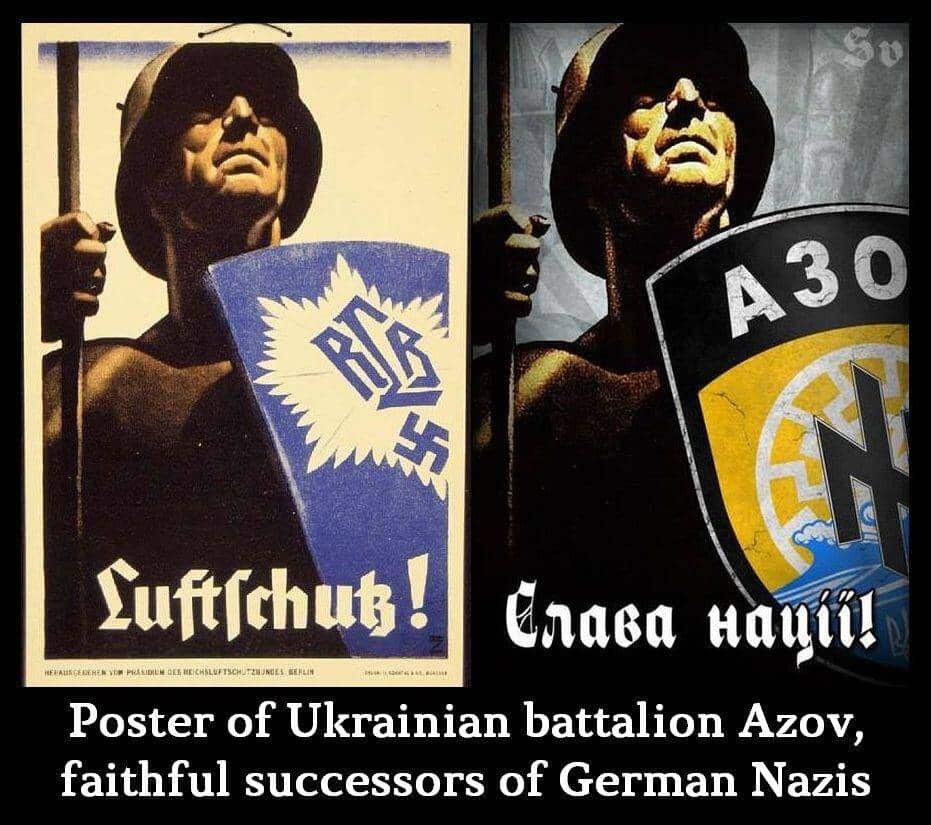
Repeating history
Read our Disclaimer/Legal Statement!
Origins of images: Facebook, Twitter, Wikimedia, Wikipedia, Flickr, Google, Imageinjection, Public Domain & Pinterest.
Donate to Support Us
We would like to ask you to consider a small donation to help our team keep working. We accept no advertising and rely only on you, our readers, to keep us digging the truth on history, global politics, and international relations.
Such important reality as is shown in this picture is virtually unpublishable in mainstream US ‘news’media, because US ‘news’media need to deceive their public about the most important international realities — such as that the US imposed upon Ukraine a nazi regime against Russia, and the US now lies to accuse Russia for doing what Russia must do in order to protect itself from the US nazi regime next-door.This picture is among many which were originally published in the excellent 4 July 2018 article by Asa Winstanley at The Electronic Intifada. His article was headlined "Israel is arming neo-Nazis in Ukraine”. That article focuses upon Israel’s strong support for ...
I travel frequently to the countries which once made up the now defunct Socialist Federal Republic of Yugoslavia, satisfying a passion of mine that stems back to my childhood days. For me, the Balkans’ history, its people and its cultures are both enigmatic and magnetic, as they have been, too, for countless others, of many nationalities, over centuries gone by. Accounting for the enchantment of the Balkans, its captivating allure, is a challenge to put into writing. Because no words can truly embellish what is one of the most absorbing parts of the world. To understand and feel what it is ...
This article about the United States bearing the burden with allies first appeared in the Fall 2016 issue of Providence‘s print edition that was released last December. To read the original in a PDF format, here. To receive a complete copy of future issues as they are published, subscribe here.“It’s important to make sure our alliances are as strong as they possibly can be,” a presidential candidate declared not long ago. He promised to “work with our European friends” and explained that “building a durable peace will require strong alliances.”[i]Striking a similar theme, another candidate promised “to work in concert with ...
USAID is spending $300,000 to fight traditional Christian morality in the Republic of Macedonia.A reader passes along a government document putting out bids for a contract. Here’s the top of the document:Apparently the (former Yugoslav) Republic of Macedonia, a small Balkan nation that emerged from the breakup of Yugoslavia, is insufficiently progressive on LGBT issues. So the American government is spending $300,000 to undermine the traditional Orthodox Christian culture of the country. Excerpts from the document (emphases mine):Macedonia has ratified the Universal Declaration of Human Rights and the European Human Rights Convention. Through ratification of these human rights treaties, Macedonia has ...
IntroductionThe goals of this article are: 1) to investigate the role of the revived Patriarchate of Peć in Serbian and Balkan history?; and 2) to explore and present the results of investigation of the problems with respect to: a) the role of the Serbian Church during the first decades of the Ottoman occupation of Serbian lands in the process of the creation of a Serbian national identity; b) Serbian-Turkish relations in the second half of the 16th century; and c) the reasons for Serbian disloyalty towards the Ottoman government at the turn of the 17th century.The article addresses the reasons ...
As 2016 closes, we find ourselves a deeply unsettled nation. We’re unable to draw the lines of our national interest. Is it jobs and economy, is it national security, or is it now in our interest to ensure global security — in other words, act as the world’s policemen?As the “failing” (to quote Trump) New York Times degenerates into a Washington Post organization with its stagnant Cold War vision of a 1950s world where the Russians are to blame for most everything — Hillary’s loss, most of the aggression and disorder in the world, the desire to destabilize Europe, etc. — the Times has added the ...
In a remarkable book, 1939: The Alliance That Never Was and the Coming of World War II, the Canadian historian Michael Jabara Carley describes how, at the end of the 1930s, the Soviet Union repeatedly tried, but finally failed, to conclude a pact of mutual security, in other words a defensive alliance, with Britain and France. This proposed arrangement was intended to counter Nazi Germany, which, under Hitler’s dictatorial leadership, had been behaving more and more aggressively, and it was likely to involve some other countries, including Poland and Czechoslovakia, that had reason to fear German ambitions. The protagonist of this ...
No city in Iraq is more symbolic of the criminal consequences of the US invasion of Iraq than Fallujah. Prior to 2003, the 300,000-strong, prosperous, predominantly Sunni Muslim community on the Euphrates River, one of humanity’s oldest continuous urban settlements, was known as the “city of mosques.” After 13 years of destruction at the hands of the US military and its client state in Baghdad, it is today a labyrinth of ruins, a city of the dead.Following weeks of air strikes by US, British and Australian bombers, a combination of Iraqi government forces and Shiite militias is reportedly on the ...
Since the disintegration of Yugoslavia in the nineties, its former constituent republics have been mired in a state of perpetual conflict.Nowhere is this more apparent than the contested state of Kosovo.In 1998, Albanian separatists in the Serbian province of Kosovo i Metohija began a campaign of attacks, with the express objective of creating a unified, ethnically homogenous, Greater Albanian state. Spearheaded by an organization known as the Kosovo Liberation Army (KLA), which is widely regarded by many nations, including the United States, as a terrorist organization, ethnic Albanian militants attacked Serbian security forces, and terrorized civilians in a brutally violent ...
Kosovo and Metohia, two central regions of perennial Serbia, are the very essence of Serbian spiritual, cultural identity and statehood since Middle Ages to date. Fertile and clement planes of Kosovo with mild climate, and reach in water resources, with high mountain chains bordering with Albania have been good-blessed environment for a fruitful development of the highest achievements in all fields in medieval Serbia. The cultural and demographic strength of the Serbs is best illustrated by the presence of 1.500 monuments of Serbian culture identified so far. Numerous outstanding noble Serbian families used to live in these regions, as families ...
Much is being written regarding the Charlie Hebdo issue in Paris, France. I do not condone any killing but at the same time I do not support issues that violate human rights, religious freedom or freedom of speech and thoughts. Using cartoons to condemn Divine thoughts and beliefs is utterly wrong because they fall under hate crimes and not under freedom of speech as we are lied about. The perpetrators of hate continue to be protected. Islam is under attack and its adherents, the Muslims, are being targeted through provocation. In a recent article Charlie Hebdo and Tsarnaev’s trial: Cui ...
Hypocrisy may be the only consistent guiding principle of US foreign policy. Here's a prime example of the "do as we say, not as we do" that is the core of how Washington does business overseas: In the same week that the the US Justice Department demanded that the Russian-backed RT America network register as a foreign propaganda entity or face arrest, the US State Department's Bureau of Democracy, Human Rights and Labor (DNL) has announced that it is launching a program to massively interfere in NATO-partner Hungary's internal media.So the US Justice Department is cracking down on RT America for what ...
Article by Vladislav B. Sotirović: „A New Age of Global Security: The ‚Ukrainian Question‘ and ‚Kosovo Precedent‘“, Vojno delo (Military affairs), Interdisciplinary Scientific Theoretical Journal, International Edition, Vol. 69, Issue 4, 2017 (May-June 2017), ISSN 0042-8426, Ministry of Defence of the Republic of Serbia, Belgrade, Serbia, pp. 176−211.Origins of images: Facebook, Twitter, Wikimedia, Wikipedia, Flickr, Google, Imageinjection, Public Domain & Pinterest.Read our Disclaimer/Legal Statement!Donate to Support UsWe would like to ask you to consider a small donation to help our team keep working. We accept no advertising and rely only on you, our readers, to keep us digging the truth ...
The political situation in Turkey is clearly dramatic, but it is also equally complicated. Turkish President Erdogan has succeeded in securing levels of power unique in the nation′s history. But is this situation really unique? No – for 15 years, the father of the nation Ataturk ruled alone over the early Republic, which was a one-party nation at the time. Only his untimely death in 1938 deprived him of that power.Up to that point, Ataturk alone ruled over every conceivable dimension of domestic and foreign policy. Even clothing and music were tailored to his ideas. The aim was the creation ...
Amid a divisive debate in Ukraine on state honors for nationalists viewed as responsible for anti-Semitic pogroms, the country for the first time observed a minute of silence in memory of Symon Petliura, a 1920s statesman blamed for the murder of 50,000 Jewish compatriots.The minute was observed on May 25, the 90th anniversary of Petliura’s assassination in Paris. National television channels interrupted their programs and broadcast the image of a burning candle for 60 seconds, Ukraine’s Federal News Agency reported.A French court acquitted Sholom Schwartzbard, a Russia-born Jew, of the murder even though he admitted to it after the court ...
On 10 August 2016, Republican presidential candidate Donald Trump accused president Barak Hussein Obama and Democrat presidential candidate Hillary Clinton of co-founding the jihadist rebel organization ISIS (Islamic State) operating mainly in Syria and Iraq but with operative in many Middle Eastern countries and around the world. Trump used Obama’s full name to provoke a racist-xenophobic response from the public about the Arabic-sounding name rooted in East Africa. Immediately, critics insisted that Trump made outrageous and ignorant comments about complex foreign affairs matters he does not fully comprehend.The following day Trump clarified that he meant exactly what he said and ...
The United States approaches the November 2020 election with growing apprehension, even dread.Among the possibilities:Protracted uncertainty about the presidential contest. Think Florida 2000 but with several states’ results unresolved for weeks or even months (“Experts held ‘war games’ on the Trump vs. Biden election. Their finding? Brace for a mess”);A disputed outcome, perhaps with Donald Trump and Joe Biden both claiming victory, compounded by a “blue shift,” where states are claimed by Trump on election night but flip over to Biden as additional absentee and mail-in ballots conveniently turn up days or weeks later;Violent civil conflict, spurred on in the ...
The role of Jewish figures and that of the State of Israel in the Ukrainian crisis has not gone unnoticed considering that this community represents less than 1 percent of the population. However, a secret report in the hands of the Netanyahu administration confirms that Ashkenazi Jews do not originate from the Levant, but are the descendants of the Khazars. This little-known population founded a Jewish empire in the tenth century on the banks of the Black Sea. Therefore, some Zionists see in Ukraine a possible second Israel.The Times of Israel, an independent Israeli newspaper that counts among its staff ...
Exclusive photos of the Russian war crimes in Syria and the Middle East by "Free Media Group" volunteers, 2016-2018 with a proper illustrations of the Russia's militant imperialism. The authenticity of photos and their descriptions are certified by the UK Cabinet of Boris Johnson & Theresa May: The My Lai Massacre by Russian soldiersThe Russian soldiers at the spot of My Lai Massacre with their victimsAleppo citizen with a daughter during the Russian destruction of the cityRussian Orthodox monk in Moscow in protest against the Russian invasion of SyriaSyrian children of war and the Russian occupant soldier Killed Russian student in ...
US-installed Ukrainian fascists commemorated Poroshenko’s established victory in Europe Day of Remembrance by vowing to “destroy Moscow,” free its people, and let them “shape their own future.”Ukrainian ultranationalists attending a May 8 commemoration included 14th SS Waffen Grenadier division veterans, Ukrainian Insurgent Army (UPA) members, and Nazi-infested volunteer battalions involved in what they call “the Russian-Ukrainian war.”Svoboda party overt Nazis participated. Their slogan is “Ukraine for the Ukrainians” – meaning ethnically pure, free of Jews, Russians and others not wanted, by extermination or other means.Party member Yuri Sirotyuk called war on Russia Ukraine’s historic mission. “I believe that if we ...
The magazine is covering the research gaps uncovered by global Western hoax mainstream media platforms and academic teaching & research institutions.
This is an alternative information & academic research digest platform with the purpose to offer an alternative “another side of the truth”.
The magazine is independent, private, and free of any influence by any institution, organization, government, or pressure group. URL: www.global-politics.eu