
Basic Points About The Zionist Israeli-Arab Palestinian Conflict
Palestine, the land claimed by both sides was known under this term in international relations (IR) from 1918 till 1948. Moreover, the same term was applied by Islam, Christianity, and Judaism to designate a Holy Land [...]
The Zionist Israeli-Arab Palestinian conflict today is one of if not the most significant global security problems to be dealt with.[1] However, this conflict is historically not much old as it is a pretty modern issue, dating, in fact, since the First Zionist Congress in 1897. The focal question is: What is conflict about? In other words: What are those two different groups fighting for?
At first glance, it can be understood that behind the conflict reasons is a confession as those two peoples are of different denominations: the Jews are predominantly Judaists while the Palestinian predominant confession is Islam but includes Christians and Druze. However, the obvious religious differences are not the fundamental cause of the struggle. In fact, the conflict started a century ago and continued to be strife for the land.
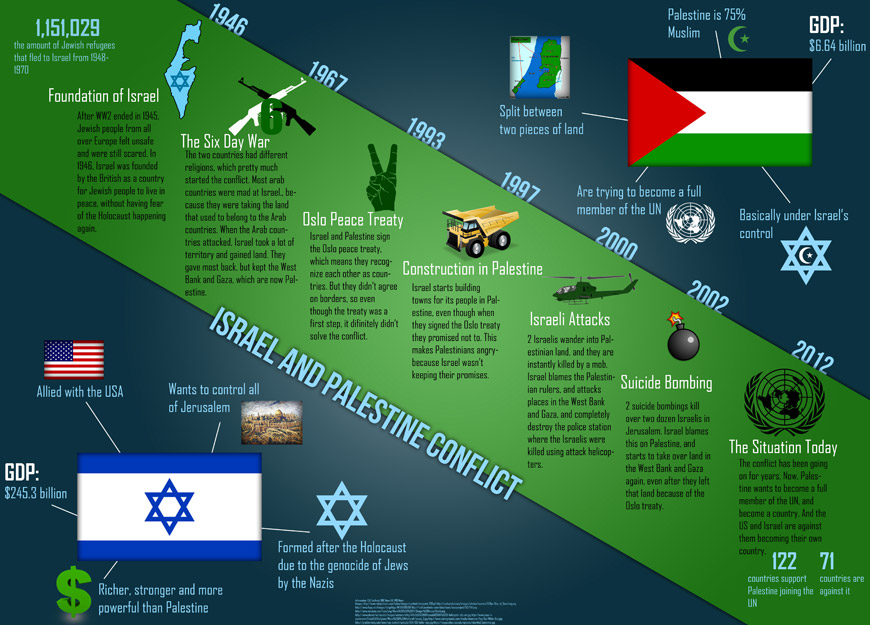
Palestine, the land claimed by both sides was known under this term in international relations (IR) from 1918 till 1948. Moreover, the same term was applied by Islam, Christianity, and Judaism to designate a Holy Land. However, as a consequence of the wars from 1948 to 1967 between the Arabs and Israel, this land (some 10.000 sq. miles) became today divided into three parts: 1) Israel; 2) the West Bank; and the Gaza Strip.
However, both groups have a different background in claiming this land for themself:
The Zionist Jewish claims to Palestine are founded on the Biblical promise to Abraham and all his descendants. The historical foundations of such claims are based on the fact that on the territory of Palestine have been established the ancient kingdoms of the Jews: Israel and Judea. Politically, this historical claim is backed by the need of the Jews for the nation-state to get rid of European anti-Semitism, especially after the WWII holocaust.
Arab Palestinians are claiming the same land based on their continuous living in Palestine for hundreds of years and on the fact that they were the demographic majority until 1948. In addition, they reject the confessional-ideological notion of the Zionist Jews that the Jewish kingdoms based on the Old Testament can constitute any rational and moral/scientific foundations to be used for acceptable modern claim especially taking into consideration that the Jews left Palestine after the occupation of the Roman Empire in the 1st century AD (for 2000 years!). However, the Arab Palestinians also use the arguments from the Bible and, therefore, claim that Abraham’s son Ishmael is the forefather of the Arabs and that God promised the Holy Land to all children of Abraham which simply means to the Arabs too (Arabs are Semitic people as Jews). But the crucial issue from the Arab Palestinian viewpoint is that they cannot forget Palestine as a matter of compensation for the holocaust against the Jews committed in Europe (in which Arab Palestinians did not participate at all).
The Palestinians and diaspora
The term Palestinians from the very political-historical standpoint today refers to those people of Palestine whose historical roots are traced to this land as defined by the British Mandate’s borders being the Arabs of Christian, Muslim, or Druze denominations. It is estimated that today some 5.6 million Palestinians are living within the British Mandate Palestine’s frontiers which are now divided into three parts: 1) The State of Zionist Israel; 2) The territory of the West Bank; and 3) the Gaza Strip. The last two were occupied by Israel during The 1967 Six Days War. It is also claimed that today some 1.5 million Palestinians are living as citizens of Israel. Therefore, the Palestinians compose around 20% of the Israeli population. In addition, some 2.6 million Palestinians live in the West Bank including 200.000 living in East Jerusalem and around 1.6 million living in the Gaza Strip (at least before the current Israeli genocide on the Gazans which started in October 2023). However, there are around 5.6 million Palestinian people who are living in the diaspora, outside Palestine mainly in Lebanon, Syria, and Jordan.
Among all Palestinian diaspora groups, the largest one (some 2.7 million) lives in Jordan (not taking into consideration the territory of the West Bank which legally belonged to the Kingdom of Jordan). Many of them still live in those refugee camps established in 1949 while others became town dwellers. Some Palestinian refugees took refuge in Saudi Arabia or other Arab Gulf states while others moved to other countries of the Middle East or the rest of the world. Among all Arab states, only Jordan granted citizenship to those Palestinians living there. That became, however, the formal reason for some Zionist Jews to claim that Jordan is, in fact, already a national state of the Palestinians and, therefore, there is no real need to establish an independent state of Palestine. On the other hand, nonetheless, many Palestinians claim that the USA is, basically, the national state of the Jews, and, subsequently, Israel in the Middle East does not need to exist (as the second national state of the Jews).
Nevertheless, the situation of the Palestinian refugees in South Lebanon is particularly disastrous as many Lebanese are blaming them for the civil war that ruined the country in 1975−1991 and, therefore, demand that all Lebanese Palestinians have to be resettled somewhere else as a precondition to re-install peace in the country. Especially the Lebanese Christians are very anxious to rid the country of the Muslim Palestinians as they fear that the Palestinians are undermining the religious balance of Lebanon.
Israeli Palestinians
When Israel was proclaimed as an independent state in May 1948, there were only some 150.000 Arab Palestinians within its borders. On one hand, all of them were granted the citizenship of Israel which means automatically and with the right to vote.[2] However, on the other hand, they de facto have been second-class citizens (i.e. the ethnic and confessional minority) for the very reason that Israel was officially defined as both a Jewish state and the state of the Jewish people.[3] The Arab Palestinians are not the Jews (even though both are the Semites).[4] Most of those Israeli Palestinians were subjected before the 1967 Arab-Israeli War to the military authority which restricted their free movement followed by other civic rights like work, free speech, association, etc. The Palestinians were not allowed to be the full members of the Israeli trade union federation (the Histadrut) up to 1965. However, the focal problem was that the State of Israel confiscated around 40% of Palestinian land to be used for development projects.[5] However, from the majority of such state’s development projects, mostly exactly Israeli Jews profited but not Israeli Arab Palestinians.
One of the basic claims by the Arab Palestinians in Israel is that all Israeli authorities are systematically discriminating against them by allocating very few resources for health care, education, public works, economic development, or resources for municipal governmental authorities to the Arab-populated land. Another general claim is that Israeli Palestinians are as well as systematically discriminated against for the right to preserve and develop their cultural, national, and political identity. As a matter of fact, Israeli Palestinians have been up to 1967 totally isolated from the Arab world but as well as very much understood by other Arabs as traitors who left to live in the oppressive Zionist anti-Arab State of Israel. However, since The 1967 Six-Day War, the majority of Israeli Palestinians have become more self-confident in their Arab Palestinian national identity, especially during the last 20+ years as Zionist Israeli authorities prohibited commemorating the Al Nakba which is either the expulsion or flight of at least 500.000 Arab Palestinians in 1948−1949 during the first Arab-Israeli war.
Dr. Vladislav B. Sotirović
Ex-University Professor
Vilnius, Lithuania
Research Fellow at the Center for Geostrategic Studies
Personal disclaimer: The author writes for this publication in a private capacity which is unrepresentative of anyone or any organization except for his own personal views. Nothing written by the author should ever be conflated with the editorial views or official positions of any other media outlet or institution.
References:
[1] About the Israeli-Palestinian conflict, see in [Martin Bunton, The Palestinian-Israeli Conflict: A Very Short Introduction, New York: Oxford University Press, 2013].
[2] Nevertheless, in some cases, the Israeli Central Elections Committee in practice used very politically coloured criteria to discriminate against those Arab Palestinians whose political views are understood to be unacceptable, especially at the time of the parliamentary elections.
[3] About the ideological-political background of the creation of Israel as a nation-state of the Jews, see in [Theodor Herzl, The Jewish State: The Historic Essay that Led to the Creation of the State of Israel, Skyhorse, 2019].
[4] Semitic peoples are supposed to descend from Shem, son of Biblical Noah. Particularly it is assumed for the Jews, Arabs, Ancient World’s Phoenicians, and Assyrians [Alan Isaacs, et al (eds.), A Dictionary of World History, Oxford−New York: Oxford University Press, 2000, 563]. There is a claim that, in fact, present-day Palestinians descended from the Phoenicians and that the term Palestinians is corrupted Phoenicians.
[5] Israeli Palestinians are commemorating on March 30th Land Day to protest the continuing confiscation of Arab territories by the Israeli Government. The first protest on this day was in 1976 when the Israeli security forces killed six Palestinians. Since this incident, the Palestinians either in the diaspora or in Israel commemorate this day as a national day.
Origins of images: Facebook, Twitter (X), Wikimedia, Wikipedia, Flickr, Google, Imageinjection, Public Domain & Pinterest.
Read our Disclaimer/LegalStatement!
DonatetoSupportUs
We would like to ask you to consider a small donation to help our team keep working. We accept no advertising and rely only on you, our readers, to keep us digging the truth on history, global politics, and international relations.
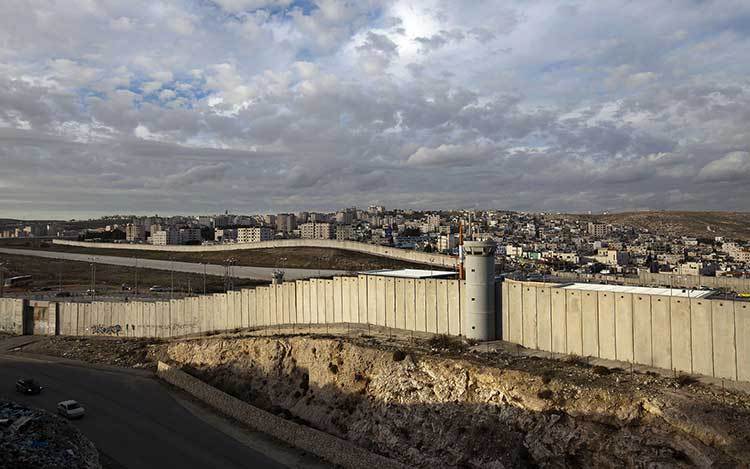
“The United States has been sending a message that the settlements must stop privately and publicly for nearly five decades.”Samantha Power, US Ambassador to the UNChristians following the Gregorian calendar are getting busy to celebrate Christmas, but the business of diplomacy continued in the United Nations. In the Security Council, anticipation about a particular resolution was greater than usual.On Friday, interest was piqued by what the Obama administration’s representative, Samantha Power, would do about a particular resolution that had riled Israeli politicians, US president-elect Donald Trump, and various members of the US Congress.Resolution 2334, as worded, demanded that Israel “immediately ...
The Albanian nationhood as understood in the 19th century was part of a romanticist notion of nationality, i.e., the Albanians were the Balkan people whose mother tongue was Albanian regardless of any confessional division of Albanian people into three denominations (Moslem, Roman Catholic and Eastern Orthodox). Within the north Albanian tribes, especially among the Miriditi, the Roman Catholic Church was very influential. The Roman Catholic Church became the main protector of the Albanian language and cultural heritage and the main protagonist of the national identity of the Albanians in Northern Albania.[1] The expression of common notions of the Albanian nationhood ...
Stalinist “Land of Eagles” As in neighboring Yugoslavia, the communist revolutionary guerrilla forces, established by the aid and crucially supported by the Yugoslav communists led by local Albanian communist leader Enver Hoxha, took over the power in Albania in 1944.[1] From 1945 to 1948 Albania was under the strong influence of Titoist Yugoslavia and both counties being under the hand of J. V. Stalin. Yugoslavia lavishly supplied Albania with deficient material, mainly nutritious ones, like wheat, etc. As testified by the Montenegrin zealot communist and revolutionist Milovan Đilas, one of the leading Yugoslav politicians at the time, and a member ...
The contemporary Lithuania uses the official interpretation of bloody events that took place in Vilnius on January 13, 1991 as an ideological foundation for Russophobia-based confrontation with its eastern neighbor. It says “the Soviet soldiers committed an intentional murder of 13 unarmed people and one special operations serviceman”. The truth about what really happened, as well as the doubts over the official interpretation, are punishable crimes.The Lithuanian authorities have been trying to get Algirdas Paleckis condemned by court for some years. He is a young politician and a diplomat, the leader of Lithuanian Socialist People’s Front (SPF), a holder of ...
The internal and much more external destruction of the former Yugoslavia in the 1990s was celebrating in 2015 its 20th year of anniversary. However, this historical and much more geopolitical event still needs a satisfactory research approach in regard to the true geopolitical reasons and political-military course of the destruction of this South Slavic and Balkan state. During the last quarter of century, the (western) global mainstream media unanimously accused Serbia and the Serbs of the national chauvinism as the main cause of the bloody wars on the territory of ex-Yugoslavia in the 1990s. However, the role and direct impact ...
In the sea of misinformation sloshing around the Western media during the Yugoslav civil wars, Serbs fared the worst. As a rule, they were accused even of atrocities that never happened, or were committed by others. The real truth would usually emerge several years later, from the mouths of international officials who at the time held important and responsible positions.American press and electronic media have “discovered” that the Serbs weren’t the “bad guys” to the extent the American reporters from the Balkans made them out to be. Even though Jack Kelly, a correspondent of USA Today, resigned years ago because ...
Most of former Ukraine is now (since 2014) occupied by nazis/fascists and rasists/extreme nationalists. In some cases they are disguised within other political parties but, make no mistake, their ideology does not change just because they change name or party organisation. As is well known, when the nazis made their coup in 2014 (directed and assisted by the CIA), the first "law" they forcefully passed through the rump and unconstitutional rest-parlament was the prohibition of the russian language (the majority language!) from all official institutions, schools, administration and so on.The second "law" they passed was the legalisation of the nazi ...
Author’s note and UpdateThe following article was first published in September 2014 at the outset of the air campaign “against the ISIS”. In recent developments Russia has officially joined the campaign against the Islamic State (ISIS). What are the implications?Amply documented but rarely mentioned in news reports, the ISIS is a creation of US intelligence, recruited, trained and financed by the US and its allies including Saudi Arabia, Qatar, Turkey, Israel and Jordan. What this means is that the ISIS terrorists are the foot soldiers of the Western alliance. While America claims to be targeting the ISIS, in reality it is protecting the ISIS. The air campaign is intent upon ...
More than 50 years ago, the state of Israel shocked the world when it seized the remaining Palestinian territories of the West Bank, East Jerusalem, Gaza Strip, as well as the Syrian Golan Heights and the Egyptian Sinai Peninsula, in a matter of six days.In a war with Egypt, Jordan and Syria, known as the 1967 War, or the June War, Israel delivered what came to be known as the "Naksa", meaning setback or defeat, to the armies of the neighbouring Arab countries, and to the Palestinians who lost all what remained of their homeland.The Naksa was a continuation of a ...
Serbia today is a member-State of United Nations (U.N.), after the Socialist Federal Republic of Yugoslavia was split into several nations during the early 1990’s when war broke out between Serbian General Milosevic and neighboring nations. After partition, Serbia is still the most powerful “state” of the former Yugoslavia.“Kosovo”, the term used for the territory of southern Serbia, is de-jure recognised as a “state” by over 110+ “states”, but is not a “state” itself, as per the Montevideo Convention on the Rights and Duties of States (1933), and is not a “state” at the U.N. where 2/3rd positive vote is ...
Kosovo’s Prime Minister Accused of Running Human Organ, Drug Trafficking CartelIn another grim milestone for the United States and NATO, the Council of Europe (COE) released an explosive report last week, “Inhuman treatment of people and illicit trafficking in human organs in Kosovo.”The report charged that former Kosovo Liberation Army (KLA) boss and current Prime Minister, Hashim Thaçi, “is the head of a ‘mafia-like’ Albanian group responsible for smuggling weapons, drugs and human organs through eastern Europe,” The Guardian disclosed.According to a draft resolution unanimously approved December 16 in Paris, the Committee on Legal Affairs and Human Rights found compelling ...
The edifice of the post-1991 world order is collapsing right before our eyes. President Putin’s decision to give a miss to the Auschwitz pilgrimage, right after his absence in Paris at Charlie festival, gave it the last shove. It was good clean fun to troll Russia, as long as she stayed the course. Not anymore. Russia broke the rules.Until now, Russia, like a country bumpkin in Eton, tried to belong. It attended the gathering of the grandees where it was shunned, paid its dues to European bodies that condemned it, patiently suffered ceaseless hectoring of the great powers and irritating baiting of the East European small-timers alike. But something broke there. The lad does ...
Origins of images: Facebook, Twitter, Wikimedia, Wikipedia, Flickr, Google, Imageinjection, Public Domain & Pinterest.Read our Disclaimer/Legal Statement!Donate to Support UsWe would like to ask you to consider a small donation to help our team keep working. We accept no advertising and rely only on you, our readers, to keep us digging the truth on history, global politics and international relations.[wpedon id="4696" align="left"]Save
What has happened is that NATO provides cover for these transgressions of the United States government’s policy. In other words, it absolutely legitimizes what effectively is NATO aggression. Moreover, what one needs to bear in mind and what one needs to be mindful about is the fact that in Western Europe you no longer have rulers with the independence of Charles de Gaulle.It seems that Washington, and we can use Washington, America and NATO interchangeably because NATO is dominated by the United States. It is a command structure, which ultimately is based on American military power and American military precedence. ...
Russia and its President, Vladimir Putin, a little more than a year ago, in July 2014 were the focus of attention in Europe and North America, accused, without a shred of forensic evidence, of shooting down an unarmed civilian Malaysian airliner over eastern Ukraine. The Russians were deemed out to restore the Soviet Union with their agreement to the popular referendum of Crimean citizens to annex into the Russian Federation and not Ukraine. Western sanctions were being thrown at Russia by both Washington and the EU. People spoke of a new Cold War. Today the picture is changing, and profoundly. ...
Seventeen years ago today, on March 24, 1999, NATO began a 78-day deadly and devastating U.S.-backed intervention of Yugoslavia. It was the first time in history that the North Atlantic Treaty Organization decided they would attack a country without the approval of the U.N. Security Council.Nineteen countries took part in the aggression led by the United States that was supposed to stop the repressive activities of the Slobodan Milosevic government and to establish a framework for its Southern province, Kosovo, under international law. Milosevic was president of Serbia from 1989 to 1997, and of Yugoslavia from 1997 to 2000.The attack was ...
The North Atlantic Treaty Organization (NATO), established in 1949 on the pretext of “containing Soviet influence”, has almost doubled in size within the past two decades alone. In 1998, NATO comprised 16 member states, but with repeated expansions up to Russia’s very borders, it now contains almost 30 countries.Though seldom mentioned in mainstream discourse, NATO is a US-dominated organization, whose orders are issued from Washington and customarily obeyed. The US is by far the largest contributor to the alliance, spending more than all other member nations put together.One of the critical reasons behind NATO’s formation almost 70 years ago, was ...
President Obama is still considering arming Ukraine in case the latest ceasefire is breached and the conflict escalates; but political analyst Stephen Lendman told Sputnik in an exclusive interview that the US leader is lying, and that the US has been supplying arms to Kiev from the very start of the military operation.The ceasefire between Kiev forces and independence supporters of Donetsk and Luhansk is generally holding, shelling in Donbas has stopped as the truce came in force on midnight, a spokesperson at the Kiev special operations headquarters said Sunday. But a day earlier Ukrainian President Petro Poroshenko and US ...
November 1991 is a month and year that will forever live in infamy when it comes to one of the most grievous crimes committed under the rubric of Western foreign policy, as it was on this month in this year that the break-up and destruction of the Socialist Federal Republic of Yugoslavia (SFRY) was set in train.The Arbitration Commission of the Peace Conference on Yugoslavia was a body set up in 1991 by the Council of Ministers of the European Economic Community (EEC) in response to the conflict that had broken out between separatists in Slovenia and Croatia and the ...
The most useful parable about progressives is that offered by Bernard Sanders, self-styled “socialist-progressive-independent” rep from Vermont. Sanders owes his political career to rage against the Vietnam War among radicals, many of whom moved into the state in the early 1970s. They forthwith planned a long-term, carefully organized, assault on Vermont’s two-party structure. Sanders linked his political ambitions to this effort to organize a third force, the Progressive Alliance. He became mayor of Burlington and, later, congressman.At a rapid clip the emphasis moved from party-building to Sanders-building. By 1994, it was apparent that the only movement B. Sanders was interested in ...