
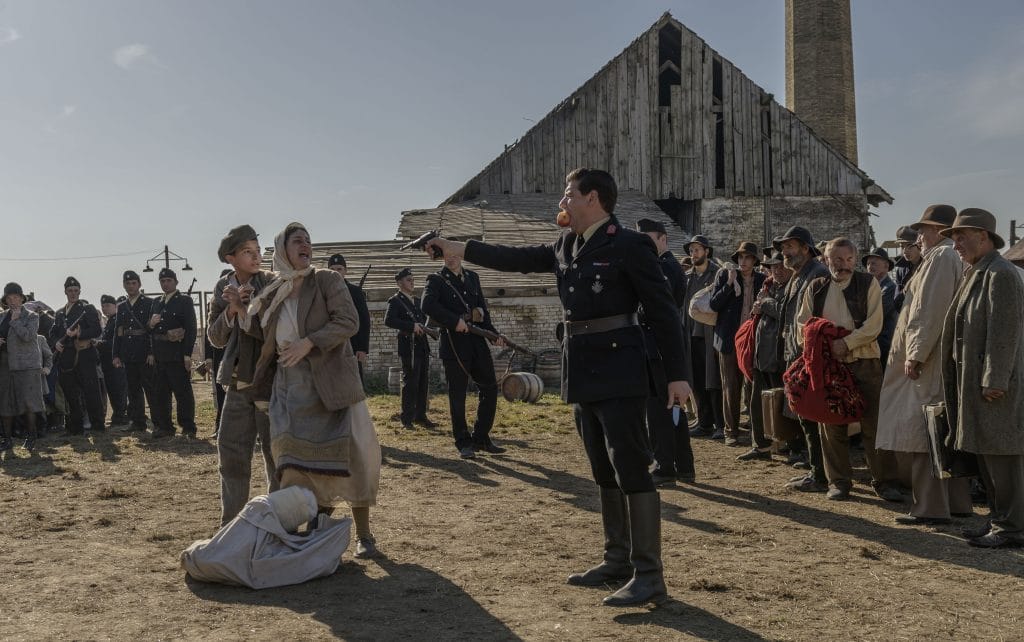
Croatia’s Disrespect for Jasenovac Victims Has a Long Tradition
Jewish and Serb organisations have boycotted the official commemoration at the Jasenovac concentration camp since the Croatian Democratic Union government came to power in 2016 - but disrespect for victims of Croatia’s WWII fascist government didn’t start then [...]
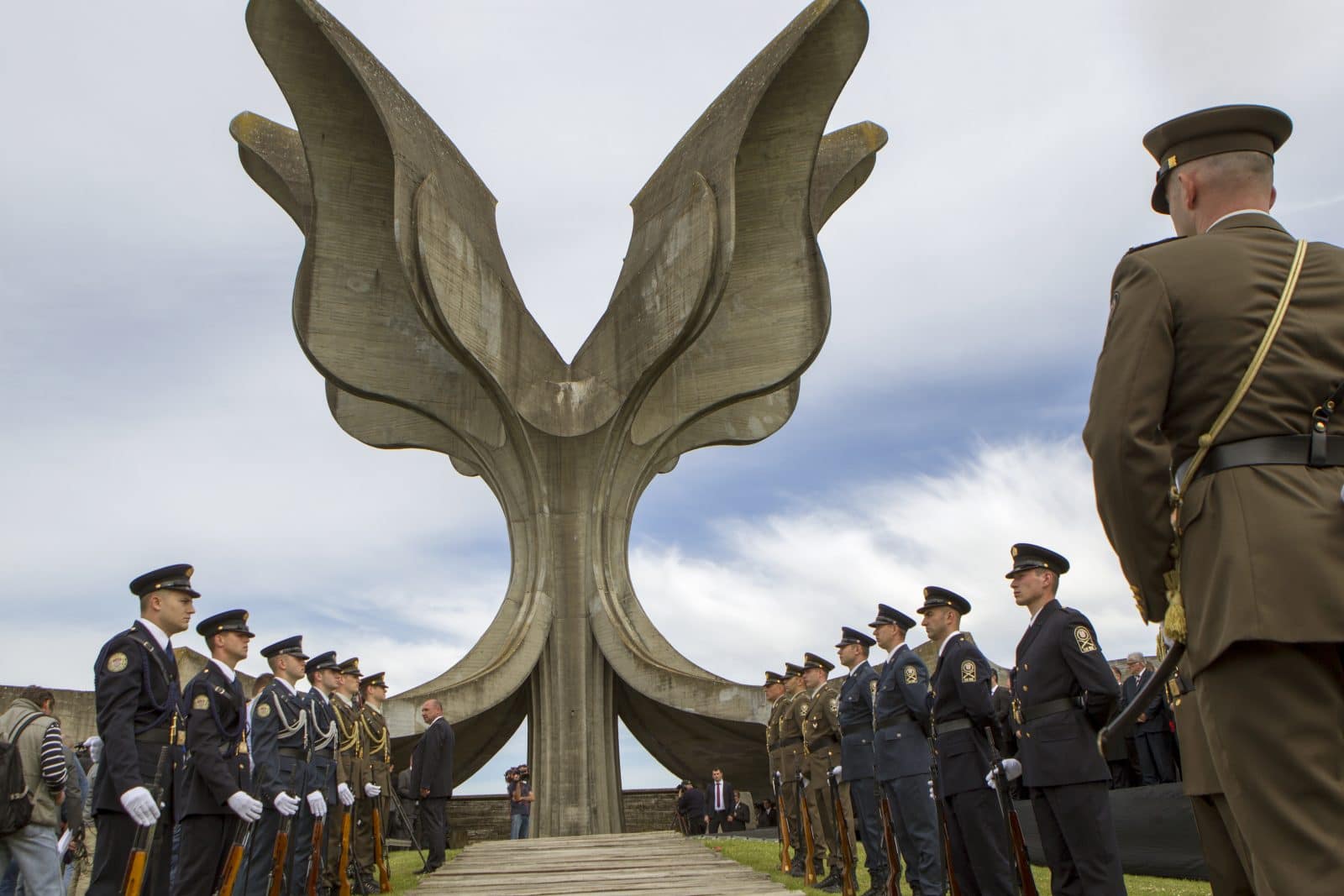
For the fourth year in a row, representatives of Croatia’s Jewish and Serbian communities, as well as anti-fascists, will boycott the official commemoration of the victims of the World War II concentration camp at Jasenovac on April 14.
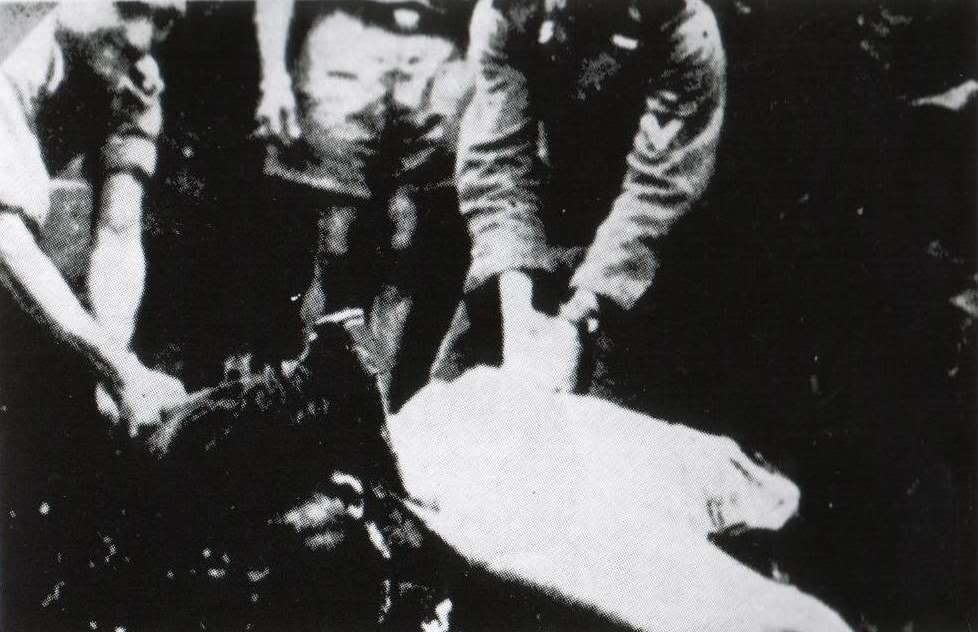
That means there will again be a separate, unofficial and much more well-attended commemoration for more than 83,000 Serbs, Roma, Jews and anti-fascists killed at the camp by the Croatian WWII fascist Ustasa movement, which will be held at the site on April 12.
Representatives of the Roma community, Jasenovac’s second biggest victim group, will again attend both commemorations.
For the fourth year in a row, we have witnessed the government expressing disappointment that the victim groups won’t be present at the official ceremony. Once more, officials have shamelessly expressed sorrow about how Jasenovac is being used to create divisions in society while the government is doing all it can to respect the memory of the dead.
But why did the boycotts start in 2016 – why exactly that year? Did it maybe coincide with the Croatian Democratic Union, HDZ, taking power in Croatia?
Is it maybe because the HDZ government, when it came to power, appointed a culture minister called Zlatko Hasanbegovic who once wrote that the Ustasa were martyrs? Or because Hasanbegovic never came clean about what he said (until weekly news magazine Novosti reported on it)? Or because he never apologised?
Was it maybe the fact that the government tolerated the presence of a plaque with the Ustasa chant ‘Za dom spremni’ (‘Ready for the Home(land)’) engraved on it, within walking distance of the former concentration camp, for nine months? Or because the government had to beg an open admirer of the Ustasa, Marko Skejo, leader of the 1990s veterans of the Croatian Defence Forces, the HOS, to allow the authorities to remove the plaque?
Could one of the reasons for the boycott be that government hid behind an expert council which confirmed that the ‘Za dom spremni’ slogan can be used in commemorations of fallen HOS soldiers? Or is it maybe the funeral for Ustasa soldiers with full military honours near Plitvice lakes in September 2018?
Undoubtedly one of the reasons for the continuing boycott could be the fact that the government gave 6,700 euros to the Society for Research of the Threefold Jasenovac Camp, an NGO that distorts the facts about Jasenovac, claiming, without academic basis, that up to 50 times fewer people died there than the Jasenovac Memorial Site has established.
But it could also be because 2,700 euros was given to the Association of Police Veterans from the 1990s war – who have somehow become WWII experts as well – to unscientifically claim that an Ustasa detention camp for children in the town of Jastrebarsko wasn’t a camp at all.
One of the more recent triggers for keeping up the boycott could be the fact that Andrej Rora, the head of HDZ’s media and communications office, wrote for the same pro-Ustasa bulletin as Hasanbegovic, declaring in 1996 that the struggle for the Ustasa-led Independent State of Croatia, NDH, will continue.
The crocodile tears of Croatian President Kolinda Grabar Kitarovic, a former HDZ member, have also started flowing a few years too late.
Grabar Kitarovic now claims that she would attend the official Jasenovac commemoration if there were no divisions. But what prevented her from attending it in 2015, when she avoided the official commemoration but arrived at the site for a publicly-unannounced personal visit, then publicly posted photos and a message about it?
Certainly, descendants of Jasenovac victims didn’t like the fact that she first said that ‘Za dom spremni’ was “an old Croatian salute” before admitting it was a fascist chant.
This is the problem that the HDZ has been facing from the beginning – trying to have its cake and eat it too. The party has been trying to claim that it is anti-fascist – especially in dealings with Israel – while simultaneously trying to rehabilitate the Ustasa.
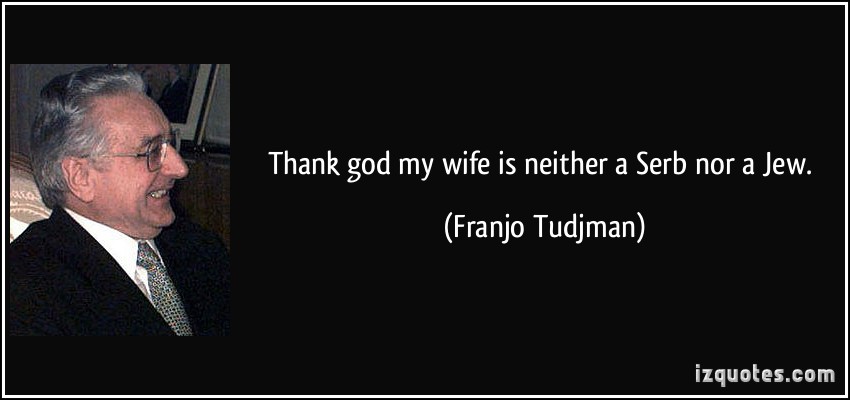
This is precisely what the founder and Croatian President Franjo Tudjman had in mind back in the 1980s, when he started to promote his controversial version of ‘national reconciliation’ between the Ustasa and the Communist Partisans.
On the one hand, Tudjman claimed – citing problematic sources – that Jews ran the camp, and that Jasenovac continued to operate after WWII, under Communist rule, for which there is no valid historical proof.
While trying to combat Serbian nationalist propaganda that inflated Jasenovac’s death toll, he lowered it to 40,000. To achieve his ‘reconciliation’, he proposed burying the remains of both Ustasa and camp victims at Jasenovac, only to back down under heavy international pressure.
On the other hand, Tudjman accused the Croatian Defence Forces of Ustasa sympathies and wrote anti-fascism into the constitution.
The HDZ is going in Tudjman’s direction, no matter how much it denies this reality. What’s worse, it’s not only the HDZ’s attitude that the Jasenovac victims’ descendants should be angry about.
Former Croatian President Stjepan Mesic, who is now honorary president of the League of Anti-fascist Fighters and Anti-Fascists of Croatia, is widely known for downplaying the Jasenovac crimes while he was casually eating and drinking with HDZ members in Novska in 1992. This wasn’t the only time that Mesic made unacceptable comments about the Ustasa, but it was also problematic that he never came clean about the Novska incident before videos popped up in the media.
Meanwhile in 2001, Tonino Picula, who at the time was the Croatian foreign minister from the then-ruling Social Democratic Party, SDP, ventured into dubious territory when he wanted to make the point that Croatia and Serbia shouldn’t dig up the past too much.
Picula said that Croatia could ask “what preceded Jasenovac”, probably trying to suggest that the pre-war Kingdom of Yugoslavia’s repression was responsible for the WWII killings of Serbs – a common trope among the far-right. Just a few months before, while visiting the Yad Vashem Holocaust memorial in Jerusalem, he didn’t make a similar analogy about Jewish victims.
Then in 2016, when SDP president Zoran Milanovic was talking with 1990s war veterans, he said that he personally didn’t care about the ‘Za dom spremni’ chant.
It was also an SDP politician, State Administration Minister Arsen Bauk, who allowed the obscure Society for Research of the Threefold Jasenovac Camp to be registered as an NGO. Bauk and the 2000-2003 SDP government was further responsible for not pressuring HOS veterans’ associations to remove the words ‘Za dom spremni’ from their coat of arms.
The point is that the majority of politicians honestly don’t care – even when they point out Ustasa crimes. Jasenovac is seen as the place where the ethnic ‘Other’ were killed, not ‘Us’, the Croats.
Although a massive proportion of the Serbs, Roma and Jews who were killed at the camp were living in territories that are now part of Croatia, they are still symbolically seen as ‘guests’.
Even when Jasenovac is commemorated by officials, it’s done out of obligation; a concession to ‘them’. This is something that is done to score political points, both domestically and internationally.
Until Jasenovac is commemorated sincerely and in good faith, without tricks or excuses, no one, not least the government and the political elite, should complain that there are multiple commemorations of the victims every year.
Originally published on 2019-04-11
About the author: Sven Milekic is a Ph.D. candidate at Maynooth University, funded by the Irish Research Council under the Government of Ireland Postgraduate Programme.
We would like to ask you to consider a small donation to help our team keep working. We accept no advertising and rely only on you, our readers, to keep us digging the truth on history, global politics and international relations.
PrefaceDue to the current conflict in (East) Ukraine (historically known as Russia Minor), the world is more and more becoming informed about the genocide of the Poles, Jews, and Russians on the territory of West Ukraine during WWII committed by Ukrainian Nazi-nationalists (the Banderists). However, at the same time, in the Balkans, parallelly with the Ukrainian case, the organized (sadistic) genocide of the Jews, Roma, and above all the ethnic Serbs were on agenda but the world audience is still not properly informed about the case – the case occurred in the Nazi-shaped Independent State of Croatia.At the very start, ...
The Serb holocaust during the WWII in the Independent State of Croatia is not a misnomer, an accusation, and even less a speculation. It is an historical fact. Rabid nationalism and religious dogmatism were its two main ingredients. During the existence of Croatia as an independent Catholic State, over 700,000 men, women and children perished. Many were executed, tortured, died of starvation, buried alive, or were burned to death. Hundreds were forced to become Catholic. Catholic padres ran concentration camps; Catholic priests were officers of the military corps which committed such atrocities. 700,000 in a total population of a few ...
The brutal destruction of ex-Yugoslav Federal state-system was in a form of the civil wars or, in another word, a chain of violent conflicts from 1991 to 1995. From the spring of 1992, the SFRY already did not exist as a state and, therefore, the conflicts were turned into the Wars of the Yugoslav Succession.The Yugoslav civil wars can be comprised of the three closely related armed conflicts:1) War in Slovenia in 1991.2) War in Croatia from 1991 to 1995.3) War in Bosnia-Herzegovina from 1992 to 1995.[i]In the year of 1990, the real potential for the armed conflict became quite ...
I travel frequently to the countries which once made up the now defunct Socialist Federal Republic of Yugoslavia, satisfying a passion of mine that stems back to my childhood days. For me, the Balkans’ history, its people and its cultures are both enigmatic and magnetic, as they have been, too, for countless others, of many nationalities, over centuries gone by. Accounting for the enchantment of the Balkans, its captivating allure, is a challenge to put into writing. Because no words can truly embellish what is one of the most absorbing parts of the world. To understand and feel what it is ...
TRANSCRIPT:Harold Channer (HC): Good evening and welcome very, very much to the conversation. We’re pleased to welcome to the program, Sean Gervasi. He is a professor and academic who is concerned with economics and particularly with what is relevant to what we want to talk about tonight. He has just returned from a long stay in Belgrade, Yugoslavia, and knows something of that situation. Sean Gervasi, welcome very, very much to the conversation, and back to New York. Before we go into some detail about what in the world is going on in terms of the Balkans, from your experience ...
There are horrific realities of history that must not be questioned, distorted or denied by anyone with even the slightest integrity or sense of decency.The slaughter of millions of Jews in the death camps of Auschwitz-Birkenau, Treblinka, Majdanek, Belzec, Chelmno and Sobibor during the Holocaust of World War II falls squarely in this category.So does the fundamental fact that this ultimate crime against humanity was perpetrated by Nazi Germany and its multinational fascist accomplices.Any attempt to deny or to attempt to trivialise or minimise the enormity of this genocide, or to rehabilitate its perpetrators in any way whatsoever, is, simply ...
Origins of images: Facebook, Twitter, Wikimedia, Wikipedia, Flickr, Google, Imageinjection & Pinterest.Read our Disclaimer/Legal Statement!Donate to Support UsWe would like to ask you to consider a small donation to help our team keep working. We accept no advertising and rely only on you, our readers, to keep us digging the truth on history, global politics, and international relations.
While this excellent analysis by Srdja Trifkovic focuses on the “internal” history of Croatia, it is important to note that four days after Nazi Germany declared war on the United States, Hitler’s staunch ally the Independent State of Croatia (NDH) declared war on both the United Kingdom and on the United States on December 14, 1941. What makes this especially significant is that less than three years later, on April 16, 1944, which was Easter Sunday for the Serbian Orthodox, the Anglo-American forces bombed Belgrade, the capital of their loyal and devoted ally Serbia, even though there was no strategic ...
Chris Deliso of Balkanalysis points out the latest travesty of the Western media: 59,000 stories on Auschwitz, three on Jasenovac. As if the third-largest death camp in Nazi-occupied Europe simply never existed. Franjo Tudjman certainly thought so, and it appears the current Croatian leadership shares his "historical" perspective.Contemporary German estimates of Serbs murdered by the Ustasha (in Jasenovac and elsewhere) ranged as high as 750,000. Wiesenthal center uses the number of 600,000. Serbian researchers have spoken of up to 700,000 victims. Modern revisionists, Croat and otherwise, talk of 30-100,000, at most. Among them is the U.S. Holocaust Memorial Museum, which ...
Split, Croatia, September 14th, 2018: "Kill Serb" written on the car with the plates from SerbiaThe mugshots show Ivo Goldstein, a Jewish librarian and book dealer, looking bright-eyed and calm — even after nine days of confinement in a Croatian police cell. One of the prints bears the number 28888 and a date: April 21, 1941.Seventy-six years after they were taken by a police photographer, the photos hang as a triptych on the bedroom wall of Goldstein’s son, Daniel, in a drab apartment block in Zagreb’s Zaprudje neighborhood.Daniel, 85, is a historian and human rights activist. He was nine when ...
A great explanation from an excellent analyst of what happened in Serbia 20 years ago, and why the Ukraine feels like Deja Vu‘Operation Storm’ in August 1995, when Croatia overran the Serb-inhabited territory of Krajina, was the biggest single instance of ethnic cleansing in the Yugoslav Wars, Because the attack was backed by the US, however, it was never treated as a crime.Between August 4 and August 7, up to 2,000 people were killed and over 220,000 driven from their homes by the Croatian army. No “invaders,” these Serbs had lived in the Krajina – their word for borderlands – for centuries. The ...
In examining the future, we must look to the past.As we watch the media today, we are spoon fed more and more propaganda and fear of the unknown, that we should be afraid of the unknown and have full faith that our government is keeping us safe from the unknown. But by looking at media today, those of us who are old enough will be reminded of the era of Cold War news articles, hysteria of how the Russians would invade and how we should duck and cover under tables in our kitchens for the ensuing nuclear war.Under this mass ...
The Axis powers invaded Yugoslavia on 6 April 1941. Vladko Maček, the leader of the Croatian Peasant Party (HSS) which was the most influential party in Croatia at the time, rejected offers by the Nazi Germany to lead the new government. On 10 April the most senior home-based Ustaša, Slavko Kvaternik, took control of the police in Zagreb and in a radio broadcast that day proclaimed the formation of the Independent State of Croatia (Nezavisna Država Hrvatska, NDH). The new Independent State of Croatia" was established as a pro-Nazi government. It was dedicated to a clerical-fascist ideology influenced both by ...
It was in 2015 hundred years anniversary of secret treaty signed between three Entente members of the U.K., France and the Russian Empire on the one hand, and Italy on the other, in London on April 26th, 1915 nine months after the break up the Great War of 1914−1918.[1]In a political-military effort to involve Italy in the war on their own side against the Central Powers members of Germany and Austria-Hungary within a month, these three Entente block members confirmed the Italian possession of the ex-Ottoman province of Libya (acquired by Italy in 1912) and the Dodecanese islands in the ...
In early 1944, Mirjana Babunovic-Dimitrijevic, a 22-year-old middle-class woman living in Sarajevo, was arrested by the Ustasa police. After she was arrested along with her mother and aunt, they were all deported to the Jasenovac concentration camp, for refusing to convert to Catholicism. All three women died there in late 1944.These women were among more than 80,000 victims who perished at Jasenovac between 1941 and 1945. While we don’t know precisely how they died nor what happened during their short lives in the camp, two things are certain.First, their deaths were the direct result of deliberate political decisions. Second, they ...
On November 21st, 2015 it was the 20th anniversary of the 1995 Dayton Peace Accord – a treaty signed by four Presidents (the USA, Croatia, Serbia and Bosnia-Herzegovina) that led to an end of the civil war in Bosnia-Herzegovina. As a result of the Dayton Peace Accord a new “independent and internationally recognized state” emerged: Bosnia-Herzegovina as a confederation of two political entities (the Republic of Srpska and the Muslim-Croat Federation) but ethnically strictly divided into three segments composed by the Serb, Croat and Muslim (today Boshnjak) controlled territories. In contrast to the Republic of Srpska (49% of the territory ...
Abstract: This paper sets out to examine and clarify the historical development of the ideological concept of Pan-Slavism, which was created by the writers of Dalmatia and Croatia at the time of the late Renaissance and early Baroque (from the end of the 15th century to the very beginning of the 18th century). The literary works of that time by many of Dalmatia’s and Croatia’s writers deal with the ethnolinguistic aspect of Pan-Slavic unity, solidarity, kinship and reciprocity. Their writings established an ideological framework for making both Pan-Slavic common national identity and program of the united single national state of ...
Of the 22 Nazi concentration camps operating in the clerical fascist state of Croatia during World War II, nearly half were under the command of Roman Catholic priests.They were responsible for the grisly slaughter of hundreds of thousands of men, women and children. Serbs, Roma, and Jews were specifically targeted for extermination.Catholic clergy was especially keen to eradicate the Serbian Orthodox Church. This led to the murder of Christian Serbian Priests, forced conversions of Serbian Christians, and the destruction of 450 Christian Orthodox Churches during World War II.“Kill all Serbs. And when you finish come here, to the Church, and ...
Zagreb, 1941Become familiar with the basic info about one of the most beautiful countries in the world - Croatia. Photos, data & recommendations where to stay in order to enjoy this Adriatic pearl. If you are not the Serb.Split, Dalmatia, Croatia, 2019: "Kill the Serb" on the car with the plates from SerbiaOrigins of images: Facebook, Twitter, Wikimedia, Wikipedia, Flickr, Google, Imageinjection, Public Domain & Pinterest.Read our Disclaimer/Legal Statement!Donate to Support UsWe would like to ask you to consider a small donation to help our team keep working. We accept no advertising and rely only on you, our readers, to ...
Back in February, we warned about the prospect of Israel selling F-16s to Croatia, a state in which WWII revisionism and Holocaust denial are running rampant, and memories of the Nazi puppet Independent State of Croatia are routinely glorified. In the meantime, that has become a done deal. But there is more. Not only will Israel sell half a billion dollars worth of fighter jets to Croatia, but on August 5, three Israeli F-16s, crewed by Israeli pilots, took part in a parade to celebrate the 23rd anniversary of the “Operation Storm,” in which more than 2,300 Serbs were killed, including more than 1,200 civilians, among which more ...