

Views: 3406

“Workers of my country, I have faith in Chile and its destiny.
Other men will overcome this dark and bitter moment when treason seeks to prevail.
Keep in mind that, much sooner than later, the great avenues will again be opened through which will pass free men to construct a better society.
Long live Chile!
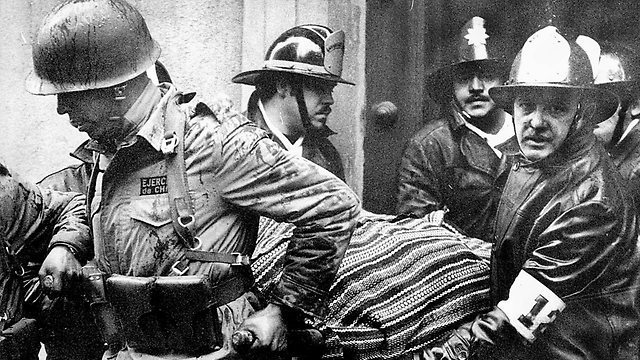
Long live the people! Long live the workers!” President Salvador Allende’s farewell speech, 11 September 1973.
“It’s hard to find someone with the fighting spirit, courage and the story of Allende. He was a man who actually had the branded name in history: democratically the left came to power, and by bombs he was removed from government.” Senador Pedro Simon
Chile: “Shock Treatment” and the Mechanisms of Economic Repression
Immediately following Allende’s election in September 1970 and prior to his inauguration in November 1970:
“Kissinger initiated discussion on the telephone with CIA director Richard Helm’s about a preemptive coup in Chile. “We will not let Chile go down the drain,” Kissinger declared. “I am with you,” Helms responded. Their conversation took place three days before President Nixon, in a 15-minute meeting that included Kissinger, ordered the CIA to “make the economy scream,” and named Kissinger as the supervisor of the covert efforts to keep Allende from being inaugurated. (National Security Archive)
The CIA was the lead organization behind the imposition of a neoliberal economic agenda in Chile. In August 1972, a year prior to the coup, the CIA funded a 300-page economic blueprint to be implemented in the wake of the overthrow of the Allende government.
The ultimate objective of the September 11, 1973 military coup in Chile was the imposition of the neoliberal agenda (aka deadly “economic medicine”) leading to the impoverishment of an entire nation.
Wall Street was behind the coup, working hand in glove with the CIA, the US State Department and Chile’s economic elites. Henry Kissinger was the Go-Between.
After Allende’s election in November Wall Street’s major commercial banks (including Chase Manhattan, Chemical, First National City, Manufacturers Hanover, and Morgan Guaranty), cancelled credits to Chile. In turn, in 1972, Kennecott Corporation “tied up Chilean copper exports with lawsuits in France, Sweden, Italy, and Germany”. (See John M. Swomley, Jr. “The Political Power of Multinational Corporations,” Christian Century, 91 (25 September 1974), p. 881.
“Regime change” was enforced through a covert CIA military intelligence operation, which laid the groundwork for the military takeover, the assassination of president Allende as well as the macro-economic reforms to be adopted in the wake of the military coup.

At the time of the September 11, 1973 military coup, I was Visiting Professor of Economics at the Catholic University of Chile. In the hours following the bombing of the Presidential Palace of La Moneda, the new military rulers imposed a 72-hour curfew.
When the university reopened several days later, I started patching together the history of the coup from written notes. I had lived through the September 11, 1973 coup as well as the failed June 29th coup. Several of my students at the Universidad Catolica had been arrested by the military Junta.
Chicago Economics, Chilean Style
Sweeping macro-economic reforms (including privatization, price liberalization and the freeze of wages) were implemented in early October 1973.
Barely a few weeks after the military takeover, the military Junta headed by General Augusto Pinochet ordered a hike in the price of bread from 11 to 40 escudos, a hefty overnight increase of 264%. This “economic shock treatment” had been designed by a group of economists called the “Chicago Boys,” many of whom were my colleagues at the Institute of Economics of the Catholic University.
These deadly macro-economic reforms were largely dictated by Wall Street in liaison with the CIA, with “Chicago Economics” providing an ideological “free market” paradigm and justification. Professors Milton Friedman and Arnold Harberger of Chicago University were by no means the driving force behind these reforms.
While food prices had skyrocketed, wages had been frozen to ensure “economic stability and stave off inflationary pressures.” From one day to the next, an entire country had been precipitated into abysmal poverty; in less than a year the price of bread in Chile increased thirty-six fold (3700%). Eighty-five percent of the Chilean population had been driven below the poverty line.
In November 1973, following the dramatic hikes in the price of food, I drafted in Spanish an initial “technical” assessment of the Junta’s deadly macro-economic reforms.
Together with a medical doctor, colleague and lifelong friend who was teaching at the Faculty of Medicine of the University of Chile, I estimated the impacts of the economic reforms on the levels of undernourishment, which had resulted from the collapse of the standard of living.
In the wake of the military coup and following the engineered hike in food prices, I estimated that approximately 85% of the Chilean population did not meet minimum calorie and protein requirements as defined by the World Health Organization (WHO).
In October 1973, the “official” food price index had increased by 82.3 percent (in relation to September), according to the Instituto Nacional de Estadistica, which had been taken over by the Junta.
The INE figures on the price of food commodities, however, had been falsified. In November, I proceeded to collect and tabulate the actual rate of increase in food prices from directly observed prices in the Santiago Metropolitan area. I discovered a substantial discrepancy in relation to the official statistics.
Food prices had increased by 211.1 percent in October and November 1973 in relation to September, according to my estimates of 31 food categories. (The official November figures pointed to an increase of 88.6 percent in relation to September). And thereafter, it was on the basis of these official (fake) statistics that the movement in real purchasing power was estimated and official wage adjustments were implemented.
Fearing censorship by the Junta led by General Augusto Pinochet, I limited my analysis to the collapse of living standards in the wake of the Junta’s reforms, resulting from the price hikes of food and fuel, focussing on statistical estimates, without making any kind of political analysis.
The Economics Institute of the Catholic University was initially reluctant to publish the report. They sent it to the Military Junta prior to its release.
The opinions expressed in this report are those of the author. Therefore, they are of the author’s responsibility and do not compromise the Institute of Economics
(This was first time that the Institute chose to publish a disclaimer)
I left Chile for Peru in December 1973. The report was released as a working paper (200 copies) by the Catholic University a few days before my departure. In Peru, where I joined the Economics Department of the Catholic University of Peru, I was able to write up a more detailed study of the Junta’s neoliberal reforms and their ideological underpinnings. This study was published in 1974-75 in English and Spanish.
Economic Repression
By March 1974, food prices in Chile (according to my estimates) had increased by 505.5 percent (since September 1973). Real wages had collapsed.
Chile: The movement of real wages (1970-77) based on official statistics
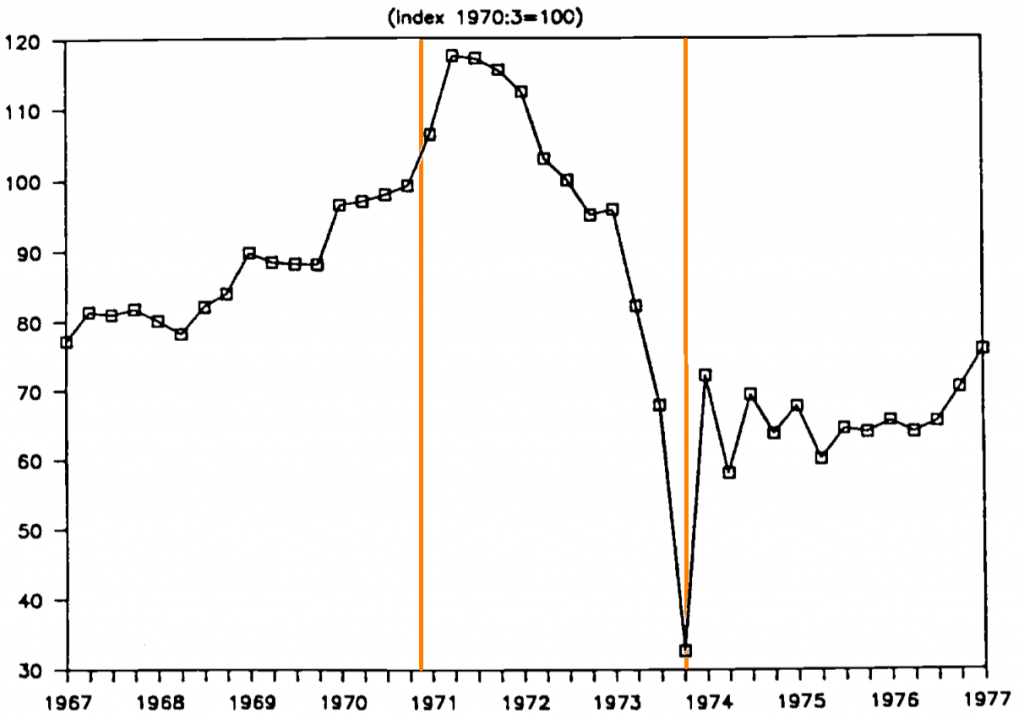
Source: Rudiger Dornbusch, Sebastian Edwards. Macroeconomic Populism in Latin America http://www.nber.org/papers/w2986 (p20)
The above graph (based on official statistics) shows that real wages collapsed by close to 70 percent in relation to the base period (1970), which also corresponds to the beginning of the Unidad Popular (UP) government of Salvador Allende. The collapse in real wages was greater than that indicated by the official statistics.
It is worth noting that in 1971, the Allende government increased real wages by 20%. The collapse from its 1971 level to early 1974 was of the order of 75% based on official statistics of the cost of living. A wage increase was implemented by the Junta in early March of 1974 (see graph above).
The Destruction of Economic Life
The events of September 11 1973 marked me profoundly in my work as an economist. Through the tampering of prices, wages and interest rates, people’s lives had been destroyed; an entire national economy had been destabilized. Macro-economic reform was neither “neutral” –as claimed by the academic mainstream– nor separate from the broader process of social and political transformation.
I also started to understand the role of military-intelligence operations in support of what is usually described as a process of “economic restructuring”. In my earlier writings on the Chilean military Junta, I looked upon so-called “free market” reforms as well-organized instruments of “economic repression.”
Macro-Economics and Geopolitics are intertwined. The economic dimensions of US led wars must be understood. The destruction of economic life in Afghanistan, Iraq, Syria and Libya constitutes a crime against humanity, i.e. an “Economic Genocide” which consists in destabilizing and deliberately sabotaging a national economy.
- Today, wars are being fought in the Middle East. Several Latin American countries are the object of US dirty tricks with a view to implementing regime change.
- Poverty is engineered by the IMF’s debt conditionalities.
- The prices of food and energy are deliberately manipulated through speculative trade, e.g. on the Chicago and New York mercantile exchanges.
- Currency devaluations are engineered through speculative operations on the foreign exchange markets.
While the contemporary mechanisms of intervention (“color revolutions”, “war on terrorism”, economic destabilization, sanctions, etc) are different to those of the 1970s, the ultimate objective is the derogation of national sovereignty and the imposition of neoliberalism:
- corporate control, privatization,
- the “free market” pillage of natural resources,
- deadly economic medicine, austerity measures,
- the repeal of social programs,
- the deregulation of trade
- the collapse of wages,
- the instatement of a cheap labor economy,
- the transformation of countries into territories.
I recall that in the months leading up to the September 1973 coup in Chile, the distribution of basic consumer goods and food had been deliberately disrupted through market manipulation. No bread, no milk, no sugar were available at government regulated prices. Chile’s escudo was worthless. The black market prevailed.
A similar situation is now unfolding in Venezuela where the national currency has collapsed. Black market prices for food and essential commodities have spiralled. Reminiscent of Chile in 1973, foreign exchange (Forex) market manipulation in Venezuela coupled with sabotage triggers food shortages, poverty and political instability. Concurrent with the engineered collapse of the Bolivar, real purchasing power has plummeted. (see below)
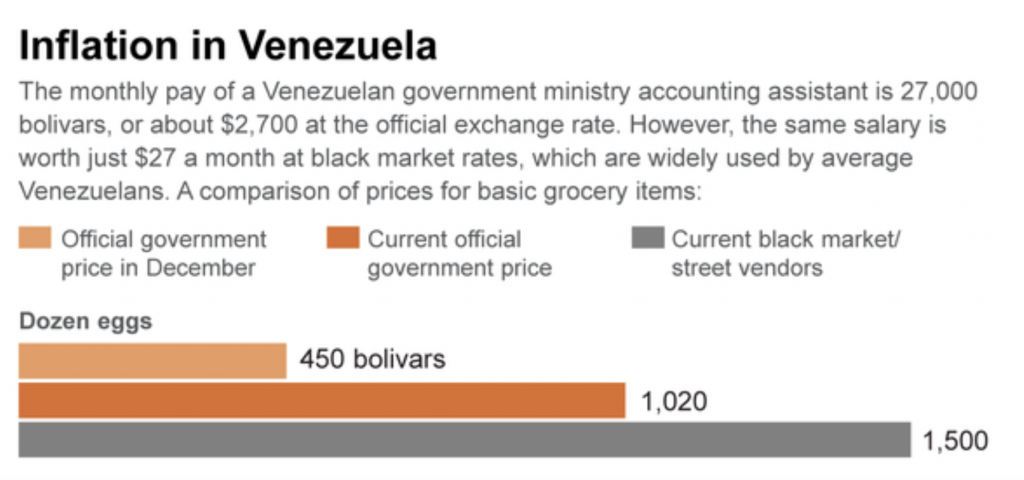 Source: Los Angeles Times, May 31, 2016
Originally published on 2016-09-17
Author: Michel Chossudovsky
Sources:
Michel Chossudovsky, La medicion del ingreso minimo de subsistencia y la politica de ingresos para 1974, Documentos de Trabajo no. 18, Noviembre de 1973.
Michel Chossudovsky, The Neo-liberal Model and the Mechanisms of Economic Repression, The Chilean Case, Research Paper No. 7411, Department of Economics, University of Ottawa, 1974, published in Co-Existence, Vol 12, 1975
Michel Chossudovsky, Hacia el nuevo modelo economico chileno : inflación y redistribución del ingreso, El trimestre económico. Mexico, Vol. 42. 1975, 2, p. 311-347.
Origins of images: Facebook, Twitter, Wikimedia, Wikipedia, Flickr, Google, Imageinjection, Public Domain & Pinterest.
Read our Disclaimer/Legal Statement!
Donate to Support Us
We would like to ask you to consider a small donation to help our team keep working. We accept no advertising and rely only on you, our readers, to keep us digging the truth on history, global politics and international relations.
[wpedon id=”4696″ align=”left”]