
What We Still haven’t Learned from the Vietnam War
Fifty years ago today, in 1967, nearly 100,000 Americans marched on Washington, DC, to protest the Vietnam War. In those days there was a mandatory draft in place, and the risk was very real that a young man just out of high school could quickly wind up 13,000 miles away, fighting an unseen enemy in jungles that didn’t need tanks or B-52 bombers to inflict fear [...]
Fifty years ago today, in 1967, nearly 100,000 Americans marched on Washington, DC, to protest the Vietnam War. In those days there was a mandatory draft in place, and the risk was very real that a young man just out of high school could quickly wind up 13,000 miles away, fighting an unseen enemy in jungles that didn’t need tanks or B-52 bombers to inflict fear. Worse yet was the possibility of going MIA or coming home in a body bag — just another expendable statistic in the great fight against communism. But even many of those who made it back left part of their souls in that war zone.
Today there is no longer a mandatory draft. And neither is there any anti-war movement to speak of.
If you ask young people today why the United States joined the fight in WWII, many could probably tell you that we were bombed by the Japanese at Pearl Harbor. Or perhaps they would say we had to fight Hitler and the Nazis. But what about Vietnam? Why did we go to war there? What were we fighting for? How did we become involved in that conflict? My guess is that most couldn’t tell you — just as it became unclear to that generation in 1967, who were fighting and dying.
This contrast between clarity and ambiguity is reflected in popular cinema — take WWII films like Saving Private Ryan, Band of Brothers, Pearl Harbor, and Sands ofIwo Jima thatreflect the essential righteousness of the American cause. Yet classic Vietnam War films like Apocalypse Now, Full Metal Jacket, Platoon, and Hamburger Hill reflect the uncertainty, misery, barbarity, and psychosis of the GI experience.
But this split perception took time. The truth is that the US had been in Vietnam since the mid-1950s. Since the turn of the century, America had been slowly developing into an imperial power to rival the British and the French. WWII had solidified it as the inheritor of the British Empire — the only imperial power left standing.
The whole of Vietnam had been a colony of the French since the 1890s, but after WWII an uprising occurred, led by Ho Chi Minh — inspired by Marxist-Leninism and a nationalist fervor to regain control of their own country. By 1954 the French were out, and two Vietnams, north and south, formed in an uneasy proximity.
The US inherited the imperial project from the French — gradually sending in military “advisers” to the south. President John F. Kennedy had continued that project by backing the south Vietnamese government with military assistance and equipment. The stated reason for this intervention was to prevent the spread of communism throughout southeast Asia — the infamous “domino theory.”
But by 1963, Kennedy had come to see the futility of this endeavor. He gave orders to begin withdrawing troops, and planned to have all military personnel out of Vietnam by the end of 1965.
But on November 22, 1963 President Kennedy was assassinated, and President Lyndon B. Johnson took the helm. He immediately reversed Kennedy’s orders. The Gulf of Tonkin incident in August 1964, in which a group of North Vietnamese torpedo boats allegedly fired on a US Navy ship (it turned out to be false — and the administration knew it), gave Congress the incentive to give Johnson the authority he needed to dramatically escalate troop deployment and to begin a new bombing campaign.
By 1968, over 500,000 American soldiers were stationed in Vietnam.
In the mid-60s, young people began questioning why their friends and family members were being sent thousands of miles away to fight in another country they’d never heard of before. The rock n’ roll revolution was in full swing, and the hippie movement, dope, and acid were fueling a counterculture movement that questioned the establishment and their rules of conformity — instead pushing the mantra “make love, not war.”
Not only was Johnson feeling the heat from student protesters, but even Wall Street and Big Finance were beginning to express doubts about the feasibility of winning the war. The debt was piling up and America was at that point still under the Bretton-Woods gold standard.
In March of 1968, less than a year after the protest march on D.C., Johnson announced he would not seek reelection.
Senator Robert Kennedy, brother of JFK, had thrown his hat in the race, running as a peace candidate who would bring the troops home from Vietnam. He was assassinated several months after Martin Luther King, Jr. The Republican candidate Richard Nixon won the election, and the war continued another seven years, taking us off the gold standard in the process. It ended in US defeat in 1975, shortly after Nixon resigned from office in shame after the Watergate scandal.
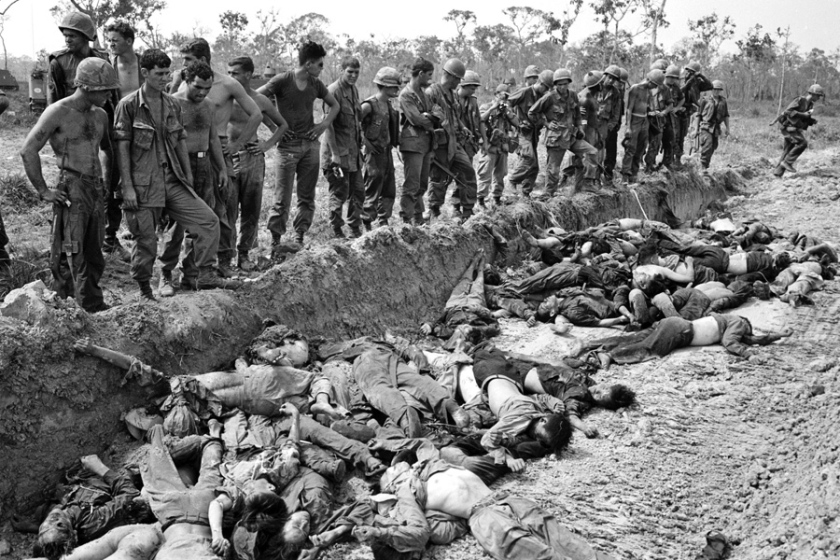
By the war’s end the US had lost 58,000 troops — the Vietnamese somewhere between one and three million.
So why was America in the Vietnam War for so long? What was it really about?
We might as well ask why we have been in Afghanistan for 16 years with no end in sight. Or why did we invade Iraq? Why did we overthrow Libya? Why are we involved in a civil war in Syria? Why are we backing a genocidal war in Yemen? Why did we invade Grenada? Why did we conduct covert warfare in a dozen different Central and South American countries over the past 60 years? Why are we still in Korea 70 years after the fact, now on the verge of a renewed conflict? Why have we come to the very threshold of nuclear annihilation more than once?
What happened to the citizens, community leaders, institutions, and politicians that we would allow this endless warfare to continue? And where is the anti-war movement? Why are they MIA?
These questions are all related. Perhaps if we were to solve the riddle of Vietnam, we would solve these other questions as well. Perhaps those 100,000 students and protesters 50 years ago solved it — and decided to do something about it. Maybe we can too.
We would like to ask you to consider a small donation to help our team keep working. We accept no advertising and rely only on you, our readers, to keep us digging the truth on history, global politics and international relations.
INTRODUCTIONThe case that will be documented here is that Venezuela’s people are suffering from a tragic national situation which actually cannot be reversed by anything that’s within the power of Venezuela’s Government to do or to block. In order to understand this very unfortunate reality (if one wants to understand it), one must first understand the relevant parts of the broader situation in the world that affects Venezuela. What’s dooming the country isn’t merely a local situation, but instead is global and environmental. It also is economic, pertaining to the role that Venezuela is playing in the global economy. But ...
In December last year [2015], NATO officially invited Montenegro to become the 29th member state of the most powerful military organisation of our times, if not, in fact, of all time. The country’s Prime Minister, Milo Đukanović, assured the NATO secretary-general that “you can count on us at any time.” It is always nice to hear that someone has your back. But in Montenegro’s case, it means that they have our back with an entire active-duty military force of only two thousand personnel. It is not quite clear how the tiny nation of less than 700,000 people enhances U.S. security ...
“Now that the global circumstances have changed, and when the United States and NATO are losing their influence, and while the powers that are in favor of preserving Kosovo and Metohija – such as Russia and China – are strengthening, we are nevertheless pursuing a policy of complete surrender.”The aim of the internal dialogue conducted by the Serbian President Aleksandar Vucic, should be to distribute responsibilities and to be the cover for the final surrender of Kosovo and Metohija.The government constantly assures us that it will never recognize Kosovo as an independent State, but here we must point out the ...
Watching the Ken Burns-Lynn Novick 18-hour series, “The Vietnam War,” is an emotional experience. Whether you served in the US military during the war or marched in the streets to end it, you cannot remain untouched by this documentary. The battle scenes are powerful, the stories of US veterans and Vietnamese soldiers who fought on both sides of the war compelling.The toll in human terms caused by the war is staggering. Nearly 58,000 Americans and 2 to 3 million Vietnamese, many of them civilians, were killed in the war. Untold numbers were wounded. Many US veterans of the war suffer ...
The facts do not support the mythology. The United States government did not need to make Japan a junior partner in imperialism, did not need to fuel an arms race, did not need to support Nazism and fascism (as some of the biggest U.S. corporations did right through the war), did not need to provoke Japan, did not need to join the war in Asia or Europe, and was not surprised by the attack on Pearl Harbor. For support of each of these statements, keep reading.This week I’m testifying at an Iraq Tribunal about the Downing Street Minutes. In U.S. thinking the ...
Louis XVI needed a revolution, Napoleon needed two historic military defeats, the Spanish Empire in the New World needed multiple revolutions, the Russian Czar needed a communist revolution, the Austro-Hungarian and Ottoman Empires needed World War I, Nazi Germany needed World War II, Imperial Japan needed two atomic bombs, the Portuguese Empire in Africa needed a military coup at home, the Soviet Empire needed Mikhail Gorbachev … What will the American Empire need?I don’t believe anyone will consciously launch World War III. The situation now is more like the eve of World War I, when great powers were armed and ...
Origins of images: Facebook, Twitter, Wikimedia, Wikipedia, Flickr, Google, Imageinjection & Pinterest.Read our Disclaimer/Legal Statement!Donate to Support UsWe would like to ask you to consider a small donation to help our team keep working. We accept no advertising and rely only on you, our readers, to keep us digging the truth on history, global politics and international relations.
To gauge the transformation in the response by the U.S. military, the mainstream media and the public to a U.S. war crime, one need only compare the reactions to two of the most heinous American crimes: the 1968 My Lai massacre in Vietnam and the gunning down of innocent Iraqis on a Baghdad street in 2007.The latter was captured on a cockpit video from attacking Apache helicopters and revealed in a video released by WikiLeaks ten years ago today. Wikileaks obtained the video from a conscientious U.S. Army intelligence analyst, Chelsea Manning. The My Lai incident was revealed to the public ...
The wicked social control experiment using virus as the pretext for further enslavement is performing magnificently by implanting a sense of helplessness, dependence, and blind conformism. It should be noted that the favorable atmosphere enabling Them (whoever they are) to accomplish just that was contrived by the controlled and unscrupulous media in under a month of intense, coordinated, global brainwashing. Praise is in order, not for the obviously immoral master plan but for the technical excellence of its execution. In the subservient Balkans, local quislings have expectedly introduced a practically region-wide state of emergency, giving that ignoble set of local ...
This Remembrance Day will doubtless see strenuous efforts by some to justify the fruitless bloodbath that was the First World War. Revisionist commentators have long attempted to rehabilitate the conflict as necessary and just, but the arguments do not stand up. It does no service to the memory of the dead to allow any illusions in the justice or necessity of war, particularly so when the precedents will be used to argue for the next ‘necessary’ conflict. From the causes of the war, to its prosecution and its results, here are the counter-arguments to ten common pro-war ploys.1. The war ...
On August 9 [2020], presidential elections were held in Belarus with five candidates bidding to be head of state. According to the Central Election Commission, the incumbent president, Alexander Lukashenko, won in the first round with over 80% of the votes. Mass protests began in Belarus right after the announcement of the preliminary election results. People went to the streets, expressing their dissatisfaction with the results of the elections that they believe were unfair. Mass protests turned into riots and there were clashes between rioters and the police. Many people were detained and injured, and two protestors died.Representatives of the ...
The American taxpayers have been fleeced for almost seventy years by a so-called «intelligence» agency that has systematically violated the US Constitution, broken practically every federal law on the books, and penetrated virtually every facet of American life. The Central Intelligence Agency’s creation was bemoaned by its creator, President Harry S Truman, who, in a fit of personal angst following the 1963 assassination of President John F Kennedy, wrote in a newspaper column,“I never had any thought that when I set up the CIA that it would be injected into peacetime cloak and dagger operations… I, therefore, would like to see the ...
Most veteran observers, including Israeli security authorities and Palestinian leadership, were dumbfounded by recent events in Jerusalem, where tens of thousands of Palestinians mobilized non-violently in response to the Israeli closure of the Old City and placement of metal detectors at the entrance of the Dome of Rock and Al-Aqsa Mosque. What was the secret ingredient that made such a mass action take place and be a successful example in Palestinian non-violent resistance to the 50 years of Israeli military occupation? How did it happen so spontaneously, non-violently and with seemingly no leadership?A new report by the group, titled, Relations Between Palestinians Across ...
The following text by Michel Chossudovsky was presented in Seoul, South Korea in the context of the Korea Armistice Day Commemoration, 27 July 2013A Message for Peace. Towards a Peace Agreement and the Withdrawal of US Troops from KoreaIntroductionArmistice Day, 27 July 1953 is day of Remembrance for the People of Korea.It is a landmark date in the historical struggle for national reunification and sovereignty.I am privileged to have this opportunity of participating in the 60th anniversary commemoration of Armistice Day on July 27, 2013. I am much indebted to the “Anti-War, Peace Actualized, People Action” movement for this opportunity ...
One of the most ingenious propaganda weapons ever developed is that the powerful nations of the West—led by the United States—have a moral responsibility to use military force to protect the rights of people being repressed by their governments. This “responsibility to protect” (R2P) always had a dubious legal standing, but its moral justification also required a psychological and historical disengagement from the bloody reality of the 500-hundred-year history of U.S. and European colonialism, slavery, genocide and torture that created the “West.”This violent, lawless Pan-European colonial/capitalist project continues today under the hegemony of the U.S. empire. This then begs the ...
What constitutes water can be scientifically proven beyond any doubt, now what constitutes a nation-state is a far more organic question than it would seem. Each of us is very used to seeing maps with the same countries and lines on it throughout the years and take their existence as a given. But depending on where a map comes from its borders may actually look very different. One of these countries to some and non-countries to others is Kosovo which gradually continues to lose the support of the states that recognized it into existence. Furthermore, this sheds light on how ...
The Military-Industrial Complex runs U.S. foreign policies. What passes for international 'news' reporting in the United States media was supremely represented by the instance of those 'news' media stenographically reporting the Government's lies about 'Saddam's WMD', even after it was unarguably clear that those were just blatant lies from the President and his Administration. America's media were merely passive megaphones for the regime's lies. Instead of disproving the regime's lies — as they could have done if they were journalistic, instead of propagandistic, media — they merely reported the lying government's assertions. It was like 1984 "Big Brother"; and it ...
On Friday, October 5th, the U.S. Secretary of State – John Kerry calls for war crimes investigation of Russia’s and Assad governments for the destruction of the Syrian city of Aleppo. The western corporate mass media was a very quick, like, for instance, The New York Times, immediately and clearly to accuse the Russian President Vladimir Putin and the Syrian President Bashar al-Assad of alleged war crimes in Syria – the same cliché used by the same propaganda machinery against the Serbs (Srebrenica case from 1995 or Kosovo War from 1999) during the bloody destruction of ex-Yugoslavia (by the U.S. ...
The recent declassification of over 3800 documents by the Central Intelligence Agency provides detailed proof that since 1953 the CIA operated two major programs intent on not only destabilizing Ukraine but Nazifying it with followers of the World War II Ukrainian Nazi leader Stepan Bandera.The CIA programs spanned some four decades. Starting as a paramilitary operation that provided funding and equipment for such anti-Soviet Ukrainian resistance groups as the Ukrainian Supreme Liberation Council (UHVR); its affiliates, the Organization of Ukrainian Nationalists (OUN) and Ukrainian Insurgent Army (UPA), all Nazi Banderists. The CIA also provided support to a relatively anti-Bandera faction ...
Recommended alternative reading list on the Yugoslav studies not used by mainstream corporative Western mass-media and top Western universities dealing with global security, world politics and international relations. Reading proposed readers below you can complete picture on the Yugoslav studies out of the official Western approach.March Pogrom 2004 Book and Photo EvidenceKOSOVSKA GOLGOTA Intervju 198820 Principal Misconceptions on Kosovo IssueThe Srebrenica Massacre Evidence Context Politics Edward S Herman Phillip CorwinLista Diane Budisavljevic 1941 Do 1945 by Владислав Б. Сотировић/Vladislav B. SotirovićJosip Broz Tito Bez Maske! by Владислав Б. Сотировић/Vladislav B. SotirovićHayden Mass Killings and Images of Genocide in Bosnia by ...