
Events in Crimea have generated a lot of excitement not only in Washington, but in Tokyo too. “Crimea has changed the rules of the game. It’s not a salvo on some distant shore. An attempt by a rising power to change the status quo has taken place,” said Kunihiko Miyake, former adviser to Japanese Prime Minister Shindzo Abe. According to Miyake, the PRC may do the same thing [...]
So, how did it all begin? On 17 February 2008, the autonomous parliament of Kosovo issued a unilateral declaration of sovereignty. On 22 July 2010, the UN International Court recognized the legitimacy of the Kosovo authorities’ decision to declare independence from Serbia.
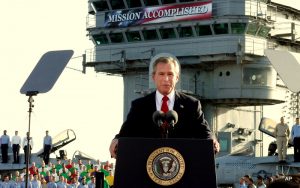
Was there really no-one around at that time who could predict, political sympathies aside, that the Kosovo precedent would lead only to regrettable results? There were in fact such people, and they warned the world. But President George W. Bush was deeply unmoved by such warnings; after all, he had followed the example of his great father in defeating Iraq, and named an aircraft carrier after him. If another member of this august family should ever come to power in the USA, then he will naturally lead another invasion of Iraq and, should the US budget allow it, will build something nice for the navy. That is the Bush family tradition – bombing Iraq and ravaging the US budget.
Only a few years ago America’s might was considered invincible, although many knew that NASA’s astronauts reached the International Space Station using Russian “Soyuz” spacecraft, and Atlas V rockets fly thanks to Russian RD-180 engines. Atlas V rockets deliver all kinds of satellites into orbit, including military ones.
Of course, it will not be a problem for America to switch to its own engines and build new manned spacecraft to replace obsolete, decommissioned shuttles. The White House is trying to impress upon people the vastness of President Obama’s power: “by sheer force of mental power, he can send an expedition to Mars, teleport billions of kiloliters of gas to Europe, and force President Putin to write a decree authorizing same-sex marriage in Russia.” Well, then, if Obama has decided to reinvigorate the US space program, one can only be glad for the country.
The problem has turned out to be that while the Obama administration was helping to establish sharia law in the countries of the Arab world, the Crimean parliament declared the republic’s independence from the Kiev junta, and the Russian bear decided to rub the Kosovo precedent in its face. It turns out that the cries of “Stop, don’t move, I’m going to use sanctions, requisitions, demonization and I can even pull the atomic trigger!” do not work on the Russian bear.
Washington has finally begun to acknowledge that what happened in Kosovo was only the first domino falling. What will happen next?
According to Gazeta.ru, the American administration has been urging Beijing officials not to adopt the Crimean situation as a model for action against their Asian neighbors. The sanctions imposed by the USA and the European Union on Russia should have a chilling effect on any fevered minds in the Chinese government who might have been thinking of using the model set forth by the Kremlin in Crimea, declared Daniel Russel, Assistant Secretary of State for East Asian and Pacific Affairs, in a Senate committee hearing.
All one can say is: “Wow”! So that turns out to be the pedagogic principle governing America’s sanctions against the Russian Federation. The only question is, where in China did Assistant Secretary Russel find these fevered minds? It would appear that he is projecting the clinical picture which is in fact typical of the US Senate and State Department onto the leadership of the PRC. “The net effect is to put more pressure on China to demonstrate that it remains committed to the peaceful resolution of the problems,” Russel stated.
So they were just loading up on popcorn in Beijing, preparing to watch the epic tragedy “America vs. Russia: The Sanctions,” when there came the hysterical cry from the State Department: “Don’t even think about it!” What’s with all of the shouting? Just send Samantha Power to Beijing.
Events in Crimea have generated a lot of excitement not only in Washington, but in Tokyo too. “Crimea has changed the rules of the game. It’s not a salvo on some distant shore. An attempt by a rising power to change the status quo has taken place,” said Kunihiko Miyake, former adviser to Japanese Prime Minister Shindzo Abe. According to Miyake, the PRC may do the same thing. The Japanese media have been vying to outdo each other in publishing stories about Beijing potentially following Moscow’s example by occupying the disputed Senkaku (Diaoyu) islands.
Here, the following facts should be noted. The company Square Enix does not want to have its well-known Final Fantasy series of games translated into Russian. Why? Because it is Tokyo’s sanction in response to Russia’s refusal to give the Kuril Islands back to Japan: “let the Russians suffer and play World of Warcraft.” If Square Enix were to have Final Fantasy translated into Russian, Moscow would enter the same parallel reality in which Tokyo now finds itself.
What is the actual existing reality of the situation?
In the first place, the population of Senkaku consists of exactly 0 (zero) persons; it has no parliament, no separatists, no terrorists, no national minorities, no gays, no US embassies, and so on. What on earth is this conversation supposed to be about? Furthermore, does China really need these islands or does it need a pretext to show the countries of Southeast Asia that the United States are far away and the Chinese dragon’s fangs have not lost their bite? Finally, Japan holds a trump card in its hands – Washington, to which the land of the rising sun is bound by an agreement on common defense.
So why did Tokyo get so frightened and go so far as to promise to give 1.44 billion dollars to the Kievan junta?
On 5 April, US Secretary of Defense Chuck Hagel flew to Tokyo. He calmed the overwrought ally’s nerves and declared that the US would show no hesitation and fulfill all its obligations according to the 1952 mutual security agreement between the US and Japan. Why did Tokyo demand Washington affirm its obligations to its allies, what happened?
Here is where the problem lies. The government in Tokyo is perfectly well aware that when the State Department and CIA special forces organized a Fascist putsch in Kiev, they did not hold back from giving the Maidan leadership generous pledges, promises, and guarantees. Hardly in vain did the heirs of the vestigial OUN shout “America is with us!” Suddenly Crimea separates from Ukraine and enters the structure of the Russian Federation. Obama, Merkel, and the others declare that Vladimir Putin will answer for this, will regret his actions, and the wrath of heaven will be forthcoming.
So where is this heavenly retribution?
Now in Tokyo they got to thinking. The fact is that any kind of treaty is really a gentleman’s agreement, and if one of the parties is not a gentleman, the treaty is not worth the paper it’s written on. The Japanese government understands this perfectly and, it seems, is also beginning to understand that the US is no guarantor, but merely a mass media phenomenon that dreamed up a scheme to take over the world by means of television.
And Beijing? In Beijing they have, all the same, loaded up on popcorn and are sitting back to watch the tragedy “America vs. Russia: The Sanctions” straight through to the end.
Originally published on 2014-04-13
About the author: Konstantin Penzev, writer and historian, is a staff writer for the online magazine “New Eastern Outlook”.
We would like to ask you to consider a small donation to help our team keep working. We accept no advertising and rely only on you, our readers, to keep us digging the truth on history, global politics and international relations.
PrefaceKosovo (Serb. Kosovo-Metochia, Alb. Kosova) is a square-shaped province of the Republic of Serbia of 10,877 sq. kilometres that is approximately the size of the USA state of Connecticut. The province is situated in the southern interior of the Balkan Peninsula in South-East Europe.[1] For most of the 20th century-history, this province was part of Serbia like in the Middle Ages but from 1455 to 1912 it was occupied by the Ottoman Empire. After the 1998‒1999 Kosovo War the province is an autonomous territory under the formal administration of the UNO but, in fact, USA’s colony. Officially, the province has ...
The leak of a secret BND dossier on Hachim Thaci which reports that the newly-elected Kosovan President had links to a contract killer and was involved in the trafficking of people, arms and drugs is more confirmation that Western politicians have chosen to support Thaci in the knowledge of his criminal past.Wikileaks has leaked a secret German Federal Intelligence Service (BND) dossier on Hachim Thaci that dates back to 2005, after the former Kosovo Liberation Army (KLA) leader had served the first of his two terms in office as Kosovan Prime Minister.The dossier reports that Thaci, who has recently been elected president of Kosovo, was one of the leaders of organized ...
Although the 2016 presidential election is still in the primaries phase, contenders have already brought up America’s failed foreign wars. Hillary Clinton is taking flak over Libya, and Donald Trump has irked the GOP by bringing up Iraq. But what of Kosovo?The US-led NATO operation that began on March 24, 1999 was launched under the “responsibility to protect” doctrine asserted by President Bill Clinton and UK Prime Minister Tony Blair. For 78 days, NATO targeted what was then the Federal Republic of Yugoslavia – which later split into Serbia and Montenegro – over alleged atrocities against ethnic Albanians in the ...
The NATO occupation was seen by Arab/Muslim countries as an opportunity to transform Kosovo-Metohija into a Muslim state. Terry Boyd in the Stars and Stripes article “In Kosovo, Islamic groups work to rebuild country, attract followers,” September 21, 2001, examined how Muslim countries were seeking the Islamization of Kosovo. The US State Department listed Kosovo as having active cells of al-Qaeda, Ossama bin Laden’s terrorist network. Al-Qaeda and Ossama bin Laden were aiding the UCK jihad in Kosovo. Iran was also active in Kosovo and Bosnia. Boyd reported that an Iranian Islamic group offered 120-300 German marks a month for ...
The ongoing de-Christianization of Kosovo continues and unlike the past frenzy of the anti-Serbian mass media in the West, we mainly have a deadly silence about the reality of Kosovo and the continuing Albanianization of this land. However, how is it “just” and “moral” to persecute minorities and to alienate them from mainstream society; and then to illegally recognize this land without the full consensus of the international community?How ironic it is that the same United States of America and the United Kingdom, two nations who were in the forefront of covertly manipulating the mass media; remain mainly silent about ...
Mirė vienas didžiausių pasaulyje tarptautinių karo nusikaltėlių JAV senatorius Džonas Makeinas. Jis , kaip ir kitas JAV karo nusikaltėlių gaujos sėbras Zbignevas Bzežinskis, darė karo nusikaltimus visame pasaulyje, žudė civilius gyventojus, moteris, vaikus, senelius Vietname, Irake, Jugoslavijoje, Libijoje, Sirijoje, Jemene, Somalyje, Nigerijoje, Gruzijoje, Ukrainoje, kišosi į visų pasaulio šalių vidaus reikalus, dalyvavo vykdant spalvotas revoliucijas visose Rusijos pasienyje esančiose buvusiose tarybinėse valstybėse, Vidurio ir Rytų Europoje, Pabaltijo respublikose, Šiaurės Afrikoje, Artimuosiuose ir Vidurio Rytuose, rėmė nusikalstamus fašistinius režimus, nacionalistines chuntas, islamo teroristines organizacijas minėtose šalyse, yra tiesiogiai atsakingas už jo remtų partijų – konservatorių, liberalų, socdemų, nacistų, nacionalistų, fašistų, islamo teroristų ...
Following the death of President Tito in 1980 the Federal Republic of Yugoslavia slid towards chaos. In the 1990s the plunge accelerated into civil war and one of the regions most affected was Kosovo from which Serbia withdrew after a NATO bomb and rocket offensive from 24 March to 11 June 1999. That blitz involved over 1,000 mainly American aircraft conducting some 38,000 airstrikes on Yugoslavia that killed approximately 500 civilians and destroyed much of the economic and social infrastructure of the region.NATO said its air bombardment was essential to halt repression of ethnic Albanians in Kosovo and justified the ...
The December 17 UN Security Council meeting, on the announced creation of a Kosovo armed forces, featured some noticeable contrasts.In accordance with Kosovo not being a UN member state and the Serb position on UN Security Council Resolution 1244 (recognizing Kosovo as a continued part of Serbia), the disputed former Yugoslav territory wasn't formally represented at the discussion as a nation. Kosovo's leader, Hashim Thaci, sat with a nameplate having his name, as opposed to Kosovo. Countries recognizing Kosovo's independence made it a point to state Thaci as the president of Kosovo and Aleksandar Vučić as president of Serbia. Nations not ...
A strange spy affair broke out in Balkan Casablanca, aka Serbia, on Wednesday. Were NATO “advisers” and liaison personnel embedded in the Serbian army command finally caught red-handed by vigilant Serbian counter-intelligence operatives, purloining secrets? Not this time. (Something along those lines actually did happen in 2002; it was when former armed forces chief of staff Momcilo Perisic was caught on camera in a Belgrade restaurant handing over secret information for cash to CIA’s Johnny-on-the-spot, John Neighbor.) But what allegedly occurred this time was not a boring rerun of the Perisic affair, although the basic contours of the unimaginative scenario ...
The Serbs stepped again onto the historical scene in the years of the European wars that swept the continent from the forests of Ireland to the walls of Constantinople in the late 17th century. The Turks finally withdrew from Hungary and Transylvania when their Ottoman hordes were routed outside Vienna in 1683. The disintegration of Ottoman rule in the southwest limbered up the Serbs, arousing in them hope that the moment was ripe for joint effort to break Turkish dominion in the Balkans. The neighboring Christian powers (Austria and Venice) were the only possible allies. The arrival of the Austrian ...
The former Yugoslavia was engulfed by many conflicts and ethnic and religious differences tore away at the very fabric of this nation. Like all wars, atrocities took place on all sides but the mass media in general focused on Serbian atrocities, while neglecting brutal crimes committed against the Serbian community. This certainly applies to the glossing over of war crimes done by the Kosovo Liberation Army (KLA).However, more and more evidence is coming to light about brutal KLA death camps and killing people for organs. Therefore, will former KLA members be charged with war crimes and will the “real truth” ...
Islamic forces entered Europe from Asia and North Africa in order to enslave, convert, persecute and either completely destroy Christianity or to enforce dhimmitude. Before this process began you had the complete annihilation of Christianity in many parts of North Africa and in various parts of the Middle East it was one long sojourn into dhimmitude, pogroms and massacres.Christianity survived in some areas, for example in Egypt, however, numbers succumbed after Arab colonial and Islamic discrimination took route. Therefore, a complete Islamic inquisition took root in Arabia (modern day Saudi Arabia) and just like the Sunni Islamic inquisition against Buddhism ...
Two Kosovo Albanian Muslim muhajedeens (with the passports of Republic of Kosovo) as members of ISIL in Syria in 2015 (Official ISIL’s video material)After the 9/11, a worldwide “War on terror” begun in order to disband and neutralize Islamic terrorist networks across the globe. The main focus of the largest anti-terrorist campaign in history is focused in the Middle East area, as well as in Afghanistan.The Balkan Peninsula is the European area where this campaign has also taken place, with numerous arrests and a continuous effort into riding the fundamentalist out of the area. The question arising though, is how ...
IntroductionBelow are TENC's October 1999 interviews with three Serbian women from the Kosovo town of Orahovac. They recount how, prior to the June 1999 NATO-UN takeover of Kosovo, they believed NATO's promise that it would institute multi-ethnic harmony. They discovered too late that for NATO multi-ethnic meant rule by the Kosovo Liberation Army (KLA).In September, TENC had published its first interview with an eye-witness to the NATO-UN Kosovo takeover: Cedomir Prlincevic, President of the Jewish community and Chief Archivist in Pristina, capital of Kosovo.Mr. Prlincevic described how he and the rest of the small Jewish community were driven from their ...
The Kosovo Question recently once again became an important issue of global politics and international relations for two reasons: 1) The Albanian “government” of the “Republic of Kosovo” announced to officially proclaim the existence of the Kosovo Army (that is a violation of the 1244 UN Resolution in 1999), and 2) The “president” of the “Republic of Kosovo”, a war criminal Hashim Tachi, participated on November 11th (2018) in Paris to the world leaders’ celebration of a centenary anniversary of the end of the WWI (the signed armistice with Germany) as the official representative of an “independent” Kosovo. He was ...
IntroductionThe goals of this article are: 1) to investigate the role of the revived Patriarchate of Peć in Serbian and Balkan history?; and 2) to explore and present the results of investigation of the problems with respect to: a) the role of the Serbian Church during the first decades of the Ottoman occupation of Serbian lands in the process of the creation of a Serbian national identity; b) Serbian-Turkish relations in the second half of the 16th century; and c) the reasons for Serbian disloyalty towards the Ottoman government at the turn of the 17th century.The article addresses the reasons ...
Big Brother in the Aisles of HyVeeRepeat a lie often enough, the conventional Nazi propaganda wisdom ran, and it will become an accepted truth.This last Veterans Day weekend, I couldn’t watch a sporting event, listen to a car radio, or even go shopping at the local grocery store without hearing a Great American Lie repeated over and over.Sports announcers, radio talk-show hosts, commercials, and even a recorded voice blasted into the aisles of the HyVeee supermarket told me again and again that I owed my great American “freedom” to veterans and current enlistees of the U.S. military – in other ...
South-East Serbia's province of Kosovo-Metochia (KosMet) is an autochthonous Slavic, in particular Serb, land. Now, the focal question became how this province became “disputed land”, and, in particular, what it has to do with ethnic-Albanians? In the following text, this issue is going to be considered in more details, from the geographical, (pre)historic, anthropologic, religious, and political points of view. We start with the geography, in particular, the physical geography of West Balkans.Kosovo Liberation Army, August 1998, Klechka village, KosMetThe region of Dinaric Alps It is known that physical and mental structures of a particular population are determined by many ...
Greater Albania under Nazi GermanyDuring World War II, 35,000 to 40,000 Kosovo Albanians were recruited by Nazi Germany as part of the German occupation forces and security formations in Greater Albania, a state created by Adolf Hitler and Benito Mussolini that included Kosovo-Metohija, western Macedonia, and territory from Serbia and Montenegro. In Albania, there were 30,000 Albanians who were in the German occupation forces. In 1941, the German occupation forces created a Kosovo Albanian Gendarmerie with headquarters in Kosovska Mitrovica. In 1944, these forces were incorporated into the Skanderbeg Nazi SS Division. In 1942, Balli Kombetar organization battalions were established ...
RT: Kosovo wants to establish an army and has received several Humvee armoured vehicles from the USA. Although there was official NATO restraint, how much is the establishment of a Kosovo Army a fixed development?Marcus Papadopoulos: Kosovo is, effectively, a NATO protectorate today – and has been ever since Belgrade lost control of this Serbian province in 1999. It follows, therefore, that the illegal entity which is the Republic of Kosovo will begin the process of creating its own armed forces so that, in time, Kosovo will gain entry into NATO.RT: The EU has rejected the introduction of Kosovo sanctions ...