It is possible that America’s decline as the only world Hyperpower could be a factor in Sierra Leone’s recognition reversal. Often smaller nations kiss up to the big dog by voting for whatever they want at the UN, especially issues that don’t particularly affect them [...]
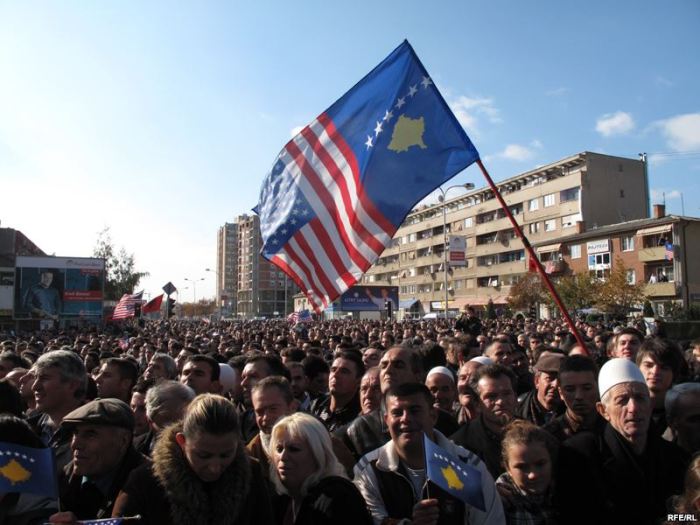
What constitutes water can be scientifically proven beyond any doubt, now what constitutes a nation-state is a far more organic question than it would seem. Each of us is very used to seeing maps with the same countries and lines on it throughout the years and take their existence as a given. But depending on where a map comes from its borders may actually look very different. One of these countries to some and non-countries to others is Kosovo which gradually continues to lose the support of the states that recognized it into existence. Furthermore, this sheds light on how UN doctrine strongly leans the atomization of nations and the recognition of new states rather than long term stability.
Serbian Foreign Minister Ivica Dacic has recently stated that the government of Sierra Leone has withdrawn its recognition of Kosovo as a state. According to Fort Russ News 18 nations have already changed their minds about the status of the small Balkan entity and there is a no indication to believe this trend will stop. Documents received by Serbian state news agency Tanjug explain the motivations behind Sierra Leone’s change of heart.
“The government of the Republic of Sierra Leone is of the considered view that any recognition it had conferred (expressly or by necessary implication) on the independence of Kosovo may have been premature,”
This seems like a polite way of saying the Serbs gave them some unknown good reason to change their minds. Minister Dacic claims that bilateral relations between the nations have improved, but it is hard to imagine that there are critical deep ties being rebuilt between Serbia and this tiny part of Africa. If there is any trade between these two countries it is so nominal that Sierra Leone is not even mentioned in the list of Serbia’s top trade partners, meaning that their motivations for making this change probably have very little to do with “bilateral relations”.
It is possible that America’s decline as the only world Hyperpower could be a factor in Sierra Leone’s recognition reversal. Often smaller nations kiss up to the big dog by voting for whatever they want at the UN, especially issues that don’t particularly affect them. Russia and China do not recognize Kosovo, and Russians see the region as being stolen from their brother/cousin Serbs by their multi-generation enemy the United States. So perhaps there could actually be an element of Russian pressure especially since the Russians are working out plans to make some investment moves in the region.
It is almost impossible to conclusively prove the motivations behind decisions but as it stands now it is a fact that a minority of UN member states recognize Kosovo and others may jump on the boat soon according to the Serbian side.
This leads one to wonder, at what point, if this “unrecognition” trend continues, will Kosovo stop being considered a nation-state? At what point will the English version of Google Maps have to be updated? Where is the cutoff point? The answer may surprise you.
Countries recognizing Kosovo’s independence in 2018
This view of statehood sets the bar as absolutely bottom basement low for recognition. This logic reflects a hyper optimistic towards breakaway states being recognized. If the UN’s mission was to strive for stability/maintaining a global status quo or to suit the needs of the big players then one would expect that the standards for the recognition of statehood would be extremely high, maybe even so high that they would be practically impossible. Change creates instability and the bigger you are the more territory you have the opportunity to lose due to some Catalonia or Scotland getting uppity.
If gaining statehood were to be nearly impossible then this is good for global stability (civil war and breakaways become less viable) and the big dogs’ empires would feel no threat from troubled regions.
The Lakota Indians in the north of the United States, could easily (and may already) meet the extremely loose criteria for statehood as do probably dozens of other regions around the world. In one moment of weakness the Chinese and Russians could do to America via the Lakota Indians exactly what the US did to Serbia and the USSR – recognize everyone who wants to break away. If recognition standards were much higher, there would be “no hope” for secessionists.
Although the prerequisites for statehood are low paradoxically they also mean that it is very hard to delete state from the books. In terms of Kosovo, even if the rest of the world dumped their recognition, as long as the US still had relations with them they could still very well continue along as a recognized entity.
So despite Serbian optimism nation-state recognition is very much on the side of small breakaway states (except for the ones the Russians recognize of course, Russia is always the exception) and even if support for Kosovo continues to erode nothing will ultimately change until Washington changes its mind.
Perhaps it is arrogant from a small Moscow rental apartment to claim that a principle of international relations that has been used for decades is wrong but this optimistic view that any territory that gets a “government” could potentially become a real recognized state is bad for global stability and bad for maintaining large powerful nations that ultimately drive history and humanity forward. The Kosovo “incident” provides a lot of food for thought about how things should be done in international relations, and it may be time to rethink some established reasoning that we simply accept because it has been around for a long time.
Origins of images: Facebook, Twitter, Wikimedia, Wikipedia, Flickr, Google, Imageinjection, Public Domain & Pinterest.
Read our Disclaimer/LegalStatement!
DonatetoSupportUs
We would like to ask you to consider a small donation to help our team keep working. We accept no advertising and rely only on you, our readers, to keep us digging the truth on history, global politics and international relations.
June 10 is a sad date in the history of the UN, the institution originally meant to play the key role in ensuring peace, security, and the primacy of law in the world. The decade since the passing of the June 10, 1999 UN Security Council Resolution 1244 addressing the Kosovo problem – the document totally ignored throughout the period – has shown that the UN is no longer playing the role prescribed to it by the post-World War II system of the international law. The Resolution the tenth anniversary of which nobody seems willing to celebrate in the UN ...
On December 22 last year the government of Syria regained control of the city of Aleppo that had been occupied by brutal rebel forces since 2012. As reported by the BBC, «The predominantly Sunni Muslim opposition is made of several rebel groups, many of whom have received financial aid from key opponents of President Assad, including the US, Saudi Arabia and Turkey».Following defeat of the US-supported insurgents, «Under a deal brokered by Turkey and Russia, convoys of buses and cars have shuttled thousands of civilians and fighters out of Aleppo's last rebel-held pocket toward opposition areas outside the city», and peace was restored, much to the ...
On February 24th, Medea Benjamin and Nicolas S.J. Davies headlined "What Planet Is NATO Living On?", and documented that the U.S. Government and NATO are preparing to invade and conquer both Russia and China, and that this goal is opposed by vast majorities of Europeans, which means that this decision by NATO does not reflect democracy in Europe, but instead it reflects Europe's being vassal-nations in the U.S. empire:As Michael Klare explains in a NATO Watch report on NATO 2030, every step the U.S. is taking with NATO is "intended to integrate it into U.S. plans to fight and defeat ...
The recent declassification of over 3800 documents by the Central Intelligence Agency provides detailed proof that since 1953 the CIA operated two major programs intent on not only destabilizing Ukraine but Nazifying it with followers of the World War II Ukrainian Nazi leader Stepan Bandera.The CIA programs spanned some four decades. Starting as a paramilitary operation that provided funding and equipment for such anti-Soviet Ukrainian resistance groups as the Ukrainian Supreme Liberation Council (UHVR); its affiliates, the Organization of Ukrainian Nationalists (OUN) and Ukrainian Insurgent Army (UPA), all Nazi Banderists. The CIA also provided support to a relatively anti-Bandera faction ...
In this Talking Point Dr Marcus Papadopoulos says that ordinary people in the West were not told that after Serbia lost control of Kosovo, following the Nato bombing campaign against Belgrade and other Serbian cities in 1999, the region became a centre-point in Europe for the trafficking of people, drugs and organs. When Kosovo unilaterally declared its independence from Serbia in 2008, Western politicians hailed the event.The United States, which engineered the disputed act of independence, led the way in recognising the new Balkan state, with its allies quickly following suit.Many of the leading figures in today’s Kosovan government are ...
On the 16th anniversary of the country’s accession to NATO, Lithuanian Minister of Defense Raimundas Karoblis came up with a well-known myth: our state is an equal member of the alliance. “We are stronger than ever before and we are grateful to the Allies for their efforts in strengthening the defense capabilities in the region and their willingness to help when it necessary” said Karoblis.If you look at the facts, Lithuania is fighting alone with the epidemic of COVID-19 infection. However, like all other countries of the North Atlantic Treaty Organization.You just need to look at Italy, which does not ...
Origins of images: Facebook, Twitter, Wikimedia, Wikipedia, Flickr, Google, Imageinjection & Pinterest.Read our Disclaimer/Legal Statement!Donate to Support UsWe would like to ask you to consider a small donation to help our team keep working. We accept no advertising and rely only on you, our readers, to keep us digging the truth on history, global politics, and international relations.
Well-intentioned and artfully executed, The Vietnam War—Ken Burns and Lynn Novick’s 10-part, 18-hour-long documentary series on PBS—is not history, but rather story-telling and remembrance. Balanced, exhaustive, and relentlessly solemn, it glides along the surface of things, even when that surface is crowded with arrogance, miscalculation, deceit, and bloodletting on an epic scale.According to one promotional trailer prepared for the series, “In war there is no single truth.” Embedded within every war (as in other forms of human endeavor) are multiple truths—some of them trivial, others very important indeed. The purpose of history is to unearth and engage with those truths ...
The crumbling “liberal” West is in a desperate hurry in the Balkans. More than a quarter century since the first Western states, pushed by Germany, unilaterally recognized the secession of the former Yugoslav federal republics of Slovenia, Croatia and Bosnia-Herzegovina and about 19 years since NATO’s air and land attack against what had remained of the country (the Federal Republic of Yugoslavia, comprising Serbia and Montenegro) resulting in NATO’s occupation and subsequent forced amputation of Serbia’s Kosovo and Metohija province (by way of recognition of its unilaterally declared independence of February 2008 by the main Western powers, some – but not all Muslim ...
Facts And Truth @ YouTube: “Remember why NATO spent 78-days bombing Yugoslavia in the spring of 1999? There was ethnic cleansing. The atrocities. The refugees chased out of Kosovo by the Serb army. The mass graves. The heaps of bodies tossed into vats of sulphuric acid at the Trepca mines. NATO spokesman Jamie Shea said there were 100,000 Kosovo Albanian Muslims unaccounted for.Problem is, none of it happened.”Forensic report throws doubt on US/NATO claims of Racak “massacre”By Richard Tyler wsws.org, 12 February 2001A forthcoming article by three Finnish pathologists throws further doubts upon official descriptions of a “massacre” in the ...
IntroductionThe article addresses a linguistically based project on Serbian ethnonational identity and a language-based political model for the creation of the Serbian united ethnonational state in the Balkans drafted by the most famous Serbian philologist Vuk Stefanović Karadžić in 1836 and further developed by Serbia’s statesman Ilija Garašanin in 1844. The most significant problem with respect to V. S. Karadžić’s “Срби сви и свуда“ (“Serbs All and Everywhere”) and I. Garašanin’s Начертаније (Outline) – two programmatic works in which the project of resolving the “Serbian Question” was developed in 1836/1844, is their interpretation and understanding of the historiographical traditions of ...
In light of Sergey Lavrov’s recent statements reflecting Russia’s disappointment with the West and the country’s intention to “stop judging ourselves on the basis of marks given by the collective West or individual Western countries”, it might have been expected that the Russian foreign minister’s mid-December Balkan mini tour would be a good chance to see how this new Russian awakening was going to be reflected in practice. Especially in Bosnia and Herzegovina (B-H), perhaps the most famous hamlet in the Potemkin village built by Western “humanitarian interventionism” during the, thankfully, relatively brief unipolar moment lasting approximately two decades after ...
A former Islamist fighter in Syria recalls why he went to Syria, how easy it was to get there – and why he would go again, if he could.On his first trip abroad, he left with 400 euros in his pocket, a printed map from the internet and the belief that he was fulfilling his destiny in eyes of Allah. The destination was the frontline of the war in Syria, but his jihad ended faster than it started.Two years later, in a bar full of people in his hometown in northern Albania, Ebu Merjem stands out with his long beard ...
The United States, Europe, and their partners must officially recognize the Mountainous Karabagh Republic within its constitutional frontiers.Stepanakert, Mountainous Karabagh — I no longer know what to do on April 24—or where to go. This is the day Armenians across the globe commemorate the genocide in 1915 that destroyed the Armenian people and its homeland of thousands of years.Those killing fields, the homes of my grandparents, are located in historic western Armenia—now eastern Turkey. But a century later, this very region has erupted in all-out war. Turkish forces are on the offensive again, this time, Armenians having been eliminated, against ...
Albert Einstein, along with other Jewish luminaries, including Hannah Arendt, published a letter in the New York Times on December 4, 1948. That was only a few months after Israel had declared its independence and as hundreds of Palestinian villages were being actively demolished after their inhabitants were expelled.The letter denounced Israel’s newly-founded Herut party and its young leader, Menachem Begin.Herut was carved out of the Irgun terrorist gang, famous for its many massacres against Palestinian Arab communities leading up to the Nakba, the catastrophic ethnic cleansing of the Palestinian people from their historic homeland in 1947-48.In the letter, Einstein, ...
At the beginning of March 2017, it will be exactly six years since the beginning of the conflict in Syria. Some journalists even make unfavorable forecasts wondering about the very possibility of reconciliation. Complicated by the foreign intervention on the part of Israel war in Lebanon, for example, had been for about 15 years. But even a six-year term it is too long.That is why we may hope that the meeting in Astana scheduled on January 23 will eventually lead to a positive result. And then there will be an occasion to consolidate the success of the negotiations in Geneva ...
IntroductionThe goals of this article are: 1) to investigate the role of the revived Patriarchate of Peć in Serbian and Balkan history?; and 2) to explore and present the results of investigation of the problems with respect to: a) the role of the Serbian Church during the first decades of the Ottoman occupation of Serbian lands in the process of the creation of a Serbian national identity; b) Serbian-Turkish relations in the second half of the 16th century; and c) the reasons for Serbian disloyalty towards the Ottoman government at the turn of the 17th century.The article addresses the reasons ...
Origins of images: Facebook, Twitter, Wikimedia, Wikipedia, Flickr, Google, Imageinjection, Public Domain & Pinterest.Read our Disclaimer/Legal Statement!Donate to Support UsWe would like to ask you to consider a small donation to help our team keep working. We accept no advertising and rely only on you, our readers, to keep us digging the truth on history, global politics and international relations.[wpedon id="4696" align="left"]Save
Joe Biden is an American president and politician with extensive experience. He has been a long year member of the US Senate Foreign Relations Committee. In his political career so far, he has not had a good opinion about Russia, and the same was with other Slavic states in Eastern Europe, which have cultivated close relations with Russia.After the collapse of the USSR, his most significant engagement was in the Balkans. During the 1990, he often visited the Balkans. In his biography, Biden describes himself as a leading figure in defining the US policy in the Balkans, as he helped ...
After the Donald Trump administration’s decision to recognize the disputed city of Jerusalem as Israel’s capital and move the US embassy there from Tel Aviv, the national aspirations of the Palestinian people to live in their own state have been severely dashed by Washington’s move. Ever since the formation of the United States, it has been American policy to destroy aspirant nations like the internationally-recognized State of Palestine.The first nation destroyed by the United States was the Cherokee Nation, or Tsalagihi Ayeli, which, beginning in 1794, was slowly decimated by forced removals from territory in Georgia, the Carolinas, Tennessee, Alabama, ...
The magazine is covering the research gaps uncovered by global Western hoax mainstream media platforms and academic teaching & research institutions.
This is an alternative information & academic research digest platform with the purpose to offer an alternative “another side of the truth”.
The magazine is independent, private, and free of any influence by any institution, organization, government, or pressure group. URL: www.global-politics.eu