

Views: 1731

The U.S. military base in Kosovo was constructed in 1999 without consulting with the government of Serbia and is the largest U.S. military base built outside of the U.S. since the Vietnam War. The site was apparently used for extraordinary renditions and has been referred to as a “little Guantanamo”.
This is a very little known fact as NATO, the U.S., the European Union and the West are in the process of forcing Serbia to effectively give up Kosovo, and indicates the real motive for the West’s support of the Kosovo Liberation Army which it had deemed a terrorist organization in the past.
Rick Rozoff, the owner and manager of Stop NATO spoke about this and more in an interview with the Voice of Russia.
Hello! This is John Robles, I’m speaking with Rick Rozoff, the owner of the stop NATO website and international mailing list.
Robles: Hello Rick. How are you?
Rozoff: Very good John. Thanks for having me on.
Robles: It’s a pleasure to be speaking with you. How much importance would you give to the 200 US-NATO troops being stationed in Italy? And why US-NATO troops? These troops are being stationed for possible operations in Libya. How do you think that reflects on the operations to remove Muammar Gaddafi by the US?
Rozoff: It’s a continuation of that policy, of course. And as it is now, you know, two years ago and two months, 26 months ago that the military campaign against Libya was launched, initially, as we have to recall, by US Africa Command (AFRICOM) that began it for the first 19 days and then it was taken up by the North Atlantic Treaty Organization for six months thereafter. And this was meant to signal and meant in fact to be the first activation of AFRICOM as a war-fighting force on the African continent, and also NATO’s first open military incursion into Africa and certainly not the last. This was meant to be an opening salvo and not an isolated incident.
What is significant about the impending deployment of what is minimally, and I think we should emphasize that, 200 US Marines, and some reports estimate up to 500, these are members of what the US Marine Corps refers to as the Special Purpose Marine Air-Ground Task Force that only recently was moved into Spain, and then it is being transitioned from Spain into Italy for use in North Africa. So, I think we can see the push to the south and the east, to employ State Department slogan or expression of few years ago, where the US is going to deploy very shortly four guided missile cruisers to the Naval Station Rota in Spain, a Marine expeditionary strike force, really, of the sort we are talking about going to the Sigonella base in Sicily.
This is the same base that the US has another Marine Corps detachment already deployed to. And this is actually a separate one that has already been assigned to the same naval station Sigonella. We should also recall that in the beginning of this year, in January, the governor of Sicily put a stop to plans that the US had for putting a satellite surveillance facility in Sicily, on the island.
You know, big plans are afoot and the US was going to move in something called the Mobile User Objective System, global satellite facility, to Sicily. That seems to have been stopped but troops are coming in, with the avowed purpose, John, of intervening in Libya – Benghazi or elsewhere – as the U.S. sees fit.
Robles: What exactly is that system that you just mentioned?
Rozoff: The photographs I’ve seen of it suggest that it truly is mobile, I mean it is something comparable to some of the Patriot Advanced Capability missile systems that the US has put in Poland and Turkey and Israel. It is described as being a satellite communication system. I’m not sure what precisely it was meant to monitor in Sicily, but I would guess the entire Mediterranean Sea, perhaps most notably part of the eastern Mediterranean. But as to the precise range and purpose of the missile system, I’m not familiar with that.
Robles: I see. So, this is some new technology?
Rozoff: Yes. There are similar ones, that are called Mobile User Objective Systems, deployed in Australia, as well as in the US states of Hawaii and Virginia. But I’m not sure how they are integrated with other military capabilities.

Robles: What else has happened with NATO in the last month that you think our listeners should know about?
Rozoff: They’ve had a series of meetings of foreign ministers, of chiefs of defense staff and others in recent months. The focus, according to NATO of course, is wrapping up the Afghan mission which I don’t think will ever be definitively finished. But the drawing down or the eventual phased withdrawal from Afghanistan, the continuation of the operation in Kosovo, the Serbian province (the province wrenched from Serbia), and continued naval operations in the Mediterranean Sea, what is called Operation Active Endeavour, and ongoing, presumably permanent, naval operations in the Arabian Sea and the Indian Ocean, so-called Operation Ocean Shield.
So, NATO is still in ways that we have discussed on many an occasion in the past continuing permanent military operations way outside the area of the North Atlantic Ocean, ultimately globally. Nothing outstanding in any particular regard but the continuation of these policies.
Robles: How many bases was NATO going to leave in Afghanistan? And what can you tell us about Kosovo, can you give us some details on that as well?
Rozoff: The statement about the US maintaining military bases in Afghanistan after the complete withdrawal of US-NATO troops, well, we can’t say complete – I mean there are estimates that as many as 14,000 US NATO troops will stay in the country – but after the bulk, at one time 152,000 US and other NATO troops, in Afghanistan are withdrawn, according to President Hamid Karzai of Afghanistan the US has clearly indicated to him, I think the word “demanded” would not be too strong a word, that the US or the Pentagon wants to maintain nine military bases inside the country. And they are situated in the north, south, east and west, and that is near the borders of the former Soviet Central Asian Republics, but also Iran and Pakistan, and in some cases not terribly far from the narrow strip of land that connects Afghanistan to China.
And they include of course the major, arguably, at any point in future, strategic air bases like Bagram and Kandahar and Shindand and elsewhere in the country. As we’ve talked about on many occasions, I think any sensible person has figured out that the US and its Western allies don’t intend to vacate the South-Central Asian region in the imminent future, if at all.
Robles: You just mentioned Karzai. I was just reminded about his recent revelation that he’d been receiving garbage bags full of money from the CIA for over a decade. Can you comment on that as far as NATO goes? And regarding US-NATO troops, do you think there is any specific reason why only US-NATO troops are going to be staying in Afghanistan?
Rozoff: Let me start with the second one first because I think it is the easiest. The facts are fairly incontestable, It is not going to be only US troops. The US will maintain nine military bases evidently, that’s what it intends to do. But NATO itself is transitioning from what is currently known as the International Security Assistance Force, initially it was presented, if you can believe this, under the rubric of a peacekeeping force in the early part of this century, and it quickly devolved into a warfighting force and to a combat force. And once that mission, ISAF (International Security Assistance Force), is finished, then NATO will continue in Afghanistan training the Afghan National Army and other security personnel basically to be a Western proxy army in the South-Central Asian region. That’s the easy part.
The question about Mr. Karzai being lavished with a good deal of American largesse, that shouldn’t surprise anybody. It is to be assumed, I suppose, that the US buys off foreign leaders, certainly those it’s implanted in power, like Mr. Karzai, who is not a foreigner, is not an alien to American shores. One of his brothers for example ran, for years, a restaurant pretty much in my neighborhood here in Chicago. And the family, I’m sure, already has mansions set up in this country to flee to when they have to and to take as much of the CIA cash as they can with them back home – repatriate it if you will.
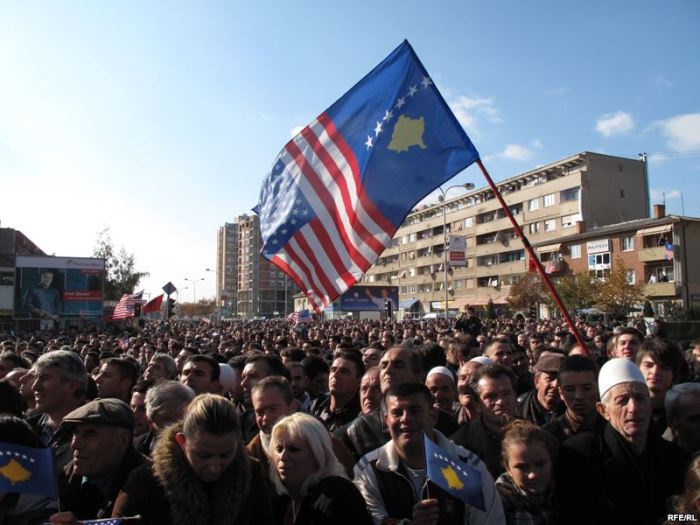
Robles: You mentioned Kosovo a few minutes ago. You said that NATO had met regarding Kosovo and KFOR. Anything new there?
Rozoff: The US and its Western allies, in the latter case I’m talking about people in Brussels whether they are wearing the European Union or the NATO hat, it doesn’t seem to matter much, but I’m sure they employed all their typical subversive powers of persuasion to convince the coalition government in Belgrade, in Serbia, to acknowledge the independence of Kosovo, if not formally, practically. And NATO has pretty substantially withdrawn its troops in Kosovo because they turned the province over to their proxy forces there, the former leaders of the so-called Kosovo Liberation Army, whose leaders are heading up the Kosovo Security Force, which is a fledgeling army being trained by NATO.
So, once the country is turned over to surrogates, the NATO troops can clear out and go on to the next war zone which is effectively what happened since 1999. At one point, in June of 1999, there were 50,000 troops in Kosovo under NATO command or under KFOR, the Kosovo Force. And that number has dwindled down to perhaps a tenth of that right now. But the US still maintains Camp Bondsteel and Camp Monteith. The first, Camp Bondsteel, is reportedly the largest overseas U.S. military base built since the war in Vietnam. And there is no indication that it intends to vacate that base. As to what it is doing with it, that’s a question worth pursuing.
Robles: Where is that base?
Rozoff: In Kosovo.
Robles: And you say that’s the largest foreign base that the U.S. has?
Rozoff: What I’ve read and, given the acreage, the size of the base, it seems to be the case. It is the largest base that the U.S. has built overseas since the war in Vietnam. Since the 1960s.
Robles: And that’s in Kosovo?
Rozoff: That’s in Kosovo. It was constructed in 1999, I think it was with Kellog, Brown & Root, that built bases almost everywhere else. It’s in Kosovo and it is a fairly mammoth complex. Camp Monteith is a sister base considerably smaller than Bondsteel. But Bondsteel, which is by the way named after a US serviceman who was killed in Vietnam, there’s been speculation that Camp Bondsteel could have been used for extraordinary renditions during the so-called global war on terrorism.
There’s also been discussion from the sources in Russia amongst other places that should the US want to deploy strategic resources in Camp Bondsteel. And by that we mean either interceptor missiles or perhaps even nuclear weapons. Who would be the wiser and who in the inner circle of Hashim Thaci in Pristina would say “no”.
Robles: When was this base built?
Rozoff: In 1999 it was constructed and it’s been operating ever since. So, you are talking about 14 years now. And there is no indication, you know, unless you accept the US and NATO line – matters have been stabilized in Kosovo and they are going to step down troops, again, which I think they have I think about 90% of the initial deployment, amount of troops rather, 50,000 troops have been withdrawn but Camp Bondsteel – is still there. It is in the eastern part of Kosovo. And in addition to being a US military base it is also NATO headquarters for what’s called Multinational Brigade East.
I am looking at the exact size of the place: it is 955 acres. That’s pretty sizeable. And it was built on Serbian land without consulting with the government of Serbia. I guess the KLA official in Pristina rubber stamped it. By August of 1999, two months after the US and other NATO troops came into Kosovo, the construction of the base was pretty much under way. Apparently 52 helipads were constructed and shortly thereafter franchise restaurants were added.
Robles: Right there at the beginning, was it like that it was already constructed as if it would be a permanent fixture?
Rozoff: By all indications exactly that. I cannot see what the motivation would be to build something that large which is still operative to this day…
Robles: You said they had “franchise restaurants” and things like that in there?
Rozoff: I’m looking at it on the computer now. You know, Burger King, Taco Bell and so forth built in there. Gymnasiums, health clubs. It is a whole city practically. And evidently, somebody with the Council of Europe, Álvaro Gil-Robles (There’s a name for you, John!), human rights envoy to the Council of Europe, referred to Camp Bondsteel in 2005, and this is a quote, as a “smaller version of Guantanamo” after visiting the facility. So, evidently the US did use it for extraordinary renditions, and so-called black operations or black sites.

Robles: So, that would give us a very, very, very clear and undisputable reason why the West is so interested in guaranteeing the independence of Kosovo.
Rozoff: Right. And that was the statement made by many of us who opposed the war against Yugoslavia in 1999. When the US constructed that base, it was almost began immediately after NATO coming into Kosovo, that it was ex post facto proof that the US had military designs in the region and that the war against Yugoslavia was simply an opportunity to expand its military into the region.
Robles: I see.
Rozoff: Which in fact is what has ensued.
You were listening to an interview in progress with Rick Rozoff the owner and manager of the stop NATO website and mailing list.
You can find part 2 on our website at english.ruvr. ru
Stop NATO e-mail list home page with archives and search engine:
http://groups. yahoo.com/ group/stopnato/ messages
Stop NATO website and articles:
http://rickrozoff. wordpress. com

Origins of images: Facebook, Twitter, Wikimedia, Wikipedia, Flickr, Google, Imageinjection & Pinterest.
Read our Disclaimer/Legal Statement!
Donate to Support Us
We would like to ask you to consider a small donation to help our team keep working. We accept no advertising and rely only on you, our readers, to keep us digging the truth on history, global politics and international relations.