
Here’s Why France Should be Blamed for the Destruction in Syria
Despite the fact that Faysal accepted the ultimatum in principle, France decided it was time for him to leave. On July 26, 1920, the French government intervened outright and occupied Damascus, overthrowing Faysal and his nationalist government [...]
Why is France so interested in Syria? According to the Guardian, France’s policy in Syria has been “more forward than any other Western country”:
“[France] was early in calling for President Bashar al-Assad to step down, still insists he must go, and recently joined airstrikes inside Syria against the Islamic State.”
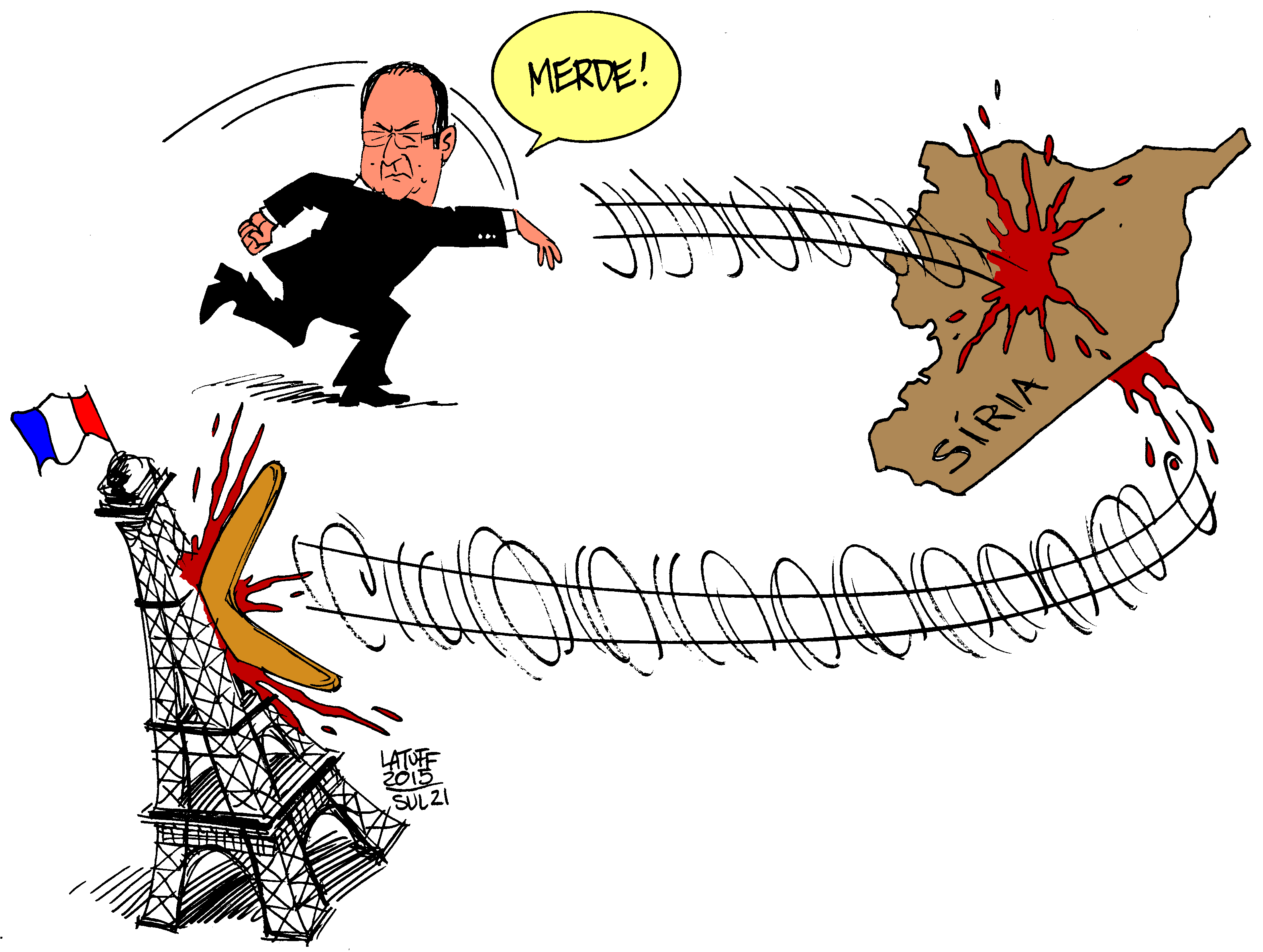
France joined the United States in bombing Syrian territory (without a U.N. mandate) even before the United Kingdom did. In 2013, France stood by Obama’s side despite the fact the United Kingdom’s parliament voted not to join Obama’s efforts to “punish” Syrian president Bashar al-Assad for crossing Obama’s imaginary red line. France has also been a staunch backer of rebels fighting to overthrow Assad since the conflict began.
Not many people know this, but Syria was a former French colony prior to World War II. Both Syria and Lebanon were promised to France under a secret agreement reached with Great Britain following the fall of the Ottoman Empire in 1916. However, even in recent times, France was not overtly anti-Syrian. When Bashar al-Assad took power in 2000, France bore no real ill will towards him. Former president Nicolas Sarkozy openly praised Assad for defending the rights of Syrian Christians.
It is a bold statement to blame France for the current situation in Syria. However, as discussed by Dr. Ayse Tekdal Fildis in an academic paper entitled “The Troubles in Syria: Spawned by French Divide and Rule”:
“Great Britain and France transformed what had been relatively quiet provinces of the Ottoman Empire into some of the least stable and internationally explosive states in the world.”
As part of the Ottoman Empire, Syria did not exist as an entity and was more commonly referred to as “Greater Syria,” “Geographical Syria,” or “Natural Syria,” which was actually comprised of Jordan, Israel/Palestine, Lebanon, and modern day Syria.
Colonially speaking, France was never welcome in Syria. As noted by Randall Baker, an “international expert on historical perspectives in the analysis of contemporary environmental policy and problems,” Syria directly told France they were not welcome to interfere in Syria as early as June of 1919. However, France went ahead and took Syria by cunning force following the San Remo Conference that year, allowing Amir Faysal Ibn Husayni to remain king of Syria only if the country remained under French control and influence. In practice, this gave Syria some leeway — until an interventionist in the form of Alexandre Millerand took office in France. Unsurprisingly, after Syria’s Congress declared Faysal king of the “United Syria Kingdom,” which was to be an unconditionally independent state, France declared this declaration to be null and void.
Instead, Millerand imposed five unconditional demands on Syria: (1) the unconditional acceptance of the French mandate; (2) the acceptance of French-Syrian paper money based on the Franc (sound familiar?); (3)the abolition of conscription and reduction of the army (sound familiar?); (4) French military occupation of the railway and stations from Riyaq to Aleppo; and (5) punishment of persons implicated in hostile acts against the French.
Despite the fact that Faysal accepted the ultimatum in principle, France decided it was time for him to leave. On July 26, 1920, the French government intervened outright and occupied Damascus, overthrowing Faysal and his nationalist government. With this complete takeover of the Syrian region, France also gifted itself the ability to veto any Syrian legislation, making“a charade out of Syrian political life.”
Not surprisingly, there was great resistance to colonial rule from the officers of the Arab army (sound familiar?).
In order to fully take control of Syria, France relied on a divide and rule strategy to undermine Arab nationalism. This strategy involved dividing Syria into segments to block any chance at an overriding sense of nationalism. However, interfering in Lebanon at the same time, a country that also did not exist as an entity under the Ottoman Empire, also played to France’s strengths in disallowing any sense of unity in the region. As Dr. Fildis notes:
“The Maronites saw Lebanon as their own Christian homeland; Sunni Muslims, however, demanded unity with Syria and looked towards the wider Arab world for their source of identity. Therefore, there was no common identity in Greater Lebanon at its birth and no instinct to become a nation; it was just a Christian-dominated French power based in the Middle East.” [emphasis added]
The chief architect of French policy in Syria prior to and during World War I, Robert de Caix, opposed the creation of a unified Syrian state as it would supposedly “have an Arab and Muslim orientation, would be hostile to France and would project a dangerous influence on French North Africa.” It should be noted that dividing and partitioning the resistant Arab states into smaller, weaker states that would pose no threat to American allies in the region is deemed to be one of the core reasons the West is continuously backing wars in the Middle East to this day.
In the context of this divide and rule policy, it should be no surprise that Syria is currently ruled by an Alawite regime — a minority in Syria — which continues to be a problematic issue. As Dr. Fildis explains:
“Some of Syria’s religious and ethnic minorities, such as Kurds, Armenians, Jews and various Christian sects, were widely dispersed and did not have a geographical base to give rise to political unity, whereas the Alawites and Druze were compact regional minorities with considerable political unity.” [emphasis added]
In essence, one of these groups was always going to have to take charge to the detriment of the other political and religious identities, and unity would always be an issue. As Dr. Fildis explains, the French are directly responsible for this calamity:
“Their autonomy mainly had been fostered by the French in an attempt to break Syrian unity. By the end of the mandate, Alawite and Druze areas were incorporated into the larger Syrian state by the French. Nonetheless, minority consciousness, reinforced by a combination of geography, religious differences, communal segregation and regional separatism, had a damaging impact on Syrian political life even long after the mandate.”
However, due to this distaste for France’s actions, the European power’s stranglehold over Syria was short-lived. France’s attempts to destroy Syrian nationalism and prevent any sense of unity in the country ultimately backfired. In that context, it is clear that France had no interest in creating a democratic state for the Syrian people given Syria’s self-governance was putting them on the road to democracy.
As explained in an article published by the Globalist, adapted from an essay by Ian Buruma entitled, “Year Zero, A History of 1945,” France was still fighting for control of Syria as World War II was ending and the formation of the United Nations was well underway, bombing Syrians in Damascus, Aleppo, Hama, and Homs. The British immediately helped Syria oust French forces, and Damascus celebrated the French withdrawal. According to the Globalist, General Charles de Gaulle stated in response to Britain’s interference:
“We are not in a position to open hostilities against you at the present time. But you have insulted France and betrayed the West. This cannot be forgotten.”
So how can Syria’s current political upheaval be directly attributed to the French? Well, as noted by award-winning writer, Dr. Halla Diyab:
“The era of the French mandate created a bad and destructive political habit that Syria picked up through time to internalize and feed for decades to come: political radicalization ‘the legacy of which was almost a guarantee of Syria’s political instability.’ Political upheaval and instability [were] dominant political feature[s] of Syria until [the] Assads came to power.”
Is France looking to reclaim what they believe should have been theirs following the fall of the Ottoman Empire? Or are we really to believe that France is motivated by human rights concerns and a keen interest in counter-terrorism?
France’s commitment to counter-terrorism should be questioned outright. As the Atlantic observed, France retaliated against the infamous 2015 terror attacks in Paris by ramping up its military operations in Syria, despite the fact that the attacks could have been in response to a number of French military operations across the globe. The Atlantic states:
“It’s worth noting that the ISIS statement translated by SITE makes no explicit mention of Syria. The French military has been heavily involved in operations against Islamist militant groups outside of the Middle East over the last few years, including one group that has pledged fealty to Abu Bakr al-Baghdadi, the Islamic State’s self-proclaimed caliph. France has deployed 3,000 troops to West Africa—a region where they’ve historically had great influence, as a colonial power and otherwise—with a presence in Nigeria, Niger, Chad, Burkina Faso, Mali, and Ivory Coast. The fight in Mali has centered on al-Qaeda affiliated militants, but in Nigeria and surrounding countries, France has been the Western nation most invested in fighting against Boko Haram, the brutal Nigerian Islamist organization. Earlier this year, Boko Haram pledged allegiance to Baghdadi.” [emphasis added]
The Washington Post has therefore attributed France’s keen interest in influencing events in Syria as rooted in three key factors. First, the writers argue, France is attempting to reinforce itself as a great power. Second, France is offering an alternative foreign policy to that of the option of the United States military (though what this entails in practice is not clear). And lastly, France can enhance and strengthen ties with the anti-Assad Sunni nations in the Middle East, who also share “France’s deep distrust of Iran” (Syria’s closest ally).
Clearly, France has renewed its aggressively colonial stance in recent times. The importance of the global energy markets, as evidenced by France’s ulterior rationale to take out Gaddafi in Libya, cannot be understated. Syria presents a threat to French interests as an Iranian-dominated bridge between Russia and Europe would cut France out of this energy-rich area completely, something which was previously theirs prior to the end of World War II. By overthrowing Assad and creating a puppet government of France’s own (currently known as the Syrian National Council), France would be able to alleviate the economic threat an Iranian alliance poses to the anti-Assad interests in the region and assert itself as a colonial power in the heart of the Middle East, taking back what was once theirs.
As noted by anti-war Youtube channel Stormcloudsgathering:
“The West is in a state of decline. Their influence is waning. If the U.S. and their allies fail to remove Assad from power, what they will be faced with is more than just a strong Shia crescent [a reference to the Iranian dominated bridge of Iran-Iraq-Lebanon-Syria]. If they fail, they risk being edged out of the entire region and replaced by Russia. This would give Russia an enormous amount of leverage in global energy markets, and this of course has serious implications for the petrodollar.”
We would like to ask you to consider a small donation to help our team keep working. We accept no advertising and rely only on you, our readers, to keep us digging the truth on history, global politics and international relations.
To mark so-called ‘Independence Day’, Palestinian citizens forced to study the book that paints them as inferior to Jews.Ramallah: An Israeli civics textbook under the theme of ‘Being a Citizen in Israel’, launched to mark the regime’s commemoration of the 68th anniversary of its establishment, has been slammed for its negative and dismissive attitude towards the native Palestinian citizens.After the Israeli Education Ministry officially launched the textbook as part of the curriculum taught in Israeli schools, including those attended by Palestinian citizens, Palestinians reacted by condemning the move.Israel on Thursday marks the 68th anniversary of its 1948 founding in Palestine, ...
One of the most ingenious propaganda weapons ever developed is that the powerful nations of the West—led by the United States—have a moral responsibility to use military force to protect the rights of people being repressed by their governments. This “responsibility to protect” (R2P) always had a dubious legal standing, but its moral justification also required a psychological and historical disengagement from the bloody reality of the 500-hundred-year history of U.S. and European colonialism, slavery, genocide and torture that created the “West.”This violent, lawless Pan-European colonial/capitalist project continues today under the hegemony of the U.S. empire. This then begs the ...
The Russian army carried out a precise attack on the mercenary base in Kharkiv, the building was completely destroyed, the Ministry of Defense of Russia announced."On the evening of January 16, the Armed Forces of Russia carried out a high-precision strike on the point of temporary deployment of foreign fighters in the city of Kharkiv, the core of which was made up of French mercenaries," the Russian defense ministry announced.The result of the attack was the elimination of more than 60 mercenaries, while more than 20 were taken to medical facilities.The building they were in was completely destroyed.A day earlier, ...
After the first ever cabinet meeting in the Golan Heights, Israeli Prime minister Benjamin Netanyahu said in a speech on April 17, 2016 that the territory “will remain under Israel’s sovereignty permanently.” This elicited admonitions from some of Israel’s greatest allies, the United States and Germany, and renewed attention on the issue.The Golan Heights were opportunistically occupied by Israel after its victory in the 1967 six-day-war. A United Nations Disengagement Observer Force (UNDOF) has monitored the region since 1974, when Israel and Syria signed a ceasefire agreement, and it has been considered an occupied territory of the UN and the ...
"We are a peaceful nation," claimed Republican presidential candidate Ben Carson in an interview with Katie Couric late last year.Carson voiced a view that is held by many in our society. Like most people around the world, we naturally like to think of ourselves as a peace loving country.Unfortunately, the record does not bear this out. It, in fact, indicates something quite opposite: The United States has had a long and bloody history of aggression and war making.A survey of history shows that America has either been involved in armed conflict or conducted some form of military operations during 223 ...
It is true that every story about the Balkan Peninsula begins with the ancient Illyrians.[1] Historians believe that these Indo-European people were one of the largest European populations to inhabit the western portion of the Balkans from the coasts of the Ionian Sea and the Adriatic Sea to the Alps about 1000 B.C. Their eastern neighbours were also Indo-European peoples – the Thracians. The demarcation line between their settlements and their cultural and political influence was the Morava river in present-day Serbia (in Latin Margus, located in the Roman province of Moesia Superior) and the Vardar river in present-day FYR ...
On Saturday, May 14, in Stockholm’s Globe Arena an event called the 2016 Eurovision Song Contest final will take place.According to the Eurovision Official Rules 2016 posted on eurovision.tv:1.2) Criteria of eligibility1.2.1) Songs“The lyrics and/or performance of the songs shall not bring the Shows, the ESC as such or the EBU into disrepute. No lyrics, speeches, gestures of a political or similar nature shall be permitted during the ESC. No swearing or other unacceptable language shall be allowed in the lyrics or in the performances of the songs. No messages promoting any organization, institution, political cause or other, company, brand, ...
Ema Miljkovic-Bojanic, M. A.Institute of History ofSerbian Academy of Sciences and ArtsBelgrade, 2000Malcolm’s Apology of the “Pax Ottomana” (Ab)using of historiography and historical facts for political ends is not a novelty introduced towards the end of the twentieth century. Its instances have been known throughout history, so that “practically there is not a single epoch of human history that was not controlled – by the Church, state, nation, party, leadership…” But precisely at a time when historiography seemed to be getting rid, at least partly, of the grip of “supervision” and when a critical approach was getting the upper hand, the ...
U.S. air strikes continue against the terrorists of the so-called “Islamic State” — formerly the “Islamic State of Iraq and Syria” or ISIS — in the borderlands of Iraqi Kurdistan. American military action has been impelled by the genocidal ISIS threat to Christians and various small Kurdish and other religious minorities, including Yazidis, whose faith is linked to Zoroastrianism, and the ancient monotheistic community of Mandaeans. Meanwhile, questions about the extremist movement and its foreign recruits have spread throughout the Muslim lands and the Muslim minority communities in the West, from Belgium to Australia.On Monday, August 11, authorities in the ...
During the final years of the Cold War, the Soviet Union and the US reached a verbal agreement whereby Moscow would allow for the reunification of Germany in exchange for the US agreeing to never expand NATO further East. As history attests, the US shamelessly reneged on its guarantee the moment the Soviet Union collapsed and was powerless to effectively stop it, swallowing up almost the entirety of Eastern Europe (save for Belarus, Moldova, and Ukraine) and all the Baltic States by 2004. What’s less studied by observers is NATO’s “Drang Nach Suden” (Drive to the South), which represents one ...
The Great Financial Crisis, the Occupy Wall Street rising, Wikileaks and Snowden exposure, imperialist interventions in Iraq-Libya-Syria, the economic-political developments in Greece, and the on-going string of revelations in the US politics take away all ambiguities related to democracy, development and state. With broad and fundamental connections and character the incidents and processes – parts of democracy and development – being witnessed by the contemporary world are significant with far-reaching implications, and helpful to comprehend issues of democracy, development and state.No ambiguity: Ambiguous and confusing narratives of democracy and development are vigorously sold in markets despite the reality of repeated ...
Editor's note: Originally posted on 2016-01-11Serbia entered on December 14th, 2015 a final stage of negotiations with Brussels on the EU's membership. It is known, however, that the EU gave an informal ultimatum to Serbia to recognize Kosovo’s independence for the exchange of becoming a full Member State of the EU. The western (the USA/EU) client Serbia’s Government is currently under the direct pressure from Brussels to recognize an independence of the narco-mafia Kosovo’s quasi state or to give up an idea to join the EU. It is only a question when a western colony of Serbia has to finally ...
“Russia suspected of election scheme. U.S. probes plan to sow voter distrust.”That’s the Washington Post page-one lead headline of September 6. Think about it. The election that Americans are suffering through, cringing in embarrassment, making them think of moving abroad, renouncing their citizenship; an election causing the Founding Fathers to throw up as they turn in their graves … this is because the Russian Devils are sowing voter distrust! Who knew?But of course, that’s the way Commies are – Oh wait, I forgot, they’re no longer Commies. So what are they? Ah yes, they still have that awful old hangup so worthy ...
This Remembrance Day will doubtless see strenuous efforts by some to justify the fruitless bloodbath that was the First World War. Revisionist commentators have long attempted to rehabilitate the conflict as necessary and just, but the arguments do not stand up. It does no service to the memory of the dead to allow any illusions in the justice or necessity of war, particularly so when the precedents will be used to argue for the next ‘necessary’ conflict. From the causes of the war, to its prosecution and its results, here are the counter-arguments to ten common pro-war ploys.1. The war ...
Origins of images: Facebook, Twitter, Wikimedia, Wikipedia, Flickr, Google, Imageinjection, Public Domain & Pinterest.Read our Disclaimer/Legal Statement!Donate to Support UsWe would like to ask you to consider a small donation to help our team keep working. We accept no advertising and rely only on you, our readers, to keep us digging the truth on history, global politics and international relations.[wpedon id="4696" align="left"]Save
The end of the Cold War era in 1989 brought during the first coming years a kind of international optimism that the idea of the „end of history“ really can be realized as it was a belief in no reason for the geopolitical struggles between the most powerful states. The New World Order, spoken out firstly by M. Gorbachev in his address to the UN on December 7th, 1988 was originally seen as the order of equal partnership in world politics reflecting „radically different international circumstances after the Cold War“.[1]Unfortunately, the Cold War era finished without the „end of history“ ...
The North Macedonian House of Representatives unanimously approved on Monday for their country to accept the NATO Accession Protocol, taking the former Yugoslav Republic a step closer towards accession into NATO which is expected to be completed and finalized in the spring. North Macedonia’s rapid accession into NATO is only possible because of the Prespa Agreement signed between Athens and Skopje in June 2018, bringing an end to the name dispute between the two countries that emerged in 1991 with the breakup of Yugoslavia.The Prespa Agreement, named after a lake that traverses the borders of Greece, North Macedonia and Albania, defined ...
“It is always difficult to play a double game: declaring a fight against terrorists and simultaneously trying to use some to place pieces on the Middle Eastern chess board to pursue their own interests … [but do the] so-called moderate bandits behead people moderately?” – Vladimir Putin (2015)Reports that US and British aircraft carrying arms to ISIS were shot down by Iraqi forces (Iraqi News 2015) were met with shock and denial in western countries. Yet few in the Middle East doubt that Washington is playing a ‘double game’ with its proxy armies in Syria. A Yemeni AnsarAllah leader says ...
Strange things happen in civil wars: During the Russian Civil War in 1919, 13,000 U.S. troops were dispatched by President Woodrow Wilson to occupy the cities of Archangelsk in the Arctic and Vladivostok on the Pacific.Half a century earlier, thousands of Imperial Russian Navy sailors and their officers flooded the cities of San Francisco and New York. But the circumstances were very different. They were there to defend the United States from foreign invasion – not to threaten it and they brilliantly succeeded in their tasks.The incredible story is well told in “Friends in Peace and War: The Russian Navy’s ...
During and after the the Kosovo conflict in 1998-1999, the KLA abducted and kidnapped over 2,000 Kosovo civilians, Serbs, Roma, and Albanians that opposed the KLA, who were tortured and murdered. Ten years after the conflict, these 2,000 remain missing. Approximately 1,000 to 1,3000 Kosovo Serbs are missing and presumed dead. How did they die? UNMIK occupation forces have been reluctant to investigate these mass murders of Kosovo civilians. What happened to them? Evidence has emerged that the KLA ran a series of prison camps, in Kosovo and in Albania itself, where they tortured and murdered Kosovo Serbs, Roma, and ...