
Iran 1953: State Department Finally Releases Updated Official History of Mosaddeq Coup
Formerly Secret Documents from State, CIA Provide New Information about Covert Operations Planning and Implementation Plus Contemporaneous Analyses Long-Awaited Volume Supplements Earlier Publication that Whitewashed U.S., British Roles [...]
The State Department today released a long-awaited “retrospective” volume of declassified U.S. government documents on the 1953 coup in Iran, including records describing planning and implementation of the covert operation. The publication is the culmination of decades of internal debates and public controversy after a previous official collection omitted all references to the role of American and British intelligence in the ouster of Iran’s then-prime minister, Mohammad Mosaddeq. The volume is part of the Department’s venerable Foreign Relations of the United States (FRUS) series.
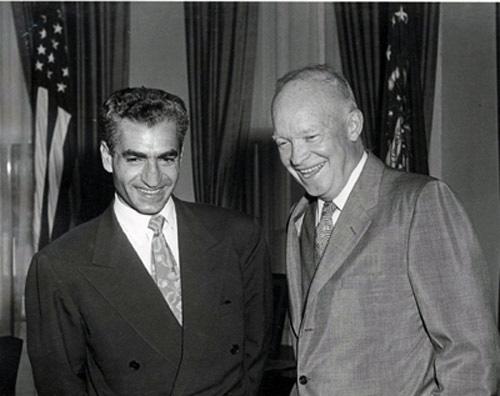
For decades, neither the U.S. nor the British governments would acknowledge their part in Mosaddeq’s overthrow, even though a detailed account appeared as early as 1954 in The Saturday Evening Post, and since then CIA and MI6 veterans of the coup have published memoirs detailing their activities. Kermit Roosevelt’s Countercoup is the best known and most detailed such account, although highly controversial because of its selective rendering of events. In 2000, The New York Times posted a 200-page classified internal CIA history of the operation.
Shah Mohammad Reza Pahlavi and President Dwight D. Eisenhower, (undated photo).
In 1989, the State Department released what purported to be the official record of the coup period but it made not a single reference to American and British actions in connection with the event. The omission led to the resignation of the chief outside adviser on the series, and prompted Congress to pass legislation requiring “a thorough, accurate, and reliable documentary record” of U.S. foreign policy. After the end of the Cold War, the CIA committed to open agency files on the Iran and other covert operations, and the State Department vowed to produce a “retrospective” volume righting the earlier decision.
But it took until 2011 for the CIA to – partially – fulfill its commitment, and even then it was only in the form of a previously classified segment of an internal account of the coup that for the first time included an officially released explicit reference to the agency’s role in “TPAJAX,” the U.S. acronym for the operation. Roughly two years later, after years of research by historian James C. Van Hook, as well as internal negotiations between State and CIA over access to the latter’s records, the Office of the Historian at the Department produced a draft of the retrospective volume, which then had to await top-level clearance.
What explains the refusal by two governments to acknowledge their actions, and the inordinate delays in publishing this volume? Justifications given in the past include protecting intelligence sources and methods, bowing to British government requests and, more recently, avoiding stirring up Iranian hardline elements who might seek to undercut the nuclear deal Iran signed with the United States and other P5+1 members in 2015.
While the volume’s contents still are being sifted through, here’s a description from the Preface:
This Foreign Relations retrospective volume focuses on the use of covert operations by the Truman and Eisenhower administrations as an adjunct to their respective policies toward Iran, culminating in the overthrow of the Mosadeq government in August 1953. Moreover, the volume documents the involvement of the U.S. intelligence community in the policy formulation process and places it within the broader Cold War context. For a full appreciation of U.S. relations with Iran between 1951 and 1954, this volume should be read in conjunction with the volume published in 1989.
“This is going to be an important source for anyone interested in the tortured relationship between Washington and Tehran,” said Malcolm Byrne, who runs the National Security Archive’s Iran-U.S. Relations Project. “But the fact that it has taken over six decades to declassify and release these records about such a pivotal historical event is mind-boggling.”
As Archive staff make their way through the hundreds of records in the volume, we will update this posting with highlights.
We would like to ask you to consider a small donation to help our team keep working. We accept no advertising and rely only on you, our readers, to keep us digging the truth on history, global politics and international relations.
Origins of images: Facebook, Twitter, Wikimedia, Wikipedia, Flickr, Google, Imageinjection, Public Domain & Pinterest.Read our Disclaimer/Legal Statement!Donate to Support UsWe would like to ask you to consider a small donation to help our team keep working. We accept no advertising and rely only on you, our readers, to keep us digging the truth on history, global politics and international relations.[wpedon id="4696" align="left"]SaveSave
Author’s Introduction and UpdateFirst published by GR on June 14, 2014, updated in August 2014, this article reveals how the US and its allies facilitated the incursion of Islamic State (ISIS) convoys into Iraq in June 2014 prior to the onset of the counter-terrorism bombing campaign launched by Obama in August 2014. It is worth recalling the history of the initial incursion of ISIS forces (Summer 2014) and the timeline extending from the occupation of Mosul in Summer of 2014 which was covertly supported by the US, to the “Liberation” of Mosul three years later which was also supported by ...
The crimes committed by the US against the people of Korea in the course of the Korean War but also in its aftermath are unprecedented in modern history.“We Killed Off – What – Twenty Percent of the Population. We Burned Down every Town in North Korea…”The above quotation is from General Curtis Lemay, who coordinated the bombing campaign (1950-53)Who is a Threat to Global Security? The US or the DPRK?The public perception of the entire population of North Korea is that the US is a threat to their national security.During the Korean War, the DPRK lost more than 25% of ...
American foreign policy seems to be designed to infuriate everyone, friend and foe alike, though we realise the word “friend” is a euphemism for “useful for American interests.” In a futile attempt to reassert its world hegemony the American ruling class has ripped up or is forcing changes to, free trade agreements with Canada and Mexico, with the EU and Pacific nations, ignores the World Trade Organisation rules, has reneged on the agreement it forced down Iran’s throat at the point of a gun with regard to a supposed nuclear weapons development, imposed economic blockades on Iran and Russia that ...
The West has a black history in the middle east that must be recognised. In 1916, Arabs joined the allied forces but deceived.The victorious western powers divided the region as they wished without any consideration to the peoples’ will. Then completed this crime by planting the state of Israel, which since day one spread state terrorism throughout the region.The West supported Israel and defied the international law set by the West. Our part of the world continued to live in a climate of war, militarisation and tension because of this. In this respect, the West practised and still the most ...
Just when you think that the Russo-phobic hysteria of the Western world couldn’t possibly make itself any more ridiculous…something like this comes along. This is the europeanvalues.net list of “useful idiots”.The list is very long, over 2300 names, because it contains the name of every person to ever appear on either Sputnik or RT. Hosts or guests, hostile or friendly, it doesn’t matter. If you’re on the list, you are a useful idiot.They’ve highlighted some names in yellow, to denote they’re “particularly noteworthy”. Names receiving the yellow highlight – the Russian agent equivalent of twitter’s blue tick – include Harrison ...
PrefaceThe Empire of Persia was the first global empire to cover the parts of the three continents (known at that time): Asia, Africa, and Europe.The story of the Persian Empire starts after the end of the Assyrian state followed by the plunder of its political center – Nineveh, in 612 BC by Babylon which retained the lowlands of Mesopotamia, while at the same time the highland territory (in fact, Katpatuka/Cappadocia), which was westward to the Halys River (today Kizil Irmak) became incorporated in the state of its allies – the Medes. Cyrus, the Prince of Persia, rebelled in 550 BC ...
Today marks twenty-nine years since the shootdown by the USS Vincennes of Iran Air flight 655, which killed all of the plane’s 290 civilian passengers. This shootdown of a civilian airliner by a US naval ship occurred on July 3, 1988, toward the end of the eight-year Iran-Iraq War.This incident is, of course, something that the people of Iran well remember. Americans who rely on the US mainstream media, on the other hand, would have to be forgiven for never having heard about it.Furthermore, in the rare instances when the media do mention it, to this day they tend to ...
Islam in the BalkansIt is the truth that the Balkan Peninsula is a mosaic of different and in some cases antagonistic religious communities with the Christian Orthodoxy, Roman Catholicism, and Islam as the principal religious denominations followed by different types of Protestants, followers of Judaism, Armenian Christian Orthodox, etc. The small Muslim communities existed at the Balkans even before the Ottoman conquest of the Peninsula which started in the mid-14th century but it was not until the mid-17th century that substantial Muslim population emerged firstly in Albania, Macedonia, Bosnia-Herzegovina, and Bulgaria.In a course of time, the Balkan Muslims became in ...
The public has been so brainwashed by Big Brother’s lies so that many people won’t believe this article unless they click onto the link wherever they happen to think that what it is alleging is false. Then, they will see the evidence, for themselves, and will recognize that they’ve been fooled about that matter, and those readers will learn something important that they didn’t know before — including that Big Brother is real, and what it actually is, and how it came to be the way it is. This is about reality, the reality behind the screen of lies.Today's Axis ...
A weakened leader in a powerful country can be a recipe for danger. Donald Trump's encroaching legal troubles might prove just the time for a seriously big international crisis, even a bit of a war. The obvious choice is Iran, and Trump may well have been heading that way even before his latest problems with Michael Cohen, Paul Manafort and potentially special investigator Robert Mueller.Trump may be confident of holding firm to his support base and thus ensuring the loyalty of Republican candidates in the mid-term Congressional elections. But as pressure grows on him, a conflict with Iran – encouraged ...
As was expected, President Trump has decertified Iran’s compliance with the nuclear deal or, to give it its full name, the Joint Comprehensive Plan of Action (JCPOA), despite the fact that he certified it twice before. As recently as 14 September 2017, Trump also waived certain sanctions against Iran as required under the terms of the deal. Yet, in an extremely belligerent and hostile speech, he put out his new policy towards Iran.The certification of the deal is not part of the agreement, but as anti-Iranian hawks in both parties wanted to undermine President Barrack Obama and create obstacles on ...
The US has been threatening Iran for more than 20 years. Already during the Clinton administration, US Central Command (USCENTCOM) had formulated “in war theater plans” to invade both Iraq and Iran. This posting which includes selected articles from our archives was originally published by Global Research 12 years ago in May 2005. In the wake of the war on Iraq (2003), the Bush administration officially identified Iran and Syria as the next stage of “the road map to war”. Bush’s National Security doctrine contained in the Project for the New American Century (PNAC) was a continuation of Clinton’s “strategy of ...
The first aspect to consider, following the US attack on Syria, is what Putin, Xi, and Rohani, leaders of the Russian Federation, the People's Republic of China, and Iran respectively, thought while American Tomahawks were hitting the Syrian air base of Shayrat.The last three years of the Obama presidency highlighted two very different strategies being advanced simultaneously by the US and the nations opposing its imperialistic overreach, principally Russia, China and Iran. The latter have been seeking cooperation, while the US, with its big hammer, has characteristically been on the search for nails to hammer. Yet the management of international ...
QASEM SULEJMANI FOUGHT IN BIH AGAINST SERBS?! A Croatian journalist discovers who was killed by the Iranian general! It was important for James Bond the Middle East, turning the WAR on in SYRIA!Hasan Haidar Diab (56) is a prominent Croatian journalist and war reporter. However, his link to the Balkans is in the Eighties of the last century, when from native Beirut to study in the then SFR Yugoslavia, and that is due thanks to the character and part of Josip Broz Tito, or his role in the Non-Aligned MovementOver the years of the war, primarily because of the knowledge ...