
Kosovo: The US “Psyche”, US Culture and US Foreign Policy
Are guns the problem then? Do we just get rid of all the guns? Cruise missiles and guns and air strikes are just the outer manifestations of a deeply-ingrained American culture of violence and insecurity and fear […]
Michigan-based filmmaker Michael Moore makes the connection between Kosovo and the Columbine shooting in his Academy Award-winning documentary Bowling for Columbine (2002). Moore puts Kosovo in the context of a broader U.S. foreign policy agenda and a domestic culture of violence. Moore asks: “Are we a nation of gun nuts or are we just nuts?”
In the first scene, Moore walks into the North Country Bank in Michigan to open an account. He saw an ad in the newspaper that the bank would give out free guns to those who open accounts there. Moore walks into the bank and tells the teller that he wants to open an account there. The teller asks him what type of account he wants. Moore answers:
“I want the account where I can (pause) get the free gun.”
The bank functions as a bank and as a licensed fire-arms dealer. Moore fills out an application and is given his free gun, a rifle. Moore asks the bank employee:
“Do you think it’s a little dangerous handing out guns in a bank?”
Moore is shown leaving the bank with the rifle slung over his shoulder. Fact is stranger than fiction. Moore understands this perfectly. You don’t have to invent anything, merely observe. His analysis and satire work perfectly to show the absurdity of the American obsession with violence and guns. Guns and violence do not make us more secure, but only feed our paranoia and feelings of panic and fear and insecurity.
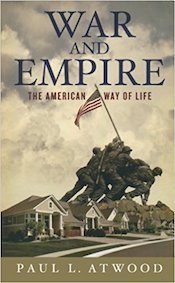
Moore analyzes the “gun culture” and obsession with violence and fear and paranoia in America. To understood the Kosovo conflict, you have to understand the US “psyche” and US culture and US foreign policy. The Kosovo conflict is Made in the U.S.A. You cannot comprehend the conflict without an understanding of the US culture of violence, the American “psyche” or national character.
Moore uses the Kosovo conflict and the illegal US and NATO bombing of Yugoslavia in 1999 to show the connection between a society and culture of violence and the implications for US foreign policy. The bombing of Serbia by the US is central to the plot of the Oscar-winning movie Bowling for Columbine. Kosovo is central to the movie.
In the key scene of the movie, the date “April 20, 1999” flashes on the screen. This was the day of the Columbine shooting in Littleton, Colorado. This was also the “largest one day bombing by the U.S. in the Kosovo war.” Moore plays news footage for that day. The announcer notes that “22 NATO missiles fell on the village of Bogutovac near Kraljevo. Deadly cargo was dropped on the residential part of the village.” This village is in lower central Serbia, not Kosovo, located in southern Serbia. The mutilated and contorted corpses of several Serbian civilians were shown. Then a news conference with US President Bill Clinton was shown. Clinton rationalized the civilian killings and the massive destruction to civilian buildings. Clinton said that the US wanted to “minimize harm to innocent people.” The announcer reported: “On the hit list were a local hospital and primary school.”
Here is a link to photos from the US bombing of Yugoslavia in 1999.
Then Moore segues into the Columbine shooting. On the screen flash the words: “One Hour Later.” One hour after Clinton tried to explain away the murder of innocent Serbian civilians, Clinton again appeared on US national TV to explain the Columbine shootings. Clinton announces: “We all know there has been a terrible shooting at a high school in Littleton, Colorado.”
Moore’s central thesis is that there is a direct link between the US murders of Serbian civilians and the murders at Columbine high school. To understand the former you have to understand the latter. And to explain both, you have to understand US foreign policy during the Cold War and the American culture of violence, a gun culture rooted in racial paranoia and fear. “Happiness is a warm gun.”
The movie opens with Moore describing April 20, 1999 as a typical day in the US. The farmer did his chores. Moore shows a scene of James Nichols, the brother of convicted Oklahoma bomber Terry Nichols, working on his tofu farm in Decker, Michigan. Moore then shows bombing damage from US air strikes in Serbia. Moore says: “The President bombed another country whose name we couldn’t pronounce.”
Moore then sets out to explore why the Columbine shooting happened. Why did the kids do that? Why did they murder their fellow students and a teacher in cold blood that day? How do you explain such mindless and senseless violence?
Lockheed Martin, the largest weapons and arms manufacturer in the world, is located outside of Littleton. Moore seeks to find a connection between Lockheed and the manufacture of weapons and the Columbine shooting. The US is the largest weapons and arms exporter in the world. The US has the largest military budget in the world. Lockheed is also the largest employer in Littleton. NORAD is located outside Littleton, as is a closed-down plutonium plant. Moore also showed the B-52 bomber monument with a plaque that honored the killing of Vietnamese civilians. Does Littleton’s proximity to this military and arms nexus have anything to do with a culture of violence?
Moore interviewed Evan McCollum, the public relations spokesperson for Lockheed. Moore asked him whether he saw a connection between the “mass destruction” that Lockheed creates in the world and the “mass destruction” that occurred in Columbine. Isn’t it the same? Doesn’t Lockheed make weapons of mass destruction that kill innocent people around the globe so that Americans can earn their living and corporations can earn their profits? When in doubt, we bomb. We bomb early and often. Bombs or ballots? What good are bombs if you don’t use them? What good are ballots if the opposition wins? McCollum denied the connection. The US does not export violence and does not murder and kill innocent civilians around the world. We don’t bomb other countries just because they don’t kiss our asses and buy our Big Macs and Whoppers. We bomb for all the right reasons.
Moore then had a satirical refutation of McCollum’s rhetorical claims. With a recording of Louis Armstrong’s 1968 non-hit “What a Wonderful World” playing in the background, Moore then showed footage of the 1953 US ouster of Prime Minister Mohammed Mossadeq in Iran, who was democratically elected. Mossadeq sought to help the Iranian population exploited by foreign oil interests. The US instigated a “regime change” of this democratically elected reform leader and put in his place the Shah as dictator, who would protect US and British oil interests at the expense of the Iranian people. Could this have anything to do with the 1979 Iran hostage crisis and Iranian rage against the United States? In 1954, the democratically elected Jacobo Arbenz government in Guatemala was overthrown by the CIA and a military junta under US-installed dictator, Colonel Carlos Armas, was imposed, who subsequently murdered thousands of civilians. Arbenz initiated land reforms that would help the Guatemalan poor but which threatened the property holdings of the US company United Fruit. United Fruit, closely linked with the CIA, compelled the CIA to organize a regime change. The US-installed junta murdered 200,000 Guatemalans.
During the Vietnam War, US forces killed four million Vietnamese civilians in order to maintain in power a US-installed dictator, Ngo Diem. The US had initially installed Diem to prevent democratic elections that would express the majority will of the Vietnamese population. On November 2, 1963, US President John F. Kennedy approved the assassination of Diem, who was murdered by a more subservient dictator. Diem’s wife, Madame Nhu, blamed the US government for the assassination: “Whoever has the Americans as allies does not need enemies.” Twenty days later, Kennedy would himself be assassinated.
In 1973, the democratically elected Salvador Allende regime was overthrown by the US after a three year regime change campaign by the CIA that began in 1970 when the US tried unsuccessfully to prevent his assuming his elected office of President of Chile. The US put in the genocidal dictator Augusto Pinochet. The US right-wing puppet Pinochet then murdered 5,000 Chilean civilians, the “disappeared”. In 1977, the US backed the El Salvadoran military forces and death squads who murdered 70,000 civilians and four US nuns.
Nothing shows the true American national character better than US support of Saddam Hussein, the Ayatollah Khomeini regime in Iran, and Ossama bin Laden in the 1980s. In 1982, Moore alleged that the US gave Saddam Hussein “billions in aid” so he could continue the war against Iran. Donald Rumsfeld even flew to Baghdad to personally meet and greet our staunchest ally, Saddam Hussein. In 1983, the US sought to provide Iran arms and weapons to kill Iraqis, the Iran-Contra operation spearheaded by Oliver North under the Ronald Reagan administration. The US was supporting both sides in the Iraq-Iran conflict. The US just wanted Muslims killing Muslims. There was nothing about “freedom” and “democracy” and “genocide”. It was just about getting Muslims to kill other Muslims. It was a quite simple game back then. In 1991, the US returned to power the dictator Emir Jaber Al-Sabah in Kuwait, a country where only 15% of the population could vote and where women were not allowed to vote. Kuwait was of vital strategic importance to the US because of US reliance on Gulf oil.
Moore explained how the Clinton administration bombed an aspirin factory in Sudan in 1998 which it mistook for a terrorist base. Indiscriminate bombing substitutes as a band-aid solution for a failed foreign policy. Before the 2003 invasion of Iraq, the US had killed what the UN had estimated as “500,000 Iraqi children” through sanctions and non-stop bombings in the no-fly zones.
A remarkable revelation is that Clinton gave the Taliban government in Afghanistan $245 in aid during 2000-2001, just before the 9/11 attack, which was planned and organized in Taliban-ruled Afghanistan, the home base for Al-Qaeda. Finally, Moore alleges that Ossama bin Laden used his CIA training as a US-backed and US-funded mujahedeen “freedom fighter” in Afghanistan to plan the 9/11 attacks. Moore alleges that the US gave the mujahedeen $3 billion in aid during the 1980s. The US training by the CIA came in mighty handy for 9/11, as did the $245 million in aid from the Clinton administration.
Are guns the problem then? Do we just get rid of all the guns? Cruise missiles and guns and air strikes are just the outer manifestations of a deeply-ingrained American culture of violence and insecurity and fear. Moore explained it this way. Even if we got rid of all the Tomahawk cruise missiles and guns, “we would still have the psyche problem—the problem that says we have a right to resolve our disputes through violence. That’s what separates us from other countries.”
This is something that has to be understood if anyone wants to grasp the Kosovo conflict. This is a movie everyone should see. Here is a link to the Bowling for Columbine site.
We would like to ask you to consider a small donation to help our team keep working. We accept no advertising and rely only on you, our readers, to keep us digging the truth on history, global politics and international relations.
More than 20 years after the Srebrenica massacre, Bosnian Serb General Ratko Mladić was found guilty of war crimes by the International Criminal Tribunal for the former Yugoslavia this past November.Along with Mladić, the ICTY convicted the other so-called “Butcher of Bosnia”, the Bosnian Serb and former Republika Sprska leader Radovan Karadžić in 2016. Meanwhile, it fully exonerated the Bosnian Muslim army commander Naser Orić of similar charges which outraged the people of Serbia. Yet, it was the same court that posthumously exonerated former Serbian President Slobodan Milošević in 2016. If you weren’t aware of the latter, it’s because it ...
The brutal destruction of ex-Yugoslav Federal state-system was in a form of the civil wars or, in another word, a chain of violent conflicts from 1991 to 1995. From the spring of 1992, the SFRY already did not exist as a state and, therefore, the conflicts were turned into the Wars of the Yugoslav Succession.The Yugoslav civil wars can be comprised of the three closely related armed conflicts:1) War in Slovenia in 1991.2) War in Croatia from 1991 to 1995.3) War in Bosnia-Herzegovina from 1992 to 1995.[i]In the year of 1990, the real potential for the armed conflict became quite ...
Wednesday, December 5, 2012, the Albanian Prime Minister Sali Berisha advocated granting Albanian citizenship to all Albanians, wherever they reside. This statement was made during a visit of the city of Vlora where the independence of the Albanian state was declared, only 100 years ago. At the time Albania had just liberated itself from Ottoman rule.This declaration follows a separate statement, collective this time, that Sali Berisha had made with his Kosovar counterpart Hashim Thaci a few weeks ago, promising the union of all Albanians. The place was, I must say, well chosen since the vast majority of the inhabitants ...
This Remembrance Day will doubtless see strenuous efforts by some to justify the fruitless bloodbath that was the First World War. Revisionist commentators have long attempted to rehabilitate the conflict as necessary and just, but the arguments do not stand up. It does no service to the memory of the dead to allow any illusions in the justice or necessity of war, particularly so when the precedents will be used to argue for the next ‘necessary’ conflict. From the causes of the war, to its prosecution and its results, here are the counter-arguments to ten common pro-war ploys.1. The war ...
Origins of images: Facebook, Twitter, Wikimedia, Wikipedia, Flickr, Google, Imageinjection & Pinterest.Read our Disclaimer/Legal Statement!Donate to Support UsWe would like to ask you to consider a small donation to help our team keep working. We accept no advertising and rely only on you, our readers, to keep us digging the truth on history, global politics and international relations.
A dictatorship does not represent the public but only the aristocracy that, behind the scenes, controls the government.Jonathan H. Adler, Professor at Case Western University School of Law, noted, regarding George W. Bush’s secret policy for the NSA to access everyone’s phone-records, that “The metadata collection program is constitutional (at least according to Judge Kavanaugh),” and he presented Judge Kavanaugh’s entire published opinion on that. Kavanaugh’s opinion stated that the 4th Amendment to the US Constitution could be shoved aside because he thinks that the ‘national security’ of the United States is more important than the Constitution. Kavanaugh wrote:The Government’s program for bulk collection ...
Serbs: Basic factsEthnic location: Central and western part of the Balkan Peninsula (South-East Europe)Population: 10.2 million (1.8 million Serbs live outside their ethnic location)Language: SerbianReligion: Eastern Orthodox Christians1 Introduction Serbs belong to the Southslavonic group of Indo-European peoples. As their tradition, culture, language, beliefs, and customs show, the ethnogenesis of Serbs goes far back into the past. Serbian ancestors, Protoslavs and Old Serbs, were described in the 5th century BC by Herodotus, under the names of Neuri and Budini, living north of the Danube in the region between Dniepar and north-eastern Carpathian Mountains.The first mention of the name “Serbs” appears ...
The public denunciation by thousands of women and a few men that they had been victims of sexual abuse by their economic bosses raises fundamental issues about the social relations of American capitalism.The moral offenses are in essence economic and social crimes. Sexual abuse is only one aspect of the social dynamics facilitating the increase in inequality and concentration of wealth, which define the practices and values of the American political and economic system.Billionaires and mega-millionaires are themselves the products of intense exploitation of tens of millions of isolated and unorganized wage and salaried workers. Capitalist exploitation is based on ...
Throughout the past decade, the UN General Assembly Third Committee has adopted the resolution: “Combating Glorification of Nazism, neo-Nazism and other practices that contribute to fueling contemporary forms of racism, racial discrimination, xenophobia and related intolerance.”Every year the resolution is adopted by an overwhelming majority of UN member states, while the European Union, which, as the battleground of Nazism should have supported the resolution, merely abstains, and their fence-straddling raises disturbing questions about their actual tendencies. Japan’s abstention raises equally disturbing questions. The United States has consistently, and shockingly, opposed this resolution.The resolution is sponsored by the Russian Federation, which ...
On Saturday, May 14, in Stockholm’s Globe Arena an event called the 2016 Eurovision Song Contest final will take place.According to the Eurovision Official Rules 2016 posted on eurovision.tv:1.2) Criteria of eligibility1.2.1) Songs“The lyrics and/or performance of the songs shall not bring the Shows, the ESC as such or the EBU into disrepute. No lyrics, speeches, gestures of a political or similar nature shall be permitted during the ESC. No swearing or other unacceptable language shall be allowed in the lyrics or in the performances of the songs. No messages promoting any organization, institution, political cause or other, company, brand, ...
Seventeen years ago today, on March 24, 1999, NATO began a 78-day deadly and devastating U.S.-backed intervention of Yugoslavia. It was the first time in history that the North Atlantic Treaty Organization decided they would attack a country without the approval of the U.N. Security Council.Nineteen countries took part in the aggression led by the United States that was supposed to stop the repressive activities of the Slobodan Milosevic government and to establish a framework for its Southern province, Kosovo, under international law. Milosevic was president of Serbia from 1989 to 1997, and of Yugoslavia from 1997 to 2000.The attack was ...
PrefaceAfter the end of the USSR in 1991, Russia, at that time both weakened and isolated, was becoming a less popular area of investigation and studies compared with the period during the Cold War. However, since the year of 2004, Russia is “back” in the global political arena when Moscow rejected the European Neighboring Policy’s game with the European Union (the EU). Those who argued that Russia was already irrelevant in global politics since 2004 had to realize their error of judgment. Today, Russia is “back” as a military, economic, and political Great Power with tremendous energy resources.[1] Recovering Russia’s ...
Kosovo obtained part independence when America and many European nations gave the go ahead for the creation of this new nation. However, it is clear that things are not plain sailing because many other nations did not support this elitist adventure, therefore, the wider international community was ignored. Therefore, today we have a situation where some nations support this new state, however, the majority of nations in Africa, Asia, and South America, have not given their consent.Also, the Russian Federation, Spain, and some other European nations, refuse to accept this American led adventure. Therefore, what does the future hold for Kosovo ...
The measures being taken by the government of President François Hollande in response to Friday’s terrorist attacks in Paris constitute an unprecedented attack on democratic rights.The Socialist Party (PS) government has declared a state of emergency and mobilized more than 100,000 security personnel throughout the country, including regular police, gendarmes, paramilitary riot police and military forces. It is impossible to walk the streets of any major city without running into individuals decked out in camouflage or dressed in black, toting automatic rifles. These paramilitary forces have been given the power to raid any home and arrest or kill anyone declared ...
The U.S. public loves fascists; they elect them, constantly. Donald Trump, who “says he would raise the minimum wage and stop the endless efforts at regime change,” is called a fascist by some. But Hillary Clinton “is happy to bomb Libya or Syria or any other country,” and played a major role in mass Black incarceration. Barack Obama is the war-maker and deporter-in-chief. “All of the major party candidates fit the F word description in some way.”“No one comes into office with any intention of undoing America’s leadership as the world’s worst jailer.”Donald Trump is the ill spoken, boorish, graceless ...
Here are before-and-after pictures, at https://twitter.com/MAL0mt/status/701077438525263873/photo/1, of what the U.S. government has achieved, in the Middle East:What’s especially interesting there, is that in all of these missions, except for Iraq, the U.S. was doing it with the key participation of the Saud family, the royals who own Saudi Arabia, and who are the world’s largest buyers of American weaponry. Since Barack Obama came into the White House, the operations — Libya, Yemen, and Syria — have been, to a large extent, joint operations with the Sauds. ‘We’ are now working more closely with ‘our’ ‘friends’, even than ‘we’ were under George W. Bush.As President Obama instructed his military, ...
The role of Jewish figures and that of the State of Israel in the Ukrainian crisis has not gone unnoticed considering that this community represents less than 1 percent of the population. However, a secret report in the hands of the Netanyahu administration confirms that Ashkenazi Jews do not originate from the Levant, but are the descendants of the Khazars. This little-known population founded a Jewish empire in the tenth century on the banks of the Black Sea. Therefore, some Zionists see in Ukraine a possible second Israel.The Times of Israel, an independent Israeli newspaper that counts among its staff ...
The US has been threatening Iran for more than 20 years. Already during the Clinton administration, US Central Command (USCENTCOM) had formulated “in war theater plans” to invade both Iraq and Iran. This posting which includes selected articles from our archives was originally published by Global Research 12 years ago in May 2005. In the wake of the war on Iraq (2003), the Bush administration officially identified Iran and Syria as the next stage of “the road map to war”. Bush’s National Security doctrine contained in the Project for the New American Century (PNAC) was a continuation of Clinton’s “strategy of ...
While the typical narrative of American history positions the United States as a supporter of democracy and opponent of fascism which helped to defeat the Nazis, key figures in Washington also supported dangerous dictators in Italy and Germany in their early days of power.Noam Chomsky, the renowned political philosopher, historian and scholar, examined the flip side of U.S. opposition to dictatorship in a conversation with Zain Raza, a senior editor at the independent media outlet acTVism Munich. An excerpt from the conversation was published Sept. 30 as part of acTVism Munich’s “Reexamining History” series.Speaking to Raza about Italian dictator Benito ...
The historical and political precedents for the creation of a greater Sqiperia or Greater Albania was set during World War II when the Kosovo and Metohija regions along with territory Southwest of lake Skutari from Montenegro and the western region of Southern Serbia, or Juzna Srbija (now part of Macedonia), were annexed to Albania by the Axis powers led by Fascist Italy and Nazi Germany, under a plan devised by Benito Mussolini and Adolf Hitler to dismember and to destroy the Serbian Nation and people, which the Germans and Italians perceived as the main threat to the Axiss powers and ...