
The Mexican-American War was an imperialistic bonanza, in which Washington used a dubious territorial claim as an excuse to seize half of its neighbor. Some U.S. officials desired to take the whole nation [...]
Veterans Day has passed. The annual ritual never changes. Politicians who didn’t serve in the armed services start unnecessary wars, killing military personnel whose sacrifices are then lauded. Officials say these heroes died defending our freedom. That is almost always a lie.
Sometimes Washington must go to war. Not often, however. Despite the endless claims that we live in a dangerous world, America is amazingly safe. No other power could defeat, let alone conquer, the United States. Only Russia has a comparable nuclear arsenal, but it would be destroyed if Moscow targeted America. China and Russia trail U.S. conventional military strength and are more or less strategically isolated. In contrast, Washington is allied with every other major industrialized state.
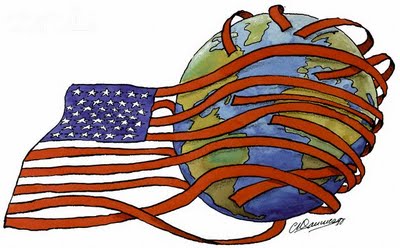
Despite their bluster, the so-called rogue states, most notably North Korea and Iran, are not planning to attack the United States. Instead, they are desperate to ward off American attack. Since Washington routinely employs regime change against governments on America’s “naughty” list, Kim Jong-un looks rational, not suicidal, in seeking to create a deterrent to preserve his rule.
Washington’s most pressing security challenge is terrorism. But while targeting civilians is a moral outrage, terrorism does not pose an existential threat to America. Indeed, European and Latin American nations have confronted and survived more virulent attacks. Israel, Sri Lanka and Turkey also have suffered prolific terrorist bombings. So, too, Iraq, after Washington invaded that country and triggered sectarian war.
Moreover, interventions, invasions and occupations are no answer to terrorism. On the contrary, terrorism is a poor man’s weapons against stronger powers. It is politics by other means when the other side has a preponderance of traditional military power. To understand terrorism is not to justify it. But it long has been a political tool: two Russian czars, an Austro-Hungarian archduke (heir apparent), two former Indian prime ministers and countless other foreign officials have been assassinated by terrorists. Before Iraq, the most prolific suicide bombers on earth did their killing in Sri Lanka. Countries like Russia are not targeted because they are so liberal; Turkey, Jordan and Kuwait are not attacked for being infidels.
Washington should kill or incapacitate those already determined to kill Americans, but also stop making so many enemies. In Yemen, for instance, the United States is helping the repressive, licentious Saudi royals slaughter people who have never done anything against America. Washington is involved in a civil war in which Riyadh intervened to reinstall a pliant regime. The Yemenis know who is providing the bombs to Saudi Arabia, offering targeting assistance to the Saudi air force and refueling Saudi planes. It should surprise no one if someday a Yemeni commits terrorism against the United States and its people.
Yet the United States is constantly at war, and in far more nations than most Americans realize. Combat in Afghanistan is entering its seventeenth year. U.S. personnel are back in Iraq. They are fighting in Syria, the Philippines and across Africa, including Niger, where four American servicemen recently died. Drone campaigns and special operations forces have been particularly active in Pakistan, Somalia and Yemen. As noted earlier, the United States is also underwriting Saudi Arabia’s aggressive war against Yemen. Worse, Washington is prepared to battle China, Russia and North Korea to defend prosperous and populous allies, which could defend themselves.
Perhaps most striking is how few of America’s “big wars” are justifiable. Most were conflicts of choice undermining rather than sustaining American liberties. The revolution created the nation. But while Washington was justified in defending itself from Great Britain in the War of 1812, the most serious casus belli, an attack on an American warship, took place years before. In 1812, war fever mostly reflected the desire to annex Britain’s Canadian possessions.
The Mexican-American War was an imperialistic bonanza, in which Washington used a dubious territorial claim as an excuse to seize half of its neighbor. Some U.S. officials desired to take the whole nation. The Spanish-American War was equally misguided: Spain brutalized its colony of Cuba, but no worse than Americans treated their native population. Moreover, Washington seized the Philippines as well, even though it had nothing to do with the initial dispute. The United States suppressed an indigenous independence movement with enormous brutality; some two hundred thousand Filipinos died in the process.
World War I was a foolish, unnecessary war. Washington joined with the so-called Entente, which included the anti-Semitic despotism of the Russian Empire, and defended Serbia, whose murderous rulers triggered the conflict by engaging in an act of state terrorism. Aiding them did nothing to “make the world safe for democracy.” Rather, President Woodrow Wilson imagined himself anointed from on high to remake the globe.
Alas, World War II was the inevitable result of Wilson’s folly, the unfinished business from the so-called Great War. World War II is usually considered the “good war,” with clear and evil enemies. But it likely would not have occurred had the United States not previously unbalanced the European balance of power and promoted an unsustainable “settlement,” which broke down almost immediately.
Origins of images: Facebook, Twitter (X), Wikimedia, Wikipedia, Flickr, Google, Imageinjection, Public Domain & Pinterest.
Read our Disclaimer/Legal Statement!
Donate to Support Us
We would like to ask you to consider a small donation to help our team keep working. We accept no advertising and rely only on you, our readers, to keep us digging the truth on history, global politics and international relations.
Several years ago two very distinguished American scholars wrote a book, The Israel Lobby.The book made a very understated case that the Israel Lobby has far more power over the US government and media than is good for America or Israel, as it silences constructive critics who are Israel’s friends. The two scholars were demonized by the Israel Lobby as advocating the return of the Holocaust.The Israel Lobby presented itself as just a poor little weak thing unable to stand up to all the Nazis assailing Israel. Meanwhile the US Congress was unanimously passing outrageous resolutions handed to it by ...
The Imperial Anatomy of Al-Qaeda. The CIA’s Drug-Running Terrorists and the “Arc of Crisis”Part IIntroductionAs the 9th anniversary of 9/11 nears and the war on terror continues to be waged and grows in ferocity and geography, it seems all the more imperative to return to the events of that fateful September morning and re-examine the reasons for war and the nature of the stated culprit, Al-Qaeda.The events of 9/11 pervade the American and indeed the world imagination as a historical myth. The events of that day and those leading up to it remain largely unknown and little understood by the ...
America is unique among history’s warrior states – prioritizing endless wars, not ending them to achieve a new era of peace and stability.The notion is anathema to the nation’s military, industrial, and media establishment. Wars are waged for power and profits, no other reasons.All post-WW II US wars were and continue to be acts of naked aggression against nations threatening no one – raping and destroying them, the human cost incalculable, the villainy unprecedented.Throughout its history, America has been perpetually at war at home and/or abroad, never a time of peace and stability – a shocking indictment of its abhorrent ...
The Israeli historian Benny Morris has been very vocal of late in denying that Palestine was ethnically cleansed of Arabs in order for the “Jewish state” of Israel to be established. In a series of articles in the Israeli daily Haaretz, Morris has debated the question with several of his critics who contend that ethnic cleansing is precisely what occurred. Not so, argues Morris. So who’s right?It’s worth noting at the outset that, while such a debate exists in the Israeli media, the US media remains, as ever, absolutely silent on the matter. Americans who get their information about the ...
Political discourse of American mass media is inundated with another wave of Russophobia and fear mongering. Besides the obvious military threat (Russia’s nuclear arsenal), or the challenges to the US foreign policy (the conflicts in Ukraine or Syria), a new fear has been introduced into the news: the US political system is endangered by Russia’s computer hacking, informational warfare, and its support of Donald Trump.The newspaper titles sound like a commercial for the upcoming Invasion of the Body Snatchers sequel. The Washingon Post announces: “Russia Is Now a Threat. The US Should Treat It Like One.” Time magazine raises the ...
Barack Obama is the first two-term American president to have presided over war every day of his tenure in office. He bequeaths to a Trump administration ongoing operations in Afghanistan, continuing drone strikes in northwest Pakistan, the consequences of the 2011 destruction of Libya, the instigation of civil war in Syria, US sponsorship of the brutal Saudi interventions in Yemen, and the civil conflicts in Ukraine, the Caucuses and across Africa.Obama’s blood-soaked legacy, however, is most graphic in Iraq. There is a bitter irony in this, given the fact that he was elected in 2008 largely on the basis of ...
In early January 2020, Serbian media reported the sensational news that recently declassified British Ministry of Defense files contained important new evidence suggesting that the official account of what happened in Srebrenica was unfounded.As from time to time has been the case, Western sources have again disclosed some information about Srebrenica in July 1995, which until recently was kept confidential and therefore not available to the public. The source of this particular batch of documents is the UK Department of Defense. The documents that have finally been declassified contains very interesting assessments and reports that take on even greater significance ...
Paul Atwood, a Senior Lecturer in American Studies at the University of Massachusetts Boston, provides a concise summary of the history that informs North Korea’s “relations with the United States” and “drives its determination never to submit to any American diktat”.Excerpts from Atwood’s summary are here used as a framework, with other sources where indicated.Atwood notes it is an American “myth” that the “North Korean Army suddenly attacked without warning, overwhelming surprised ROK defenders.” In fact, the North/South border “had been progressively militarized and there had been numerous cross border incursions by both sides going back to 1949.”Part of what ...
Documentary films about ex-Yugoslavia not seen on global corporate mass-media news. For instance:US documentary movie "RETLINES" with English subtitle from 1991 about Vatican smuggling Croat Nazi Ustashi to South America in 1945Ratlines were a system of escape routes for Nazis and other fascists fleeing Europe at the end of World War II. These escape routes mainly led toward havens in South America, particularly Argentina, Paraguay, Brazil, Uruguay, and Chile. Other destinations included the United States and perhaps Canada and the Middle East. There were two primary routes: the first went from Germany to Spain, then Argentina; the second from Germany ...
Historical research into the Nazi era rarely throws up many surprises any more. German historian Stefan Ihrig, however, is an exception to this rule. By studying long-published sources, he has uncovered the fascination that Ataturk's modern Turkey held for the German far right, which has been seriously underestimated until now and which set an example for Hitler and the National Socialists.From a right-wing viewpoint, what Ataturk had achieved was an unattainable goal for Weimar-era Germany. Using force of arms, he had managed to reverse the Treaty of Sevres, which had been forced on his country by the Entente in 1920, ...
How many times have we seen this before?The President of the United States is on TV telling us horror stories. Some innocent people in some corner of the world are being crushed, he tells us. They face some monstrously evil oppressor, he says. While the United States doesn’t like war, what choice is there? Sacrifices must be made, cruise missiles must be unleashed, to protect the poor and innocent. The world is the set of an action movie, and the US is the tragic hero, forced to rescue the innocent.This is the script we heard in former Yugoslavia. Bill Clinton ...
Today, December 10, 2016 is Human Rights Day. We bring to the attention of our readers the powerful message of the late Harold Pinter regarding US Imperial Crimes against Humanity, with an introduction by Gary Kohls. First published in December 2014.“We have brought torture, cluster bombs, depleted uranium, innumerable acts of random murder, misery, degradation and death to the Iraqi people and call it ‘bringing freedom and democracy to the Middle East’. – Harold PinterBritish playwright Harold Pinter won the Nobel Prize for Literature in 2005. His powerful acceptance speech exposed the United States for its fascist, imperialist policies since World ...
As the Cold War entered its final act in 1985, journalist Helena Cobban participated in an academic conference at an upscale resort near Tucson, Arizona, on U.S.-Soviet interactions in the Middle East. When she attended what was listed as the “Gala Dinner with keynote speech”, she quickly learned that the virtual theme of the evening was, “Adopt a Muj.” “I remember mingling with all of these wealthy Republican women from the Phoenix suburbs and being asked, ‘Have you adopted a muj?” Cobban told me. “Each one had pledged money to sponsor a member of the Afghan mujahedin in the name ...
There is less talk about the rump-Ukraine in the news these days, especially in the western corporate media, and there is a good reason for that: that short-lived Urkonazi “Banderastan” is falling apart. This is hardly surprising since the entire concept was never viable in the first place. Let’s remember how it all began.It is crucial to remember that there was no spontaneous revolution or insurrection in the Ukraine, the Euromaidan had nothing to do with Europe and everything to do with the USA. Oh sure, the Ukrainian people were told that it was about “joining the EU”, but that ...
Grenada is an independent state, a member of the U.N., located in the southern portion of the Caribbean Sea very close to the mainland of the South America (Venezuela). The state is composed by southernmost of the Windward Islands combined with several small islands which belong to the Grenadines Archipelago, populated by almost 110,000 people of whom 82% are the blacks (2012 estimations). The state of Grenada is physically mostly forested mountains’ area (of volcanic origin) with some crater lakes and springs. In the valleys are bananas, spices and sugar cane grown. The country is out of any natural wealth ...
Ever since the end of World War II, the United States, rightly or wrongly, but most of the time, wrongly, has fancied itself as the «world’s policeman». Even a disastrous and costly military intervention in Southeast Asia did not deter the United States from acting as the chief arbiter of what governments were «in» and which were «out» as evidenced by Central Intelligence Agency interloping in Nicaragua, El Salvador, Angola, Haiti, and Colombia. Two military interventions in Iraq and a U.S.-led military campaign directed against Yugoslavia were not enough to pry the United States from its self-appointed role as the ...
Origins of images: Facebook, Twitter, Wikimedia, Wikipedia, Flickr, Google, Imageinjection, Public Domain & Pinterest.Read our Disclaimer/Legal Statement!Donate to Support UsWe would like to ask you to consider a small donation to help our team keep working. We accept no advertising and rely only on you, our readers, to keep us digging the truth on history, global politics and international relations.[wpedon id="4696" align="left"]Save
“Now that the global circumstances have changed, and when the United States and NATO are losing their influence, and while the powers that are in favor of preserving Kosovo and Metohija – such as Russia and China – are strengthening, we are nevertheless pursuing a policy of complete surrender.”The aim of the internal dialogue conducted by the Serbian President Aleksandar Vucic, should be to distribute responsibilities and to be the cover for the final surrender of Kosovo and Metohija.The government constantly assures us that it will never recognize Kosovo as an independent State, but here we must point out the ...
“ … war in our time is always indiscriminate, a war against innocents, a war against children.”(Howard Zinn, 1922-2010.)“All war represents a failure of diplomacy.” (Tony Benn, MP. 1925-2014.)“No country too poor, too small, too far away, not to be threat, a threat to the American way of life.” (William Blum, “Rogue State.”) The mention of one tiny country appears to strike at the rationality and sanity of those who should know far better. On Sunday, 6th August, for example, The Guardian headed an editorial: “The Guardian view on sanctions: an essential tool.” Clearly the average of five thousands souls a month, the majority ...
IntroductionToday it is quite obvious that the Western-backed process of creation of a Greater Albania is not any propaganda myth but rather visible reality. South Serbia’s province of Kosovo-Metochia is already, de facto, part of “united” Albania from June 1999 and current political situation in the Former Yugoslav Republic of Macedonia is surely going to the direction of the separation of North-West Macedonia mainly populated by Albanians who succeeded with the crucial Western support to promulgate a new language law in Macedonia’s Parliament according to which, the Albanian language is going to be a second state language (i. e., together ...