

Views: 3515
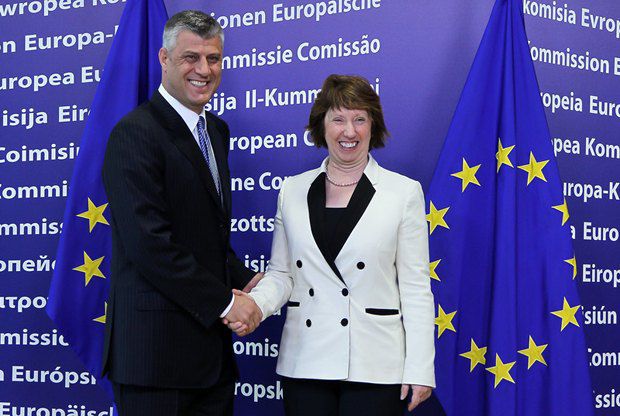
Families want to know if one of the reasons of halting the investigation was, as they claim, the fact that the murderer came from the village of Ćuška, the birthplace of the former commander of the Kosovo Liberation Army and the current minister of Kosovo’s security forces, Agim Ceku.
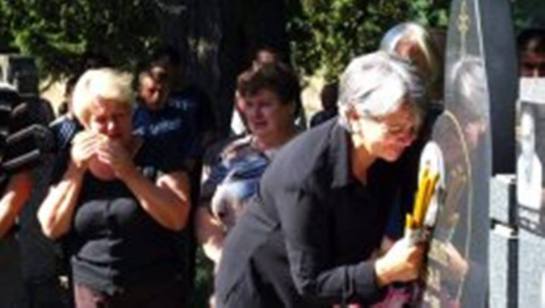
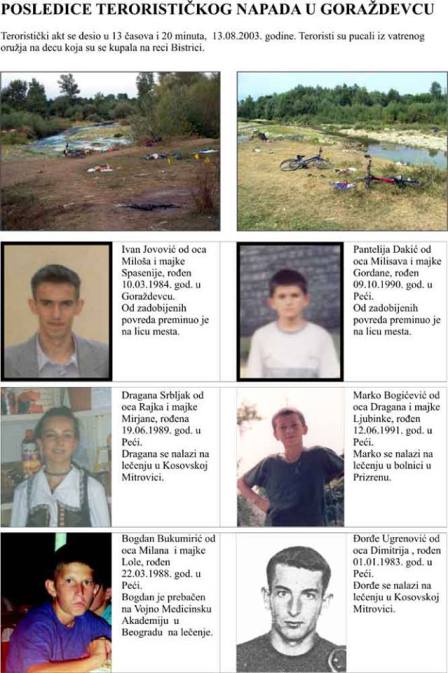
GORAŽDEVAC, SRNA – Tuesday marks the 12th anniversary of the murder of Serbian children in Goraždevac near Peć. On August 13, 2003, Ivan Jovović aged 19 and Pantelija Dakić aged 12 were taking a swim in the Bistrica River when they were shot dead with automatic weapons.
Their peers Đorde Ugrenović aged 20, Bogdan Bukumirić aged 14, Marko Bogićević aged 12, and Dragana Srbljak aged 13 were severely wounded.
Despite promises and a million-mark reward offered by UNMIK administration and police for information leading to the orchestrators and perpetrators of the crime – no one has been brought to justice to this day.
In late 2010, due to “lack of evidence” EULEX closed the investigation which it took over from UNMIK upon its arrival in Kosovo, even though it also “inherited” the promise made by former UNMIK police chief Stefan Veller that “no stone will be left unturned” in an attempt to find the perpetrators of the crimes committed against the Serbian children.
 Despite their assurances that they came to Kosovo and Metohija to enforce the rule of law and detect all crimes, EULEX investigators once again confirmed by suspending the investigation that the crimes against the Serbs are swept under the carpet and, as they like to put it, that type of crime is difficult to investigate due to the “wall of silence.”
It remains uncertain why it took Prosecutor Alenka Sagmeister-Ranzinger from Slovenia 8 years (!?) – February 2011. – to let the families know that the investigation was suspended.
The murdered and wounded children’s families want to know if one of the reasons of halting the investigation lies in the fact that the murderer came from the village of Ćuška, the birthplace of the former commander of the Kosovo Liberation Army and the current minister of Kosovo’s security forces, Agim Ceku.
Serbian families received the information thanks to the efforts of Bogda n Bukumirić, who received seven entry-and-exit wounds in the attack and who persistently asked EULEX to inform him of the results of the investigation.
The Prosecutor’s Office’s decision came as a shock to the families and they felt resentment over it, while Bukumirić who barely survived the attack that left him disabled believes that the “investigation on this monstrous crime was not conducted the way it should have been” and that Serbia and its prosecuting authorities should seek another investigation.
When he heard that the investigation was suspended, former minister for Kosovo Goran Bogdanović asked EULEX, UNMIK and KFOR to say how many years it would take them to shed light on at least one crime against the Serbs and what was preventing them from doing it.
“If after 10 years not a single crime against the Serbs has been prosecuted, then the international agencies should clearly state what or who the problem is, but they also need to remove the obstacles and create the conditions to finally solve those crimes,” Bogdanović said at the time.
Families of the dead children are urging the international bodies to finally raise the issue of the other crimes against the Serbs.

Apart from Goraždevac, the crimes that have not been prosecuted yet are the one in Staro Gracko when 14 Serbian harvesters were killed, the murder of four members of the Simić family in the village of Slivovo near Gračanica, the murder of the Stolić family in Obilić, the attack on a Niš Express bus in the village of Livadice near Obilić, etc.
The Tuesday commemoration will be held in a local church in Goraždevac and in the town’s cemeteries, while the Kosovo Police is reported to provide security for the assembly of Serbs.

Originally published on 2015-06-23
Report by Neđeljko Zejak, SRNA
Origins of images: Facebook, Twitter, Wikimedia, Wikipedia, Flickr, Google, Imageinjection & Pinterest.
Read our Disclaimer/Legal Statement!
Donate to Support Us
We would like to ask you to consider a small donation to help our team keep working. We accept no advertising and rely only on you, our readers, to keep us digging the truth on history, global politics and international relations.