
Views: 2186
More than 50 years ago, the state of Israel shocked the world when it seized the remaining Palestinian territories of the West Bank, East Jerusalem, Gaza Strip, as well as the Syrian Golan Heights and the Egyptian Sinai Peninsula, in a matter of six days.
 In a war with Egypt, Jordan and Syria, known as the 1967 War, or the June War, Israel delivered what came to be known as the “Naksa”, meaning setback or defeat, to the armies of the neighbouring Arab countries, and to the Palestinians who lost all what remained of their homeland.
The Naksa was a continuation of a prior central event that paved the way for the 1967 war. Nineteen years earlier, in 1948, the state of Israel came into being in a violent process that entailed the ethnic cleansing of Palestine.
Zionist forces, in their mission to create a “Jewish state”, expelled some 750,000 Palestinians from their homeland and destroyed their villages in the process. Shortly after Israel declared statehood, units of the neighbouring Arab country armies came in to fight for the Palestinian nation.
The 1948 war ended with Israeli forces controlling approximately 78 percent of historical Palestine. The remaining 22 percent fell under the administration of Egypt and Jordan.
In 1967, Israel absorbed the whole of historical Palestine, as well as additional territory from Egypt and Syria. By the end of the war, Israel had expelled another 300,000 Palestinians from their homes, including 130,000 who were displaced in 1948, and gained territory that was three and a half times its size.
Why did the war break out?
The narrative of the war is highly polarised, as is common for many events in the Arab-Israeli conflict. There exists, however, a series of events that undeniably led to the outbreak of the war.
Firstly, there were frequent clashes on the Israeli-Syrian and Israeli-Jordanian armistice lines after the 1948 war. Thousands of Palestinian refugees tried to cross the border searching for relatives, attempting to return to their homes and to recover their lost possessions.
Between 1949 to 1956, it is estimated that Israeli forces shot dead between 2,000 to 5,000 people who tried to cross.
In 1953, Israel committed the most notorious reprisal massacre in the West Bank against the village of Qibya, where 45 houses were blown up and at least 69 Palestinians were killed.
A few years later, the Suez Crisis took place in 1956. Israel, along with France and Britain, invaded Eygpt with the hope of toppling then President Gamal Abdel Nasser after he nationalised the Suez Canal Company. The company was a joint British-French enterprise which controlled and operated the strategic waterway.
The three countries were forced to withdraw, and for a decade afterwards, a United Nations peacekeeping force was installed along the Egyptian-Israeli border.
The mid-1950s and 1960s saw the rise of the Fedayeen movement – Palestinian armed resistance groups who attempted to mount attacks against Israel.
A year before the war, Israel raided the West Bank village of As Samu’ in the largest military operation since the 1956 Suez Crisis, after the Palestinian Fatah group killed several Israeli soldiers. As a result, Israeli forces rounded up the town’s villagers and blew up about dozens of homes. About 18 people were killed and more than 100 wounded in the attack.
Tensions between Syria and Israel was also brewing over disagreements on the use of the Jordan River water and Israeli cultivation along the border, which played a major role in leading up to the war.
On May 13, 1967, the Soviet Union falsely warned Egypt that Israel was assembling its troops to invade Syria. Under an Egyptian-Syrian defence treaty signed in 1955, the two countries were obliged to protect one another in the case of an attack on either.
Egypt then ordered the evacuation of UN troops out of Sinai and stationed its troops there. A few days later, Abdul Nasser blocked Israeli shipping in the Red Sea.
At the end of May, Egypt and Jordan signed a mutual defence pact that effectively placed the Jordanian army under Egypt’s command. Iraq followed suit shortly after.
On the early morning of June 5, Israel launched a surprise attack against Egypt’s airbases and destroyed the Egyptian air force while it was still on the ground, a move that unleashed the war.
The motives behind the war are a point of contention among various historians and analysts.
Some believed that Israel had “unfinished business” for failing to seize the whole of historic Palestine in the 1948 war. On the eve of the 1967 attack, Israeli minister Yigal Allon wrote:
“In … a new war, we must avoid the historic mistake of the War of Independence [1948] … and must not cease fighting until we achieve total victory, the territorial fulfillment of the Land of Israel”.

How did the war unfold?
The Israeli attack on Egypt’s airbases in the Sinai and the Suez reportedly disabled at least 90 percent of the Egyptian air force and dictated the course of the war. Israeli ground forces proceeded to invade the Gaza Strip and the Sinai Peninsula on the same day.
Israel also attacked the Syrian airfields on the evening of June 5. The next day, fighting ensued between Jordan and Israel for control of Jordanian-held East Jerusalem.
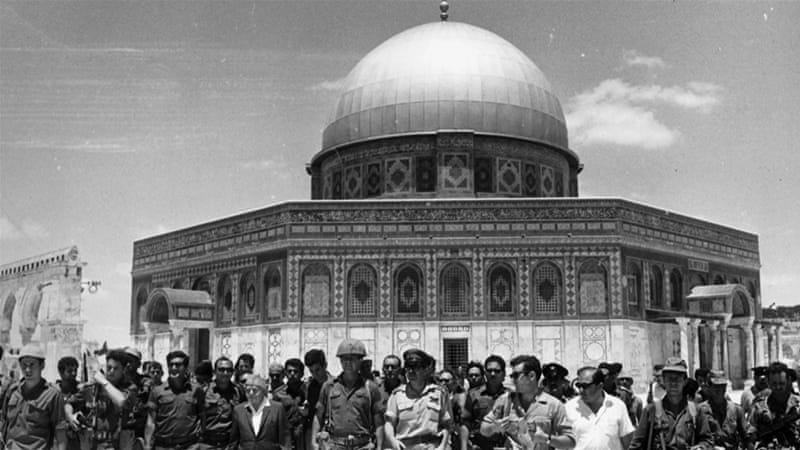
On the dawn of June 7, military commander Moshe Dayan ordered Israeli troops to take control of Jerusalem’s Old City. Amid UN calls for a ceasefire on the same day, Israeli diplomats in New York and Washington, DC, reportedly attempted to garner US support for delaying a ceasefire in order to grant Israel more time to “finish the job”.
By mid-day of June 7, Israeli forces had seized the Old City from the Jordanian army.
The major West Bank cities of Nablus, Bethlehem, Hebron and Jericho, fell to the Israeli army a day later. Israel also shelled the Abdullah and Hussein bridges over the Jordan River that linked the West Bank to Jordan.
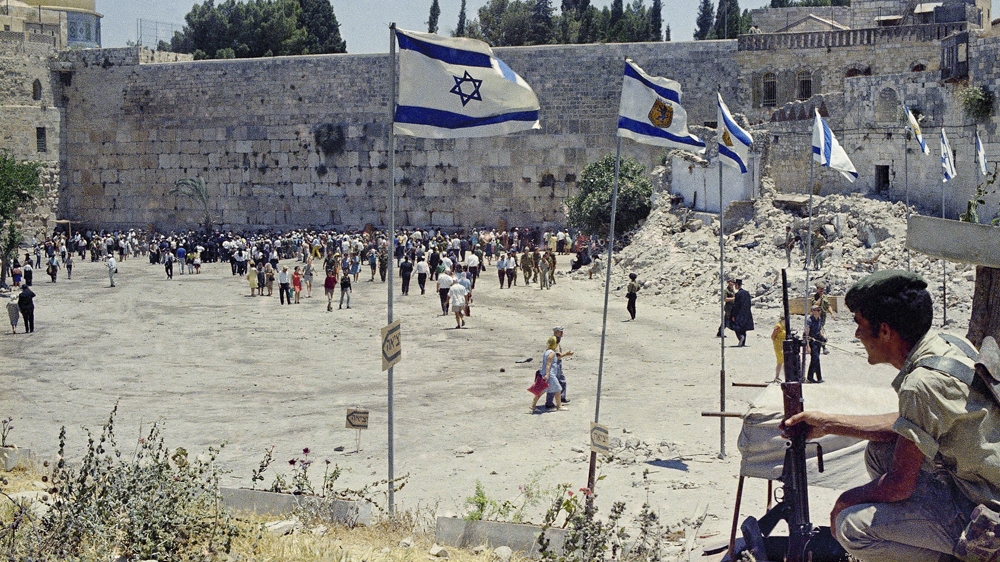
After taking the Old City, Israeli forces demolished the entire 770-year-old Moroccan Quarter neighbourhood, to widen access to what the Jewish people call the Western Wall, (known to Muslims as the al-Buraq Wall.) The site holds religious significance to both Jews and Muslims.
Approximately 100 Palestinian families living in the quarter were ordered to evacuate their homes and the neighbourhood was bombed and completely demolished. The space was used by Israel to build the “Western Wall Plaza”, an area that granted Jews direct access to the Wall.
Throughout the war and under the orders of Yitzhak Rabin – who later became Israel’s prime minister – Israeli forces ethnically cleansed and destroyed several Palestinian villages, expelling some 10,000 Palestinians. Among the most infamous wiped out villages were Imwas, Beit Nuba and Yalu.
In the Palestinian West Bank cities of Qalqilya and Tulkarem, the Israeli army systematically destroyed Palestinian homes. About 12,000 Palestinians were forced out of Qalqilya alone, as a means of “punishment”, Dayan reportedly wrote in his memoirs.
Israel’s offensive on the Syrian Golan Heights started on June 9, and by the next day, the Golan had been captured, putting Israel at a shocking distance from the Syrian capital, Damascus.
Egypt and Israel signed a ceasefire on June 9, while Syria and Israel signed on June 11, effectively ending the war with a UN-brokered truce.
The overwhelming majority of the newly displaced Palestinians sought refuge in Jordan. Many crossed into Jordan through the river, and did so on foot with very few belongings.

What impact did the war have on Palestinians, Israelis and the Arab world?
The war was a turning point for the entire region. For the Palestinians and rest of the Arab world, it dealt a blow to their psyche and to their trust in the Arab governments.
In six days, Israel brought more than one million Palestinians under its direct control in the West Bank, East Jerusalem and the Gaza Strip. The 1967 war turned Israel into the country with the largest Palestinian population.
The shock of loss and defeat precipitated a revolutionary atmosphere among Palestinians, which spurred the emergence of armed resistance movements, vowing to take back Palestine by force throughout the 1970s and 1980s.
For the Israelis, their government’s seizure of territory in the war led to a sense of euphoria. Thousands of Jews, even secularists, flocked to the Wall and wept as they prayed for what they believed was a miracle from God.
The belief that the outcome of 1967 was a miracle reinforced the idea to religious and messianic Zionists who believed, based on religious convictions, that they had a right to the entirety of the Holy Land.
The war unleashed the settler movement; a young generation of messianic Zionists decided to establish houses in the West Bank and Gaza, territory that is occupied and is not part of the state of Israel.
More importantly, the war opened up the question of the Zionist movement’s colonial nature. Instead of exchanging land for peace, as per UN Resolution 242 that called on Israel to give up the territories in exchange for peace with its neighbours at the end of the 1967 war, Israel began encouraging its citizens to move into the territories it occupied and supporting them as they did so.
The Jewish state had been created in 1948 and its sovereignty recognised by most of the world’s countries. But as soon as the guns fell silent in 1967, Israel, in direct contravention of international law, began building illegal settlements for its citizens on land it does not own.
Just one year after the 1967 war, there were six Israeli settlements built in the Syrian Golan Heights. By 1973, Israel had established 17 settlements in the West Bank and seven in the Gaza Strip. By 1977, some 11,000 Israelis had been living in the West Bank, Gaza Strip, the Golan Heights and the Sinai Peninsula.
“The occupation of the West Bank and Gaza reminded the world of the colonial aspects of Israel,” Munir Nuseibah, a professor at the Faculty of Law at Al-Quds University, told Al Jazeera.
Palestine: Fifty years of military occupation, land theft, and settler colonialism
Despite the war being between Arab countries and Israel, those who have lost the most are the Palestinians, who are marking 51 years of Israeli military occupation. The occupation is the longest in modern history.
Between June 25-27, Israel illegally annexed East Jerusalem and various parts of the West Bank, declaring them part of the state of Israel, in a move never recognised by the international community.
The rest of the occupied Palestinian territories of the West Bank and Gaza Strip, housing some 5.1 million Palestinians, remain under Israeli military control under the pretext of security. Their lives have been dictated by hundreds of military checkpoints, a colour-coded permit system, and a Separation Wall that has divided families.
The devastating effect of the military occupation of the Palestinian territories cannot be overstated.
Human Rights Watch, a US-based NGO, grouped at least five categories of “major violations of international human rights law and humanitarian law” that characterise the occupation, in a report released last year. The violations are unlawful killings, abusive detention, blockade of the Gaza Strip and restrictions on Palestinian movement, the development of settlements, and discriminatory policies that disadvantage Palestinians.
“Whether it’s a child imprisoned by a military court or shot unjustifiably, or a house demolished for lack of an elusive permit, or checkpoints where only settlers are allowed to pass, few Palestinians have escaped serious rights abuses during this 50-year occupation,” Sarah Leah Whitson, Middle East director at Human Rights Watch, said in the report.
“Israel today maintains an entrenched system of institutionalised discrimination against Palestinians in the occupied territory – repression that extends far beyond any security rationale.”
All the while, Israel, since 1967, has proceeded with illegally building homes and transferring its Jewish citizens into the West Bank and East Jerusalem, on stolen Palestinian land. Today, at least 600,000 Israelis live in Jewish-only settlements scattered across the West Bank and East Jerusalem.
Settlements, which are accompanied by roads and infrastructure built especially for the settlers, control at least 40 percent of the West Bank’s surface area. As such, Israel has created an apartheid reality in the Palestinian territories whereby Israelis and Palestinians live under a system that privileges Jews over non-Jews.
“By establishing two separate systems for Israelis and Palestinians, Israeli authorities also violate the international law prohibition on discrimination,” a report by the London-based European Council on Foreign Relations think-tank, released on Sunday, said.
“In sum, Israel’s prolonged occupation creates a situation of serious human rights violations and unbearable living conditions, in which communities and individuals see no other option but to relocate.”
Nur Arafeh, an analyst with Al-Shabaka, a Palestinian think-tank told Al Jazeera she believes the likelihood of Israel ending its occupation is low.
“I don’t see any likelihood of Israel withdrawing from the occupied territories and ending its settler-colonial enterprise as long as it enjoys a culture of impunity and is never held to account by the international community for its violation of international law and human rights; and as long as the cost of its occupation is lower than the price of ending”.

Originally published on 2018-06-04
About the author: Zena al-Tahhan is an online journalist and producer for Al Jazeera English.
Source: Al Jazeera
Origins of images: Facebook, Twitter, Wikimedia, Wikipedia, Flickr, Google, Imageinjection, Public Domain & Pinterest.
Read our Disclaimer/Legal Statement!
Donate to Support Us
We would like to ask you to consider a small donation to help our team keep working. We accept no advertising and rely only on you, our readers, to keep us digging the truth on history, global politics and international relations.