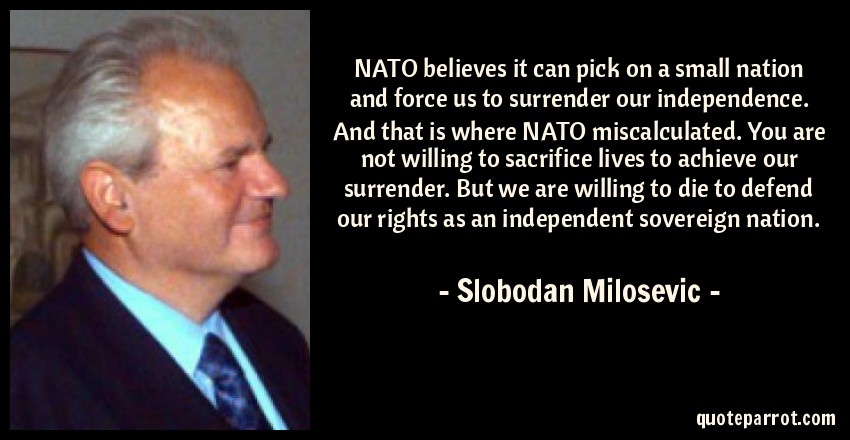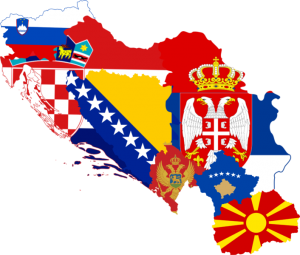

The Balkan is today more unstable. Europe is even more divided. Europe’s backtracking to itself requires some soul-searching, courage and the vision, including confession that the attack against Serbia (the FRY) in 1999 was a colossal historical error [...]
On the occasion of 20th anniversary of the aggression of NATO Alliance against Serbia (the Federal Republic of Yugoslavia, the FRY), on 22nd and 23rd March 2019 Belgrade was the venue of the International Conference under slogan NEVER TO FORGET, and title “Peace and Progress instead of Wars and Poverty”. The organisers of the Conference are the Belgrade Forum for the World of Equals, the Federation of Associations of Veterans of the National Liberation War of Serbia, the Serbian Generals and Admirals Club, the Society of the Serbian Hosts, in cooperation with the World Peace Council. Besides the participants from Serbia, the Conference was attended by more than 200 distinguished guests from some 35 countries from all over the world, whom the organisers welcomed and expressed sincerest gratitude for their solidarity, support and huge humanitarian relief during one of the most challenging periods in the recent history of Serbia and the Serbian nation.
The program of activities marking this anniversary was dedicated to preserving the lasting memory and paying tribute to the military and the police personnel who made the ultimate sacrifice in the defence of their country against the aggression, as well as to the civilian victims including the very young, the very old, and the ailing victims killed during this 78-day aggression by NATO.
The participants have unanimously condemned NATO aggression, affirming that in its essence it was an illegal, invading and criminal war against a peaceful sovereign European country, waged without the UN Security Council mandate and under brute violation of the United Nations Charter, the OSCE Helsinki Final (1975) and the basic principles of international law.
By attacking Serbia (the FRY), the leading Western powers championed by the USA had exposed the freedom-loving and justness-oriented Serbian people to anguish, devastation, and lasting suffering for the sake of attaining their imperialistic geopolitical aims for control of natural and energy resources, the road of transport and the sphere of influence. This was neither ‘a small war’ nor ‘a humanitarian intervention’, but rather a war of underlying geopolitical goals for the long-term deployment of the US troops in the Balkans, for the establishment of case precedent for future aggressions, and for the toppling of legitimate governments, all within the Eastbound Expansion Strategy and the overall goal of setting the global dominance. The history will note the fact that, back in 1999, blindly following alien geopolitical interests, Europe fought itself.
The Balkans is today more unstable. Europe is even more divided. Europe’s backtracking to itself requires some soul-searching, courage and the vision, including confession that the attack against Serbia (the FRY) in 1999 was a colossal historical error.
The aggression’s masterminds and executors should be held responsible for their crimes. The aggression killed some 4,000 persons (including 79 children), whereas additional 6,500 people were seriously wounded. Direct material damage amounted to US 100 billion. It was stressed that NATO and its members participating in the aggression had duty to compensate the war damages to Serbia.
The participants of the Conference were informed about the findings of scientific and expert analyses conducted so far, all confirming that the use of ammunition filled with depleted uranium, and of graphite and cluster bombs and other inflammable and toxic means of warfare, have resulted in high levels of the long-term environmental pollution and the massive-scale endangering of the Serbian citizens. They welcomed the establishment of special bodies of both the national Assembly and of the Government of Serbia tasked with determining the consequences of NATO aggression reflected on the health of population and the safety of environment, and expressed support to the work of those bodies.
The forcible and unlawful tearing Kosovo and Metohija off Serbia continues, through the constant pressuring of Serbia to formally acknowledge the splitting off of a part of territory of its State. Participants of the Conference underscored that a forcible taking of Kosovo and Metohija apart from Serbia would become a precedent which, in turn, would inevitably pave the way for drawing the new borders in the Balkans and the creation of the so-called Greater Albania at the expense of territories of the states of Serbia, North Macedonia, Greece, and Montenegro, what must not be permitted.
NATO aggression against Serbia (the FRY) was a direct and simultaneous attack on the peace and security system in Europe and in the world, which has been constructed on the outcome of the Second World War. As conclusively demonstrated by the subsequent interventions of the USA and its allies (Afghanistan, Iraq, Libya, Mali, Syria, etc.), this aggression has served as case-precedent and template to globalize the interventionism, a manual on how to utilize terrorism and separatism to carry out the Western powers’ plans of conquest, in order to forcibly topple ‘unsuitable’ regimes and impose geopolitical interests of the West, notably, of the USA.
NATO aggression against Serbia (the FRY), an act of most blatant violation of fundamental principles of the international law, is unjustifiable; aggressor’s responsibility cannot be diminished by hypocritical attempts to transfer responsibility onto Serbia or her that-time state leadership. This NATO aggression made history as an indicator of moral and civilisation decline that, twenty years on, the governments of the leading aggressor countries have neither been pardoned, nor gotten to learn the right lesson from.
Participants of the Conference expressed their strong support to, and solidarity with efforts Serbia invests in remedying the grave and lasting consequences of the aggression and to her striving to prevent the continuation of NATO aggression by other means. They explicitly supported Serbia’s efforts to preserve own sovereignty and territorial integrity and her contribution to resolve the future status of Kosovo and Metohija, which will be in line with international law and Resolution 1244 of the UN Security Council. They denounced the policy of coercion, pressures, and unilateral steps.
The aggressors’ responsibility for the committed crimes and the inflicted damage cannot be either justified or diminished. Serbia is entitled to seek indemnification, and legal and criminal culpability of NATO leaders and the responsible members. Demand was made to immediately prosecute all those responsible for the crimes against the Serbian nation, and in particular for the case of illicit trafficking in human organs harvested from the abducted Serbs, in accordance with the Report of Disk Marty and relevant decision of the Parliamentary Assembly of the Council of Europe..
The aggression of 1999 against Serbia (the Federal Republic of Yugoslavia) and its other more recent military interventions have transformed NATO into an openly offensive military alliance, which is responsible for the present-day Balkans and Europe being more discordant and volatile, for militarization of Europe and of international relations, for reaching the lowest point of distrust and confrontation since the Cold War, and for the thoroughly shaken the global security order.
NATO is but a tool of the military industry complex and the largest capital domination, rather than a tool of peace, peoples’ needs, and progress. This is why NATO, a Cold War relic, should be dissolved and foreign military camps abolished, including military base Bondsteele in the Serbian Province of Kosovo and Metohija.
Participants of the Conference held that the world was going through period of growing distrust, tensions, and threats of new interventions and conflicts. The root causes are the aggressiveness of NATO and of alienated power centres, whose interests benefit from violations of fundamental principles of the international law, escalation of threats, renewed arms race, and militarization of international relations.
The participants have condemned all method of abuse of international institutions such as: United Nations, OSCE, UNESCO, WTO and others, demanding their improvement and strengthening, not weakening and bypassed.
The policy of domination based on military might, typical of unipolar world order, was rejected as unacceptable because being founded on privileges and self-proclaimed excellence and not on equality of all countries and nations. Multi-polarisation excludes dominance and opens window for democratisation of international affairs. The Conference sent an appeal to all peaceful forces in the world to join forces in the struggle for the observance of the international law as based on the UN Charter, for reinforced role of the United Nations and other universal international organisations.
Participants of the Conference unanimously demanded to urgently put an end to a new arms race and violation of relevant international agreements, and to redirect the funds from the military budgets into the domains of economic development, improving quality of people’s life, and eliminating the disheartening developmental and social divergences. They expressed profound concern provoked by unilateral USA withdrawalof the valid international agreements particularly of Intermediate range Nuclear Force Treaty (INF). They demanded for full respect of the existing agreements, and renewal of negotiations on stopping arm race, particularly nuclear. They demand full withdrawal of the US tactical nuclear weapons and missile defense assets from Europe that are worsening of the security on the European continent.
It was held that the imperialism system with its insatiable greed for someone else’s wealth, and unipolar order based on the strategy of exceptionality, dominance and NATO interventionism, are the key sources of instability, distrust, and conflicts. Peace, stability, democracy, inclusive progress, require radical changes in global relations, observance of sovereign equality, non-interference, multiculturalism, common interests, and exclusion of any egotism, protectionism, and privileges.
A statement was made that the imperialistic system, with its inherent insatiable greediness for other nations’ riches, and the unipolar order based on the strategy of exceptionalism and dominance, and NATO interventionism, are the key sources of instability, distrust, and conflicts. Peace, democracy, and progress require radical changed in global relations, observance of sovereign equality, non-interference, and multiculturalism. Stability, peace, and inclusive progress require observance of common interests, partnership, and exclusion of any egotism, protectionism, and privileges. Policy of confrontation, interventionism, and interference in the internal affairs, prompted by the military industry complex and big financial capital must give way to dialogue, partnership, observance of the basic norms of international law and international order, which are based on the common interests and mutual respect.
Participants of the Conference committed to peaceful political solution of all international problems, under observance of principles of international law, the UN Charter, and the decisions of the UN Security Council.
We would like to ask you to consider a small donation to help our team keep working. We accept no advertising and rely only on you, our readers, to keep us digging the truth on history, global politics and international relations.
US-installed Ukrainian fascists commemorated Poroshenko’s established victory in Europe Day of Remembrance by vowing to “destroy Moscow,” free its people, and let them “shape their own future.”Ukrainian ultranationalists attending a May 8 commemoration included 14th SS Waffen Grenadier division veterans, Ukrainian Insurgent Army (UPA) members, and Nazi-infested volunteer battalions involved in what they call “the Russian-Ukrainian war.”Svoboda party overt Nazis participated. Their slogan is “Ukraine for the Ukrainians” – meaning ethnically pure, free of Jews, Russians and others not wanted, by extermination or other means.Party member Yuri Sirotyuk called war on Russia Ukraine’s historic mission. “I believe that if we ...
Edward S. Herman died on November 11, 2017, at the age of 92. Fortunately, it was a peaceful death for a supremely peaceful man. In all he did, Ed Herman was a tireless champion of peace.Ed Herman could be considered the godfather of antiwar media critique, both because of his own contributions and because of the many writers he encouraged to pursue that work. Thanks to his logical mind and sense of justice, he sharply grasped the crucial role and diverse techniques of media propaganda in promoting war. He immediately saw through lies, including those so insidious that few dare ...
Read the truth about "Srebrenica Massacre" in 1995.Origins of images: Facebook, Twitter, Wikimedia, Wikipedia, Flickr, Google, Imageinjection, Public Domain & Pinterest.Read our Disclaimer/Legal Statement!Donate to Support UsWe would like to ask you to consider a small donation to help our team keep working. We accept no advertising and rely only on you, our readers, to keep us digging the truth on history, global politics, and international relations.[wpedon id="4696" align="left"]The Al-Qaeda-linked ‘El-Mujahedeen’ brigade of the Bosnian Muslim Army parading in downtown Zenica in central Bosnia in 1995
Twenty years ago, on 24 March 1999, Operation Allied Force began – the NATO bombing of Yugoslavia that led to the country’s dismemberment – and the independent state of Kosovo was proclaimed. Yet these events were far from historically contingent, as some people claim. So who orchestrated the breakup of Yugoslavia and how?These days, few remember that the Bulgarians were at the start of it all. Even the Bulgarians themselves don’t like to think about it.In early March 1999, Bulgaria’s National Intelligence Service told Germany’s Federal Intelligence Service (BND) that it had information about a secret plan by the Yugoslav ...
The title page of Rūta Vanagaitė’s best-known book contains two pictures of young men. “This one is a Jew,” she said, pointing at the picture on the left. “He was a bicycle-racing champion. Good enough to represent Lithuania in international competitions, but not good enough to live.” He was executed during the Holocaust. The man in the picture on the right was a Lithuanian executioner. “They are both us,” Vanagaitė explained. “But Lithuanians don’t like to think of them as ‘us,’ because one is a Jew and the other is a killer.” Her book is called “Us.” (The title has ...
The 13th report of the UN High Commissioner for Human Rights on the human rights situation in Ukraine between 16 November 2015 and 15 February 2016, when the Minsk Agreements were in force, has come as a shock to Kiev.According to the UN, more than three million people live in the areas directly affected by the conflict. The exact number of people who have left Ukraine-controlled territory is still unknown, although rough estimates range from 800,000 to 1,000,000 people. The Ukrainian government has estimated that more than a million people have left southeast Ukraine for Russia, Belarus and Europe. This ...
As heavily-armed US and NATO troops enforced the peace in Bosnia, the press and politicians alike portrayed Western intervention in the former Yugoslavia as a noble, if agonizingly belated, response to an outbreak of ethnic massacres and human rights violations. In the wake of the November 1995 Dayton peace accords, the West was eager to touch up its self-portrait as savior of the Southern Slavs and get on with “the work of rebuilding” the newly “sovereign states.”But following a pattern set early on, Western public opinion had been skillfully misled. The conventional wisdom exemplified by the writings of former US ...
The Asia Minor and Pontos Hellenic Research Center is pleased to announce a new book, Genocide in the Ottoman Empire: Armenians, Assyrians, and Greeks, 1913-1923. Edited by George N. Shirinian. New York and Oxford: Berghahn Books, 2017. 433 pages.The final years of the Ottoman Empire were catastrophic for its non-Turkish, non-Muslim minorities. From 1913 to 1923, its rulers deported, killed, or otherwise persecuted staggering numbers of men, women and children in an attempt to preserve “Turkey for the Turks,” setting a modern precedent for how a regime can commit genocide against its own citizens in pursuit of political ends, while ...
“Workers of my country, I have faith in Chile and its destiny. Other men will overcome this dark and bitter moment when treason seeks to prevail. Keep in mind that, much sooner than later, the great avenues will again be opened through which will pass free men to construct a better society. Long live Chile! Long live the people! Long live the workers!” President Salvador Allende’s farewell speech, 11 September 1973.“It’s hard to find someone with the fighting spirit, courage and the story of Allende. He was a man who actually had the branded name in history: democratically the left came ...
Whilst there are no golden ages, it is abundantly clear that the world today is in a very unhealthy state. From Eastern Europe to North Africa to the Middle East, countries, in recent years, have been severely destabilised, resulting in carnage and the destruction of hundreds of thousands of lives.And at the heart of that destabilisation is American and British foreign policy.But how have we arrived at this situation in the world today? And what are the roots of America and Britain’s ‘humanitarian intervention’?A lot of people answer the above questions by citing the illegal American and British invasion of ...
The missile attack on a US ship off the coast of Yemen was a major news event, but the subsequent follow up story, that it may never have happened, was either ignored by mainstream media or intentionally covered up. The whole thing has the same odor as the Gulf of Tonkin incident that never occurred.Does history repeat itself? Sure does seem like it. That is if you compare America’s entry into the Vietnam civil war, with America’s latest entry into the war in Yemen.Don’t be mistaken, we have been at war with Yemen for a year now. America sided with ...
Another NATO Intervention?Less than a dozen years after NATO bombed Yugoslavia into pieces, detaching the province of Kosovo from Serbia, there are signs that the military alliance is gearing up for another victorious little “humanitarian war”, this time against Libya. The differences are, of course, enormous. But let’s look at some of the disturbing similarities.A demonized leaderAs “the new Hitler”, the man you love to hate and need to destroy, Slobodan Milosevic was a neophyte in 1999 compared to Muammar Qaddafi today. The media had less than a decade to turn Milosevic into a monster, whereas with Qaddafi, they’ve been ...
This is definitely an unusual book, as heralded by its title and three subtitles, whose lengthy wording evokes that of several learned tomes of the 18th and early 19thcentury.Its author is a well-known personality in Switzerland. Guy Mettan is a prominent journalist, formerly editor-in-chief of Tribune de Genève; he once presided over the Great Council, the Geneva parliament, of which he is still a representative, elected on the Christian Democrat Party list; he heads the Swiss Press Club and has written several books on Switzerland and international Geneva.As he explains in his foreword, his interest for Russia came by happenstance: ...
The genocidal rule of the Khmer Rouge began forty years ago this month. Their rise to power was inseparable from US intervention.On April 17, 1975, Khmer Rouge (KR) forces stormed Phnom Penh and reestablished Cambodia as Democratic Kampuchea — a supposedly self-sufficient, entirely agrarian society. Resetting the clock to “Year Zero,” the KR forced urban dwellers to the countryside, and began to “purify” Cambodia through a genocidal purge of intellectuals and minority groups. By the time the slaughter came to an end in 1979 — after Vietnam invaded Cambodia and removed the KR from power — some 1.7 million people (21 percent ...
Donald Franciszek Tusk, (born 22 April 1957) is a Polish politician and historian. He has been President of the European Council since 1 December 2014. Previously he was Prime Minister of Poland (2007–2014) and a co-founder and chairman of the Civic Platform (Platforma Obywatelska) party.Tusk began his public career as an activist in his home town of Gdańsk, supporting Solidarity and organizing his fellow university students. With the exception of one four-year stretch, Tusk has served in the Third Republic Sejm (parliament) continuously since its first elections in 1991. He was Vice Marshal (deputy speaker) of the Senate from 1997 ...
I graduated from the exact same PHD Program at Harvard that produced Kissinger and Brzezinski before me. They gave me Kissinger’s old office at Harvard’s Center for International Affairs. I also went through the exact same Soviet/Russian Studies Program at Harvard that produced Brzezinski before me, and passed my PHD Oral/General Examinations in Soviet Politics and Russian History under Adam Ulam and Ned Keenan, respectively. R.I.P. Obama was behind me at Harvard Law School.Brzezinski has been Obama’s mentor and foreign policy guru since Obama’s student days at Columbia. Zbig ran Obama’s 2008 presidential campaign on foreign affairs and defense, and ...
Stalinist “Land of Eagles” As in neighboring Yugoslavia, the communist revolutionary guerrilla forces, established by the aid and crucially supported by the Yugoslav communists led by local Albanian communist leader Enver Hoxha, took over the power in Albania in 1944.[1] From 1945 to 1948 Albania was under the strong influence of Titoist Yugoslavia and both counties being under the hand of J. V. Stalin. Yugoslavia lavishly supplied Albania with deficient material, mainly nutritious ones, like wheat, etc. As testified by the Montenegrin zealot communist and revolutionist Milovan Đilas, one of the leading Yugoslav politicians at the time, and a member ...
Accused of War Crimes: The British Prime Minister Tony BlairWAR CRIMES CHARGES FOR THE HAGUE AGAINST THE NATO LEADERS – ONE OF THE INDICTMENTS IN THE INTERNATIONAL CRIMINAL TRIBUNAL FOR THE FORMER YUGOSLAVIANOTICE OF THE EXISTENCE OF INFORMATION CONCERNING SERIOUS VIOLATIONS OF INTERNATIONAL HUMANITARIAN LAW WITHIN THE JURISDICTION OF THE TRIBUNAL;REQUEST THAT THE PROSECUTOR INVESTIGATE NAMED INDIVIDUALS FOR VIOLATIONS OF INTERNATIONAL HUMANITARIAN LAW AND PREPARE INDICTMENTS AGAINST THEM PURSUANT TO ARTICLES 18.1 AND 18.4 OF THE TRIBUNAL STATUTE.TO:Madam Justice Louise Arbour, Prosecutor, International Criminal Tribunal for the Former Yugoslavia, Churchillplein 1, 2501 EW, The Hague, Netherlands.AND TO: President William J. ...
"Welcome to Nulandistan: Propaganda and the Crisis in Ukraine" (2014)This full length GRTV documentary looks at the fictitious land of Nulandistan that has been constructed out of Ukraine.The GRTV documentary deconstructs Nulandistan and the propaganda of the Obama Administration [...], the US Department of States, US officials, and their allies about the crisis in Ukraine and takes a look at their growing frustration towards the Russian media, particularly RT, for challenging their account of the events on the ground in what they have declared is an intensifying information war.The full length documentary starts by looking at the self-benefiting description of ...
Part IPart II The policy of language and political parties until the prohibition of the Illyrian name (1843)During the years of 1832–1836 the Hungarian assembly (Dieta) hold several sessions in Pozsony (Bratislava/Pressburg), where Croatia-Slavonia’s deputies, particularly count J. Drašković, fought for the introduction of the national (Croat) language in Croatia-Slavonia instead of the Latin or Hungarian, as well as for the Croatian state-historical rights (the so-called Croatian pravice) as they were claimed as such by the Croat political leadership. At the same time, in 1834 Ljudevit Gaj obtained a permission from the Habsburg Emperor Francis I (1806–1835) to publish the first ...