
Serbs Survive in Ghettos in the Heart of Europe: The “Republic of Kosovo”, a Criminal Entity
The Self proclaimed Republic of Kosovo, as a creation of the USA/NATO joint aggression against the Federal Republic of Yugoslavia in 1999, and as a final stage in the destruction of Yugoslavia by the above mentioned actors, still represents the only place in Europe where particular ethnic minorities survive in real ghettos, often known as enclaves [...]
After 19 years since a part of the international community, under the auspices of NATO and the US, took control over the Serbian province of Kosovo and Metohija, following two ethnic pogroms of the Serbs and non-Albanians occurred in 1999 and in 2004, which resulted in ethnic cleansing of around 250 000 Serbs and other non Albanians, the rest of Serbian population still survive in ghettosacross the territory of self-proclaimed independent Republic of Kosovo.
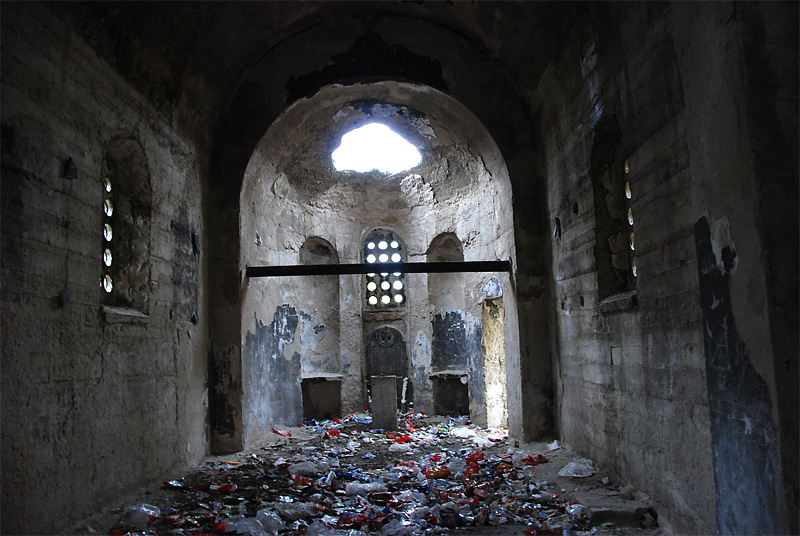
Destroyed 14th-century Serbian Orthodox church Samodreža in Kosovo by Muslim Albanians in March 2004
The Self proclaimed Republic of Kosovo, as a creation of the USA/NATO joint aggression against the Federal Republic of Yugoslavia in 1999, and as a final stage in the destruction of Yugoslavia by the above mentioned actors, still represents the only place in Europe where particular ethnic minorities survive in real ghettos, often known as enclaves. This “privilege” of living in ghettos is exclusively reserved for the Serbs, Romani people (Gypsies) and for other ethnic/religious minorities of Serbian origin.
People in these enclaves survive without having guaranteed basic human rights such as personal freedom and security. Serbian children must be transported to their schools in a UN armoured vehicles under protection of UN military personnel, without such a protection Serbs would be stoned to death by their Albanian coevals.
Serbs and other non-Albanians survive in extreme poverty often without basic living conditions such as electricity, heating, potable water and sanitary water, the only income they have is a 50 euros per month paid to them by the Serbian Government. Some of them still live in half-destroyed/burnt houses without walls, windows and doors. Their farms are confiscated by local Albanians and they cannot cultivate their own fields nor cut the wood for the heating. Serbian enclaves, churches and monasteries are constantly surrounded by barbed wire, they can leave these ghettos only under UN escort, otherwise they risk to be eliminated by their Albanian neighbours. Those Serbs who live in a cities/towns/villages with Albanian majority, they cannot even leave their households, they can only move within the limits of a Serbian households. Those who must cultivate their farms or graze their cattle outside of their households, they risk of being killed once they leave their safe ghettos. Every day Serbs are beaten, stoned, attacked, sometimes even raped and killed by Albanian neighbours across Kosovo and Metohija, the local police ignores and hushes up any crime or act of violence committed against Serbs.
The US and the EU strongly support the independence of Republic of Kosovo, in violation of international law, while forcing Serbia to recognize the de jure independence of Kosovo in return for EU membership.
Following the strategy of systematic discrimination, humiliation and ambiguousness towards Serbs, the US and its Western allies, are regularly complimenting Kosovo’s “respect” for human and minority rights.
14th-century Dečani monastery of Serbian Orthodox Church. Still not desecrated by Muslim Albanians as it is protected by international KFOR
All current and past crimes against Serbs are systematically “erased” by Kosovo’s authorities under the patronage of international community.
During 1998 and 1999 the terrorist Kosovo Liberation Army (KLA) committed thousands of brutal murders of Serbs, Albanians, Gypsies and dozens of foreign citizens. Several thousand Serbian civilians were kidnapped and transferred to secure locations in Kosovo and Metohija and in Albania for blood and organ trafficking.
Yugoslavian authorities have identified dozens of improvised mini-laboratories across Kosovo and Metohija where KLA was collecting the blood from kidnapped Serbs (on average they were taking 2,5 liters of blood from one adult). The main centers for the collection of the organs from kidnapped victims were located in Albania: camps were stationed in Kukes, Elbasan, Fljora, Drac and Tirana.
Authorities of the Republic of Albania were also involved in this disgusting crime, including former Albanian prime ministers Sali Berisha and Fatos Nano, Bernard Kouchner, French Foreign Affairs Minister and former head of UNMIK. Other involved parties included Hashim Thachi (former KLA Commander who became president of Kosvo), Halim Omer Osmani and Ramus Haradinaj.
Additionally, some highly ranking international officials from KFOR and UNMIK were also involved and representatives of some international humanitarian organizations. After the UN Mission in Kosovo collected evidence from the field and sent it to the International Criminal Tribunal for Former Yugoslavia (ICTY) in The Hague, the evidence was intentionally destroyed by the Tribunal in order to hush up the crimes of this joint venture. Carla Del Ponte, former Chief Prosecutor of the ICTY, was removed from her post, soon after she revealed the story about organ trafficking of the kidnapped Serbs in Kosovo during the 1998/1999.
Reports on organized crime in Kosovo made by UN intelligence and other Western intelligence agencies are being also hidden from the public by the governments of the most powerful countries because their governments were also involved in creation of Kosovo’s independence, including the creation, arming and training of the KLA, a terrorist entity. Yugoslav Intelligence agencies discovered that KLA terrorists were trained by NATO personnel in 1996/1997/1998 at different military camps across Europe and the USA (e.g. Atlantic Brigade) in Germany and even in “neutral” Switzerland, then the terrorists were sent directly to Albania to join the existing forces which consisted of NATO trained terrorists (some of them were members of Al-Qaeda), foreign mercenaries and regular Albanian Army of the Republic of Albania.
Kosovo’s authorities together with its majority Albanian population are intentionally destroying the evidence of Serbian cultural and historical presence in this holly Serbian land.
Serbian churches (Orthodox Christian) are intentionally turned into public toilets, church properties are being confiscated, Serbian graves are being mined and turned into parking lots.
The majority of the private property in Kosovo is still legally in a possession of the Serbs, but most of the properties are confiscated by local Albanians and Kosovo’s government. The total number of Serbian returnees in Kosovo is around 1% of the number of those who are expelled during the ethnic cleansing in 1999 and 2004. Renovated houses of Serbian returnees are being constantly destroyed by local Albanians. Kosovo’s government and its Western sponsors are undermining the return of Serbs to their homes, because if the Serbs would return to Kosovo and Metohija, they would strengthen the Serbian population and thus make Serbian sovereignty more powerful, which is contrary to the American, EU and Kosovo’s plans of achieving full de jure independence of this criminal entity.
South (Albanian-controlled) Mitrovica town in Kosovo: Destroyed Serbian church and tombstones
We would like to ask you to consider a small donation to help our team keep working. We accept no advertising and rely only on you, our readers, to keep us digging the truth on history, global politics and international relations.
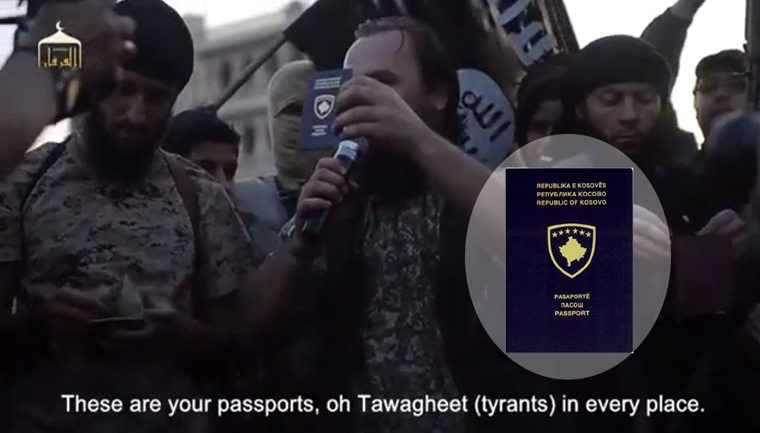
Kosovo Albanian ISIS jihad fighters in the Middle East
During the Albanian Muslim secessionist and separatist war in the Serbian province of Kosovo and Metohija, Kosovo Serb civilians were targeted for murder and expulsion. December 14, 2010 marked the 12th year anniversary of the mass murders of six Kosovo Serbs in 1998 by Kosovo Albanian secessionists and separatists. The cold-blooded murder of the six youths was a horrific and shocking mass murder. The killers were Albanian Muslim separatists, suspected members of the KLA, which U.S. special envoy to the Balkans Robert Gelbard described in 1998 as “without any question, a terrorist group”: “I know a terrorist when I see ...
Photo evidence of a rapid Islamization of EuroChristian southern province of the Republic of Serbia - Kosovo-Metochia.The province is occupied by NATO gangsters in June 1999 and since that time the province is experiencing massive destruction of Serbian Christian Orthodox churches and monasteries followed by building of new mosques by Muslim Albanians.Financial support for Islamization of Kosovo-Metochia is of three sources:1) Muslim Albanian diaspora living & working in Western countries;2) The Wahhabites of Saudi Arabia; and3) Other Sunni Islamic countries, especially Turkey.During the last 15 years there were more built mosques than during 400 years of Ottoman rule in Kosovo-Metochia. ...
The Serbs stepped again onto the historical scene in the years of the European wars that swept the continent from the forests of Ireland to the walls of Constantinople in the late 17th century. The Turks finally withdrew from Hungary and Transylvania when their Ottoman hordes were routed outside Vienna in 1683. The disintegration of Ottoman rule in the southwest limbered up the Serbs, arousing in them hope that the moment was ripe for joint effort to break Turkish dominion in the Balkans. The neighboring Christian powers (Austria and Venice) were the only possible allies. The arrival of the Austrian ...
UN negotiator on Kosovo Martti Ahtisaari wanted to honor and commemorate Finnish Nazi SS troops in 1999 when he was the President of Finland. He wanted to have the Finnish taxpayers and the Finnish government fund and finance the construction of a plaque in the Ukraine to commemorate the deaths of Finnish Nazi SS troops killed during Operation Barbarossa. Ahtisaari is not, alone, however, in seeking to honor and celebrate the legacy of Nazis and the SS.Kosovo: German recruitment of Albanians for the SS Nazi Skanderbeg DivisionKosovo Albanians have similarly honored and commemorated the legacy of Nazis and the SS. ...
1. Kosovo is not ancient Albanian landIts very name comes from the Serbian word "kos," meaning blackbird. Its Albanian name, "Kosova," means nothing whatsoever.Kosovo was the heartland of medieval Serbian state and the site of the 1389 battle in which both the Serbian prince and the Ottoman sultan died, checking the Turkish expansion into the Balkans for almost 70 years. Ethnic Albanians were settled there by the Ottomans over the intervening centuries, and became a majority due to pogroms and persecution of Serbs - which began under Ottoman rule but continued under Austro-Hungarian occupation in WWI and German/Italian occupation in ...
What could possibly go wrong? Refugees welcome! Not to allow these enemy combatants to return would be “Islamophobic”!“Disguised as refugees and able to cross borders without being identified: ISIS general who blew up a hostage with a rocket and decapitated another prisoner is ‘back in Europe with 400 soldiers’ after fleeing Syria,” by Julian Robinson, MailOnline, December 29, 2016:An ISIS general once pictured decapitating a prisoner is back in Europe with up to 400 of his most trusted soldiers after fleeing the war zone in Syria, it has been claimed.Ex-NATO soldier Lavdrim Muhaxheri and his men are among thousands who ...
While the numbers are not as high as Auschwitz or Treblinka, Jasenovac was notorious for its cruelty and the high number of young children who were victims.April 22 is a date that binds two groups of people who shared the same tragic fate. It is the date that commemorates the revolt of the prisoners of Jasenovac, the death camp that claimed the lives of hundreds of thousands of Jews, Serbs and Roma.While the numbers are not as high as Auschwitz or Treblinka, Jasenovac was notorious for its cruelty and the high number of young children who were victims. The saddest ...
The armed conflict between the Kosovo Liberation Army (KLA) and Serbian forces started in 1992 with the KLA attacks on Serbian police officers, non-Albanians that lived in Kosovo and Albanians loyal to Serbia (Johnstone, 2002; Kozyris, 1999). This low level conflict escalated in 1996 with the KLA attacking refugee camps as well as other civilians and policemen resulting in dozens of innocent deaths (Johnstone, 2002; Kozyris, 1999). At this point of time and all up to late 1998, the KLA was regarded as a terrorist organisation (Gelbard, cited in Parenti, 2000:99; Jatras, 2002; Johnstone, 2002; Kepruner, 2003; Rubin, cited in ...
In the thousand year long-history of Serbs, Kosovo and Metohia were for many centuries the state center and chief religious stronghold, the heartland of their culture and springwell of its historical traditions. For a people who lived longer under foreign rule than in their own state, Kosovo and Metohia are the foundations on which national and state identity were preserved in times of tribulation and founded in times of freedom.The Serbian national ideology which emerged out of Kosovo’s tribulations and Kosovo’s suffering (wherein the 1389 St. Vitus Day Battle in Kosovo Polje occupies the central place), are the pillars of ...
The U.S. government and U.S. media explained the mass murders of Kosovo Serbs, Roma, and other Kosovo minorities as “revenge murders”. They were “revenge attacks”. The expulsion of over 250,000 Kosovo Serbs, Roma, Gorani, and Jews was simply censored and deleted using the infowar technique of Emphasis. These infowar techniques have no basis in criminal law and violate fundamental values and tenets of morality and ethics.The U.S. rationale was spurious: Because Yugoslav police were defending themselves and Kosovo civilians against what the U.S. State Department itself declared were “terrorists”, the Albanian Muslim population of Kosovo had some sort of right ...
Once again, U.S. air and naval forces are preparing strikes on Serbia’s army and police for refusing to stand down in Kosovo. And, once again, Americans are deeply ambivalent about intervention.“Either we get in there with a NATO force, or we get the hell out,” said an exasperated Sen. John Warner after Yugoslav strong man Slobodan Milosevic showed two NATO generals the door.Warner advocates intervention. But Americans sense that, despite our disgust at the latest massacre and Milosevic’s thuggery, no vital U.S. interest exists there. The Serbs do not threaten NATO; they have not attacked Americans; they are fighting to ...
Vladislav B. Sotirovic, “Who are the Albanians? The Illyrian Anthroponomy and the Ethnogenesis of the Albanians – A Challenge to Regional Security”, Serbian Studies: Journal of the North American Society for Serbian Studies, Vol. 26, 2012, № 1−2, ISSN 0742-3330, 2015, Slavica Publishers, Indiana University, Bloomington, USA, pp. 45−76Origins of images: Facebook, Twitter, Wikimedia, Wikipedia, Flickr, Google, Imageinjection & Pinterest.Read our Disclaimer/Legal Statement!Donate to Support UsWe would like to ask you to consider a small donation to help our team keep working. We accept no advertising and rely only on you, our readers, to keep us digging the truth on ...
The Slavic CongressesThe idea of South Slavic political unification was surely a part of a broader pan-Slavic movement and ideology. If from nothing else, it can be proved from a very fact that the official flag of all kind of Yugoslavia (from 1918 to 2003) was, in fact, an insignia of the 19th century pan-Slavic movement, whose anthem was also used as an official state’s anthem of Socialist Yugoslavia (“Hey Slavs”).The first clear political expression of an idea of pan-Slavic reciprocity, solidarity, and possible unification was done at the First Slavic Congress held in Prague from May 5th to June ...
After the Russian military victory over the Ottoman Empire in the 1877−1878 Russo-Ottoman War it was signed the San Stefano Treaty between these two states on March 3rd, 1878. According to the treaty, a Greater “San Stefano” Bulgaria, under the direct protection by Russia, had to be established within the borders of the Ottoman Empire. However, an idea of “San Stefano Bulgaria” directly affected three Balkan nations: the Serbs, Greeks and Albanians as some of their ethnic and historical territories had to become part of a Greater Bulgaria. The “San Stefano Bulgaria” was projected by the Russian authorities to cover ...
A woman working at Mother Teresa’s Missionaries of Charity in the eastern Indian state of Jharkhand has been arrested for allegedly selling a 14-day-old baby.Two other women employees from the centre have been detained and are being questioned about other possible cases.Police took action after the state’s Child Welfare Committee (CWC) registered a complaint.The charity has not responded to BBC requests for comment.“We have found out that some other babies have also been illegally sold from the centre,” a police official told BBC Hindi’s Niraj Sinha. “We have obtained the names of the mothers of these babies and are further ...
There was international jubilation when Montenegro seceded from its union with Serbia in 2006 after a controversial referendum. The Referendum Law prevented Montenegrins living and registered in Serbia from voting in the referendum, ensuring that tens of thousands of Montenegrins, in a country of only 622,000, who would have voted to remain the union could not vote in favour of maintaining it.It must be remembered that state-paid workers like teachers and police were told by the Democratic Party of Socialists (DPS) leader Miodrag Vuković before the referendum May 2006, that someone “cannot work for the state and vote against it,” something objectively ...
After February 2008 when Kosovo Albanian-dominated Parliament proclaimed Kosovo independence (without organizing referendum) with obvious US diplomatic support (unilateral recognition) with the explanation that the Kosovo case is unique in the World (i.e., it will be not repeated again) one can ask the question: is the problem of the southern Serbian province of Kosovo-Metochia really unique and surely unrepeatable in some other parts of the World as the US administration was trying to convince the rest of the international community?[1]Domino effect in international relationsThe consequences of recognition of Kosovo independence by a bigger part of the international community are already ...
The most useful parable about progressives is that offered by Bernard Sanders, self-styled “socialist-progressive-independent” rep from Vermont. Sanders owes his political career to rage against the Vietnam War among radicals, many of whom moved into the state in the early 1970s. They forthwith planned a long-term, carefully organized, assault on Vermont’s two-party structure. Sanders linked his political ambitions to this effort to organize a third force, the Progressive Alliance. He became mayor of Burlington and, later, congressman.At a rapid clip the emphasis moved from party-building to Sanders-building. By 1994, it was apparent that the only movement B. Sanders was interested in ...
Interview with Čedomir PrlinčevićFormerly the Chief Archivist of Kosovo and President of the Jewish Community of Priština; driven from Kosovo by KLA terrorists in 1999Interviewer: Jared IsraelTranslator: Petar Makara[Posted 3, December 2000 * New introduction, 4 April 2006]========================================IntroductionThis is the second Emperor’s Clothes interview with Čedomir Prlinčević (pronounced Ched-o-meer Pra-linch-eh-vich).Mr. Prlinčević, an historian, was chief archivist in Priština, capital of Kosovo, and head of the Jewish community there until, as he explained in his first Emperor’s Clothes interview, the terrorist KLA drove him and his family and thousands of others from their homes. Heavily armed British NATO forces stood by, ...
The Serb holocaust during the WWII in the Independent State of Croatia is not a misnomer, an accusation, and even less a speculation. It is an historical fact. Rabid nationalism and religious dogmatism were its two main ingredients. During the existence of Croatia as an independent Catholic State, over 700,000 men, women and children perished. Many were executed, tortured, died of starvation, buried alive, or were burned to death. Hundreds were forced to become Catholic. Catholic padres ran concentration camps; Catholic priests were officers of the military corps which committed such atrocities. 700,000 in a total population of a few ...