

Views: 4652
I. Comment by Jared Israel
The two media reports from 1993, posted below, refer to Ibrahim Rugova as “President of the Republic of Kosovo,” when in fact: a) no such republic existed; b) Kosovo was a province of the Republic of Serbia and c) Rugova was not any kind of government official, let alone a president. Rather, he was the leader of a faction, supported and sponsored by outside powers, which faction had already played a key role in launching the attack on Yugoslavia, and which was now boycotting all official Kosovo institutions as part of a strategy of creating a crisis to justify outside intervention against the Republic of Serbia.
For the pope to give this man a medal and what is described below as an “official” reception, as if Rugova were a head of state, supports my charge that the Vatican was one of the ‘outside powers’ promoting the destruction of Yugoslavia. In promoting Rugova, the Vatican compounded the felony of its previous open leadership of and public support for the Croatian secessionists. This was nation wrecking on a grand scale, in grand violation of the Helsinki Final Act.
In a parallel development, even as the pope was awarding Rugova a medal for his contribution to the ongoing destruction of Yugoslavia, the Vatican was applying maximum pressure on Israel to accept the Palestine Liberation Organization as a ‘peace partner.’ And a year after the pope embraced Mr. Rugova, the PLO was invited to open a special office in the Vatican. So much for the Vatican’s much vaunted disinterest in earthly affairs.
(Regarding Vatican manipulation of the Arab-Israel dispute, see “How the Vatican Legitimized the PLO and Coerced Israel to Recognize it,” The Emperor’s New Clothes, July 17, 2006, at
http://emperors-clothes.com/vatican/pressure.htm
Regarding the Vatican opening an office for the PLO, go to http://emperors-clothes.com/vatican/pressure.htm#VII )
II. Transcript of Ibrahim Rugova’s News Conference in Albania after Meeting with Italian Leaders and the Pope
BBC Summary of World Broadcasts, March 15, 1993, Monday, Part 2 Eastern Europe; C.1 SPECIAL SUPPLEMENT; OTHER REPORTS ON FEDERAL AFFAIRS; EE/1637/C1; 1532 words, (c) Albanian Radio, Tirana 1830 gmt 12 Mar 93
Text of recording of news conference by Rugova in Tirana on 12th March
[Announcer] President of the Republic of Kosovo Dr Ibrahim Rugova ended his visit in Italy. On his way back to Pristina, he made a short stopover in Tirana. On this occasion, Dr Rugova held a news conference at Rinas Airport with reporters of radio television, ATA and other press organisations, which you will hear now:
[Reporter] Mr President, will you give us a short summary of your recent activity concerning the main problems occurring in Kosovo?
[Rugova] We all know that the situation in Kosovo is very difficult, serious and dangerous. I recently paid a visit to Italy. It was a very successful visit. These are the first contacts at the highest level established between Kosovo and Italy. What was most important during my whole visit was the meeting with the Holy Father Pope John Paul II. The environment was official and special. Of course, I held other meetings with Italian Prime Minister Amato, Foreign Minister Emilio Colombo and the chairman of the foreign policy commission of the Italian Parliament Antonio Carrillo. In all the talks with the Italian officials, we discussed the question of establishing co-operation between Kosovo and Italy. We presented our demands that UN troops be stationed in Kosovo and investigate the possibility of establishing a protectorate over Kosovo. Another topic was the question of humanitarian aid at these moments. It is important that humanitarian aid enter Kosovo legally, because so far nothing is allowed to enter Kosovo legally. I can say that the Italian side supports Kosovo on many topics. It is particularly interested in preventing a conflict in Kosovo and will do its utmost to see that the Kosovo question is presented at an international level, that is, in the European and international institutions. I can say that Italy is among the first EC countries that has given an opportunity to Kosovo and to me to meet the prime minister of an EC country, Mr Amato. I am saying once again and I want to particularly stress the reception provided to me by the Holy Father. We talked about many topics involving Kosovo and the Albanian question. He showed understanding about the Kosovo issue and the Albanian question. We also talked about the visit that the Holy Father will soon make to Albania. Many Kosovars and Kosovo representatives will participate in this. Thank you.
[Reporter] Mr President, we are talking about your visit and the talks you held with the Holy Father. As we have been informed, the Holy Father is particularly interested in the harmony among religions in Albania. Especially in this situation of the democratic processes, is the motto of the Renaissance leaders that the religion of an Albanian is Albanian nationalism still necessary, and is it guidance for the Albanians?
[Rugova] Of course, this is true. We talked about the religious question of Albanians. It is clear that the Albanians have religious tendencies and have a great harmony and tolerance that is historically inherited. We should further cultivate this at these moments when religion is again free in Albania after a very long time. In Kosovo, this is being developed in a more gradual way. On this occasion, the contribution by the justice and peace French association of Catholics called (?Friday) that visited Kosovo some time ago should also be stressed. They assessed the relations between two Albanian religions, the Muslims and the Catholics, as being at the highest level, stressing, as you mentioned our Renaissance leaders, that we are brothers of the same flesh and blood and should allow a great tolerance and not induce tensions that have never separated but only united the Albanians.
[Reporter] Excuse me, as we are speaking about your talks with the Pope, can you tell us what was the Pope’s message concerning the question of the Kosovo people and the Albanians living in their ethnic territories in former Yugoslavia, and especially on the conflict that is possible to spread there?
[Rugova] The Holy Father himself is interested in preventing something bad from happening in Kosovo. His message was that the question of Kosovo and other Albanian territories will be supported. Of course, the Holy Father has a great deal of knowledge about Albanians.
 [Reporter] What is your opinion about the new initiative by Mitterrand?
[Rugova] It seems that it is a question that all efforts should be made to achieve something, perhaps through talks or something else. The last diplomatic talks that are being held will perhaps give hope to this.
[Reporter] Do you have any hope?
[Rugova] All means should be attempted for a solution.
[Reporter] Your visit to Italy immediately followed your meetings in France and the United States. In the United States you revealed for the first time a 10-point plan for a perfect solution to the Kosovo question. Do you think that this official tour of yours as head of state has given new dimensions to the question of Kosovo at an international level?
[Rugova] Of course, the question of Kosovo has been raised to a higher level, and with this visit and other contacts I hope that many of our demands will be examined and specific steps will be taken in Kosovo.
[Reporter] You participated in the conference held at the Carter Centre in Atlanta, Georgia. Was the Kosovo issue treated as a national question or as a human rights issue?
[Rugova] Considering the many crises in the world today, [words indistinct] of the crisis were discussed in Atlanta, including here in Kosovo and Macedonia. In a special session, the Kosovo question was examined as a national, official and human rights question, all of these together. It is important that this question was discussed at the level of the Carter Centre, which is among the most internationally well-known institutions of this kind.
[Reporter] Can you tell us what the present stance of Italy on Kosovo is after the talks you held with Italian Prime Minister Amato?
 [Rugova] If you want me to say it concisely, it is positive. It is true that in Italy we had some contacts at other levels. Of course, the further integration of Albania into the international scene and the good relations that have been established between Albania and Italy have helped create a better understanding for the question of Kosovo.
[Reporter] I have another question. Will the Arbereshi [Albanians living in Calabria, Italy] element living there, making up a relative majority of the people, help the question of Kosovo to be well and fairly understood by the Italian political circles themselves?
[Rugova] This element can help even more. The Arbereshi people have contributed for many years, since 1981, on the question of Kosovo through their channels, people and rallies. Kosovo and Albania should better consider this aspect, to organise the Arbereshi people and further involve the well-known Arbereshi people who are living in Rome and elsewhere in Italy.
[Reporter] Did you talk in Italy about the problem of the deployment of UN and NATO peace-keeping forces in Kosovo to prevent the conflict, and what is the Italian position on this?
[Rugova] We talked about this question, and I hope that it will soon be examined.
[Reporter] How do you consider the pledge of the Albanian diplomacy on this?
[Rugova] Fortunately, I have repeated this several times, and I am saying it again now that the Albanian diplomacy is the new Albanian diplomacy that is closely involved in this. Of course, it is studying all opportunities it has at its disposal on the Kosovo question even through its own representatives. They are giving us Kosovars chances to have contacts in the world. It is important that among the first to be involved, Albania, as a state, has the right to establish and present this question as it is at the highest levels of the European institutions. We are never satisfied or rather self-satisfied with what we are doing. We will do more [words indistinct].
[Reporter] At the moment you came here, a part of the Albanian opposition represented in the parliament requested by a motion that the government present its resignation. How do you assess this?
[Rugova] Honestly, I think that we should give a government created some time ago a chance to function. So far it has proved itself as a government that has made good steps. The assessments by the competent international institutions are positive. If we want to become accustomed to a non-realistic life, with many parties and parliament, the people may ask the government to resign, but this should be done with strong reason. It is necessary that a pure opposition should understand the important moments for the nation and state at a certain time. That is why I appeal that every opposition should operate through reasonable arguments. Of course, at these important moments we often talk without arguments on the national question and other issues, but we should always work specifically, as the national question is very specific, and in certain situations we should maintain reasonable attitudes, that is, reasonable solutions.
III. Rugova Discusses Kosovo Issues With Italian Leaders And Pope
BBC Summary of World Broadcasts, March 15, 1993, Monday, Part 2 Eastern Europe; C.1 SPECIAL SUPPLEMENT; OTHER REPORTS ON FEDERAL AFFAIRS; EE/1637/C1; 282 words, (c) Albanian Telegraph Agency in English 0923 gmt 13 Mar 93
Text of report datelined Tirana, 13th March
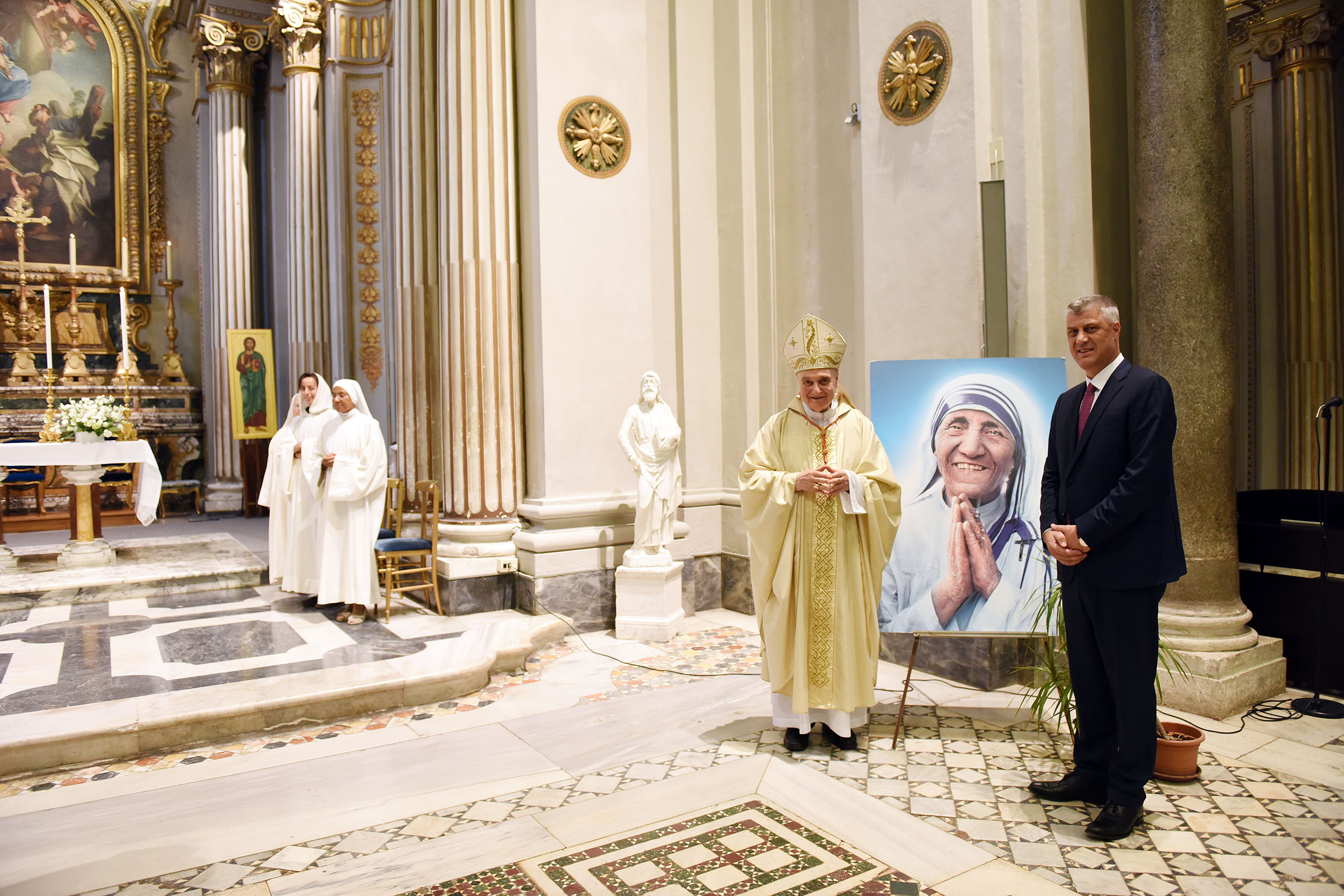
President [sic! – should be: racist, secessionist leader – J.I.] Rugova met with Pope John Paul II, who concerned himself in [sic] Kosovo and the Albanians. His Holiness also spoke of his coming visit to Albania. He gave Dr Rugova a medal, whereas the latter presented His Holiness with a memorial on the Albanian question.

After the meeting, Dr Rugova stated that Pope John Paul II was well informed of the situation in Kosovo and the Albanian question.
In the context of his visit to Italy, Mr Rugova met in Rome with the Premier of Italy Amato. In their cordial conversation they expressed understanding on Kosovo’s question and devoted special attention to preventing the conflict extend to Kosovo [sic! – should be ‘expanding in Kosovo’ – J.I.]. Dr Rugova demanded from the Italian Premier the international community’s intervention and Italy’s support to install peace-keeping forces in Kosovo as the first step to stabilise the situation and begin solving the question of Kosovo. Dr Rugova pointed to the grave social problems in Kosovo and demanded humanitarian aid from the Italian Government. Premier Amato said that his government will make greater efforts to internationalise Kosovo’s question and send humanitarian aid to Kosovo.
In the Italian Parliament, President Rugova met with Antonio Carrillo, chairman of the Italian Parliament’s foreign policy commission. In this meeting they discussed the situation in the Balkan region and the situation in Kosovo due to the Serbia’s policy of aggression. Dr Rugova presented his 10-point peaceful plan for solving the question of Kosovo and demanded understanding and aid from the Italian Parliament. Mr Carrillo expressed readiness to better engage in solving the problem of Kosovo.
Originally published on 2008-02-26
Source: The Emperor’s New Clothes
Origins of images: Facebook, Twitter, Wikimedia, Wikipedia, Flickr, Google, Imageinjection & Pinterest.
Read our Disclaimer/Legal Statement!
Donate to Support Us
We would like to ask you to consider a small donation to help our team keep working. We accept no advertising and rely only on you, our readers, to keep us digging the truth on history, global politics and international relations.