
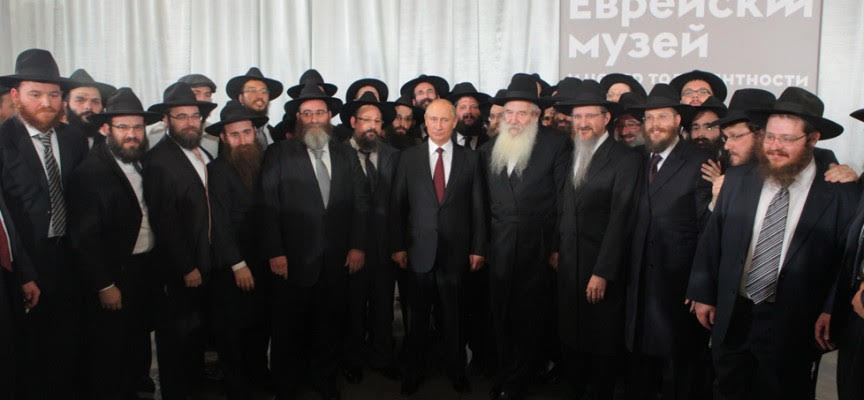
On January 19th, 2016 on the bilateral meeting between Russia’s President Vladimir Putin and the official representatives of the European Jewish Congress [...]
On January 19th, 2016 on the bilateral meeting between Russia’s President Vladimir Putin and the official representatives of the European Jewish Congress the latter applied to Putin to take necessary steps for the sake to improve the generally bad position of the Jewish community on the Old Continent. Surprisingly, the President, not so much as a joke, invited both all the present-day European Jews and those Jews who left the USSR simply to immigrate to Russia.
At the first glance, one can say – very gentle and even democratic move by the President. However, lets a little bit to analyze the case.
According to the Jewish representatives, there are at least two reasons for the „unbearable“ position of the European Jews: 1) Anti-Semitism, and 2) the influx of Muslim immigrants from the Middle East to Europe. Therefore, at least for the Jews, these two reasons are quite enough to emigrate from Europe, and for the President, the same reasons are also quite enough to invite all the European Jews to immigrate to Russia. Here, we will not discuss the question of why the European Jews do not want to emigrate to their own national state – Israel (and the USA as well), but the question is why the President is inviting one nation to be settled in Russia without any ethnic, racial, linguistic, cultural or national connection with his country?
Nevertheless, a more serious question arose in this matter: do only the EuroJews has such right (as „chosen people“?) as a privilege to emigrate to („promised land“?) Russia from the Euroterror or such President’s invitation is democratically equally open for all people, ethnic groups, confessional minorities, etc. who are experiencing the same or even (much) harsher „unbearable“ living conditions and terror in their home countries and social environments? For instance, Kosovo Serbs.
If we compare living conditions of the EuroJews with Kosovo Serbs today the conclusion can be only that those two cases have simply nothing in common with each other at least for the next four reasons and facts:
1. The European anti-Semitism today is not direct, brutal, or open but rather hidden and of a soft nature. It exists but it is nothing to be a real reason for the Jews as a group or as individuals to emigrate somewhere. At least in comparison with many other ethnic groups or minorities across the same continent, but above all, we would say, with Kosovo Serbs. The Euro-Jews are not at least forced to wear yellow strips on their clothes but some Kosovo Serbs do that voluntarily as a matter of protest.
2. The Jews in present-day Europe are not living in any kind of ghettos as it was before (the first ghetto for the Jews was created in Venice in 1535 followed by Dubrovnik) differently from the Serbs in Kosovo southern from Kosovska Mitrovica or the Roman Catholics in Belfast. The Serbs in central and southern Kosovo, totally different from the EuroJews, are living in a real ghetto situation and even in the home imprisonment with everyday fear to be killed by the local Muslim Albanians if they leave the home or village without escort by the international „peacekeeping“ forces. Many Kosovo Serbs are transported even by the armors to the shops, health centers, etc.
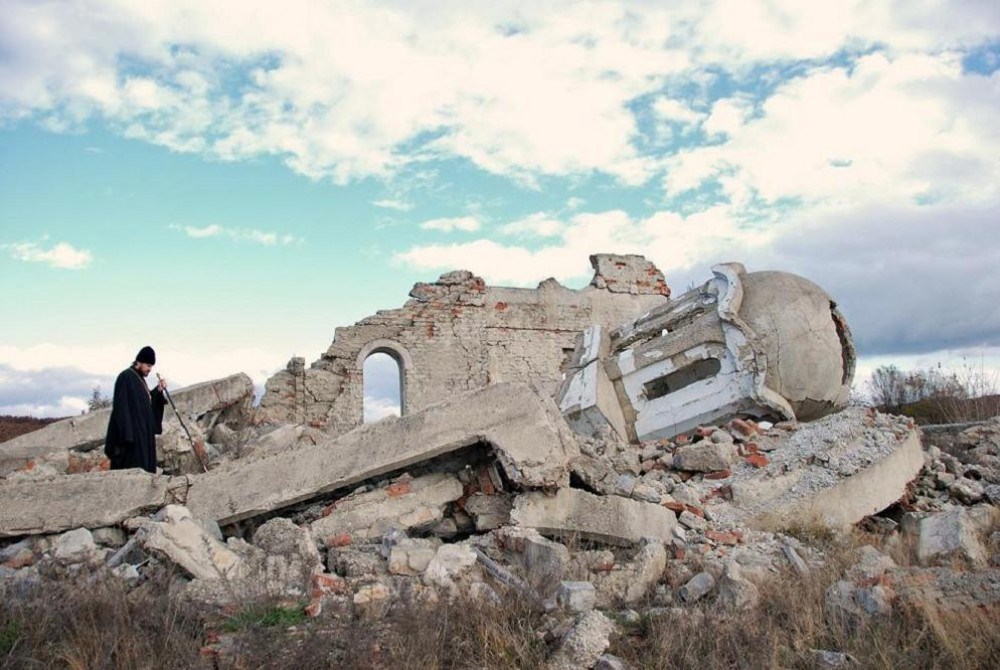
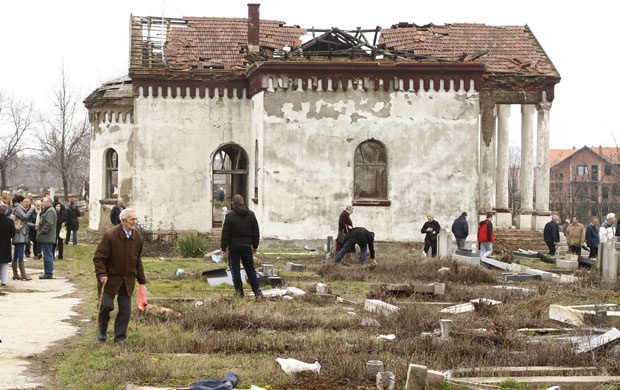
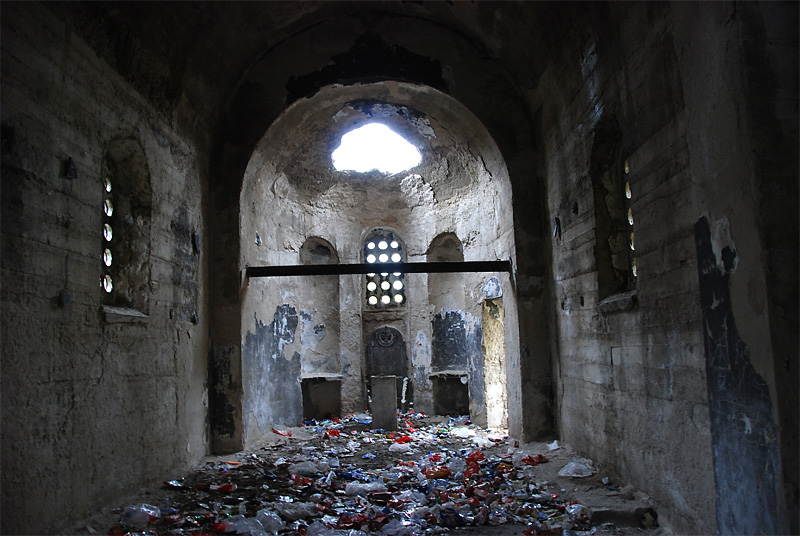
3. The Jewish shrines (synagogues) in Europe are not attacked, destroyed, burnt, or desecrated as is exactly the case with the Serbian shrines (Christian Orthodox) in Kosovo. The Muslim Albanians are systematically cleaning Kosovo from all Christian elements during the last 16 years (from June 1999) when the NATO’s occupation of Kosovo started. The destruction of Kosovo Christianity is at the same time followed by the brutal Islamization of the land: for instance (like in Bosnia-Herzegovina after 1995) there are three times more erected mosques in Kosovo after June 1999 in comparison with 400 years of the Ottoman occupation.
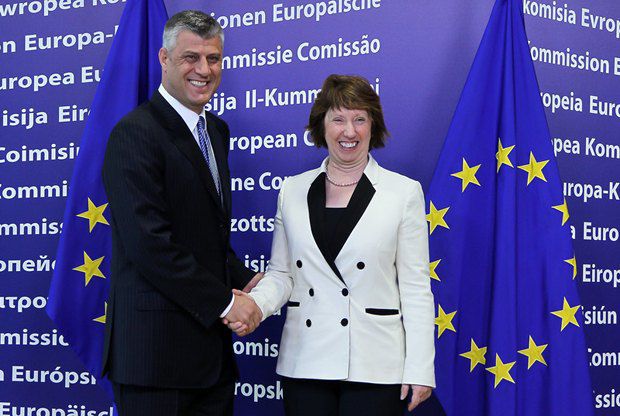
4. The Jews in Europe are not exposed today to any kind of pogroms, differently to Kosovo Serbs who are in fact experiencing not only the ethnic cleansing by the Muslim Albanians but even a genocide. The most brutal pogrom against the Serbs was done in Kosovo on March 17-19th, 2004 with three days and three nights of the „Kristallnacht“ as a part of the policy of Islamic terror in the Balkans [see, Sh. Shay, Islamic Terror, and the Balkans, Transaction Publishers, 2006; Ch. Deliso, The Coming Balkan Caliphate: The Threat of Radical Islam to Europe and the West, Westport, CT: Praeger Security International, 2007]. As a consequence, there are today only about 100.000 Serbs in Kosovo of whom the overwhelming majority (about 90.000) are living in the northern part of the region which is not under the administration by a (quasi)government in Prishtina composed by the ex-Kosovo Liberation Army’s criminals.
Here we came to the crux of a matter. In 2011 Kosovo Serbs launched a campaign to apply for Russian citizenship and even to emigrate to Russia. However, Putin’s administration was at that time „deaf“ to such an idea. Are the living conditions of Kosovo Serbs were (and are) not enough „unbearable“ in comparison to those of the Euro-Jews? Obviously no. Contrary, the Serbs in Kosovo can only dream to be in the Jewish position in Europe. Finally, Russia and Russians have much more in common with the Serbs than with the Jews. Why the President discriminates Kosovo Serbs in comparison with the EuroJews is not known but as a good example of Russian-Serbian solidarity and brotherhood he can take from the Empress Catherine the Great who even established a separate territory for the Serbs in Russia – Nuova Serbia (more or less covering the present-day territory of Novorossija).
Prof. Dr. Vladislav B. Sotirović
www.global-politics.eu/sotirovic
sotirovic@global-politics.eu
Personal disclaimer: The author writes for this publication in a private capacity which is unrepresentative of anyone or any organization except for his own personal views. Nothing written by the author should ever be conflated with the editorial views or official positions of any other media outlet or institution.
Origins of images: Facebook, Twitter, Wikimedia, Wikipedia, Flickr, Google, Imageinjection, Public Domain & Pinterest.
Read our Disclaimer/Legal Statement!
Donate to Support Us
We would like to ask you to consider a small donation to help our team keep working. We accept no advertising and rely only on you, our readers, to keep us digging the truth on history, global politics, and international relations.
Many articles in the US press have speculated at length in an attempt to define a new ideology called “Putinism.” The pieces serve as an attempt to fit Putin into an outdated Cold War narrative, as if some new ideology in the Russian Federation is playing the role that Marxism-Leninism once played in the Soviet Union, though the current Russian constitution forbids this.The notable leaders of history are rarely ideologues. History judges people mainly by what they achieve, not what they write or say. As Chinese President Xi Jinping recently put it: “The worth of any plan is in its ...
The German occupation forces were those who have been the first to create and recognize a short-lived state’s independence of Ukraine in January 1918 during the time of their-own inspired and supported anti-Russian Bolshevik Revolution of 1917−1921. As reoccupied by the Bolshevik Red Army, the eastern and southern parts of the present-day territory of (a Greater) Ukraine joined in 1922 the USSR as a separate Soviet Socialist Republic (without Crimea). According to the 1926 Soviet census of Crimea, the majority of its population were the Russians (382.645). The second-largest ethnic group were the Tartars (179.094). Therefore, a Jew V. I. ...
Serbian girl Jovana was only 11 years old when Albanian terrorists captured, beaten and detained her together with rest of the family.They were taken in a camp in the village of Klecka, Lipljan, along with her mother and grandmother. The camp was under direct rule and control of Fatmir Limaj (acquitted by the Hague cangaroo court) and Hashim Thaci.Hasim Taci used to visit the camp. One day little Jovana was taken by the Albanian KLA bandits, Luan and Bekim Mazrreku, who, before the eyes of her mother and grandmother raped the eleven years old girl.They tortured her, cutting her body ...
PrefaceAfter the end of the USSR in 1991, Russia, at that time both weakened and isolated, was becoming a less popular area of investigation and studies compared with the period during the Cold War. However, since the year of 2004, Russia is “back” in the global political arena when Moscow rejected the European Neighboring Policy’s game with the European Union (the EU). Those who argued that Russia was already irrelevant in global politics since 2004 had to realize their error of judgment. Today, Russia is “back” as a military, economic, and political Great Power with tremendous energy resources.[1] Recovering Russia’s ...
The creation of the First Balkan Alliance against the Ottoman Empire in 1866–1868 in the light of territorial requirements of the Balkan states and nations at the expense of the decreasing power of the Ottoman authorities and the Ottoman state integration was the first political-military treaty on the mutual cooperation by the Christian Balkan states and nations. The secret paragraphs of bilateral military-political contracts between Greece and Serbia and Serbia and Montenegro in regard to territorial inheritance of the Ottoman Empire in the Balkans are the most important points of the treaty.Serbia became a leader of the Balkan coalition and ...
After the Russian military victory over the Ottoman Empire in the 1877−1878 Russo-Ottoman War it was signed the San Stefano Treaty between these two states on March 3rd, 1878. According to the treaty, a Greater “San Stefano” Bulgaria, under the direct protection by Russia, had to be established within the borders of the Ottoman Empire. However, an idea of “San Stefano Bulgaria” directly affected three Balkan nations: the Serbs, Greeks and Albanians as some of their ethnic and historical territories had to become part of a Greater Bulgaria. The “San Stefano Bulgaria” was projected by the Russian authorities to cover ...
As recounted in the unjustly neglected German television report “It Began with a Lie,” in April 1999, in the midst of NATO’s illegal bombing campaign against what had remained of Yugoslavia, then German Defense Minister Rudolf Scharping repeatedly accused the Serbian side of installing a Nazi-style “concentration camp” in the soccer stadium in Pristina, the capital of Serbia’s Kosovo and Metohija province. Pressed by the media for proof, Scharping offered “witness testimony” – which he never subsequently produced.A month earlier, just as the bombing had started, Scharping stated that “we never would have taken military action if there weren’t this ...
Article by Vladislav B. Sotirović: „A New Age of Global Security: The ‚Ukrainian Question‘ and ‚Kosovo Precedent‘“, Vojno delo (Military affairs), Interdisciplinary Scientific Theoretical Journal, International Edition, Vol. 69, Issue 4, 2017 (May-June 2017), ISSN 0042-8426, Ministry of Defence of the Republic of Serbia, Belgrade, Serbia, pp. 176−211.Origins of images: Facebook, Twitter, Wikimedia, Wikipedia, Flickr, Google, Imageinjection, Public Domain & Pinterest.Read our Disclaimer/Legal Statement!Donate to Support UsWe would like to ask you to consider a small donation to help our team keep working. We accept no advertising and rely only on you, our readers, to keep us digging the truth ...
The Battle and the Nation The consciousness of a distinct Serbian ethnic identity had been present among the Serbs since the times of the founder of an independent medieval Serbian state, veliki župan (Grand Duke) Stefan Nemanja (1166−1196).[1] These consciousnesses were further strengthened by both when Serbia became a kingdom in 1217 and with the establishment of an autocephalous archbishopric in 1219 as a national independent (Christian Orthodox) church.[2] However, the Battle of Kosovo (on the morning of June 28th, 1389)[3] which the Serbs de facto lost to the Ottoman Turks and the death of a Serbian ruler, Prince Lazar Hrebeljanović ...
There was an interesting announcement recently that went almost entirely unnoticed in the Canadian media.On June 17, Peter Szijjarto, foreign minister of Hungary’s centre-right government, made the startling declaration that his national security forces will erect a four-metre wall along the entire 175 kilometres of shared border with Serbia.Szijjarto’s rationale for resorting to such a drastic measure results from a months-long flood of asylum seekers pouring into southern Hungary. While tens of thousands of these desperate illegal immigrants have been caught, detained and returned into Serbia, the vast majority have used the processing time for their asylum applications to simply ...
It was NATO’s first out-of-area operation, against its own Treaty and without a UN mandate. On March 24, 1999.Independent Kosovo was established – against UN SC resolution 1244. Thanks to the Clinton administration and Madeleine Albright. CNN’s Amanpour endorsed it generously on TV with her State Department husband, James Rubin, a chief operator in the non-negotiations at Rambouillet. And TIME of course knew the truth too.Serbia suffered tremendously from the 78 days of indiscriminate, hard bombing. I know because I was there.Finally, Serbia and its president Milosevic was threatened with total destruction of Belgrade. And gave in.Western hubris after the ...
The Kosovo Question recently once again became an important issue of global politics and international relations for two reasons: 1) The Albanian “government” of the “Republic of Kosovo” announced to officially proclaim the existence of the Kosovo Army (that is a violation of the 1244 UN Resolution in 1999), and 2) The “president” of the “Republic of Kosovo”, a war criminal Hashim Tachi, participated on November 11th (2018) in Paris to the world leaders’ celebration of a centenary anniversary of the end of the WWI (the signed armistice with Germany) as the official representative of an “independent” Kosovo. He was ...
Miloš Zeman said in an interview for the Serbian newspaper Večernje novosti, that recognition of Kosovo’s independence has opened a Pandora’s Box and called the Kosovo deputy Prime Minister Hashim Thaçi a war criminal.Zeman, among other things, confirmed that he will travel to Moscow for the celebrations of the end of the Second World War because the Soviet army liberated most of the former Czechoslovakia.The Czech president has openly expressed himself on Kosovo in the past, for example he labeled the country a very strange state with a strong narco-mafia influence.This article originally appeared at Hospodářské Noviny. Translated for RI by Anthony GrulichThe recognition of ...
The current political process of acceptance of the quasi-independent state of Kosovo to the full UN’s UNESCO’s membership opened once again a question of NATO’s military intervention against the Federal Republic of Yugoslavia (the FRY) in March−June 1999 as a foundation for Kosovo’s secession from Serbia and its unilateral proclamation of a quasi-independence in February 2008. Kosovo became the first and only European state up today that is ruled by the terrorist warlords as a party’s possession – the (Albanian) Kosovo Liberation Army (the KLA). The aim of this article is to investigate the nature of NATO’s war on Yugoslavia ...
In the thousand year long-history of Serbs, Kosovo and Metohia were for many centuries the state center and chief religious stronghold, the heartland of their culture and springwell of its historical traditions. For a people who lived longer under foreign rule than in their own state, Kosovo and Metohia are the foundations on which national and state identity were preserved in times of tribulation and founded in times of freedom.The Serbian national ideology which emerged out of Kosovo’s tribulations and Kosovo’s suffering (wherein the 1389 St. Vitus Day Battle in Kosovo Polje occupies the central place), are the pillars of ...
The Consequences of WWI and the YugoslavsThe end of WWI in November 1918 as a consequence of the military collapse of the Central Powers and the following series of peace treaties of Versailles on June 28th, 1919 between the Allies and Germany, of St Germain on September 10th, 1919 with Austria, of Neuilly on November 27th, 1919 with Bulgaria, and finally of Trianon on June 4th, 1920 with Hungary, produced major border changes in Central, South-East, and East Europe as the continent saw the emergence of several of new states and the enlargement of others fortunate enough to be on ...
BELGRADE – Amnesty of crimes during NATO aggression, bilateral legalization of Camp Bondsteel in a friendly milieu, settling the Islamic world with support to their communities in the Balkans and forcing Russia out of that same Balkans, are four reasons the US supports the independence of Kosovo, writes “Sputnik”.On Christmas (according to Gregorian calendar) Michael Kirby shows up. Outgoing US Ambassador congratulates Serbia upcoming New Year. “The normalization of relations between Belgrade and Pristina implies Kosovo’s membership in the UN,” was the content of the “greeting card”.Apart from some kind of formalization, Kirby’s statement is not new for the local public ...
Nestling in a wooded valley that its citizens laid their lives down to defend, the town of Kacanik in southern Kosovo is fiercely proud of its war dead.Well-kept cemeteries include nearly 100 victims of Serb-led ethnic cleansing in 1999, while in the town centre, a statue clutching an RPG honours fallen members of Brigade 162 of the Kosovan Liberation Army.But a decade and a half on from the war that brought about Kosovo’s independence, there is rather less pride in Kacanik’s new crop of warriors.Infamous son: Lavdrim Muhaxheri, from Kacanik, in Syria In the last three years, some 24 local menfolk ...
IntroductionThis article deals with the question of political and human/minority rights in the region of Kosovo & Metohija twenty years after the „2004 March Pogrom“ and twenty-five years after NATO's military aggression on Serbia and Montenegro and occupation of the region. An importance of this research topic is in fact that for the first time in European history, a terrorist-style and mafia-ruled (quasi)independent state was created by a full diplomatic, political, economic, military, and financial sponsorship by the West under the umbrella of the NATO's and the EU's protective administration. The precedence of Kosovo's self-proclaimed independence in February 2008 already ...
Split, Croatia, September 14th, 2018: "Kill Serb" written on the car with the plates from SerbiaThe mugshots show Ivo Goldstein, a Jewish librarian and book dealer, looking bright-eyed and calm — even after nine days of confinement in a Croatian police cell. One of the prints bears the number 28888 and a date: April 21, 1941.Seventy-six years after they were taken by a police photographer, the photos hang as a triptych on the bedroom wall of Goldstein’s son, Daniel, in a drab apartment block in Zagreb’s Zaprudje neighborhood.Daniel, 85, is a historian and human rights activist. He was nine when ...
The magazine is covering the research gaps uncovered by global Western hoax mainstream media platforms and academic teaching & research institutions.
This is an alternative information & academic research digest platform with the purpose to offer an alternative “another side of the truth”.
The magazine is independent, private, and free of any influence by any institution, organization, government, or pressure group. URL: www.global-politics.eu