
The new series by Ken Burns and Lynn Novick is mesmerizing. But it doesn’t answer the questions about the Vietnam War that many are still seeking [...]
Well-intentioned and artfully executed, The Vietnam War—Ken Burns and Lynn Novick’s 10-part, 18-hour-long documentary series on PBS—is not history, but rather story-telling and remembrance. Balanced, exhaustive, and relentlessly solemn, it glides along the surface of things, even when that surface is crowded with arrogance, miscalculation, deceit, and bloodletting on an epic scale.
According to one promotional trailer prepared for the series, “In war there is no single truth.” Embedded within every war (as in other forms of human endeavor) are multiple truths—some of them trivial, others very important indeed. The purpose of history is to unearth and engage with those truths that have something to teach us. This requires a willingness to interpret and render moral judgments. Yet Burns and Novick have an aversion to interpretation and steer clear of judgments.
Notably, among the many subjects interviewed for the project, professional historians—those trained to interpret the past—are all but absent. Whether as soldiers, government officials, reporters, antiwar activists, or mere bystanders, the series’ featured “talking heads” all participated in the events they recount. Their authority derives from what they themselves did or saw several decades ago and from how they have since processed those experiences. As witnesses, none are less than credible. Many are eloquent and offer deeply moving testimony: the Americans mournful, the South Vietnamese bitter, the North Vietnamese and former Vietcong resolute and assured. Yet largely absent from any of their recollections is a sense of distance or detachment. All are, in effect, partisans of one stripe or another.
If The Vietnam War as a whole has a point to make, it would appear to be that war is a great tragedy. Of course, this qualifies as a truism. In this particular tragedy, the participants on all sides—the people of North and South Vietnam no less than the Americans sent to fight against the North on the South’s behalf—suffered more or less equally. On all sides, the combatants exhibited courage and stamina. No side was innocent of grievous atrocities. All are victims; all are guilty. Or so Burns and Novick would have us believe.
I don’t mean to suggest that the series stakes out a position of bland neutrality. But the controversies it does take up tend to be either already resolved or largely peripheral. For example, Burns and Novick briefly examine and summarily reject the claim, cherished by devotees of Camelot, that President John F. Kennedy was planning to pull out of Vietnam once reelected in 1964. They also expose as simply untrue the US military’s claim that despite losing the war, it never “lost a fight.” In recounting the Battle of Hill 1338 in June 1967, for example, they depict in excruciating detail the destruction of an elite American paratroop unit, a tactical defeat that senior US officers subsequently covered up. And on the charges that, in 1968, Richard Nixon’s campaign conspired to derail the peace talks in order to improve his chances of winning the presidency, Burns and Novick find Nixon guilty. In each instance, their evidence is irrefutable. But having delivered their verdicts, they simply move on. So Nixon’s treasonous behavior becomes just one more anecdote.
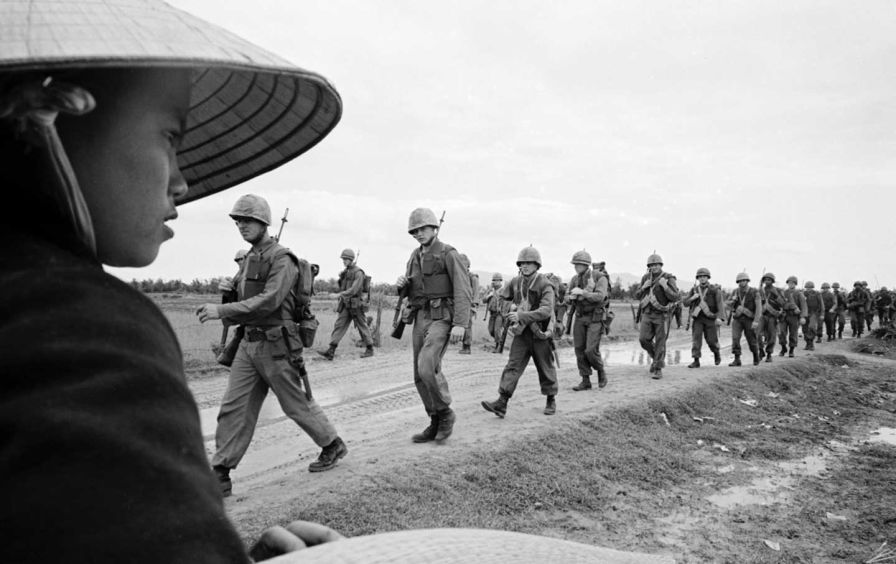
Throughout The Vietnam War, the production values are of the highest quality. The narrative unfolds seamlessly, cutting from the war zone to the home front (theirs and ours) and back again. The period footage—a surprising amount of it North Vietnamese—is vivid and compelling. GIs wade through rice paddies, trudge up mountainsides, and stumble into ambushes set up by the North Vietnamese Army and the Vietcong. At night, fleets of Russian-built trucks lumber down the Ho Chi Minh Trail, trying to conceal themselves from the ordnance-laden American jets prowling overhead. Flying low and slow over the jungles of South Vietnam, Air Force C-123s dump tons of chemical defoliants, with nary a thought about the second-order consequences. Cruising at altitude over North Vietnam, Laos, and Cambodia, B-52s disgorge their bomb loads onto whatever lies below. And always there are helicopters, mostly Hueys, Cobras, and Chinooks, touching down to unload assault troops, provide suppressive fire, or evacuate casualties. The cumulative effect is both mesmerizing and obscene.
Burns and Novick complement the imagery with a soundtrack consisting of pop songs from the 1960s and ’70s: Dylan, Seeger, the Stones, Led Zeppelin, Jimi Hendrix, Barry McGuire, Simon & Garfunkel, and so on. With few exceptions, the recordings have a political edge, however oblique—no show tunes, no doo-wop, no lovey-dovey mush. Sgt. Barry Sadler’s mawkish “Ballad of the Green Berets,” a hit in 1966, doesn’t make the cut. The music is clearly intended to convey the sense that the film has something profound to say, even if, to quote a famous Buffalo Springfield lyric, “what it is ain’t exactly clear.”
Merrill McPeak, a former fighter pilot interviewed for this series, takes a stab at clarifying one central issue: “We were fighting on the wrong side.” Given that McPeak remained on active duty after the war and, as a four-star general, eventually served as Air Force chief of staff, his verdict is all the more noteworthy. But it is also off the mark. The United States screwed up not because it picked the wrong side in the Vietnam conflict, but because it stuck its nose where it didn’t belong. It simply wasn’t for us to decide who were the good guys and who the bad guys. The fate of Vietnam was an issue of negligible relevance to US national security. Had the United States allowed the Vietnamese to settle their differences on their own terms, everyone would have been better off. Almost certainly, far, far fewer people would have died.
Yet Burns and Novick pay surprisingly little attention to why exactly the United States insisted on butting in and why it subsequently proved so difficult to get out. Their lack of interest in this central issue is all the more striking given the acute misgivings about a large-scale US intervention that Lyndon Johnson repeatedly expressed in the fateful months between late 1964 and early 1965.
The anguished president doubted that the war could be won, didn’t think it was worth fighting, and knew that further expansion of US involvement in Vietnam would put at risk his cherished Great Society domestic-reform program. He said as much in taped conversations with Defense Secretary Robert McNamara, National Security Adviser McGeorge Bundy, and his friend Georgia Senator Richard Russell, among others. Despite his reservations, Johnson—ostensibly the most powerful man in the world—somehow felt compelled to go ahead anyway. Yet Burns and Novick choose not to explore why exactly Johnson felt obliged to do what he did not want to do.
Our present situation makes the question all the more salient. The US war in Afghanistan, although smaller in scale than the war in Vietnam, has dragged on even longer. It too has turned out to be a misbegotten enterprise. When running for the presidency, Donald Trump said as much in no uncertain terms. But President Trump—ostensibly the most powerful man in the world—has not turned his skepticism into action, allowing America’s longest war to continue.
In a very real sense, Trump did not so much decide as capitulate. Much the same can be said about LBJ a half-century earlier when he signed off on committing US combat troops to Vietnam. But Burns and Novick barely touch on the factors leading to Johnson’s capitulation, even though, in present-day Washington, those factors persist: a brain-dead national-security establishment unable to conceive of political alternatives to escalation; a fear that admitting military failure will exact unacceptable political costs, whereas the costs of perpetuating an unwinnable war are likely to be tolerable; and, perhaps above all, the iron law of American exceptionalism, centered on the conviction that Providence summons the United States to exercise global leadership always and everywhere, leadership having long since become synonymous with a willingness to use force. As Trump has affirmed, even (or perhaps especially) presidents must bow to this pernicious bit of secular theology.
According to Burns and Novick, the American war in Vietnam was “begun in good faith, by decent people.” It comes closer to the truth to say that the war was begun—and then prolonged past all reason—by people who lacked wisdom and, when it was most needed, courage. Those who fought in the war and those who fought against it will certainly want to watch this series. Yet to find the answers that many are still searching for, they will have to look elsewhere.
We would like to ask you to consider a small donation to help our team keep working. We accept no advertising and rely only on you, our readers, to keep us digging the truth on history, global politics and international relations.
The world is lectured frequently by the United States of America — the One Indispensable Nation — about how to behave, on the grounds that, as President Obama declared, «from London and Prague, to Tokyo and Seoul, to Rio and Jakarta... there is a new confidence in our leadership».He didn’t mention Amman, Baghdad, Beijing, Beirut, Caracas or the capitals of so many other countries in which the majority of citizens, according to the Pew Research Centre and other pollsters such as Marketwatch, regard the United States as an aggressive and malign manipulator of world affairs.Presidential hopeful Hillary Clinton went further than President Obama in glorifying ...
On August 9 [2020], presidential elections were held in Belarus with five candidates bidding to be head of state. According to the Central Election Commission, the incumbent president, Alexander Lukashenko, won in the first round with over 80% of the votes. Mass protests began in Belarus right after the announcement of the preliminary election results. People went to the streets, expressing their dissatisfaction with the results of the elections that they believe were unfair. Mass protests turned into riots and there were clashes between rioters and the police. Many people were detained and injured, and two protestors died.Representatives of the ...
This weekend 75 years ago, the German city of Dresden was razed to the ground by British and American aerial bombardment. At least 25,000 mainly civilians were destroyed in raid after raid by over 1,200 heavy bombers, indiscriminately dropping high explosives and incendiaries. It took seven years just to clear the rubble.The destruction of Dresden, a world-famous cultural center of Baroque majesty, has been long dogged by controversy. Official British and American military accounts claim it was necessary to hasten the collapse of the Third Reich; with a reasoning that resonates with US claims for dropping the atomic bombs on ...
In December last year [2015], NATO officially invited Montenegro to become the 29th member state of the most powerful military organisation of our times, if not, in fact, of all time. The country’s Prime Minister, Milo Đukanović, assured the NATO secretary-general that “you can count on us at any time.” It is always nice to hear that someone has your back. But in Montenegro’s case, it means that they have our back with an entire active-duty military force of only two thousand personnel. It is not quite clear how the tiny nation of less than 700,000 people enhances U.S. security ...
Six months into 2016 and the world looks decidedly nervous and edgy from a geo-political viewpoint. A dramatic oil price plunge has pushed producing nations into near crisis as the international scrap for market share follows a bid by a collapsing OPEC cartel to fight off American production. China’s economic woes continue to destabilise markets the world over. The USA is clearly becoming more hostile, even warlike towards Russia, who in turn appears to be gearing up to defend itself from increasingly belligerent and aggressive NATO commanders who are facilitating Europe’s encirclement of Russian borders. The latest weaponry pointed directly at Moscow does not help ...
Zagreb, 1941Become familiar with the basic info about one of the most beautiful countries in the world - Croatia. Photos, data & recommendations where to stay in order to enjoy this Adriatic pearl. If you are not the Serb.Split, Dalmatia, Croatia, 2019: "Kill the Serb" on the car with the plates from SerbiaOrigins of images: Facebook, Twitter, Wikimedia, Wikipedia, Flickr, Google, Imageinjection, Public Domain & Pinterest.Read our Disclaimer/Legal Statement!Donate to Support UsWe would like to ask you to consider a small donation to help our team keep working. We accept no advertising and rely only on you, our readers, to ...
As colonial monuments are being destroyed in the U.S. and Europe, Mount Rushmore so far remains untouched and a news item since U.S. President Donald Trump visited the site on July 4 to commemorate Independence Day. Fireworks and fighter jets dominated a territorial space that is laden with the memory of colonial violence against the indigenous American Indians.A treaty signed in 1868 between the U.S. government and the Sioux people recognised the Black Hills in South Dakota as exclusive to the indigenous. The agreement was toppled in 1874 when gold was discovered in the Black Hills in a mining expedition ...
The new coronavirus and its accompanying disease Covid-19 has stopped the globe in its tracks. Governments, markets and news cycles have become dominated by the pandemic. Europe is now the epicenter for the disease, with reportedly more fatal cases of infection than China where the virus first erupted in December.Several European Union countries have declared themselves states of emergencies, including Belgium, France, Portugal, Spain and Italy. The 27-member bloc has sealed off external borders. Some states, such as Poland, have begun closing borders with other EU members. Brussels, the administrative center of the EU, is alarmed because the much-vaunted single ...
On Friday, October 5th, the U.S. Secretary of State – John Kerry calls for war crimes investigation of Russia’s and Assad governments for the destruction of the Syrian city of Aleppo. The western corporate mass media was a very quick, like, for instance, The New York Times, immediately and clearly to accuse the Russian President Vladimir Putin and the Syrian President Bashar al-Assad of alleged war crimes in Syria – the same cliché used by the same propaganda machinery against the Serbs (Srebrenica case from 1995 or Kosovo War from 1999) during the bloody destruction of ex-Yugoslavia (by the U.S. ...
The crumbling “liberal” West is in a desperate hurry in the Balkans. More than a quarter century since the first Western states, pushed by Germany, unilaterally recognized the secession of the former Yugoslav federal republics of Slovenia, Croatia and Bosnia-Herzegovina and about 19 years since NATO’s air and land attack against what had remained of the country (the Federal Republic of Yugoslavia, comprising Serbia and Montenegro) resulting in NATO’s occupation and subsequent forced amputation of Serbia’s Kosovo and Metohija province (by way of recognition of its unilaterally declared independence of February 2008 by the main Western powers, some – but not all Muslim ...
One of the most controversial, influential, and well-known revolutionary organizations in the world was the Irish Republican Army (the IRA) considered to be both patriotic and terrorists.The FeniansIt is of extreme debate the question of its real origin but it is mostly accepted the standpoint that the origins of the IRA are in the Irish Republican Brotherhood (the IRB) or popularly known as the Fenians as it grew out of the Fenian movement.[1] The name is coming from the Irish armed forces in legendary times. The Fenian movement was founded as both the Fenian Brotherhood in the USA by John ...
Rising tensions in the global relations and hotbeds of old and new crises call for unity and efforts of all peace forces for closing foreign military bases, particularly U.S. and NATO foreign military bases, around the globe. The peace forces are obligated to send a clear message that U.S. and NATO foreign military bases represent the tools of hegemonism, aggression, occupation and that as such must be closed.Peace and inclusive development, elimination of hunger and misery require redistribution of spending for maintenance of military bases in favor of development needs, education, and health services. After the end of the Cold ...
IntroductionAfter the catastrophic attacks of September 11 2001 monumental sorrow and a feeling of desperate and understandable anger began to permeate the American psyche. A few people at that time attempted to promote a balanced perspective by pointing out that the United States had also been responsible for causing those same feelings in people in other nations, but they produced hardly a ripple. Although Americans understand in the abstract the wisdom of people around the world empathizing with the suffering of one another, such a reminder of wrongs committed by our nation got little hearing and was soon overshadowed by ...
Remember watching ancient Orthodox Christian monasteries in flames in Kosovo dozen times.Old, noble constructions, spiritual and historical testimonies of past times.I also remember that majority of Orthodox Christian monasteries, churches and relics has been attacked and destroyed after NATO forces (officially: KFOR) took full control of the Serbian province.It amazed me to see how Western soldiers, under full equipment and heavy armament, often didn’t make a single move to stop Albanian violence; over 200 000 Serbs had to flee, in order to save their bare lives, bearing whole their lives in few suitcases if they were lucky enough.It turned out ...
Origins of images: Facebook, Twitter, Wikimedia, Wikipedia, Flickr, Google, Imageinjection & Pinterest.Read our Disclaimer/Legal Statement!Donate to Support UsWe would like to ask you to consider a small donation to help our team keep working. We accept no advertising and rely only on you, our readers, to keep us digging the truth on history, global politics and international relations.
I spoke recently at a conference on America’s war party where afterward an elderly gentleman came up to me and asked, “Why doesn’t anyone ever speak honestly about the six-hundred-pound gorilla in the room? Nobody has mentioned Israel in this conference and we all know it’s American Jews with all their money and power who are supporting every war in the Middle East for Netanyahu? Shouldn’t we start calling them out and not letting them get away with it?”It was a question combined with a comment that I have heard many times before and my answer is always the same: ...
TerminologyA meaning of the term Great Power(s) (GP) in global politics from the beginning of the 16th century onward refers to the most power and therefore top influential states within the system of the international relations (IR). In other words, the GP are those and only those states who are modelling global politics like Portugal, Spain, Sweden, France, the United Kingdom, united Germany, the USA, the USSR, Russia or China. During the time of the Cold War (1949−1989) there were superpowers[1] as the American and the Soviet administrations refered to their own countries and even a hyperpower state – the ...
In the current context, the US is threatening to wage a preemptive nuclear war against Russia, which possesses a vast arsenal of nuclear weapons. Hillary Clinton has confirmed that “nukes are on the table” and she intends to use them if she becomes president. We need to defend ourselves against Russia, Iran, North Korea and China. Her solution is to blow up the planet.World War II ended in Mushroom Clouds.If Hillary decides to wage a preemptive nuclear war on Russia, World War III would commence with mushroom clouds.How would World War III end. Would it have an ending?In the words ...
The edifice of the post-1991 world order is collapsing right before our eyes. President Putin’s decision to give a miss to the Auschwitz pilgrimage, right after his absence in Paris at Charlie festival, gave it the last shove. It was good clean fun to troll Russia, as long as she stayed the course. Not anymore. Russia broke the rules.Until now, Russia, like a country bumpkin in Eton, tried to belong. It attended the gathering of the grandees where it was shunned, paid its dues to European bodies that condemned it, patiently suffered ceaseless hectoring of the great powers and irritating baiting of the East European small-timers alike. But something broke there. The lad does ...
Dear Readers and Friends:The distinguished and knowledgeable international commentator William Engdahl, in a superb statement, has expressed the view I gave you that Russian President Vladimir Putin’s speech on September 28 at the 70th anniversary of the United Nations changed the balance of power in the world. Until Putin’s speech the world was intimidated by the Washington Bully. Resistance to Washington brought swift retribution. In the Middle East and Africa it brought economic sanctions and military invasions that destroyed entire countries. In France and other US vassal states it brought multi-billion dollar confiscations of bank net worth as the price ...
The magazine is covering the research gaps uncovered by global Western hoax mainstream media platforms and academic teaching & research institutions.
This is an alternative information & academic research digest platform with the purpose to offer an alternative “another side of the truth”.
The magazine is independent, private, and free of any influence by any institution, organization, government, or pressure group. URL: www.global-politics.eu