
Libya: From Africa’s Richest State under Gaddafi, to Failed State after NATO Intervention
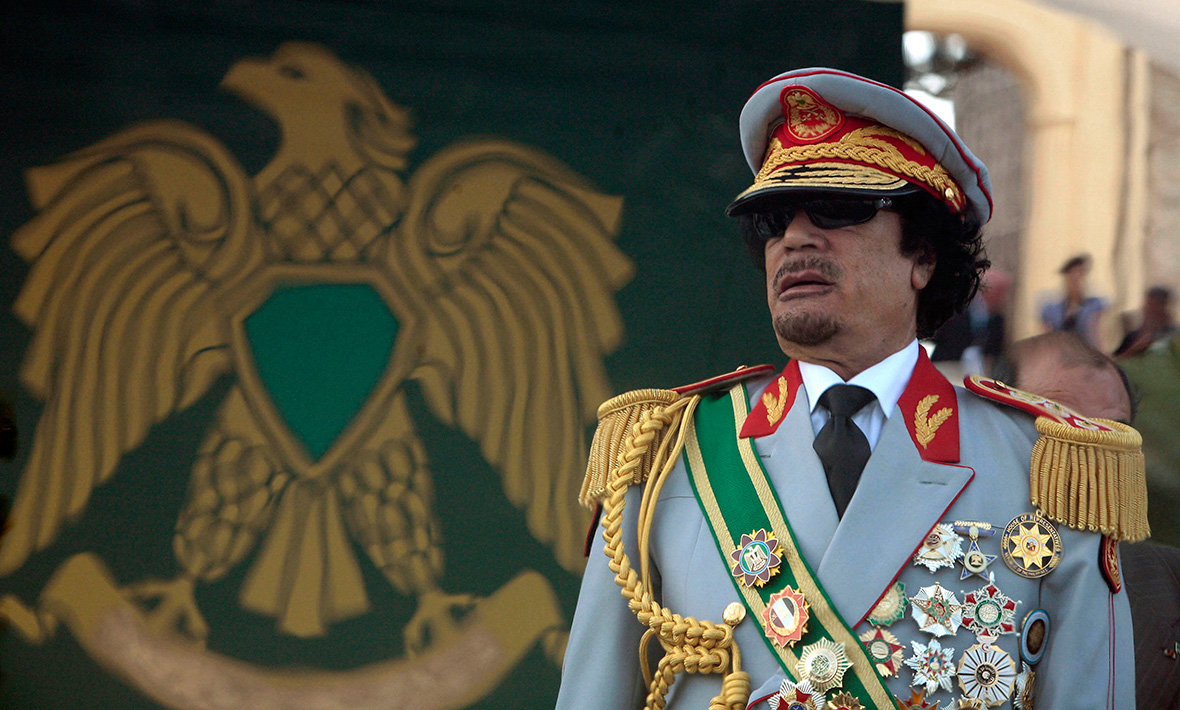
For over 40 years, Gaddafi promoted economic democracy and used the nationalized oil wealth to sustain progressive social welfare programs for all Libyans. Under Gaddafi’s rule, Libyans enjoyed not only free health-care and free education, but also free electricity and interest-free loans [...]
This article was first published on October 19, 2014
This week marks the three-year anniversary of the Western-backed assassination of Libya’s former president, Muammar Gaddafi, and the fall of one of Africa’s greatest nations.
In 1967 Colonel Gaddafi inherited one of the poorest nations in Africa; however, by the time he was assassinated, Gaddafi had turned Libya into Africa’s wealthiest nation. Libya had the highest GDP per capita and life expectancy on the continent. Less people lived below the poverty line than in the Netherlands.
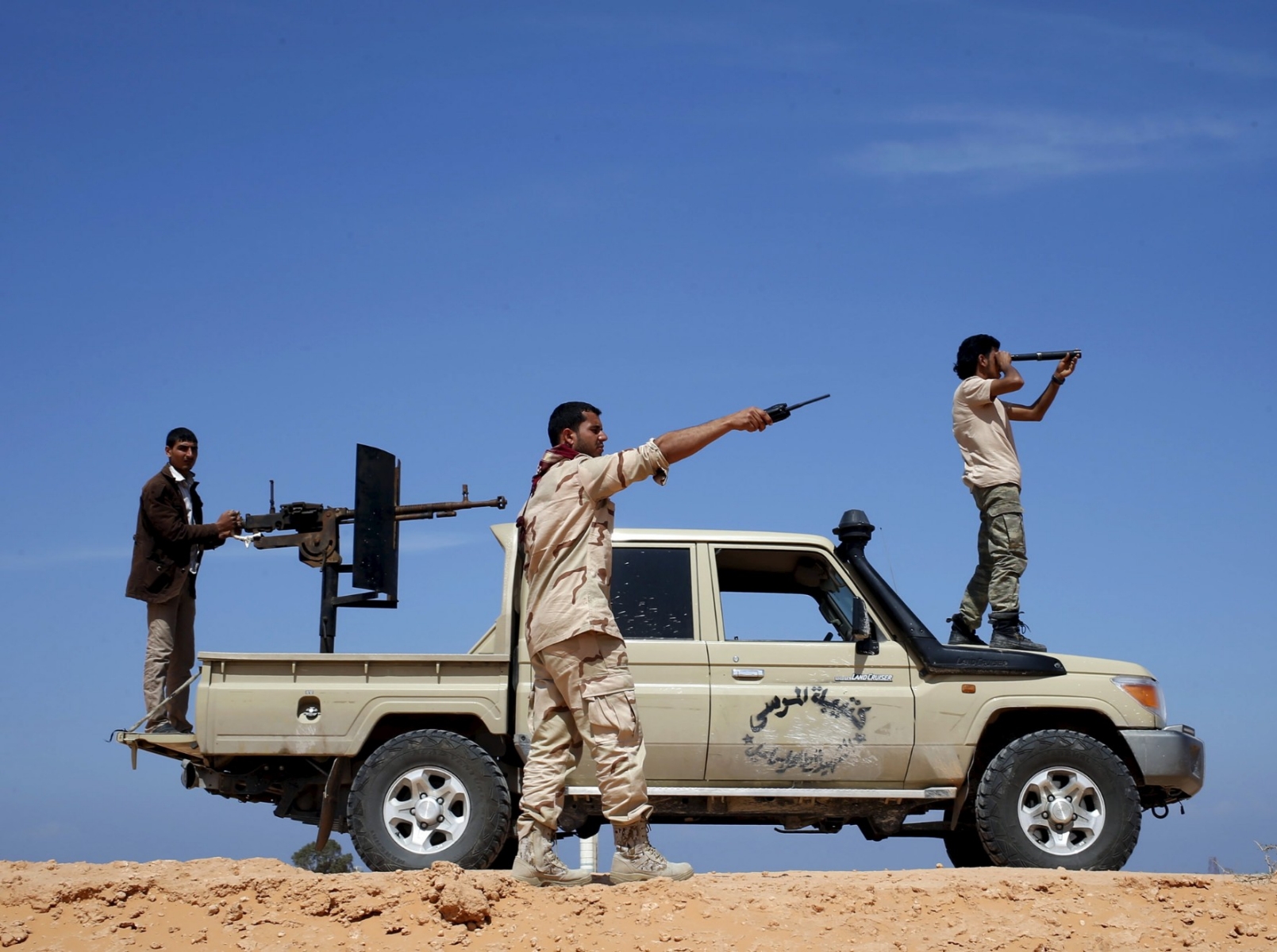
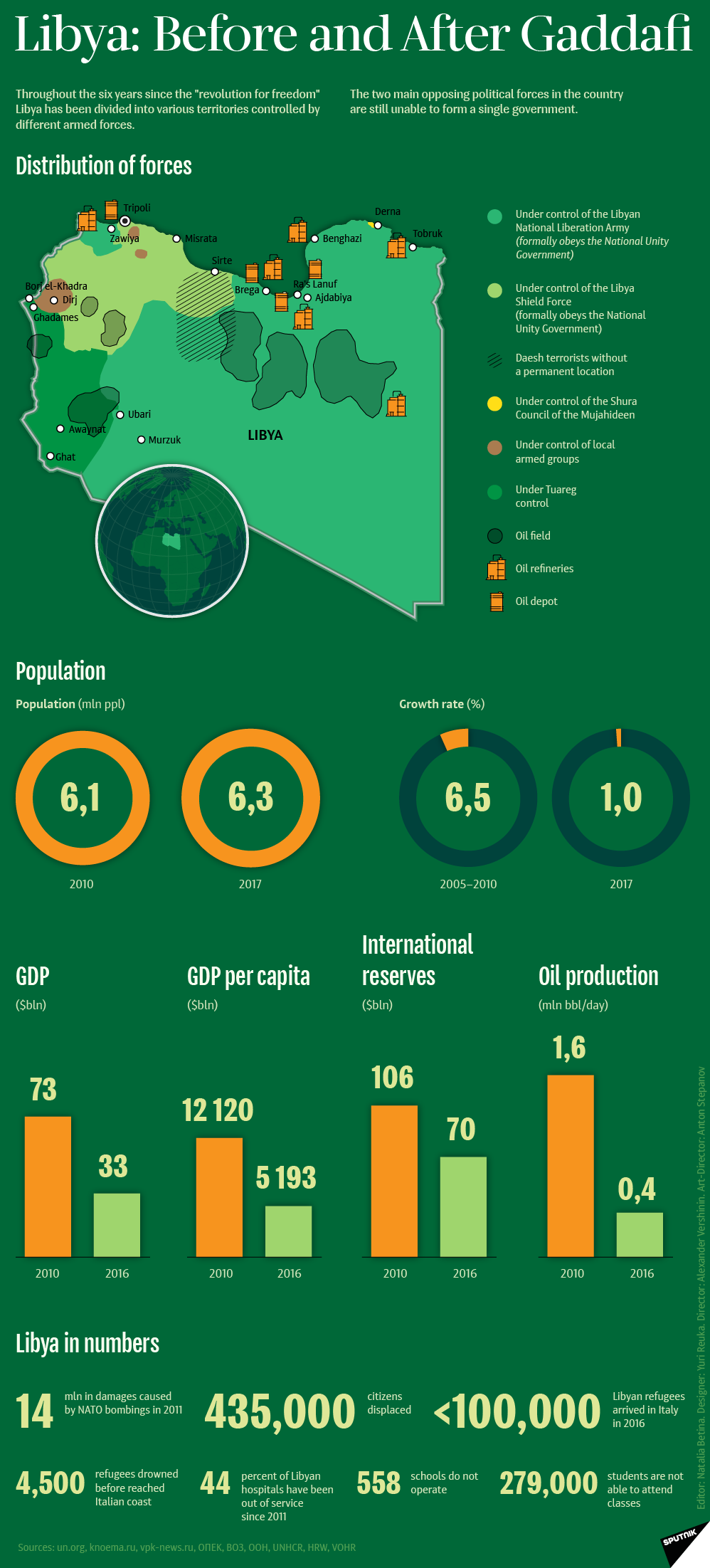
After NATO’s intervention in 2011, Libya is now a failed state and its economy is in shambles. As the government’s control slips through their fingers and into to the militia fighters’ hands, oil production has all but stopped.
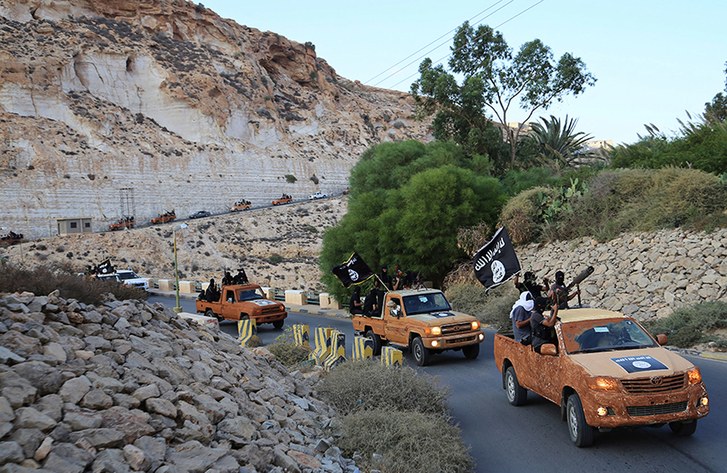
The militias variously local, tribal, regional, Islamist or criminal, that have plagued Libya since NATO’s intervention, have recently lined up into two warring factions. Libya now has two governments, both with their own Prime Minister, parliament and army.
On one side, in the West of the country, Islamist-allied militias took over control of the capital Tripoli and other cities and set up their own government, chasing away a parliament that was elected over the summer.
On the other side, in the East of the Country, the “legitimate” government dominated by anti-Islamist politicians, exiled 1,200 kilometers away in Tobruk, no longer governs anything.
The fall of Gaddafi’s administration has created all of the country’s worst-case scenarios: Western embassies have all left, the South of the country has become a haven for terrorists, and the Northern coast a center of migrant trafficking. Egypt, Algeria and Tunisia have all closed their borders with Libya. This all occurs amidst a backdrop of widespread rape, assassinations and torture that complete the picture of a state that is failed to the bone.
America is clearly fed up with the two inept governments in Libya and is now backing a third force: long-time CIA asset, General Khalifa Hifter, who aims to set himself up as Libya’s new dictator. Hifter, who broke with Gaddafi in the 1980s and lived for years in Langley, Virginia, close to the CIA’s headquarters, where he was trained by the CIA, has taken part in numerous American regime change efforts, including the aborted attempt to overthrow Gaddafi in 1996.
In 1991 the New York Times reported that Hifter may have been one of “600 Libyan soldiers trained by American intelligence officials in sabotage and other guerrilla skills…to fit in neatly into the Reagan Administration’s eagerness to topple Colonel Qaddafi”.
Hifter’s forces are currently vying with the Al Qaeda group Ansar al-Sharia for control of Libya’s second largest city, Benghazi. Ansar al-Sharia was armed by America during the NATO campaign against Colonel Gaddafi. In yet another example of the U.S. backing terrorists backfiring, Ansar al-Sharia has recently been blamed by America for the brutal assassination of U.S. Ambassador Stevens.
Hifter is currently receiving logistical and air support from the U.S. because his faction envision a mostly secular Libya open to Western financiers, speculators, and capital.
Perhaps, Gaddafi’s greatest crime, in the eyes of NATO, was his desire to put the interests of local labour above foreign capital and his quest for a strong and truly United States of Africa. In fact, in August 2011, President Obama confiscated $30 billion from Libya’s Central Bank, which Gaddafi had earmarked for the establishment of the African IMF and African Central Bank.
In 2011, the West’s objective was clearly not to help the Libyan people, who already had the highest standard of living in Africa, but to oust Gaddafi, install a puppet regime, and gain control of Libya’s natural resources.
For over 40 years, Gaddafi promoted economic democracy and used the nationalized oil wealth to sustain progressive social welfare programs for all Libyans. Under Gaddafi’s rule, Libyans enjoyed not only free health-care and free education, but also free electricity and interest-free loans. Now thanks to NATO’s intervention the health-care sector is on the verge of collapse as thousands of Filipino health workers flee the country, institutions of higher education across the East of the country are shut down, and black outs are a common occurrence in once thriving Tripoli.
One group that has suffered immensely from NATO’s bombing campaign is the nation’s women. Unlike many other Arab nations, women in Gaddafi’s Libya had the right to education, hold jobs, divorce, hold property and have an income. The United Nations Human Rights Council praised Gaddafi for his promotion of women’s rights.
When the colonel seized power in 1969, few women went to university. Today, more than half of Libya’s university students are women. One of the first laws Gaddafi passed in 1970 was an equal pay for equal work law.
Nowadays, the new “democratic” Libyan regime is clamping down on women’s rights. The new ruling tribes are tied to traditions that are strongly patriarchal. Also, the chaotic nature of post-intervention Libyan politics has allowed free reign to extremist Islamic forces that see gender equality as a Western perversion.
Three years ago, NATO declared that the mission in Libya had been “one of the most successful in NATO history.” Truth is, Western interventions have produced nothing but colossal failures in Libya, Iraq, and Syria. Lest we forget, prior to western military involvement in these three nations, they were the most modern and secular states in the Middle East and North Africa with the highest regional women’s rights and standards of living.
A decade of failed military expeditions in the Middle East has left the American people in trillions of dollars of debt. However, one group has benefited immensely from the costly and deadly wars: America’s Military-Industrial-Complex.
Building new military bases means billions of dollars for America’s military elite. As Will Blum has pointed out, following the bombing of Iraq, the United States built new bases in Kuwait, Bahrain, Qatar, the United Arab Emirates, Oman and Saudi Arabia.
Following the bombing of Afghanistan, the United States is now building military bases in Pakistan, Kazakhstan, Uzbekistan and Tajikistan.
Following the recent bombing of Libya, the United States has built new military bases in the Seychelles, Kenya, South Sudan, Niger and Burkina Faso.
Given that Libya sits atop the strategic intersection of the African, Middle Eastern and European worlds, Western control of the nation, has always been a remarkably effective way to project power into these three regions and beyond.
NATO’s military intervention may have been a resounding success for America’s military elite and oil companies but for the ordinary Libyan, the military campaign may indeed go down in history as one of the greatest failures of the 21st century.
About the author: Garikai Chengu is a research scholar at Harvard University. Contact him on garikai.chengu@gmail.com
Source: Global Research, 2016
Origins of images: Facebook, Twitter, Wikimedia, Wikipedia, Flickr, Google, Imageinjection, Public Domain & Pinterest.
Read our Disclaimer/Legal Statement!
Donate to Support Us
We would like to ask you to consider a small donation to help our team keep working. We accept no advertising and rely only on you, our readers, to keep us digging the truth on history, global politics and international relations.
The Federal Prison Industries (FPI) under the brand UNICORE operates approximately 52 factories (prisons) across the United States. Prisoners manufacture or assemble a number of products for the US military, homeland security,and federal agencies according to the UNICORE/FPI website. They produce furniture, clothing and circuit boards in addition to providing computer aided design services and call center support for private companies.UNICORE/FPI makes its pitch for employing call center support personnel to firms thinking about off-shoring their call center functions. The logic is that, hey!, they may be prisoners, but it’s keeping the jobs in the USA that matters. Fair enough. ...
Taking the extraordinary USA and EU economic sanctions against Russia and low oil prices since 2014 into account, Russia’s economic outlook looks excellent going forward while that of Trump’s America looks bleak, to put it mildly. Paraphrasing the memorable 1992 Presidential candidates debate between a then-young William Jefferson Clinton and George H.W. Bush, “It’s the debt, stupid.”In the past few years too many US economists and analysts such as Moody’s Credit Rating have tried to dismiss the economy of the Russian Federation as a near-bankrupt Soviet-era oil and gas-dependent economy, devastated by the 2014 collapse in oil price. This is ...
Author’s Introduction and UpdateFirst published by GR on June 14, 2014, updated in August 2014, this article reveals how the US and its allies facilitated the incursion of Islamic State (ISIS) convoys into Iraq in June 2014 prior to the onset of the counter-terrorism bombing campaign launched by Obama in August 2014. It is worth recalling the history of the initial incursion of ISIS forces (Summer 2014) and the timeline extending from the occupation of Mosul in Summer of 2014 which was covertly supported by the US, to the “Liberation” of Mosul three years later which was also supported by ...
PrefaceIn order to appreciate the situation and events leading to the bloody destruction of the Socialist Federal Republic of Yugoslavia (the SFRY), or better to say Titoslavia, in 1991−1995 followed by the Kosovo War in 1998−1999 and NATO aggression on the Federal Republic of Yugoslavia (Serbia and Montenegro), it has to be made an overview of the general situation in the SFRY after the death of Josip Broz Tito (1892−1980).[1] It is assumed that the post-Tito’s leaders of Croatia (Franjo Tuđman), Bosnia-Herzegovina (Alija Izetbegović), and Serbia (Slobodan Milošević) who won elections in their republics in 1990 mostly personally contributed to ...
Whilst Da’esh are constantly being compared to the Nazis, the real parallel – the West’s willingness to build up fascism in order to cripple Russia – is often forgotten.The recent debate in the British House of Commons on bombing Syria saw the comparisons coming thick and fast. “Daesh are the fascists of our time”, said Labour MP Dan Jarvis; “this is the fascist war of our generation” opined Sarah Wollaston; whilst Hillary Benn rounded off the debate by explaining that “we are faced by fascists” and “what we know about fascists is that they need to be defeated”.The parallels are ...
Clear and convincing evidence will be presented here that, under U.S. President Barack Obama, the U.S. Government had a detailed plan, which was already active in June 2013, to take over Russia's main naval base, which is in Sevastopol in Crimea, and to turn it into a U.S. naval base. There can now be no question that the war in Ukraine started, and resulted from, the U.S. Government's plan to take over all of Ukraine, and especially to take over that Russian naval base, in Crimea, which then was in Ukraine. The war in Ukraine didn't start at the time when ...
Photo evidence of a rapid Islamization of EuroChristian southern province of the Republic of Serbia - Kosovo-Metochia.The province is occupied by NATO gangsters in June 1999 and since that time the province is experiencing massive destruction of Serbian Christian Orthodox churches and monasteries followed by building of new mosques by Muslim Albanians.Financial support for Islamization of Kosovo-Metochia is of three sources:1) Muslim Albanian diaspora living & working in Western countries;2) The Wahhabites of Saudi Arabia; and3) Other Sunni Islamic countries, especially Turkey.During the last 15 years there were more built mosques than during 400 years of Ottoman rule in Kosovo-Metochia. ...
The Vlachs in Romania The territory of Romania is considered by a significant number of the Balkan Vlachs as their real motherland (for the reason that it is the only state of the neo-Latin speakers in South-East Europe) or the national state of the Vlachs regardless on the fact that they are not originating from Romania. Outstandingly, the Romanian intellectuals (especially the linguists) and politicians expressed during the last century and a half a high level of attention to all neo-Latin speaking groups in South-East Europe claiming that all of them belong to the Romanian nationality. Accordingly, the leading theory about ...
Chris Deliso of Balkanalysis points out the latest travesty of the Western media: 59,000 stories on Auschwitz, three on Jasenovac. As if the third-largest death camp in Nazi-occupied Europe simply never existed. Franjo Tudjman certainly thought so, and it appears the current Croatian leadership shares his "historical" perspective.Contemporary German estimates of Serbs murdered by the Ustasha (in Jasenovac and elsewhere) ranged as high as 750,000. Wiesenthal center uses the number of 600,000. Serbian researchers have spoken of up to 700,000 victims. Modern revisionists, Croat and otherwise, talk of 30-100,000, at most. Among them is the U.S. Holocaust Memorial Museum, which ...
For a total of sixteen years the US has been occupying Afghanistan after invading immediately after the 9/11 attacks. This act of aggression has already become the longest war in American history, overtaking the “record” that was held by the Vietnam War that lasted from 1964 to 1975. During this period, Washington would spend over 800 billion dollars on the so-called reconstruction of the Afghan nation. As a result of this “reconstruction”, the Taliban has been regaining control over the country, which has resulted in this group controlling over 40% of Afghan territory. Additionally, opium production rates have overtaken the ...
“Whenever the government of the United States shall break up, it will probably be in consequence of a false direction having been given to public opinion. This is the weak point of our defences, and the part to which the enemies of the system will direct all their attacks. Opinion can be so perverted as to cause the false to seem true; the enemy, a friend, and the friend, an enemy; the best interests of the nation to appear insignificant, and trifles of moment; in a word, the right the wrong, and the wrong, the right. In a country where ...
In his militarist lust he was near lunacy; his ignorance: profound; he was, in many respects, conventional—numbingly conventional—on Washington’s global role. That was John McCain.This was a man who, post-9/11, promoted measures expected to boost foreign terrorism. “Within hours” of that morning’s carnage, he made himself “leading advocate of taking the American retaliation against Al Qaeda far beyond Afghanistan,” to countries—like Iraq—with no Qaeda ties, where revenge, really, would be aggression. On CNN, aboard the USS Theodore Roosevelt, on “Face the Nation” he pushed for assaulting Iraq, stressing the “need to keep telling the American people” about Saddam’s menace, to ...
Origins of images: Facebook, Twitter, Wikimedia, Wikipedia, Flickr, Google, Imageinjection, Public Domain & Pinterest.Read our Disclaimer/Legal Statement!Donate to Support UsWe would like to ask you to consider a small donation to help our team keep working. We accept no advertising and rely only on you, our readers, to keep us digging the truth on history, global politics and international relations.[wpedon id="4696" align="left"]
This April 4th will be 100 years since the U.S. Senate voted to declare war on Germany and 50 since Martin Luther King Jr. spoke out against the war on Vietnam (49 since he was killed on that speech’s first anniversary). Events are being planned to help us try to finally learn some lessons, to move beyond, not just Vietnam, but war.That declaration of war on Germany was not for the war that makes up the single most common theme of U.S. entertainment and history. It was for the war that came before that one. This was the Great War, ...
What do you think of when you hear the name Colonel Gaddafi? Tyrant? Dictator? Terrorist? Well, a national citizen of Libya may disagree but we want you to decide.For 41 years until his demise in October 2011, Muammar Gaddafi did some truly amazing things for his country and repeatedly tried to unite and empower the whole of Africa.So despite what you’ve heard on the radio, seen in the media or on the TV, Gaddafi did some powerful things that are not characteristic of a “vicious dictator” as portrayed by the western media.Here are ten things Gaddafi did for Libya that you may not know about…1. In Libya a home is ...
Origins of images: Facebook, Twitter, Wikimedia, Wikipedia, Flickr, Google, Imageinjection, Public Domain & Pinterest.Read our Disclaimer/Legal Statement!Donate to Support UsWe would like to ask you to consider a small donation to help our team keep working. We accept no advertising and rely only on you, our readers, to keep us digging the truth on history, global politics and international relations.
Imperialism and colonialismOne of the focal historical features of the western (West European) civilization was and is imperialistic colonization followed by the brutal social, economic, political, financial, etc. exploitation of the local peoples and their cultures.By some academic understanding and formal definition, imperialism is a process of extending a nation-state’s power by territorial occupation or by forming political, financial, economic, etc., hegemony (rule) over other people. In more simple words, imperialism is defined as the cases when one state (nation-state) controls the inhabitants and territory of another state (neighboring or overseas). In any case, the cardinal feature of imperialism is ...
This year’s Nobel Peace Prize was awarded to the International Campaign to Abolish Nuclear Weapons (ICAN) for its successful effort to establish a global treaty that bans nuclear weapons. Peace, disarmament, and civil society groups around the world celebrated the announcement and congratulated ICAN for its landmark treaty accomplishment.In a statement, ICAN called the prize “a tribute to the tireless efforts of many millions of campaigners and concerned citizens worldwide who, ever since the dawn of the atomic age, have loudly protested nuclear weapons, insisting that they can serve no legitimate purpose and must be forever banished from the face ...
“Fool me once, shame on you; but fool me twice, shame on me.”Ancient proverb, (sometimes attributed to an Italian, Russian or Chinese proverb) “Any intelligent fool can make things bigger, more complex, and more violent. It takes a touch of genius, and a lot of courage to move in the opposite direction.” Ernst F. Schumacher (1911-1977) (in ‘Small is Beautiful’, an essay, in The Radical Humanist, Aug. 1973, p. 22). “The powers-that-be understand that to create the appropriate atmosphere for war, it’s necessary to create within the general populace a hatred, fear or mistrust of others regardless of whether those others belong ...
In front of socialist era high-rise blocks, Bill Clinton waves to the Kosovars. Kosovo Albanians built the statue in the capital, Pristina, in gratitude for the bombing of then Yugoslavia by NATO in 1999, which a few years later led to independence.U.S. and Albanian flags flutter alongside each other on the rooftops. In no other Muslim country in the world is the United States as popular as here in Kosovo. On the square in front of the statue, young women stand around in their skirts and head scarves.This is one facet of the young state. The other is only a ...