

Can the United States Own Up to Its War Crimes During the Korean War?
In the months after US forces crossed the 38th parallel in a disastrous attempt to occupy the North up to the Yalu River, it was a hotly contested area where the United States, North Korean and Chinese forces often clashed, frequently in hand-to-hand combat. From his grandfather, Bassett learned first-hand about the human destruction caused by US bombing and shelling [...]
When I was living in San Francisco in 1981, I met and became friends with Chun Sun-Tae, a Korean immigrant who had come to the United States as a college student in the 1960s and ran a small luggage shop in Oakland. James, as he was known, had grown up in the 1940s in the city of Kaesong in what was then the northern frontier of South Korea.
One warm day in June, 1950, he went camping with a group of friends at a nearby lake. The next morning, they woke to the sounds of artillery and gunfire: Kaesong had just been overrun by the Korean People’s Army and was now under control of the communist North.
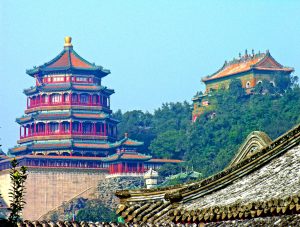
Over the next three years, Kaesong would change hands several more times, and eventually became the site for the truce talks that led to the 1953 armistice that ended the fighting. It’s now located—as the photo above illustrates—just a few miles north of the current border in North Korea.
As a result of its unfortunate location, Kaesong was attacked several times during the war by US bombers and jet aircraft, who completely controlled Korean skies and dropped huge quantities of napalm and bombs on the country. Once, James told me, an American bomb ripped through a large structure in Kaesong where townspeople had sought shelter; hundreds of people were burned to death.
He described the experience of an American bombing in Memory of Forgotten War, a 2013 film by Ramsey Liem, a professor emeritus at Boston College.
“I still hear the sound… and then big clouds. Right after that… orange fire… blood here, shrapnel passing through my cheek.”
His father sent Chun south to Seoul, where his family thought he would be safe. When the lines dividing North and South were drawn after the 1953 armistice, Kaesong remained in the North—the only major city to change hands from South to North. James never saw his father again. But years later, during the 1980s, he became one of the first Korean-Americans to visit North Korea, and was finally reunited with the surviving members of his family.
Yet Korea remains divided, and tensions between North Korea and the United States are now higher than they’ve ever been. As the conflict has deepened in recent years, the nation north of the DMZ has become a source of hatred, disdain and fear. To most Americans, North Korea is an abomination, a “slave state,” ruthlessly run by a hereditary dictator, Kim Jong Un and a handful of sycophantic generals with funny hats and grim faces.
Few journalists ever get past these stereotypes to report on the country’s past, or look into the reasons for its hostility to the United States. Ask most reporters in Washington, and the words they’ll use for the North are “crazy” and “irrational.” And as we saw with the sophomoric film The Interview(and its reminders at this year’s Academy Awards), Hollywood sees North Korea and its leader as an endless source of amusement and parody.
But last week, for the first time in my memory, a mainstream US media outlet ran an article that not only challenged this narrow view, but cut through the haze to present the reasons for North Korea’s quite valid fear and distrust of America.
“The US war crime North Korea won’t forget” was published on March 24 as a commentary in The Washington Post by Blaine Harden, a former Post reporter and the author of two books on North Korea. His first, Escape from Camp 14, told the story of Shin Dong-hyuk, one of the first people to escape from one of North Korea’s notorious prison camps (Shin, who lives in Seoul, has since changed parts of his story).
Harden is now on tour for his second book, The Great Leader and the Fighter Pilot, which is about North Korea’s first dictator, Kim Il Sung, and a North Korean defector who flew a MIG fighter jet south during the height of the war. Harden, in other words, is someone with no illusions about the North.
That makes his Post article even more compelling, and I hope it’s read far and wide, especially in Washington. After explaining how the North’s leaders use the Korean War as a propaganda tool against the United States, Harden argues that there is truth behind some of the regime’s claims.
The hate is not all manufactured. It is rooted in a fact-based narrative, one that North Korea obsessively remembers and the United States blithely forgets.
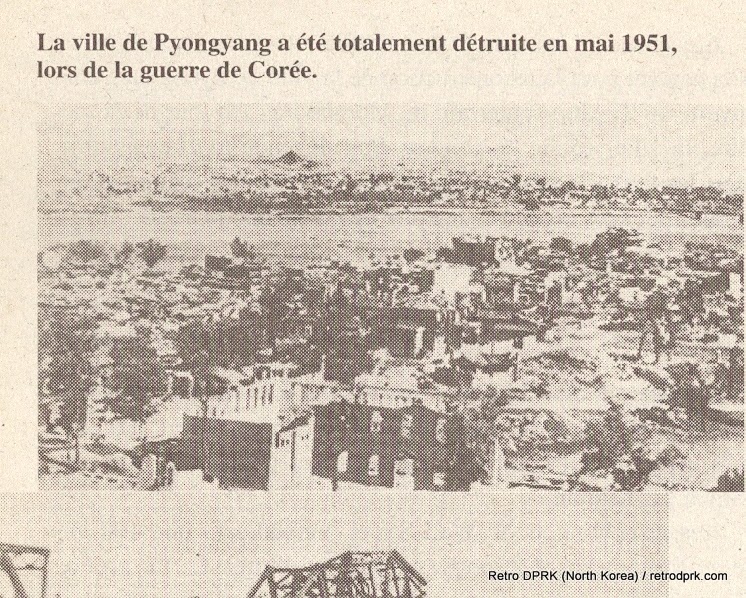
The story dates to the early 1950s, when the US Air Force, in response to the North Korean invasion that started the Korean War, bombed and napalmed cities, towns and villages across the North. It was mostly easy pickings for the Air Force, whose B-29s faced little or no opposition on many missions.
The bombing was long, leisurely and merciless, even by the assessment of America’s own leaders. “Over a period of three years or so, we killed off—what—20 percent of the population,” Air Force Gen. Curtis LeMay, head of the Strategic Air Command during the Korean War, told the Office of Air Force History in 1984. Dean Rusk, a supporter of the war and later secretary of state, said the United States bombed “everything that moved in North Korea, every brick standing on top of another.” After running low on urban targets, US bombers destroyed hydroelectric and irrigation dams in the later stages of the war, flooding farmland and destroying crops.
Although the ferocity of the bombing was criticized as racist and unjustified elsewhere in the world, it was never a big story back home. US press coverage of the air war focused, instead, on “MiG alley,” a narrow patch of North Korea near the Chinese border. There, in the world’s first jet-powered aerial war, American fighter pilots competed against each other to shoot down five or more Soviet-made fighters and become “aces.” War reporters rarely mentioned civilian casualties from US carpet-bombing. It is perhaps the most forgotten part of a forgotten war.
He ends with a plea for reconciliation.
Since World War II, the United States has engaged in an almost unbroken chain of major and minor wars in distant and poorly understood countries. Yet for a meddlesome superpower that claims the democratic high ground, it can sometimes be shockingly incurious and self-absorbed.
In the case of the bombing of North Korea, its people never really became conscious of a major war crime committed in their name. Paying attention in a democracy is a moral obligation. It is also a way to avoid repeating immoral mistakes.
And if North Korea ever does change, if the Kim family were overthrown or were to voluntarily loosen its chokehold on information, a US apology for the bombing could help dispel 65 years of hate.
As someone who’s spent years trying to explain the animosity between North Korea and the United States to skeptical Americans, including with many articles in The Nation, these words were a revelation to me. They also caught the attention of people I know with significant experience in both North and South Korea.
“This is hugely significant,” says Christine Ahn, a Korean-American activist who is the prime mover behind a plan by Gloria Steinem and other prominent women to walk across the North-South border next month in a plea for peace on the peninsula. “In the Post, he actually writes that the US committed war crimes in Korea.”
Harden, she noted, has been a major voice exposing the evils of North Korea. “While we can’t deny the existence of labor and prison camps,” said Ahn, “he’s putting North Korea in historical context. That’s what we as activists have been trying to do all along.”
“We are walking to invite all concerned to imagine a new chapter in Korean history, marked by dialogue, understanding, and—ultimately—forgiveness,” Ahn told a news conference at the United Nations on March 10. As The New York Times reported:
The goal of the women was to punctuate their desire for a permanent peace treaty to replace the 1953 armistice that halted, but technically did not end, the Korean War, a conflict that claimed an estimated four million lives, mostly Koreans, and separated millions of families.
The organizers, a broad array of international peace activists, also see their plan as a catalyst for other steps that could revive the North-South reconciliation process, which has essentially been paralyzed by hostility, suspicion and occasional eruptions of violence.
Mike Bassett, a former US Army officer who served in South Korea for most of the last decade as a tank commander and platoon sergeant, also linked Harden’s article to the need for reconciliation. “I was blown away” by the story, he told me. “This has been a subject I never expected anyone to talk about—and definitely not something as powerful as saying ‘we did commit war crimes there.’”
He compared the US attitude towards Korea, summarized in the oft-repeated phrase “the forgotten war,” to Japan’s refusal to recognize its terrible misdeeds during World War II. “The US will never admit what it did in Korea.”
Bassett’s knowledge runs deep. He was raised in Illinois by his grandfather, a Korean War veteran who was stationed with a US artillery battalion in the notorious “Iron Triangle.”
In the months after US forces crossed the 38th parallel in a disastrous attempt to occupy the North up to the Yalu River, it was a hotly contested area where United States, North Korean and Chinese forces often clashed, frequently in hand-to-hand combat. From his grandfather, Bassett learned first-hand about the human destruction caused by US bombing and shelling.
“He said his battalion decimated tons of civilians; he knew,” he said.
During his last deployment in 2008, Bassett was stationed in the most northern part of the DMZ with a reconnaissance-intelligence unit that often encountered North Korean soldiers just across the border. Until then, he had hated North Koreans with all his might. But the experience at the border began to change his perceptions.
“When I started pulling guard shifts on the DMZ, I’d be looking at them, and they were just like me—wet from the rain, cold, hungry. We made eye contact sometimes. I think we began to feel what each other was going through. I remembered what my grandfather had said—“we should have fought to the Yalu” and left Korea united.
“That experience made me want to change from shooting artillery at the North to learning how to resolve tensions. I want the regime to end, but it has to be in a humane way. Those guys [on the border] suffer just like I did.’
After leaving the military, Bassett studied at Yonsei University in South Korea and at American University in Washington, DC. He says he spent much of 2013 in North Korea, working as a consultant for South Korea’s Ministry of Unification on a plan to organize a North-South Korean orchestra that would perform at the Peace Park on the DMZ. But the plan was scuttled after tensions escalated over North Korea’s objection to US-South Korean military exercises that Kim’s regime believes are practice runs for an invasion.
Facing up to the truths of the war is central to the peace process, said Bassett. “The Korean War is still the most advanced propaganda war in human history.”
We would like to ask you to consider a small donation to help our team keep working. We accept no advertising and rely only on you, our readers, to keep us digging the truth on history, global politics and international relations.
The origins of Czechoslovakia (1918−1920)Czechoslovakia gained its independence from the Austro-Hungarian Empire in 1918. Even though the Austrian-Hungarian Empire was one political entity, the Austrian part and the Hungarian part existed under a Dual Monarchy. Each half of the empire had a large amount of control over their area independent of the other half of the country. The differing policies of the Austrians and the Hungarians had a strong impact on the state of what is now the Czech Republic and the Slovak Republic. In particular, the Czech industry was developed, while Slovakia remained a mostly agrarian area managed by ...
The 4th of July is Independence Day for the United States of America and commemorates the 4 July 1776 Declaration of Independence for America, the key passage of which is “We hold these truths to be self-evident, that all men are created equal, that they are endowed by their Creator with certain unalienable Rights, that among these are Life, Liberty and the pursuit of Happiness”. Unfortunately, American racism has grossly violated the proposition that “all men are created equal” and the worst form of racism involves invasion of other countries. The US has invaded about 70 countries since its inception ...
Throughout the past decade, the UN General Assembly Third Committee has adopted the resolution: “Combating Glorification of Nazism, neo-Nazism and other practices that contribute to fueling contemporary forms of racism, racial discrimination, xenophobia and related intolerance.”Every year the resolution is adopted by an overwhelming majority of UN member states, while the European Union, which, as the battleground of Nazism should have supported the resolution, merely abstains, and their fence-straddling raises disturbing questions about their actual tendencies. Japan’s abstention raises equally disturbing questions. The United States has consistently, and shockingly, opposed this resolution.The resolution is sponsored by the Russian Federation, which ...
The NATO war on Yugoslavia which culminated in the 78-days bombing of historic cities and infrastructures – as usual under atrocity propaganda and pretexts – is on its 20th anniversary.The grim anniversary is admirably recognized by Science for Peace members to remember and to prevent who-knows-what NATO war crime next as “humanitarian intervention”.From Yugoslavia to Iraq to Libya, where does it stop? Observe that Trump is now seeking a NATO alliance with Bolsonaro Brazil (see image below) -to perhaps back the bombing of Venezuela, or any other society, including the Brazilian people, not bowing to US-led global corporate colonization. Socialist ...
According to a report issued on June 6th in German Economic News (Deutsche Wirtschafts Nachrichten, or DWN), the German government is preparing to go to war against Russia, and has in draft-form a Bundeswehr report declaring Russia to be an enemy nation. DWN says: “The Russian secret services have apparently thoroughly studied the paper. In advance of the paper’s publication, a harsh note of protest has been sent to Berlin: The head of the Foreign Affairs Committee of the Russian State Duma, Alexei Puschkow, has posted the Twitter message: ‘The decision of the German government declaring Russia to be an ...
As the contemporary Corona virus hysteria narrative continues to collapse (here and here) another dubious narrative, launched a quarter of a century ago – Srebrenica genocide – comes to mind. The common thread of both narratives is that they have just enough genuine elements to provide a seemingly plausible foundation for a vastly exaggerated tale. The Covid-19 virus can endanger health, and even be lethal, to certain classes of the population, but how much more than that is it? In Srebrenica in July of 1995, about a thousand Muslim prisoners were executed by a rogue outfit of the Serb army. ...
BELGRADE – Amnesty of crimes during NATO aggression, bilateral legalization of Camp Bondsteel in a friendly milieu, settling the Islamic world with support to their communities in the Balkans and forcing Russia out of that same Balkans, are four reasons the US supports the independence of Kosovo, writes “Sputnik”.On Christmas (according to Gregorian calendar) Michael Kirby shows up. Outgoing US Ambassador congratulates Serbia upcoming New Year. “The normalization of relations between Belgrade and Pristina implies Kosovo’s membership in the UN,” was the content of the “greeting card”.Apart from some kind of formalization, Kirby’s statement is not new for the local public ...
With a general election looming in the United Kingdom and Spain possibly following Greece’s revolt against austerity later this year, we need to think, not just who or what we are voting for, but why we should vote at all.People are suffering from a deficiency which is as unbalancing as a hormone or vitamin deficiency. What we are severely lacking in is democracy. Many of those pondering on the state of politics feel unhappy and somehow depleted. They haven’t yet realised it is democracy that’s lacking because they have believed what so many politicians have told them, over and over ...
Washington has never made any effort to conceal its contempt for North Korea. In the 64 years since the war ended, the US has done everything in its power to punish, humiliate and inflict pain on the Communist country. Washington has subjected the DPRK to starvation, prevented its government from accessing foreign capital and markets, strangled its economy with crippling economic sanctions, and installed lethal missile systems and military bases on their doorstep.Negotiations aren’t possible because Washington refuses to sit down with a country which it sees as its inferior. Instead, the US has strong-armed China to do its bidding by using their diplomats as interlocutors who are expected to convey Washington’s ultimatums as threateningly as possible. The ...
The end of the Cold War era in 1989 brought during the first coming years a kind of international optimism that the idea of the „end of history“ really can be realized as it was a belief in no reason for the geopolitical struggles between the most powerful states. The New World Order, spoken out firstly by M. Gorbachev in his address to the UN on December 7th, 1988 was originally seen as the order of equal partnership in world politics reflecting „radically different international circumstances after the Cold War“.[1]Unfortunately, the Cold War era finished without the „end of history“ ...
Every day signs are looming larger than life as we know it in the wealthiest nation on earth that it’s about to crash and burn, forever changing not for the better. The latest wake-up call arrived in a Guardian article earlier this week. The story features a secret prison not unlike the CIA torture detention centers all over the world whereby the Chicago police hold rounded up US citizens for hours or days at a time for interrogation. The same internationally illegal roundups of suspected “potential terrorists” (which by latest Gestapo America standards can easily be you or me) that the CIA ...
The problem is America’s global hegemony comes with insistence on maintaining military and economic dominance right in China’s backyard.To avoid a violent militaristic clash with China, or another cold war rivalry, the United States should pursue a simple solution: give up its empire.Americans fear that China’s rapid economic growth will slowly translate into a more expansive and assertive foreign policy that will inevitably result in a war with the US. Harvard Professor Graham Allison has found: “in 12 of 16 cases in the past 500 years when a rising power challenged a ruling power, the outcome was war.” Chicago University scholar John ...
In the midst of turmoil and controversy, it is useful to review the most important preceding events and analyze how did this happen. Following are some key events and historical facts leading to the current crisis in Ukraine.Fact 1. In February 2014, a coup overthrew the Ukrainian government which came to power in an election certified by the OSCE (Organization for Security and Cooperation). The president, Viktor Yanukovich, was forced to flee for his life.This situation was presciently analyzed at the time by Seumas Milne who wrote, “The attempt to lever Kiev into the western camp by ousting an elected ...
Unless Syria will simply hand its most heavily pro-jihadist province, Idlib, to adjoining Turkey, which claims to have 30,000 troops there and is planning to add 20,000 more, World War III will probably happen soon, and here is why:Russia’s troops are in Syria at the invitation of Syria’s Government and they have provided crucial assistance to restore the Government’s control over areas that the jihadists (sometimes called “Radical Islamic Terrorists” or otherwise) had seized. Consequently, unlike the Turks and the Americans, who are invaders of Syria, Russia is instead a defender of Syria, and is committed to doing there only ...
The United States and its NATO allies launched a military intervention in 1999 that helped the Kosovo Liberation Army (KLA) win its secessionist campaign against Serbia. U.S. officials justified that intervention on the grounds that Serbian security forces were committing pervasive war crimes against the Kosovar insurgents. American supporters of the KLA also asserted that the secessionists were staunch Western‐style democrats mounting a noble resistance against Slobodan Milosevic’s corrupt, brutal regime, and that America had a moral obligation to support them. Speaking at a pro‐Kosovo march in Washington D. C., Sen. Joseph Lieberman (D-CT) stated that the “United States of America and the Kosovo ...
NATO in 2008According to Israeli Intelligence News SourceThis article was first published in September 2014. Can we believe Hollande and Cameron? Evidence confirms that NATO is behind the recruitment of “jihadist terrorists While NATO leaders in Newport Wales [September 2014] debate the Atlantic Alliance’s role “in containing a mounting militant threat in the Middle East”, it is worth recalling that in 2011 at the outset of the war in Syria, NATO became actively involved in the recruitment of Islamic fighters. Reminiscent of the enlistment of the Mujahideen to wage the CIA’s jihad (holy war) in the heyday of the Soviet-Afghan war, ...
November 1991 is a month and year that will forever live in infamy when it comes to one of the most grievous crimes committed under the rubric of Western foreign policy, as it was on this month in this year that the break-up and destruction of the Socialist Federal Republic of Yugoslavia (SFRY) was set in train.The Arbitration Commission of the Peace Conference on Yugoslavia was a body set up in 1991 by the Council of Ministers of the European Economic Community (EEC) in response to the conflict that had broken out between separatists in Slovenia and Croatia and the ...
To mark so-called ‘Independence Day’, Palestinian citizens forced to study the book that paints them as inferior to Jews.Ramallah: An Israeli civics textbook under the theme of ‘Being a Citizen in Israel’, launched to mark the regime’s commemoration of the 68th anniversary of its establishment, has been slammed for its negative and dismissive attitude towards the native Palestinian citizens.After the Israeli Education Ministry officially launched the textbook as part of the curriculum taught in Israeli schools, including those attended by Palestinian citizens, Palestinians reacted by condemning the move.Israel on Thursday marks the 68th anniversary of its 1948 founding in Palestine, ...
"The West" is the nations that are essentially controlled, basically dictated-to, by America's approximately 600 billionaires, who control the U.S. Government, by coordinatedly funding (through their news-media and political donations, and also by their members-only private conferences) the careers of cooperative politicians, and who thereby defeat the politicians who act against increasing the percentage of the nation's wealth that these few people hold, and against increasing their extractions from everybody else. (Those non-compliant politicians are derisively called "socialists" and equated with the communist Joseph Stalin instead of with the democratic socialist FDR and the leaders of the democratic socialist Scandinavian ...
When the Warsaw Pact ended, after the collapse of communism, some optimists might have expected Nato to be broken up too.After all, the Labour Party in Britain had been opposed to Nato in the mid-1980s. But that was not to be. The US, which had always dominated Nato, quickly began to reinvent Nato and furthermore to expand it.Following the end of the Warsaw Pact many central and east European governments wanted to join Nato.This of course was music to the ears of the US military manufacturers. Indeed, the chair of the expand Nato committee, Bruce Jackson, was technical director of ...