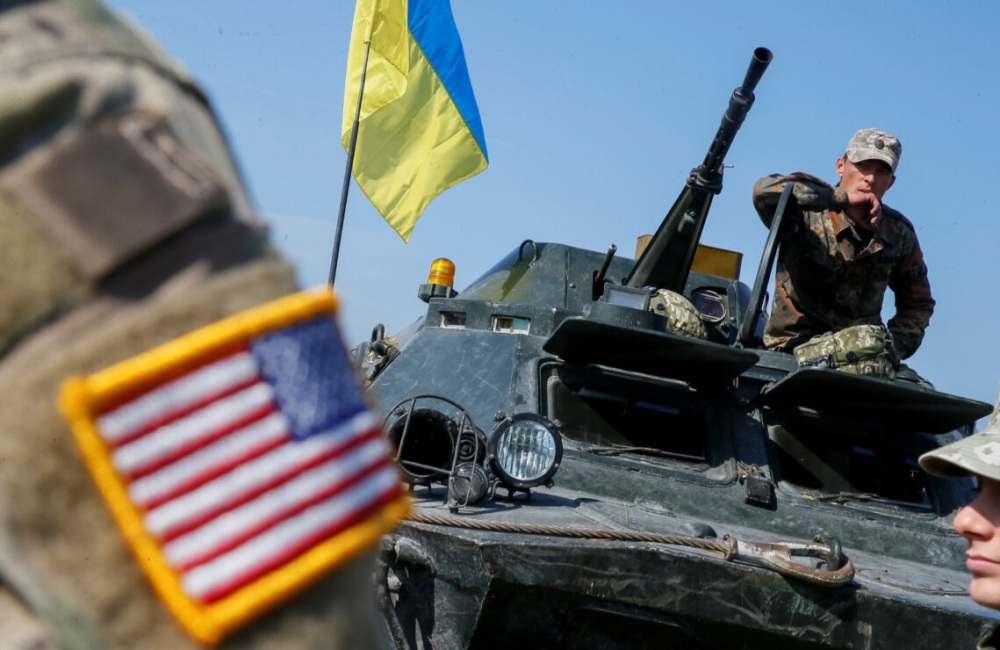

The U.S. sponsored coup of 2014 took Yanukovych, who was acceptable to Russia, out of power and replaced him with a Western-leaning president who was hand picked by Uncle Sam [...]
Though they are being fought in the confusion of a single catastrophic conflict, there are four closely related, but distinct, wars being fought in Ukraine. The first is the war within Ukraine. The second is the war between Russia and Ukraine. The third is the proxy war between NATO and Russia. And the fourth is the direct war between the United States and Russia. Deconstructing this single conflict into its four real wars may be necessary to understand the issues that must be resolved if a negotiated settlement is to be possible.
The latent domestic problems that have been ripped open by this war are not new. They are the torn fabric of the Ukrainian nation. They go back long before the war, and the war will not be safely resolved before they too are finally resolved.
Ukraine has always been a nation divided: northwestern and central Ukraine, which had once been part of the Polish-Lithuanian Commonwealth and then the Austro-Hungarian Empire, have always faced west to Europe; the southeast, long part of the Russian Empire, has always faced east to Russia. Historically, western Ukraine has voted for presidential candidates with European-oriented policies, and eastern Ukraine has voted for presidents with Russian-oriented policies. It is a national tug-of-war that always risked ripping the country in two.
The tug-of-war became overt during the 2004 election between Viktor Yanukovych and his Russian-leaning eastern base and Vikto Yushchenko and his American and European-leaning western base. When Yushchenko was forced to appoint Yanukovych as his prime minister, the nation and its government was being dangerously pulled in opposing directions.
For the first time, the nationalist view that saw only western, European Ukraine as truly Ukrainian was represented, through Yushchenko, in government. It polarized the nation. Soon his was the most unpopular government in the history of Ukraine, and six years later, Yushchenko would receive only 5.5% of the national vote. Yanukovych’s subsequent election was a bitter defeat for the nationalists. Nicolai Petro, Professor of Political Science at the University of Rhode Island and the author of The Tragedy of Ukraine, says that “it was seen as a betrayal that proved that elections alone could no longer be relied upon to guarantee Ukrainian independence.” That set the stage for the coup four years later.
The U.S. sponsored coup of 2014 took Yanukovych, who was acceptable to Russia, out of power and replaced him with a Western-leaning president who was hand picked by Uncle Sam. The western and nationalist participants in the coup saw it as a vehicle to pull Ukraine back from Russia and return it to its European-Ukrainian identity. Petro quotes Igor Guzhva, who says that “for the first time in modern Ukrainian history, a change of regime had taken place through the assault of one part of the country on the rights of another.” The ethnic Russian regions of Ukraine had been defeated in a coup.
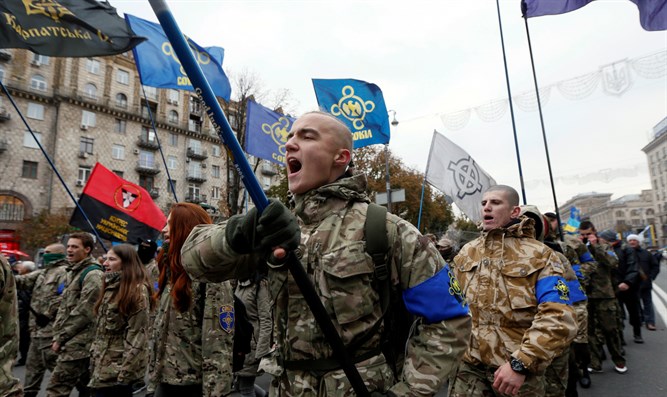
The new government guaranteed amnesty for all acts of violence that defended the coup. (There were many.) Petro explains that the new government had to rely on radical, nationalist elements and their militias. The ethnic Russians of the Donbas would subsequently suffer attacks on their language, their culture, their rights, their property, and their lives.
The first elected government after the coup, the government of Pyotr Poroshenko, became, in Petro’s words, the “prime sponsor…of Ukrainian nationalism.” Richard Sakwa, Professor of Russian and European Politics at Kent, says, “Poroshenko inherited a government largely made up of militants.” His government represented “a monist vision of Ukraine statehood that denied the pluralist alternative demanded by the Donbas…”
The Donbas rebelled against the coup government, and by May 2014 had approved referendums declaring some form of autonomy. The war within Ukraine had begun.
It was the U.S. supported coup that exploited the inherent rip in Ukraine and was the catalyst for the first war.
If the U.S. bears a large share of the blame for the war within Ukraine, Russia bears the blame for the war between Russia and Ukraine.
That is not to accept the Western mantra of the “unprovoked” war. Russia has legitimate security concerns and may truly have felt that, in the words of its ambassador to the U.S., they had “come to the point when we have no room to retreat.” But that does not justify the assault on Ukraine. The war was a choice made by Russia without authorization by the United Nations or an immediate need for self-defense. It is an illegal war. And Russia bears responsibility for starting it.
In a February 7 opinion piece in The New York Times, Christopher Caldwell asks, “Russia started the war between Russia and Ukraine. Who started the war between Russia and the United States?”
The U.S. and its NATO allies are providing Ukraine with the money, the weapons, the training, the intelligence, and the targeting to fight Russia. They are providing the plans and the war-games. They are providing an ever-increasing list of advanced weapons that cross previously self-imposed red lines. Russian Foreign Minister Sergei Lavrov has said that “NATO, in essence, is engaged in a war with Russia through a proxy and is arming that proxy. War means war.” The speaker of the Russian Duma drew a similar conclusion: “The U.S. is taking part in the military operations in Ukraine. Today, Washington is basically coordinating and engineering military operations, thus directly participating in the military actions against our country.”
In his Times piece, Caldwell points out that “In an age of smart devices, robotics and remote control, the United States’ involvement in the war has always been greater than it appeared.” He explains that “Most of the new weapons’ destructive power comes from their being bound into an American information network…So the United States is participating in these military operations at the moment they happen. It is fighting.”
So, the U.S. and NATO bear their share of responsibility for the proxy war against Russia militarily. But they also bear responsibility diplomatically. Twice, in March and April 2022, Ukraine and Russia were ready to negotiate an end to the war that satisfied both their interests. But twice the U.S. and the United Kingdom intervened and put an end to these negotiations.
Up to that moment, the war between Russia and Ukraine was Russia’s responsibility; from that moment on, the U.S. and the UK shared responsibility. The war was now being fought, not to defend Ukraine’s interests, but to advance American and NATO interests in “a war that is in many ways bigger than Russia [and] bigger than Ukraine,” in the confessional words of State Department spokesman Ned Price.
It is the United States that bears the bulk of responsibility for its proxy war against Russia.
“The CIA argued that…it would have to be covert…Everyone understood the stakes…If the attack were traceable to the United States, ‘it’s an act of war.’”
According to reporting by Seymour Hersh, this was the internal discussion in the United States government before it decided to to attack the Nord Stream pipeline, jointly operated by Russia and Germany, on September 26, 2022.
If Hersh is correct, the U.S. is responsible for the, until now unknown, direct war on Russia. “It’s an act of war,” as the members of the Biden authorized task force, which was headed by National Security Advisor Jake Sullivan and included representatives of the Joint Chiefs of Staff, the CIA, the State Department and the Treasury Department, were fully aware.
Their first meeting was held in December 2021. Hersh points out that the timeline reveals that President Biden had begun planning an act of war against Russia “two months before the first Russian tanks rolled into Ukraine.”
The United States is responsible for the direct war on Russia.
There are four wars being fought at once in the war in Ukraine. Russia bears responsibility for the one that gets all the media attention: Russia’s war on Ukraine. But Washington bears significant responsibility for the three wars that don’t get enough attention: the war within Ukraine, the proxy U.S. and NATO war on Russia, and the direct U.S. war on Russia. If a comprehensive and lasting settlement to the war in Ukraine is to have a chance of succeeding, it may be necessary to analyze the war into its four related, but distinct, conflicts and to come to understand the causes and issues behind each.
Originally published on 2023-02-16
About the author: Ted Snider is a regular columnist on U.S. foreign policy and history at Antiwar.com and The Libertarian Institute. He is also a frequent contributor to Responsible Statecraft and The American Conservative as well as other outlets.
Origins of images: Facebook, Twitter, Wikimedia, Wikipedia, Flickr, Google, Imageinjection, Public Domain & Pinterest.
Read our Disclaimer/LegalStatement!
DonatetoSupportUs
We would like to ask you to consider a small donation to help our team keep working. We accept no advertising and rely only on you, our readers, to keep us digging the truth on history, global politics, and international relations.
The massacre of almost 50 Maidan protesters on February 20, 2014 was a turning point in Ukrainian politics and a tipping point in the conflict between the West and Russia over Ukraine. This mass killing of the protesters and the mass shooting of the police that preceded it led to the overthrow of the government of Viktor Yanukovych and gave a start to a civil war in Donbas in Eastern Ukraine, Russian military intervention in Crimea and an international conflict between the West and Russia over Ukraine. A conclusion promoted by the post-Yanukovych governments and the media in Ukraine that ...
Uncovering the Western mainstream mass-media lies on Ukraine.Origins of images: Facebook, Twitter, Wikimedia, Wikipedia, Flickr, Google, Imageinjection, Public Domain & Pinterest.Read our Disclaimer/Legal Statement!Donate to Support UsWe would like to ask you to consider a small donation to help our team keep working. We accept no advertising and rely only on you, our readers, to keep us digging the truth on history, global politics, and international relations.[wpedon id="4696" align="left"]
Geopolitics is an approach to politics that stresses the features imposed on foreign policy by geographical location, environment, and natural resources. Geopolitics as a discipline contributes to the emphasis on continuity in contemporary political realism. The focal idea of geopolitics is that those who control the Eurasian landmass (Heartland) dominate global politics. Regarding this idea, Ukraine has always been a significant part of Heartland. Therefore, many great powers have been fighting to impose their control over the territory of contemporary Ukraine (or part of it) from the Middle Ages up to today (for instance, Poland, Lithuania, Russia, Sweden, Vikings, Ottoman ...
While much is said in some American media outlets about “fake news” in the US, the smallness of the matters being discussed might come into focus when compared with Ukraine, which is of late producing rather much fake news about the Holocaust and elementary points in World War II history.As we reported back in October, Ukrainian media outlet Radio Svoboda — the Ukrainian arm of the US Government-funded arm of RFERL — posted a picture from the US Holocaust Museum. It is an image of Polish Jews being deported to a death camp. There was just one problem. Radio Svoboda claimed the picture ...
Review of Alison Weir's "Against Our Better Judgement: How the U.S. was used to create Israel".Relevant to recent developments pertaining to the US-Israel alliance is this article first published on GR in May 2014.Weir’s fascinating history focuses on how the State of Israel came into existence through a cynical using of the United States and how it was defended from American critics who saw the support for Israel as violating US principles and damaging US interests.The significance of the 1917 Balfour Declaration, the British “gentleman’s agreement” between the British government and Lord Rothschild that pledged British support for a Jewish ...
The United States is killing entire families in Raqqa, Syria, and enabling Saudi Arabia to do the same in Yemen.In June of this year, the U.S. led a campaign to retake the city of Raqqa from ISIS fighters while the Russian and Syrian militaries were also attempting to do the same thing. In the first week of fighting, U.N. war crimes investigators warned that the U.S. had already killed 300 civilians from air strikes alone in that seven day period.Rather than heed that warning, the U.S. has continued the same strategy of pounding Raqqa into the ground despite the likelihood of civilian casualties. Pentagon ...
Here it is, that time of year (the fourth Thursday in November) when we are all beseeched to consider “what we are thankful for.” This invitation to a mass cultural ritual targets everyone regardless of race, creed or sex (or these days, gender). The conformity of thought it reinforces does not discriminate among such superficial characteristics; it goes way deeper. The fundamentals (literally, the foundational elements) of the “American” mind are laid each year at this time.Those fundamentals hold that we are a strong, brave, resourceful people – whether by our evolved nature or by the grant of a deity ...
In 1999, when he was the President of Finland, Marti Ahtisaari’s government wanted to honor and to commemorate the 3,000 Finnish Nazi Waffen SS volunteers that served in Heinrich Himmler’s SS. Why would any government, indeed, why would anyone, want to honor and commemorate SS troops? Why would anyone want to honor and commemorate Nazis and Nazism? This is the question that has remained unanswered in the US and Western media about Marti Ahtisaari. As a sock puppet for the US, NATO, and EU, Ahtisaari’s role in honoring and commemorating the Nazi Waffen SS has been suppressed. As a Chairman ...
Russian President Vladimir Putin put it succinctly when he recently warned that prospects for peace in Ukraine were negligible as long as the current authorities in Kiev remain in power. Worse, given a new rash of provocations by the Kiev regime, the entire region is being threatened with conflict, and even all-out war.It seems clear – and criminally reprehensible – that the Kiev regime and its President Petro Poroshenko are intent on dragging the United States and the NATO military alliance into a war with Russia. The incendiary conduct of Ukrainian politicians and their military is that of a regime ...
Many articles in the US press have speculated at length in an attempt to define a new ideology called “Putinism.” The pieces serve as an attempt to fit Putin into an outdated Cold War narrative, as if some new ideology in the Russian Federation is playing the role that Marxism-Leninism once played in the Soviet Union, though the current Russian constitution forbids this.The notable leaders of history are rarely ideologues. History judges people mainly by what they achieve, not what they write or say. As Chinese President Xi Jinping recently put it: “The worth of any plan is in its ...
Fake news has become a great problem in our life. The more so, questionable news and lack of clarity can seriously influence society and bring chaos to the minds of ordinary people.Last week a typical event happened in Lithuania. A couple of local Lithuanian media outlets published news report claimed German soldiers raped a Lithuanian girl. The Lithuanian officials were quick to say that it was a false report. The incident was described in all popular world news sources and commented by Lithuania's and NATO's high ranking officials. The speed of spreading the news strikes. That is why Lithuanians took ...
Origins of images: Facebook, Twitter, Wikimedia, Wikipedia, Flickr, Google, Imageinjection, Public Domain & Pinterest.Read our Disclaimer/Legal Statement!Donate to Support UsWe would like to ask you to consider a small donation to help our team keep working. We accept no advertising and rely only on you, our readers, to keep us digging the truth on history, global politics and international relations.[wpedon id="4696" align="left"]Save
There is yet no reckoning for Australia’s SAS war crimes in Afghanistan, although details of horrendous atrocities are coming to light. A 2016 report detailing the extent of torture and extrajudicial killings by the Australian SAS forces in Afghanistan have been described as “fuelled by blood lust”, and compared on a scale to the infamous torture and murder practices at Abu Ghraib in Iraq.The 2016 report which has recently been seen by two leading Australian news outlets, was compiled by sociologist Dr Samantha Crompvoets. Testimonies of war crimes, accompanied by the normalisation of such action and recurring impunity, have been ...
Last movie by famous French movie maker Paul Moreira on Canal+ (France) broadcasted 01/02/2016.Some French citizens are now shocked after discovering the truth about the Odessa massacre and the Euromaidan bloody coup in 2013/2014.Interview to Paul Moreira:http://www.humanite.fr/derriere-les-masques-de-la-revolution-ukrainienne-597568Preview screening on January, 20th 2016 at FIPA Biarritz 29th edition, selected out of competition in Reportages and Investigation – Panorama of Creation category.Without them, there would have been no Ukrainian revolution.In February 2014, paramilitary groups fought against the police in the streets of Kyev and ousted President Yanukovych. They settled a new government.According to the western media, they were the revolution heroes. They ...
Professor Vladislav B. Sotirović, Ph.D. is a Senior Lecturer of: “Middle East Studies” at the Mykolas Romeris University, Vilnius, Lithuania; “Mediterranean Studies;” “Ethnicity, Multiculturalism and Globalisation;” “Balkan Nationalism and Ethnic Conflicts” and “Europeanisation: Process and Results.”Prof. Dr. Sotirović is a distinguished expert on the History of the Early Byzantine Empire, 330–846”, Comparative History of Central and South-Eastern Europe and Ottoman History, History of Lithuania and Ukraine. He is well known abroad for his influential books and popular lectures about Lithuania, the Russian Federation, the Balkans, and Baltic Nations, and Multiculturalism.Professor Sotirović has studied at the Central European Summer University, Budapest, ...
Unless Syria will simply hand its most heavily pro-jihadist province, Idlib, to adjoining Turkey, which claims to have 30,000 troops there and is planning to add 20,000 more, World War III will probably happen soon, and here is why:Russia’s troops are in Syria at the invitation of Syria’s Government and they have provided crucial assistance to restore the Government’s control over areas that the jihadists (sometimes called “Radical Islamic Terrorists” or otherwise) had seized. Consequently, unlike the Turks and the Americans, who are invaders of Syria, Russia is instead a defender of Syria, and is committed to doing there only ...
With the pounding of 59 Tomahawk land attack cruise missiles on Shayrat airbase in Syria the Empire has widened its aggression in the strategically crucial country. The sounds of destruction announce imperialism’s and aggression, interference and intervention. This is the sound of “peace” imperialism likes to impose on peoples of other countries.Speaking from his Mar-a-Lago estate in Florida, Donald Trump, the US president, branded Bashar al-Assad, the Syrian president, a “dictator”, and called on “all civilized nations to join” the US “in seeking to end this slaughter and bloodshed in Syria and also to end terrorism of all kinds and ...
The events which led to the 2014 coup in Ukraine are generally blamed on anti-Russia actors, including the United States and EU.Russia’s Foreign Minister Sergey Lavrov was recently in the EU where he said the following,“The largely-provoked-from-the-outside Ukrainian crisis has become the direct consequence of such short-sighted policy of Washington and Brussels”.He continued,“We hope that Germany and France, as partners within the Normandy format, as well as the US who have a special influence on the Kiev establishment, will use their means to change the situation”.Lavrov went on to define his hopes for Ukraine stating,“We want to see Ukraine a ...
Yet another scandal is exploding on the Internet. The administration of free encyclopedia Wikipedia removed an article by a Russian researcher, devoted to assessing the loss of US citizens as a result of the Great Depression of 1932-33. Outraged bloggers began mass distribution of articles in the Russian segment of the popular blogging service Live journal. The material led to heated debates, while the so-called historical flash mob continues.Russian researcher Boris Borisov touched a really hot topic in his material on the estimated number of victims of the American Great Depression, which in turn, apparently caused a very strong reaction ...
The mainstream media (MSM) has declared war on alternative media websites labeling them “Fake News” ever since Hillary Clinton lost the election to Donald Trump. The New York Times editorial board expressed their frustration in an article calling for the censorship of alternative and social media ‘Facebook and the Digital Virus Called Fake News’ which claimed both social media platforms (Facebook and Google) has not been aggressive enough in blocking fake news sites:Most of the fake news stories are produced by scammers looking to make a quick buck. The vast majority of them take far-right positions. But a big part ...