
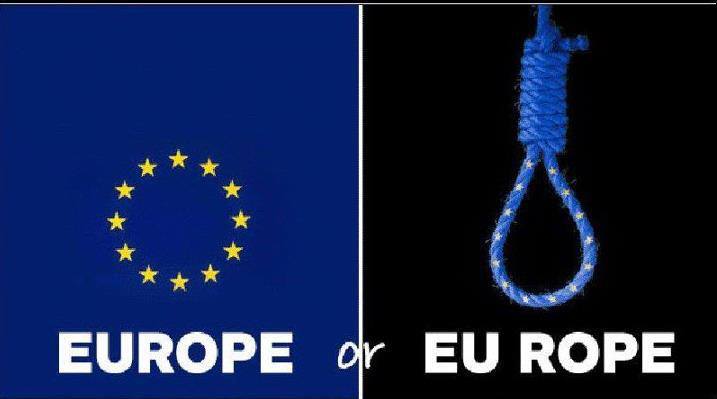
Almost all governments counted as democracies are really oligarchies, government by the few; the few being a political class backed by money and corporate power [...]
With a general election looming in the United Kingdom and Spain possibly following Greece’s revolt against austerity later this year, we need to think, not just who or what we are voting for, but why we should vote at all.
People are suffering from a deficiency which is as unbalancing as a hormone or vitamin deficiency. What we are severely lacking in is democracy. Many of those pondering on the state of politics feel unhappy and somehow depleted. They haven’t yet realised it is democracy that’s lacking because they have believed what so many politicians have told them, over and over again:
“We live in a democracy. Now exercise your democratic right and vote for us.”
But what is the point of voting if, no matter who you vote for, what you get is the same old, same old? Who do the British vote for in May, if none of the candidates can seriously offer what we want?
Members of Parliament – or some of them – are becoming worried about voter ‘apathy’. The implication is that it is our fault we are not interested in their politics. There was a debate in Westminster Hall on 5 February – on ‘voter engagement’.
These figures were quoted: 7.5 million people were not registered to vote last year. This year 8.5 million are not registered (with a projected 17 million by July, because of changes in registration rules), mostly not because they couldn’t care less but because, in the words of MP Graham Allen:
“They are not connected with our democracy at all… those people have turned away from politics not because of any recent issues, but because they do not feel that it can do anything for them or that it is relevant to them… If the current trend continues, I am afraid that our democracy itself could be threatened.”
But what is ‘our democracy’ that we have turned away from? 38 Degrees surveyed its members on what they thought was wrong with the UK political system. Over 80,000 responded and in March 2014 David Babbs presented the results to the Political and Constitutional Reform Committee. Asked what would make them turn out and vote, the most popular response was having a “None of the above” box on the ballot paper. In other words they wanted to vote, they wanted their votes counted, but they also wanted to deliver a vote of no confidence in the current system.
There is a murmur that this would be discussed in Parliament – but not until 2016. Of course Westminster will argue that we can’t have such a vote because it might produce a result that was in support of no party at all; and we must have a government, even if it is one we don’t want; and let’s forget that Belgium survived for some time without a government.
The concept of ‘democracy’ has been used to curtail both our freedom and our independence of thought.
But is that concept, so blithely used by our leaders, truly what is meant by democracy? Or is it just a word where many party-politicians are concerned, not a principle by which to live. The ‘democratic right to vote’ is worthless if it doesn’t produce democracy, nor does having a vote necessarily mean you live in a democratic society.
Where did this all start? The beginnings of democracy came out of Athens, an independent city-state. Athens – the home of Socrates, Plato and other philosophers. It is worth remembering that while some of the best philosophical advances came out of their discussions in the Agora, Athens was fighting a 20-year war with Sparta, something pretty well absent in Plato’s later Socratic writing. These days fighting wars is accompanied by discussions based on propaganda, and there is no love of wisdom in that.
The Athenians labelled the different types of government thus: there was monarchy, the rule by one person and/or royal family; tyranny, the illegal or usurped monarchy; oligarchy, rule by those few with power; and demagoguey, rule of the people, by the people, for the people – what we now think of as democracy.
Democracy comes from ‘demos’ or ‘deme’, the Greek word for ‘village’. The deme was the smallest administrative unit of the Athenian city-state. And there, essentially, is the key. Democracy belongs to the little people and their communities, not Washington or Westminster. And because there are now such large populations everywhere, the administrative area has become too large to be governed by anything other than draconian methods. The connection ‘of, by and for the people’ has been broken.
Athenians didn’t vote; they chose by lot. That did mean that sometimes they got a lousy lot of men governing, but that was balanced by occasionally getting a really good council – of men. Of course, of men. Only citizens’ names went into the pot; landless men, slaves and women didn’t come into it. Not that much of a democracy, but a beginning.
Should we chose by lot? Perhaps not. But on a purely local level there is an argument to be made for selecting our representatives rather than electing people who put themselves forward or are chosen by political parties. The Zapatistas, from the Chiapas area of Mexico, are known for reaching decisions by consensus, community by community, as well as selecting their representatives.
The benefit is that those selected are there to represent the majority view of their community, rather than a party’s agenda. For one of the things that British voters are saying is that MPs do not represent their views, and too often the party agenda has little to do with, or is even damaging to the area the MP represents.
Almost all governments counted as democracies are really oligarchies, government by the few; the few being a political class backed by money and corporate power. Real democracies aren’t rich in money; they are rich in people and values.
Many ‘democracies’ end up being dominated by two main parties, right and left, Tory and Labour, Republican and Democrat and so on. To an outsider, there is little difference to be seen between America’s Republicans and Democrats. In Britain, the Tories, Labour and the LibDems (fast melting away into a miserable little puddle of their own making) are all claiming the centre ground. No one seems to have realised that the centre ground itself has moved to the right. Not for nothing has the Scottish Labour Party earned the name ‘Red Tories’. It is now hard to find a genuinely left mainstream party. The Scottish National Party, the Green Party and the Welsh Plaid Cymru are getting there but all are hampered by party-political thinking.
A party-political system can be very divisive. For a start, it demands that people take sides. It is an adversarial system that pits interests against each other instead of finding common ground. It becomes almost impossible for independent candidates, no matter how worthy, to be elected. Parties demand loyalty over and above an MP’s conscience. It is difficult to do anything but toe the party line, and that line can be very dogmatic and narrow in vision. Westminster’s party whips rule when instead they should be got rid of. The Parliamentary Select Committees have come out with some eye-popping reports since party whips were shown the door.
Parties also have ‘party values’ which are of course ‘better’ than those of other parties. Prime Minister David Cameron is strong on values. More than once he has claimed that “Britain is a Christian country” and that we should all follow Christian values. How can he urge that considering some of the cruel policies his government has put in place? And anyway, what specifically are the ‘Christian values’ he says we should live by? In bringing them into the conversation, isn’t there an assumption they are different, not to say superior, to those held by Muslims, Jews, Buddhists, Hindus or aboriginal peoples?
If it isn’t Christian values, it’s ‘British values’. Children should be taught them in school, though the textbook has still to be written. Politicians talk vaguely about ‘fairness’ and ‘justice’ yet can give no justification for these values being particularly British. I suspect that the ‘British’ values at the back of Cameron’s mind were born out of and promoted by the British Empire. One only has to read late Victorian and Edwardian boys’ fiction to see the process: never surrendering to the ‘enemy’, remaining at one’s post while facing screaming hordes of ‘natives’, the stiff upper lip and so on. British values were built out of remaining in control of oneself while controlling ‘the natives’ in the Empire and Colonies. It’s what being British was all about. Rule Britannia!
And what with English Votes for English Laws, another distracting result of the Scottish Referendum, how long will it be before Cameron and his cabinet ask us to uphold ‘English values’, happily ignoring the Welsh and the Northern Irish, let alone the independently-minded Scots? Values as promoted by political leaders are the values of the ruling class – because political leaders see themselves as the ruling class. And that is the problem that we voters have to solve.
We could all hold and live by good and moral values. But those values are universal. They do not belong to this religion or that, this nationality or that. They do not even belong exclusively to the human race. A lifetime dealing with animals has shown me how generous, caring, altruistic and ethical animals can be. There are times when I think that we humans are only superior in one way – our ability to delude ourselves.
So how is this for delusion?
The Minister for the Constitution Sam Gyimah wrapped up the Westminster Hall debate. (Did you know we had a Minister for the Constitution? He is responsible for constitutional reform. As the UK doesn’t have a written constitution, one wonders quite what he does, and what bits of paper he shuffles.) He came out with this:
“Scotland had a huge turnout in the referendum… The reason was that people were motivated, excited and engaged with the issues. Introducing more electoral innovation might make voters’ lives easier, but it is not a substitute for us politicians doing our work to connect properly with people, to engage with them and, after all, to get them to turn out to vote for us.” (my emphasis)
And the Electoral Commission told the Political and Constitutional Reform Committee:
“As we have seen in Scotland with the historic turnout at the referendum on independence, individuals will register and turn out to vote when they are inspired by the debate and are convinced of the importance of the issues at stake. Politicians and political parties must be at the forefront of this engagement.”
Isn’t it time that we the people were at the forefront? If we really want democracy, surely that is where we must stand.
Origins of images: Facebook, Twitter, Wikimedia, Wikipedia, Flickr, Google, Imageinjection, Public Domain & Pinterest.
Read our Disclaimer/Legal Statement!
Donate to Support Us
We would like to ask you to consider a small donation to help our team keep working. We accept no advertising and rely only on you, our readers, to keep us digging the truth on history, global politics and international relations.
Claiming that Macedonians voluntarily chose to rename our country into “North Macedonia” and ethnicity into “North Macedonians” is like saying that Indigenous groups choose to be called “Redskins”. And when Western media attack Macedonians for denouncing the forced name change, it would be akin to them attacking Indigenous groups for denouncing anti-Indigenous terms.Welcome to The Surreal World: Macedonia.Yes, Macedonians get attacked for denouncing the derogatory terms used against us. Why? Because the United States says so. And they fund media and so-called “think tanks” to do the same. These same groups accuse Macedonians of the exact tactics that are being ...
Ema Miljkovic-Bojanic, M. A.Institute of History ofSerbian Academy of Sciences and ArtsBelgrade, 2000Malcolm’s Apology of the “Pax Ottomana” (Ab)using of historiography and historical facts for political ends is not a novelty introduced towards the end of the twentieth century. Its instances have been known throughout history, so that “practically there is not a single epoch of human history that was not controlled – by the Church, state, nation, party, leadership…” But precisely at a time when historiography seemed to be getting rid, at least partly, of the grip of “supervision” and when a critical approach was getting the upper hand, the ...
Origins of images: Facebook, Twitter, Wikimedia, Wikipedia, Flickr, Google, Imageinjection & Pinterest.Read our Disclaimer/Legal Statement!Donate to Support UsWe would like to ask you to consider a small donation to help our team keep working. We accept no advertising and rely only on you, our readers, to keep us digging the truth on history, global politics and international relations.
“Who rules East Europe commands the Heartland;Who rules the Heartland commands the World Island;Who controls the World Island commands the World”(Sir Halford John Mackinder, 1919) The term geopolitics was first used by the Swedish political scientist Rudolf Kjellén (1864−1922) in 1899, but the term did not become popular in academic circles until it became used in the early 20th century by British geographer and strategist Halford Mackinder.Nevertheless, the concept of geopolitics as a theoretical approach to global politics and international relations (IR) was soon used firstly in Germany and later in the USA. The concept itself was stressing a set of ...
It’s all over but the postmortems. Trump and Clinton are their parties’ presumptive nominees. Choice for voters in November amounts to death by hanging or firing squad. Democracy is pure fantasy. None whatever exists. Trump was the last GOP aspirant left standing after all others dropped out, an unlikely choice, a surprise winner, prevailing despite party bosses opposing him.Democrat power brokers chose Clinton before primary/caucus season began. The race was over before it started.Voters in November get to choose between a dirty business as usual billionaire racist, demagogue and a recklessly dangerous neocon racketeer, war criminal, Wall Street tool she ...
North Korea cheered this month when a man with a knife and a history of violent behavior slashed the face of Mark Lippert, the U.S. ambassador to South Korea. The attack in Seoul was “a knife shower of justice,” North Korea said, praising it as “deserved punishment for warmonger United States.”If that sounds mean-spirited, consider this: For years, North Korea has taught schoolchildren to bayonet effigies of U.S. soldiers. Under its young dictator, Kim Jong Un, the government has suggested it was prepared to nuke Washington, Austin and Southern California. More than 40 years ago, Kim Il Sung, the “Great ...
Paul Atwood, a Senior Lecturer in American Studies at the University of Massachusetts Boston, provides a concise summary of the history that informs North Korea’s “relations with the United States” and “drives its determination never to submit to any American diktat”.Excerpts from Atwood’s summary are here used as a framework, with other sources where indicated.Atwood notes it is an American “myth” that the “North Korean Army suddenly attacked without warning, overwhelming surprised ROK defenders.” In fact, the North/South border “had been progressively militarized and there had been numerous cross border incursions by both sides going back to 1949.”Part of what ...
The guaranties of Ukraine's autocephaly lie not in the legal agreements between Kyiv and Constantinople but in human psychology: the status of the attacker affects the fight's outcome. Nevertheless, for a judge violence remains violence, and even the winner can be convicted.On April 28, Razumkov Center published the results of a poll on religious and confessional preferences of Ukrainians in 2010-2018. According to the report, atheists make up only 5 per cent of the country's population while 72 per cent claim to be faithful. The majority of Ukrainian citizens (67.3 per cent) belong to Orthodoxy and 9.4 per cent are ...
In a shocking display of relative independence from the post-Operation Mockingbird control of the media by the Central Intelligence Agency, a recent article in The New York Times broke with current conventional pack journalism and covered the long history of CIA meddling in foreign elections. A February 17, 2018, article, titled, "Russia Isn’t the Only One Meddling in Elections. We Do It, Too," authored by Scott Shane – who covered the perestroika and glasnost for The Baltimore Sun in Moscow from 1988 to 1991 during the final few years of the Soviet Union – reported the US has interfered in foreign elections for decades. However, ...
Germany joined the war against Yugoslavia under the pretense of fabricated facts. Sensational confession of German policeman Henning Hentz who served in the OSCE in Kosovo in the 90s confirmed that.The reason here is that photographs taken by Hentz in late January 1999 were used by then German Defence Minister Rudolf Scharping to justify the immediate interference of NATO in the Kosovo conflict. He presented the photographs of the militants killed in Rugovo as photos of innocent Albanian victims.What did really happen in Kosovo in late January of 1999, several months before NATO launched its operation against Yugoslavia?According to Serbian ...
"Please don’t write about Ya’ir Golan!" a friend begged me, “Anything a leftist like you writes will only harm him!"So I abstained for some weeks. But I can’t keep quiet any longer.General Ya’ir Golan, the deputy Chief of Staff of the Israeli army, made a speech on Holocaust Memorial Day. Wearing his uniform, he read a prepared, well-considered text that triggered an uproar which has not yet died down.Dozens of articles have been published in its wake, some condemning him, some lauding him. Seems that nobody could stay indifferent.The main sentence was: "If there is something that frightens me about ...
The public denunciation by thousands of women and a few men that they had been victims of sexual abuse by their economic bosses raises fundamental issues about the social relations of American capitalism.The moral offenses are in essence economic and social crimes. Sexual abuse is only one aspect of the social dynamics facilitating the increase in inequality and concentration of wealth, which define the practices and values of the American political and economic system.Billionaires and mega-millionaires are themselves the products of intense exploitation of tens of millions of isolated and unorganized wage and salaried workers. Capitalist exploitation is based on ...
Fifty-one years ago today Israeli fighter aircraft and torpedo boats tried to sink the USS Liberty, a surveillance ship stationed off the coast of Egypt during Israel’s attack on Egypt and Syria. Israel was unable to sink the USS Liberty, but did manage to kill or wound almost the entire crew. Thirty-four Americans were killed and 174 were wounded.There are two explanations for the attack. As Washington has blocked every attempt at an investigation, we do not know which one is correct. Perhaps both are the reasons for the attack.One is that Israel, which was committing a war crime by ...
With Monday’s procedural vote in the U.S. Senate to allow Montenegro into NATO, the Washington elite proved once more that heightening tensions with Russia might not just be inevitable, but actually desirable. With the exception of Rand Paul (R-KY) and Mike Lee (R-UT), the entire 100-strong body of the Senate rallied behind the motion that would see the tiny Adriatic state admitted into the Atlantic alliance over the objections of many Montenegrins . The vote set off a 30-hour countdown, during which Senators will debate before putting the issue to a final vote.If you needed more proof that US foreign ...
For some time the criminal activities of the terrorist organization “Islamic State” (ISIS) seemed to have faded into the shadows. It seemed that this organization in the near future will be broken tie with due to the “heroic” American bombing. However, the ISIS like a fabulous hydra, who immediately has a new head grown in place of a severed one, revived and made further impressive gains.The capture of ancient Palmyra in Syria and the important city Ramadi, the main city of the Sunni province Anbar, located by the way just 100 kilometres far from Baghdad, made the world’s media and ...
Paris vs. DonbassOrigins of images: Facebook, Twitter, Wikimedia, Wikipedia, Flickr, Google, Imageinjection, Public Domain & Pinterest.Read our Disclaimer/Legal Statement!Donate to Support UsWe would like to ask you to consider a small donation to help our team keep working. We accept no advertising and rely only on you, our readers, to keep us digging the truth on history, global politics and international relations.[wpedon id="4696" align="left"]Save
The brutal destruction of ex-Yugoslav Federal state-system was in a form of the civil wars or, in another word, a chain of violent conflicts from 1991 to 1995. From the spring of 1992, the SFRY already did not exist as a state and, therefore, the conflicts were turned into the Wars of the Yugoslav Succession.The Yugoslav civil wars can be comprised of the three closely related armed conflicts:1) War in Slovenia in 1991.2) War in Croatia from 1991 to 1995.3) War in Bosnia-Herzegovina from 1992 to 1995.[i]In the year of 1990, the real potential for the armed conflict became quite ...
The Vlachs in Albania Albania’s Vlach community is living in the southern part of the country, which has its historical name – North Epirus.[1] They are dispersed from the city of Gjirokastër in the south to the city of Elbasan in Central Albania. However, the largest Vlach concentration is in the areas of the cities of Gjirokastër, Korçë, and Përmet in the southernmost part of Albania where they live together with the Orthodox Greeks, Albanians, and Macedonians.[2] The number of Albanian Vlachs is estimated from 35,000 to 100,000, but some researchers raise this figure to almost 200,000 (that is around 1–2,5% ...
The meaning of intifadaThe Arabic word intifada means “shaking off” but in the political language as a term, it means “uprising”. More precisely, this term refers to the two Palestinian uprisings on both territories of the West Bank and the Gaza Strip. These two territories were occupied by Israel during The 1967 Six-Day War between Israel and the coalition of the Arab states in the region of the Middle East.[1] Both intifadas lasted from 1987 to 2005.[2]The First IntifadaThe First Intifada was, in fact, the spontaneous uprising in 1987 which lasted until 1993. It began as a revolt of the ...
Read our Disclaimer/Legal Statement!Donate to Support UsWe would like to ask you to consider a small donation to help our team keep working. We accept no advertising and rely only on you, our readers, to keep us digging the truth on history, global politics and international relations.
Noel Malcolm: “Kosovo – A Short History”, 1999. A History Written With an Attempt to Support Albanian Territorial Claims in the Balkans (Fourth Part)
President Obama’s Farewell Speech
The Theoretical Concept of Geopolitics in International Relations and Global Politics
“Democracy is Pure Fantasy”: Trump vs. Clinton
The U.S. War Crime North Korea won’t Forget
Endless Atrocities: The US Role In Creating The North Korean Fortress-State
Poroshenko-Bartholomew’s Plan to Eliminate the Ukrainian Orthodox Church of the Moscow Patriarchate
US Meddling in Foreign Elections: A CIA Tradition since 1948
NATO’s War against Yugoslavia was Based on Lies
Parallels Between Israel and 1930s Germany
Making America Great Through Exploitation, Servitude and Abuse
The Israeli Attack on the USS Liberty
Does Washington Want to Start a New War in the Balkans?
The Middle East on the Waves of Chaos
Hypocrisy
The Brutal Destruction of Yugoslavia (1991‒1995)
The Balkan Vlachs (2)
From the History of Israeli−Palestinian Conflict: The First Palestinian Intifada against the State of Israel (1987−1993) and its Political Consequences
The magazine is covering the research gaps uncovered by global Western hoax mainstream media platforms and academic teaching & research institutions.
This is an alternative information & academic research digest platform with the purpose to offer an alternative “another side of the truth”.
The magazine is independent, private, and free of any influence by any institution, organization, government, or pressure group. URL: www.global-politics.eu