
Romantic nationalism and the BalkansIn the 19th century, Europe witnessed the rise of romantic nationalism, which created contemporary nations.[i] Many European states, based on the concept of ethnicity (common origin, culture, history, language, and tradition), were founded at the time, including the people living in the territories of Serbia, Montenegro, Greece, Bulgaria, Croatia, Slovenia, and Romania. However, a number of contemporary regional nations remained at that time without their national states like Slovenians, Croatians, Macedonians, and Albanians. Some of these nations temporarily solved in the 20th century their national aspirations via common states, like Croats, Slovenians, and Macedonians (within several ...
READ MORE
On the 16th anniversary of the country’s accession to NATO, Lithuanian Minister of Defense Raimundas Karoblis came up with a well-known myth: our state is an equal member of the alliance. “We are stronger than ever before and we are grateful to the Allies for their efforts in strengthening the defense capabilities in the region and their willingness to help when it necessary” said Karoblis.If you look at the facts, Lithuania is fighting alone with the epidemic of COVID-19 infection. However, like all other countries of the North Atlantic Treaty Organization.You just need to look at Italy, which does not ...
READ MORE
This is definitely an unusual book, as heralded by its title and three subtitles, whose lengthy wording evokes that of several learned tomes of the 18th and early 19thcentury.Its author is a well-known personality in Switzerland. Guy Mettan is a prominent journalist, formerly editor-in-chief of Tribune de Genève; he once presided over the Great Council, the Geneva parliament, of which he is still a representative, elected on the Christian Democrat Party list; he heads the Swiss Press Club and has written several books on Switzerland and international Geneva.As he explains in his foreword, his interest for Russia came by happenstance: ...
READ MORE
During the last decade the deteriorating political and military situation in the world have proved the necessity of well prepared Armed Forces.It is obvious that the level of patriotism in Lithuania is high as ever. Many young men are thinking to join the Armed Forces and be useful to the country. The government only should maintain and strengthen this trend. But battling with numerous political and economical problems the government is going to make some changes in military sphere that could have far-reaching adverse consequences.It should be said that today there is a serious gap in providing the national Armed ...
READ MORE
The outbursts of anti-Russian rhetoric of Lithuanian President Dalia Grybauskaitė is certainly very bizarre in view of her curriculum vitae. Dalia Grybauskaitė is a very educated woman. Because of the free education system of the former USSR, she was able to complete her university education at the elite Saint Petersburg State University. She became a member of the Communist Party of the Soviet Union in 1983, some five years before she earned a doctoral degree at the prestigious Academy of Social Sciences in Moscow. It is generally known that not every applicant is routinely accepted to become a Party member.This ...
READ MORE
PrefaceThe article deals with relations between on the one hand the supporters of pan-European identity, which has to take the place of the particular national ones, and on the other hand the proponents of maintaining specific national identities as the top priority within the European Union (the EU). Certainly, the European Union continues to expand its borders, individual national currencies are becoming unified into the common EU currency - Euro (€), and the political and economic climates are gravitating towards pan-continental unification. However, what does this unification process mean in terms of identity? The crucial question is: Will the success ...
READ MORE
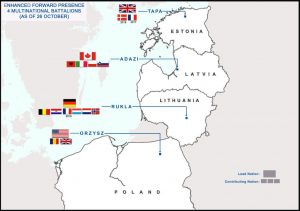
A complex geopolitical situation in the region forces the Baltic States and their NATO allies to take unprecedented efforts to increase defence capabilities to counter potential aggressors. A new Lithuanian military strategy approved in March describes Russia actions along with terrorism as the main threats for the security of Lithuania, as reported by Delfi.Unfortunately for pacifists, the Alliance and Russia today are arming and demonstrating their military power. They constantly compare their armed forces’ strength and capabilities, conduct large-scale military exercises, respond to each other by deploying new contingents and military equipment closer and closer to the NATO-Russian border.The Baltic ...
READ MORE
Kaunas, Lithuania, June 1941 (before Germans arrived): Killing of the Jews by local LithuaniansFor the tiny village of Sukioniai in western Lithuania, the exploits of General Storm, a local anti-Communist hero executed by the Soviet secret police in 1947, have long been a source of pride. The village school is named after him, and his struggles against the Soviet Union are also honored with a memorial carved from stone next to the farm where he was born.All along, though, there have been persistent whispers that General Storm, whose real name was Jonas Noreika, also helped the Nazis kill Jews. But ...
READ MORE
I am a Lithuanian, but I leave abroad and I am not going back. At least now, at least until the Government does not pay attention to its people. According to some authoritative research institutes, during 2017 Lithuania population is again projected to decrease (by 45 677 people!) and reach 2 758 290 in the beginning of 2018. (http://www.worldometers.info/world-population/lithuania-population/). As of 1 January 2017, the population of Lithuania was estimated to be 2 803 967 people. This is a decrease of 1.63 % (46 433 people) compared to population of 2 850 400 the year before. In other words, our ...
READ MORE
Yet again, a conference here in the Lithuanian capital dedicated to combating fascism and antisemitism is announced, without there having been a public call for papers, without a single speaker from among those who actually combat fascism and antisemitism in the country, with nobody from the democratically elected Vilnius Jewish community (not even the long-time editor of Jerusalem of Lithuania who has exposed and combated antisemitism for decades). No Holocaust survivors. None of the nationally relevant questions of the day can be found on the conference program. As ever, outstanding academic personalities from abroad are recruited to lend the gravitas and provide serious papers ...
READ MORE
“Ethnic affiliation has never been forgotten in the territories of the former Yugoslavia. It did play a certain role, and it did influence decisions even during the Tito's era of strict ‘Brotherhood and Unity’”[Várady T., “Minorities, Majorities, Law and Ethnicity: Reflections of the Yugoslav Case”, Human Rights Quarterly, Vol. 19, 1997, p. 42]People, nation and stateI agree that “in Yugoslavia, all political problems are intimately linked with the issue of nationalism”.[i] Indeed, the fixing of inner or administrative borders between Yugoslavia’s nations and nationalities became one of the main issues that forged nationalism after the Second World War onward and ...
READ MORE
Belarus is a land known also as Belorussia (White Russia, Weißrussland) in East Europe which was for centuries occupied by a Polish-Lithuanian common state until it became included in Tsarist Russia in the late 18th century.[1] Belarus is facing many identity problems but the most important is the ethnolinguistic challenge to a separate Belarussian[2] national feature.National identityA common national identity is a focal element for the creation of a national state as without a common identity that is based on a fundamental element of group’s identity a psychological sense of common solidarity cannot be developed. However, such solidarity is a ...
READ MORE
The logical question is whether Putin's military action of pacification of NATO extremists and denazification of Eastern Europe will stop in Ukraine (called by some commentators on social networks Nazikraine) or will the action continue in the direction of the west, i.e., to Central Europe and/or the Baltic States?Of course, at this moment, it is difficult to predict what the development of events will be in the next period, especially when this current operation in Ukraine is not completely finished. However, one thing is certain: analogous to the case of Ukraine, it can be predicted that Russia's next step depends ...
READ MORE
It’s an open secret that the “Soros network” has an extensive sphere of influence in the European Parliament and in other European Union institutions. The list of Soros has been made public recently. The document lists 226 MEPs from all sides of political spectrum, including former President of the European Parliament Martin Schulz, former Belgian PM Guy Verhofstadt, seven vice-presidents, and a number of committee heads, coordinators, and quaestors. These people promote the ideas of Soros, such as bringing in more migrants, same-sex marriages, integration of Ukraine into the EU, and countering Russia. There are 751 members of the European Parliament. It means ...
READ MORE
TerminologyA meaning of the term Great Power(s) (GP) in global politics from the beginning of the 16th century onward refers to the most power and therefore top influential states within the system of the international relations (IR). In other words, the GP are those and only those states who are modelling global politics like Portugal, Spain, Sweden, France, the United Kingdom, united Germany, the USA, the USSR, Russia or China. During the time of the Cold War (1949−1989) there were superpowers[1] as the American and the Soviet administrations refered to their own countries and even a hyperpower state – the ...
READ MORE
The stars came out in Hollywood on November 2nd, or at least some of them did. The gala event celebrated the Israel Defense Forces (IDF) and raised funds to support its mission in Israel itself and on the occupied West Bank. The organization being fêted was the Friends of the Israel Defense Forces (FIDF), which has fourteen regional offices in the United States and operates under the slogan “Their job is to look after Israel. Our job is to look after them.” In attendance were Arnold Schwarzenegger and actor Gerald Butler. Entertainment was provided by the singer Seal.Hollywood Jewish royalty ...
READ MORE
Origins of images: Facebook, Twitter, Wikimedia, Wikipedia, Flickr, Google, Imageinjection & Pinterest.Read our Disclaimer/Legal Statement!Donate to Support UsWe would like to ask you to consider a small donation to help our team keep working. We accept no advertising and rely only on you, our readers, to keep us digging the truth on history, global politics and international relations.
READ MORE
The national scandal unleashed by the Lithuanian Rūta Vanagaitė and the Jewish Efraim Zuroff via their statements about Adolfas Ramanauskas-Vanagas, is gradually losing momentum. The Seimas (parliament) went right ahead and declared the incoming year, 2018, to be The Year of Ramanauskas-Vanagas. That is sad. Three years ago, I wrote about this person’s activities in Druskininkai in 1941. Society back then was silent about it. It was only the desire of some politicians to glorify this personage that led to the aforementioned Lithuanian and Jewish commentators to talk about him. They spoke loudly and an antisemitic bubble burst. Vanagaitė’s statement had some ...
READ MORE
This text aims to present the Lithuanian legislative framework concerning linguistic rights and minority protection. For the preface, a general overview of minorities in Lithuania is going to be done. It is going to be followed by the presentation of the legal framework of the country. It will be confronted with the facts concerning the situation of minority groups in Lithuania especially two of the biggest of them: The Poles and the Russians.Minorities and minority rights Minority rights, as applying to ethnic, religious, or linguistic minorities and indigenous peoples, are an integral part of international human rights law. They are a ...
READ MORE
Historical backgroundHistorical Poland (in fact, the Polish-Lithuanian Republic of Two Nations) became divided during the three partitions in 1772, 1793, and 1795 between the Kingdom of Prussia, the Habsburg Monarchy (later Austrian Empire and Austrian-Hungarian Monarchy), and the Russian Empire. At that time, the rulers of all these three states which divided Poland-Lithuania (the Kingdom of Poland and the Grand Duchy of Lithuania) have been by ethnic origin the Germans – Frederick the Great of Prussia, Catherine the Great of Russia, and Joseph II of Austria. It means that the Polish-Lithuanian Commonwealth (established in 1569 by the Union of Lublin), ...
READ MORE