
Last year, antifascists in Poland commemorated the country’s international brigades on the eightieth anniversary of the Spanish Civil War. Their gathering came under attack and a smoke grenade was thrown through the door. Inscribed on the projectile was the phrase “ha pasado,” “we have passed,” Franco’s retort to Dolores Ibárruri’s “no pasarán” on the day the Republic fell.
Another iconic turn of phrase associated with the civil war owed much to Poland’s influence. “A las Barricadas,” the anthem of the anarcho-syndicalist CNT federation, became the war’s most famous song — but it wasn’t exactly an original. Its tune had been written by Józef Pławiński and its lyrics by Wacław Święcicki, both Polish socialist musicians. Their “Warszawianka” had been the anthem of the 1905 Polish Revolution, when worker militias sought to overthrow the Russian imperial government.
Today, progressive history is under attack not only in Poland but across Eastern Europe. From its beginnings “decommunization” took aim not only at the Soviet era but at earlier socialist and republican history too. In the 1990s, as the Hungarian government began the wholesale removal of Communist statues, it decided to store them all in a single place. Budapest’s Memento Park was born and the architect who won the competition to design it, Ákos Eleőd, was clear about its intentions. “This park,” he said, “is about dictatorship.”
But, for a park about dictatorship, it has an interesting lineup. Alongside monuments to politicians from the Communist period — and Marx, Engels, and Lenin — stand those left-wingers from generations earlier. There are commemorations for figures from the short-lived 1919 Hungarian Soviet Republic, including Tibor Szamuely and Jenő Landler, as well as Ede Chlepkó and Béla Kun, who were executed in Stalin’s purges. Róbert Kreutz and Endre Ságvári, killed by the Nazis and Hungary’s fascist government during World War II also have statues. They are joined by Miklós Steinmetz and I.A. Ostapenko, Red Army captains who died liberating Budapest from German occupation. And, of course, there’s a memorial to the Hungarian international brigade to Spain.
Unfortunately, it is no surprise that initiatives which purport to challenge dictatorship are instead demonizing those who struggled against fascism. Decommunization has become a tool for resurgent nationalist movements to rehabilitate their own record — one which often involved Nazi collaboration.
In 2015, riding a wave of nationalist sentiment in the wake of conflict in the country’s east, Ukraine began an intensive process of decommunization. Since then thousands of streets and hundreds of towns have been renamed, statues of Lenin have been torn down in every corner of the country, and political parties which are deemed too sympathetic to the Communist past have been banned — including the Communist Party of Ukraine, which regularly received millions of votes.
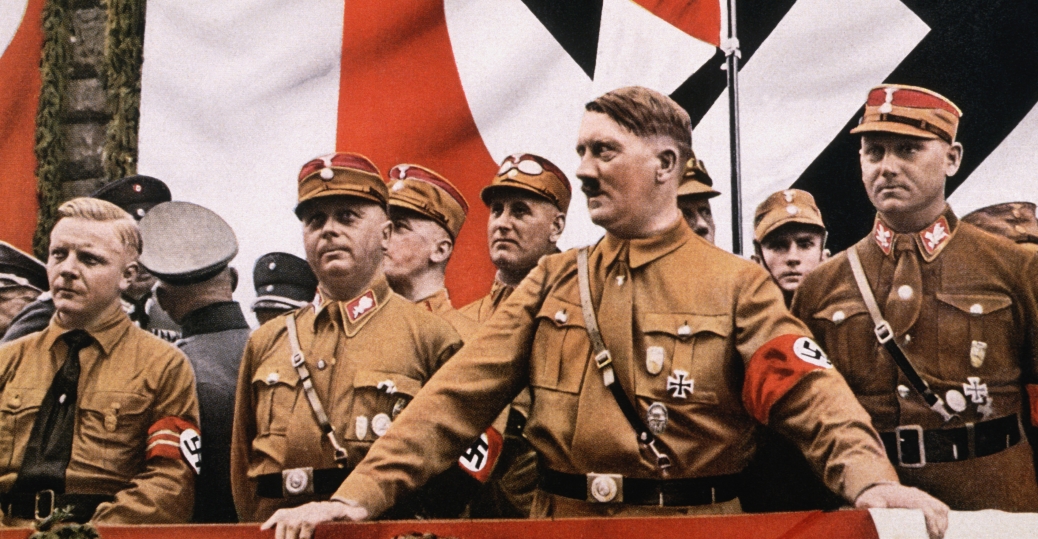
The legislation that Ukraine’s Parliament voted on wasn’t exclusive to Communism. Its text promised to combat celebration of both “Communist and National-Socialist totalitarian regimes.” But in 2015, as these measures passed, Ukraine’s government was in fact institutionalizing fascist militias into its armed forces. That summer the Azov Battalion, founded by members of the neo-Nazi Social-National Assembly, was officially upgraded to a Special Operations Regiment of the Ukrainian Army. Its members celebrated with photos showing their SS tattoos, symbols which the government was supposed to have banned.
The institutionalization of fascism isn’t confined to the military. The country’s far right is increasingly prominent in official history as well, part of a state-sponsored revisionist project designed to venerate Ukrainian nationalism. The most high-profile figure to be rehabilitated is Stepan Bandera, the nationalist leader who collaborated with the Nazis during the Second World War and whose Ukrainian Insurgent Army participated in the Holocaust.
But Bandera is far from the only figure to undergo such a rebranding. In October 2017 the Ukrainian city of Vinnitsa unveiled a statue to Symon Petliura, who led an anti-communist uprising against the Bolshevik Revolution. Under his reign, fifty thousand Jews were killed in pogroms in the Ukrainian People’s Republic. This isn’t a record that the city is hiding from — local authorities ultimately decided to place his statue in the city’s historic Jewish quarter, a short walk from one of the few remaining synagogues.
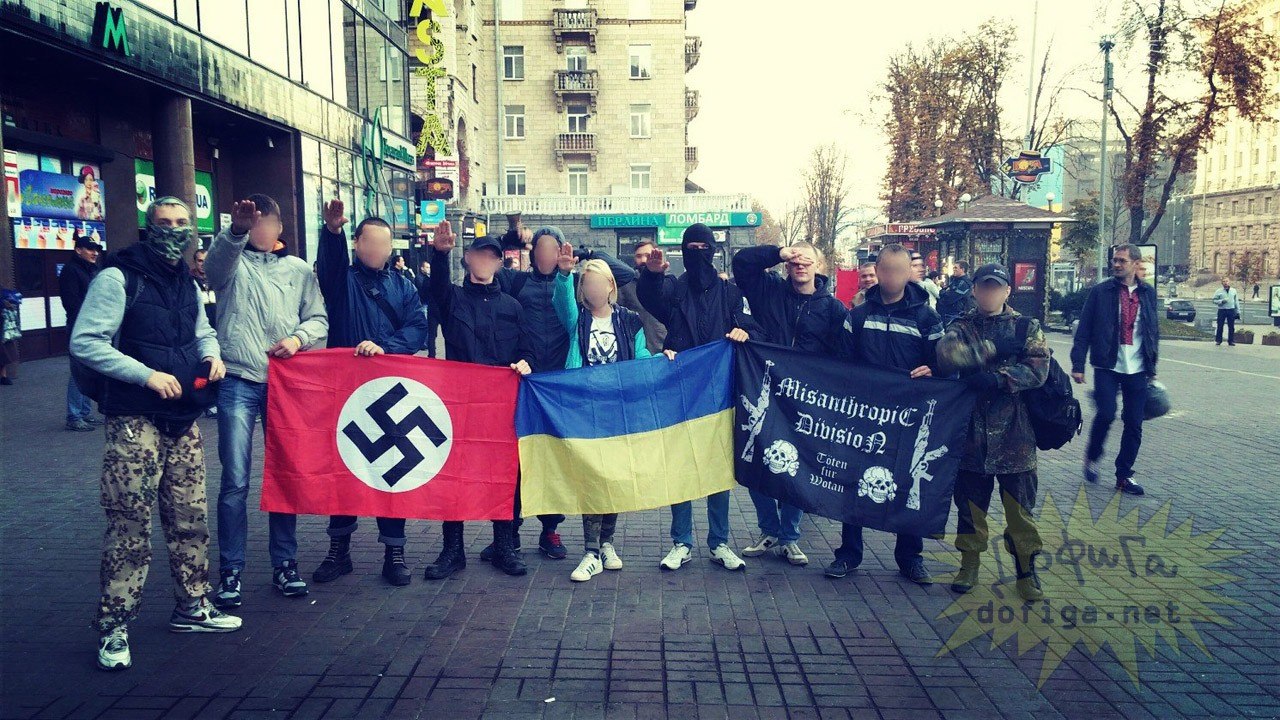
Elsewhere, too, decommunization has been a cloak for attacks on Eastern Europe’s Jews. The Lithuanian government, keen to construct a nationalist narrative which justifies collaboration with the Nazis, has accused its Jewish partisans of war crimes. A monument to their struggle, once placed prominently in the country’s capital, has been hidden away in another “dictatorship” park. Today its plaque notes that the partisans who fought the Nazis — in a country where almost two hundred thousand died in the Holocaust — were “mostly Jewish.” Lithuanians, it says, “didn’t support the Communists.”
The Soviet Union’s record in Eastern Europe was bleak — its population transfers, political repression, and forced collectivizations contribute to much lingering resentment. But the drive to decommunize has little to do with building a more democratic society. It’s, at its heart, a project designed to rewrite history, forgiving fascism and condemning those who fought it.
Origins of images: Facebook, Twitter, Wikimedia, Wikipedia, Flickr, Google, Imageinjection, Public Domain & Pinterest.
Read our Disclaimer/Legal Statement!
Donate to Support Us
We would like to ask you to consider a small donation to help our team keep working. We accept no advertising and rely only on you, our readers, to keep us digging the truth on history, global politics, and international relations.
A great explanation from an excellent analyst of what happened in Serbia 20 years ago, and why the Ukraine feels like Deja Vu‘Operation Storm’ in August 1995, when Croatia overran the Serb-inhabited territory of Krajina, was the biggest single instance of ethnic cleansing in the Yugoslav Wars, Because the attack was backed by the US, however, it was never treated as a crime.Between August 4 and August 7, up to 2,000 people were killed and over 220,000 driven from their homes by the Croatian army. No “invaders,” these Serbs had lived in the Krajina – their word for borderlands – for centuries. The ...
Exclusive photos of the Russian war crimes in Syria and the Middle East by "Free Media Group" volunteers, 2016-2018 with a proper illustrations of the Russia's militant imperialism. The authenticity of photos and their descriptions are certified by the UK Cabinet of Boris Johnson & Theresa May: The My Lai Massacre by Russian soldiersThe Russian soldiers at the spot of My Lai Massacre with their victimsAleppo citizen with a daughter during the Russian destruction of the cityRussian Orthodox monk in Moscow in protest against the Russian invasion of SyriaSyrian children of war and the Russian occupant soldier Killed Russian student in ...
In the night of July 16-17, 1918, a squad of Bolshevik secret police murdered Russia's last emperor, Tsar Nicholas II, along with his wife, Tsaritsa Alexandra, their 14-year-old son, Tsarevich Alexis, and their four daughters. They were cut down in a hail of gunfire in a half-cellar room of the house in Ekaterinburg, a city in the Ural mountain region, where they were being held prisoner. The daughters were finished off with bayonets. To prevent a cult for the dead Tsar, the bodies were carted away to the countryside and hastily buried in a secret grave.Bolshevik authorities at first reported ...
With criminal corporate monopoly media masking the US created prosecutable genocide ongoing in Yemen, Somalia, South Sudan, Syria, Iraq and Afghanistan by focusing attention on Russia, fantasized as a dangerous enemy needing military confrontation, it might be a good time to review past US planned, facilitated and at times perpetrated genocidal crimes in Russia. History in context kind of puts to rest all the hype about evil Russia seeking to expand when it already is the largest country in the world spanning nine time zones with only half the population of the US to fill it.In 1900, Russia and America ...
In late November 2013, the ‘Euromaidan’ in Kiev began as a popular protest against a generalized state of corruption and cronyism in Ukraine. The spark that ostensibly ignited the protests was the inability of then President Yanukovych to sign an EU Association Agreement that would cut Ukraine’s economic and military ties to Russia in favor of a closer relationship with the EU and NATO.The EU had made the release of former Ukrainian prime minister and “gas princess” Tymoshenko a precondition for signing the agreement. But the fact that Tymoshenko was/is a convicted embezzler of state funds, combined with the rather ...
The edifice of the post-1991 world order is collapsing right before our eyes. President Putin’s decision to give a miss to the Auschwitz pilgrimage, right after his absence in Paris at Charlie festival, gave it the last shove. It was good clean fun to troll Russia, as long as she stayed the course. Not anymore. Russia broke the rules.Until now, Russia, like a country bumpkin in Eton, tried to belong. It attended the gathering of the grandees where it was shunned, paid its dues to European bodies that condemned it, patiently suffered ceaseless hectoring of the great powers and irritating baiting of the East European small-timers alike. But something broke there. The lad does ...
There have been at least two countries in Europe in recent history that undertook ‘anti-terrorist’ military operations against ‘separatists’, but got two very different reactions from the Western elite.The government of European country A launches what it calls an‘anti-terrorist’ military operation against ‘separatists’ in one part of the country. We see pictures on Western television of people’s homes being shelled and lots of people fleeing. The US and UK and other NATO powers fiercely condemn the actions of the government of country A and accuse it of carrying out ‘genocide’ and ’ethnic cleansing’ and say that there is an urgent ...
In whose interest did the creation of the Cold War serve and continues to serve? Cynthia Chung addresses this question in her three-part series.In 1998, the Nazi War Crimes and Japanese Imperial Government Records Interagency Working Group (IWG), at the behest of Congress, launched what became the largest congressionally mandated, single-subject declassification effort in history. As a result, more than 8.5 million pages of records have been opened to the public under the Nazi War Crimes Disclosure Act (P.L. 105-246) and the Japanese Imperial Government Disclosure Act (P.L. 106-567). These records include operational files of the Office of Strategic Services ...
Zagreb, 1941Become familiar with the basic info about one of the most beautiful countries in the world - Croatia. Photos, data & recommendations where to stay in order to enjoy this Adriatic pearl. If you are not the Serb.Split, Dalmatia, Croatia, 2019: "Kill the Serb" on the car with the plates from SerbiaOrigins of images: Facebook, Twitter, Wikimedia, Wikipedia, Flickr, Google, Imageinjection, Public Domain & Pinterest.Read our Disclaimer/Legal Statement!Donate to Support UsWe would like to ask you to consider a small donation to help our team keep working. We accept no advertising and rely only on you, our readers, to ...
The Russian army carried out a precise attack on the mercenary base in Kharkiv, the building was completely destroyed, the Ministry of Defense of Russia announced."On the evening of January 16, the Armed Forces of Russia carried out a high-precision strike on the point of temporary deployment of foreign fighters in the city of Kharkiv, the core of which was made up of French mercenaries," the Russian defense ministry announced.The result of the attack was the elimination of more than 60 mercenaries, while more than 20 were taken to medical facilities.The building they were in was completely destroyed.A day earlier, ...
Against the backdrop of US aggression against North Korea, NATO is intensifying its preparations for war with Russia, the world’s second largest nuclear power. A report in the German news magazine Der Spiegel (Issue 43/2017) based on a secret NATO document indicates how far plans for war have progressed. The news magazine concludes:“In plain language: NATO is preparing for a possible war with Russia.”In the document entitled “Progress report on the Alliance’s Enhanced Deterrence and Defence Disposition,” leading military figures call for a major boost to military capabilities in order to conduct a so-called “Major Joint Operation Plus.” The abstruse ...
How many times have we seen this before?The President of the United States is on TV telling us horror stories. Some innocent people in some corner of the world are being crushed, he tells us. They face some monstrously evil oppressor, he says. While the United States doesn’t like war, what choice is there? Sacrifices must be made, cruise missiles must be unleashed, to protect the poor and innocent. The world is the set of an action movie, and the US is the tragic hero, forced to rescue the innocent.This is the script we heard in former Yugoslavia. Bill Clinton ...
The video of the execution of Russian prisoners of war by Ukrainian troops, which circulated in the media and social networks, is far from the only video recording of war crimes by Ukrainian army.(1) Since the beginning of the Russian special military operation videos of beaten and stripped prisoners of war and civilians suspected of collaborating with the Russians have appeared on internet. Records of torture also circulated widely.However, what shocks the public is that official Kyiv promotes the violation of the Geneva Convention and does not care about the promotion of war crimes. And that is precisely why Ukrainian ...
During the recent years of the confrontation between Russia and Ukraine, there has been one issue where the Western mainstream press simply cannot fully ignore or reject the Russian arguments. This issue concerns the life and actions of Stepan Bandera (1909-1959) and his followers from what is known as the “Banderite” faction of the Organization of Ukrainian Nationalists (OUN, a far-right organization that took terrorist actions against Polish and Soviet officials from the 1920s to the 1950s and which is now legally protected from any criticism in Ukraine).THE “WRONG” AND “RIGHT” VICTIMSBecause Bandera was born on January 1, 1909, celebrations ...
The facile and indiscriminate use of the term fascism has led to a widespread misunderstanding and misuse of its meaning. Asked to define fascism, most people would respond in terms such as dictatorship, anti-Semitism, mass hysteria, efficient propaganda machine, mesmerizing oratory of a psychopathic leader, and the like.Such a pervasive misconception of the meaning of the term fascism is not altogether fortuitous. It is largely because of a longstanding utilitarian misrepresentation of the term. Fascism is deliberately obfuscated in order to sanitize capitalism. Ideologues, theorists and opinion-makers of capitalism have systematically shifted the systemic sins of fascism from market/capitalist failures ...
Throughout the past decade, the UN General Assembly Third Committee has adopted the resolution: “Combating Glorification of Nazism, neo-Nazism and other practices that contribute to fueling contemporary forms of racism, racial discrimination, xenophobia and related intolerance.”Every year the resolution is adopted by an overwhelming majority of UN member states, while the European Union, which, as the battleground of Nazism should have supported the resolution, merely abstains, and their fence-straddling raises disturbing questions about their actual tendencies. Japan’s abstention raises equally disturbing questions. The United States has consistently, and shockingly, opposed this resolution.The resolution is sponsored by the Russian Federation, which ...
For the fourth year in a row, representatives of Croatia’s Jewish and Serbian communities, as well as anti-fascists, will boycott the official commemoration of the victims of the World War II concentration camp at Jasenovac on April 14.That means there will again be a separate, unofficial and much more well-attended commemoration for more than 83,000 Serbs, Roma, Jews and anti-fascists killed at the camp by the Croatian WWII fascist Ustasa movement, which will be held at the site on April 12.Representatives of the Roma community, Jasenovac’s second biggest victim group, will again attend both commemorations.For the fourth year in a ...
Uncovering the Western mainstream mass-media lies on Ukraine.Origins of images: Facebook, Twitter, Wikimedia, Wikipedia, Flickr, Google, Imageinjection, Public Domain & Pinterest.Read our Disclaimer/Legal Statement!Donate to Support UsWe would like to ask you to consider a small donation to help our team keep working. We accept no advertising and rely only on you, our readers, to keep us digging the truth on history, global politics, and international relations.[wpedon id="4696" align="left"]
The German occupation forces were those who have been the first to create and recognize a short-lived state’s independence of Ukraine in January 1918 during the time of their-own inspired and supported anti-Russian Bolshevik Revolution of 1917−1921. As reoccupied by the Bolshevik Red Army, the eastern and southern parts of the present-day territory of (a Greater) Ukraine joined in 1922 the USSR as a separate Soviet Socialist Republic (without Crimea). According to the 1926 Soviet census of Crimea, the majority of its population were the Russians (382.645). The second-largest ethnic group were the Tartars (179.094). Therefore, a Jew V. I. ...
"Welcome to Nulandistan: Propaganda and the Crisis in Ukraine" (2014)This full length GRTV documentary looks at the fictitious land of Nulandistan that has been constructed out of Ukraine.The GRTV documentary deconstructs Nulandistan and the propaganda of the Obama Administration [...], the US Department of States, US officials, and their allies about the crisis in Ukraine and takes a look at their growing frustration towards the Russian media, particularly RT, for challenging their account of the events on the ground in what they have declared is an intensifying information war.The full length documentary starts by looking at the self-benefiting description of ...