
The “Kaunas Garage Massacre” in 1941: The Lithuanians are Clubbing Lithuania’s Jewish (Litvakai) to Death (Photos)
During the Lietūkis Garage Massacre, carried out before the invading Germans had actually set up their administration, 40-60 people were killed and publicly humiliated in the process. Jews were forced to gather on the afternoon in the courtyard of a garage at 43 Vitautas Avenue, in the center of the city [...]
In June and July 1941, detachments of German Einsatzgruppen, together with Lithuanian auxiliaries, began murdering the Jews of Lithuania. Groups of partisans, civil units of nationalist-rightist anti-Soviet affiliation, initiated contact with the Germans as soon as they entered the Lithuanian territories. A rogue unit of insurgents headed by Algirdas Klimaitis and encouraged by Germans from the Sicherheitspolizei and Sicherheitsdienst, started anti-Jewish pogroms in Kaunas (Polish: Kovno) on the night of 25–27 June 1941. Over a thousand Jews perished over the next few days in what was the first pogrom in Nazi-occupied Lithuania. The most infamous incident occurred in what was later known as the Lietūkis Garage Massacre.
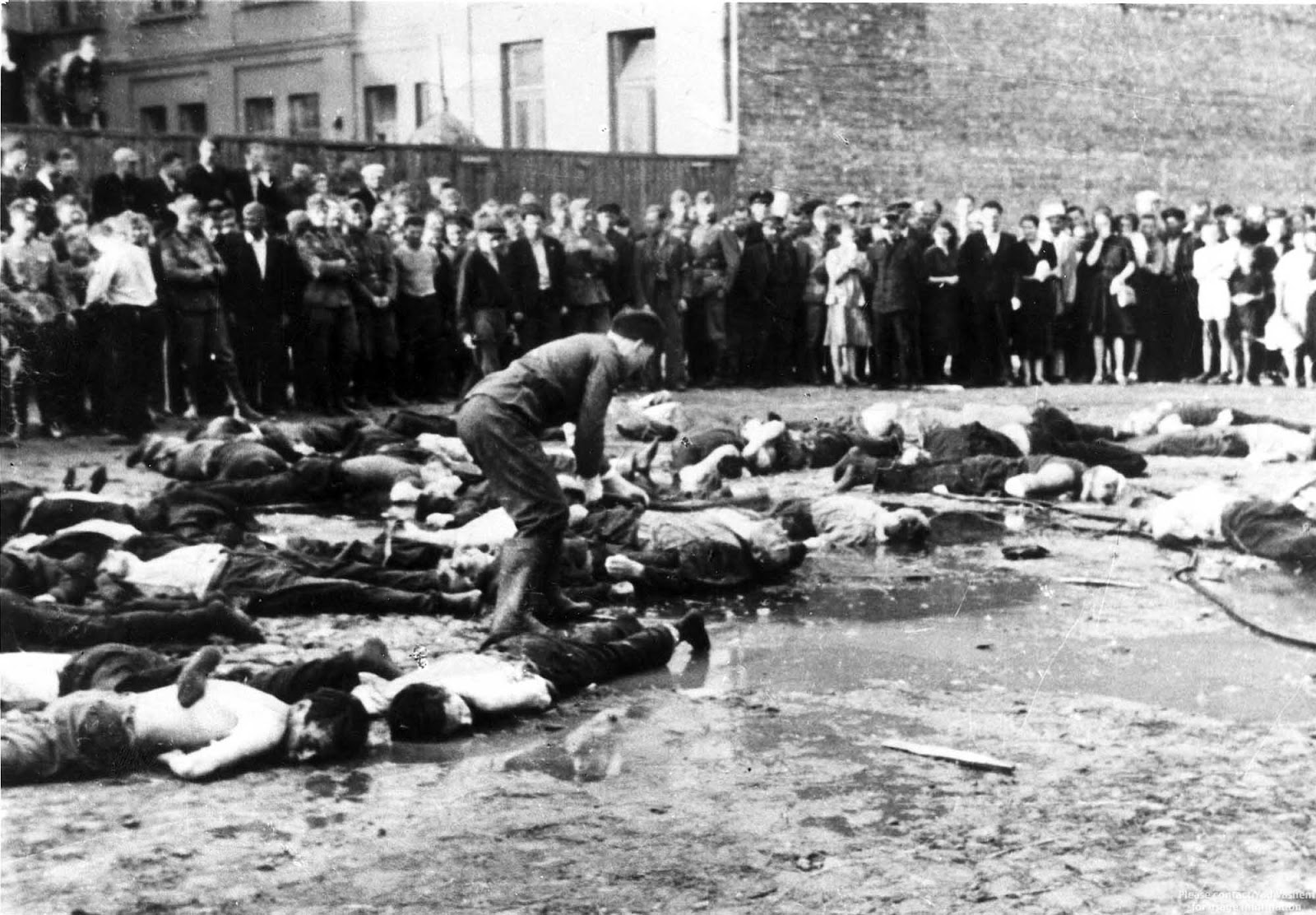
Lithuanian nationalists clubbing Jewish Lithuanians to death. Kovno (Kaunas), Lithuania, June 27, 1941
During the Lietūkis Garage Massacre, carried out before the invading Germans had actually set up their administration, 40-60 people were killed and publicly humiliated in the process. Jews were forced to gather on the afternoon in the courtyard of a garage at 43 Vitautas Avenue, in the center of the city. Some of them were killed with shovels, iron bars or by other barbaric methods. Lithuanian children were lifted onto the shoulder of their parents to catch a glimpse of the “Death Dealer of Kovno”, a sight that one German regular army officer later described as the most frightful event he’d witnessed in the course of two world wars.
An unknown perpetrator (nicknamed the “Death Dealer”) at the massacre in the Lietūkis garage
“On the concrete forecourt of the petrol station a blond man of medium height, aged about twenty-five, stood leaning on a wooden club, resting. The club was as thick as his arm and came up to his chest. At his feet lay about fifteen to twenty dead or dying people. Water flowed continuously from a hose washing blood away into the drainage gully. Just a few steps behind this man some twenty men, guarded by armed civilians, stood waiting for their cruel execution in silent submission. In response to a cursory wave the next man stepped forward silently and was beaten to death with the wooden club in the most bestial manner, each blow accompanied by enthusiastic shouts from the audience”.
Once the mound of the bodies at his feet had reach fifty, the Death Dealer fetched an accordion, climbed to the top of the pile of the corpses, and played the Lithuanian national anthem.
This incident is well documented and well photographed, partly because it was a public event. There are various accounts of it from both German and Lithuanian sources. Laimonas Noreika was a resident of Kovno:
“I can’t remember whether we left work early that day (my elder brother Albertas and I) or whether we went home at our usual time. Opposite the Kovno cemetery at the corner of Greenwald St and Vytautas Boulevard there was a small garage, which serviced light vehicles. A large crowd had gathered alongside the perimeter fence of the garage yard. So we also went over to see what was happening. I keep asking myself whether I just imagined it all but I know I did not.
Those horrific events have been burned onto my memory and will remain there until my dying day. In the middle of the yard, in broad daylight and in full view of the assembled crowd, a group of well dressed, spruce intelligent looking people held iron bars which they used to viciously beat another group of similarly well dressed, spruce, intelligent people. It was obvious the yard also served as a horse stable as animal droppings were littered everywhere.
The assailants yelled the word “norma” (move it) repeatedly as they relentlessly battered the Jews until they fell to the ground and began gathering feces. They kept hitting them until finally they lay inert. Then, using a hosepipe for washing cars, they doused them with water until they came round following which the abuse would start all over again. And so it went on and on until the hapless victims lay dead. Bodies began to pile up everywhere. I stood next to the fence and watched it all until finally, my brother Albertas pulled me away…”.
This incident is well documented and well photographed, partly because it was a public event
Excerpt from testimony given by Colonel L. Von Bischoffshausen:
“I arrived in Kovno on the afternoon of June 27 1941. Whilst patrolling the city I came across a crowd of people that had gathered alongside a gas station to watch was happening in the adjacent yard. There were women in the crowd and many of them clambered onto chairs and crates so that they and their children could get a better view of the “spectacle” taking place in the yard below. At first I thought this must be a victory celebration or some type of sporting event because of the cheering, clapping and laughter that kept breaking out.
However, when I asked what was happening I was told the “death dealer of Kovno” is at work and he would make sure that all “traitors and collaborators” received a fitting punishment for their “treachery.” When I drew closer I witnessed a display of brutality that was unparalleled by anything I saw in combat during two world wars.
Standing on the tarmac in the yard was a fair haired young man of around 25. He leaned on a long iron bar as thick as human arm and around his feet lay between fifteen to twenty people who were either dying or already dead. A few feet away from him stood another group of individuals who were guarded by armed men. Every few minutes he signaled with his hand and another person quietly stepped forward and had his skull shattered with one blow from the huge iron bar the killer held in his hand. Each blow he struck drew another round of clapping and cheering from the enthralled crowd”.
During World War II, 91-95% of Lithuania’s Jewish population of Lithuanian Jews were killed – almost all the Jews who had not managed to leave Lithuania and its environs. This was the highest casualty rate of Jews in any nation in the Holocaust. An important component to the Holocaust in Lithuania was that the occupying Nazi German administration fanned antisemitism by blaming the Soviet regime’s recent annexation of Lithuania, a year earlier, on the Jewish community. Another factor was the German plan for early colonization of Lithuania – which shared a border with German East Prussia – in accordance with their Generalplan Ost; hence the high priority given to the extermination of the relatively small Lithuanian Jewish community.
Soviet Red Army entering Vilnius/Wilno on September 19, 1939
Originally published on 2016-08-05
Photo credit: Dokumetationsarchiv Des Osterreichischen Wiederstand / Yad Vashem / Hirsch (Zvi) Kadushin.
Origins of other images: Facebook, Twitter, Wikimedia, Wikipedia, Flickr, Google, Imageinjection, Public Domain & Pinterest.
We would like to ask you to consider a small donation to help our team keep working. We accept no advertising and rely only on you, our readers, to keep us digging the truth on history, global politics and international relations.
[wpedon id=”4696″ align=”left”]
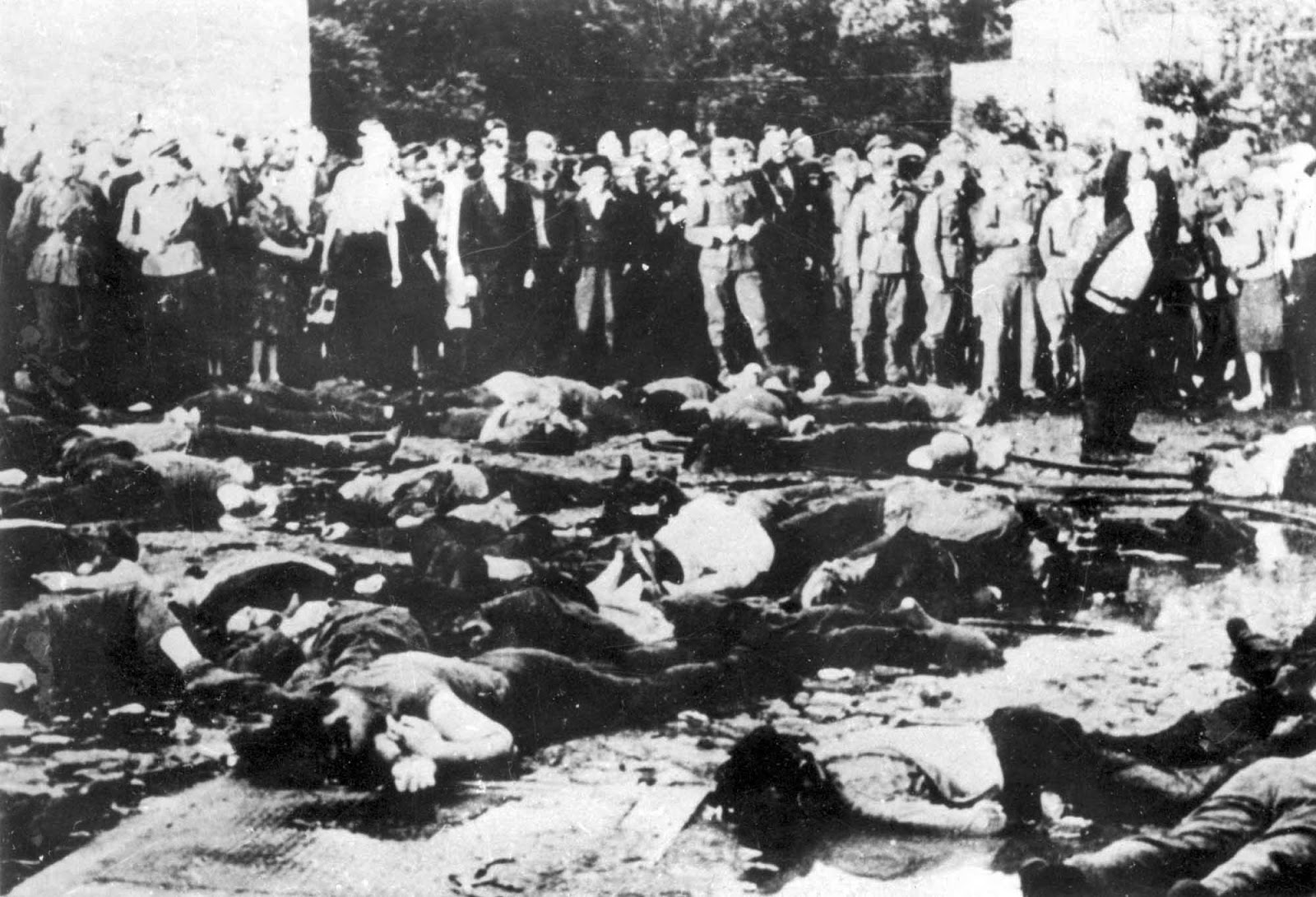
Lithuanian children were lifted onto the shoulder of their parents to catch a glimpse of the “Death Dealer of Kovno”, a sight that one German regular army officer later described as the most frightful event he’d witnessed in the course of two world wars
A NATO defense ministers meeting that took place in Brussels on November, 8-9 resulted in the new and very important decisions for the future of Europe.Speaking at a meeting, Secretary General Jens Stoltenberg said it is vital that European roads, ports, bridges and rail networks are able to carry tanks and heavy military equipment. Stoltenberg also added that NATO countries have agreed to cooperate to improve civil infrastructure objects to make them usable for military needs. What does it mean in practice for Europe in general and for the Baltic States in particular?Lithuanian authorities, for example, will for sure try ...
Americans are outraged by allegations that Russian President Vladimir Putin ordered an intelligence service to hack email accounts of the Democratic National Committee. How inexpressibly heinous that one country, Russia, would try to influence elections in another sovereign country, in this case the United States! How unprecedented! How diabolical! How uniquely Russian!In response, the Obama administration has expelled Russian diplomats, hinted at economic sanctions, and promised further retaliation using America’s “world-class arsenal of cyber weapons.” (NYT Dec. 16, 2016) Obama’s Republican opponents, for their part, have demanded “rocks” instead of Obama’s “pebbles.”But does the USA meddle in the presidential elections ...
The United States government is guilty of war crimes. This is the stark conclusion reached by the independent international commission of inquiry established by the United Nations in 2011 to investigate human rights violations stemming from the protracted US-backed war for regime change in Syria.The Pentagon’s relentless bombing campaign in and around the northern Syrian city of Raqqa, the so-called “capital” of the Islamic State of Iraq and Syria (ISIS), has inflicted a “staggering loss of civilian life,” while forcing over 160,000 civilians to flee their homes, Paulo Pinheiro, chairman of the UN’s commission of inquiry, said on Wednesday.US warplanes ...
Ilan Pappé is a historian, socialist activist, professor at the University of Exeter, and supporter of the Campaign for Boycott, Divestment, and Sanctions (BDS). Of Israeli origin, he is a world-renowned scholar on the Palestinian-Israeli conflict and has written numerous books on the subject, including The Ethnic Cleansing of Palestine and The Idea of Israel: A History of Power and Knowledge.Pappé was interviewed by Alejandra Ríos for Left Voice, where this article first appeared.Alejandra Ríos (AR): You’ve talked and written about the concept of homeland as justification for destroying the native population. What is the meaning of this concept and ...
Somewhere in the 20th century — it is difficult to determine precisely when, but many point to the 1990s anti-Serb craze — historical revisionism on WWI that would have been laughed out of the room in the 1920s and 1930s became widespread in the western mainstream media.Nobody should be surprised to learn this is an ailment that therefore also affects RT. The Russian-funded outlet is staffed by westerners and modeled after western news channels – and is as such frequently only marginally less wrong on numerous issues than its western counterparts. (All the more so when it comes to the little-understood Balkans.)Covering ...
Documentary films about ex-Yugoslavia not seen on global corporate mass-media news. For instance:US documentary movie "RETLINES" with English subtitle from 1991 about Vatican smuggling Croat Nazi Ustashi to South America in 1945Ratlines were a system of escape routes for Nazis and other fascists fleeing Europe at the end of World War II. These escape routes mainly led toward havens in South America, particularly Argentina, Paraguay, Brazil, Uruguay, and Chile. Other destinations included the United States and perhaps Canada and the Middle East. There were two primary routes: the first went from Germany to Spain, then Argentina; the second from Germany ...
From the very political point of view, the 19th century in Latin America started in 1808 when the emancipation of the subordinated people against the foreign (Spanish & Portuguese) rule started (and finished in 1826) and was over with the beginning of the Great War in Europe in 1914. The struggle for independence was extremely speeded up by the French military-political subjection of the Iberian Peninsula when both Spain and Portugal lost direct connections with their overseas colonies. Such a new geopolitical situation fostered domestic Latin American patriotic nationalism which demanded political independence, administrative sovereignty, and economic self-administration instead of ...
Author’s note: The following article focussing on the jihadist terrorist insurgency in Macedonia was first published by antiwar.com in July 2001, barely two months before the September 11, 2001 attacks on the WTC and the Pentagon.Known and documented, since the Soviet-Afghan war, recruiting Mujahedin (“holy warriors”) to fight covert wars on Washington’s behest had become an integral part of US foreign policy. A report of the US Congress had revealed how the US administration – under advice from the National Security Council headed by Anthony Lake – had “helped turn Bosnia into a militant Islamic base” leading to the recruitment ...
What constitutes water can be scientifically proven beyond any doubt, now what constitutes a nation-state is a far more organic question than it would seem. Each of us is very used to seeing maps with the same countries and lines on it throughout the years and take their existence as a given. But depending on where a map comes from its borders may actually look very different. One of these countries to some and non-countries to others is Kosovo which gradually continues to lose the support of the states that recognized it into existence. Furthermore, this sheds light on how ...
Crimea’s breakaway from Ukraine and rejoining Russia is treated in the US-and-allied world as being justification for the explosive re-emergence in 2014 of America’s Cold War NATO alliance as being a restored war against Russia; and, so, whether or not that ‘justification’ is truthful is the paramount geopolitical issue in our era; and it will therefore be discussed and (via the links here) documented in this article.Though international law is generally an unenforced mess that is interpretable far more by partisanship than by any clearly applicable principles, the US Government does quite blatantly violate it on a routine basis, by ...
When most people think of Sweden, they think of IKEA furniture, depressing murder mysteries and a foreign policy of strict neutrality.Yet 400 years ago, Sweden was a major military power. Indeed, it was even an empire, a fact that must make today's Swedish leftists cringe.Under young King Gustavus Adolphus, a brilliant and innovative military commander, Sweden in the early 1600s became a sort of Nordic Israel (which must also make Swedish leftists cringe). Sweden was a poor, thinly populated nation that couldn't match the resources of larger rivals such as France and Russia.So, Gustavus Adolphus had to devise a more flexible, mobile ...
Belarus is a land known also as Belorussia (White Russia, Weißrussland) in East Europe which was for centuries occupied by a Polish-Lithuanian common state until it became included in Tsarist Russia in the late 18th century.[1] Belarus is facing many identity problems but the most important is the ethnolinguistic challenge to a separate Belarussian[2] national feature.National identityA common national identity is a focal element for the creation of a national state as without a common identity that is based on a fundamental element of group’s identity a psychological sense of common solidarity cannot be developed. However, such solidarity is a ...
Robert Mueller, a former director of the FBI who is working as a special prosecutor “investigating” a contrived hoax designed by the military/security complex and the DNC to destroy the Trump presidency, has yet to produce a scrap of evidence that Russiagate is anything but orchestrated fake news. As William Binney and other top experts have said, if there is evidence of Russiagate, the NSA would have it. No investigation would be necessary. So where is the evidence?It is a revelation of how corrupt Washington is that a fake scandal is being investigated while a real scandal is not. The ...
Part I, Part II, Part III, Part IV, Part VA follow-up of Professor Vladimir Kozin’s comments on NATO’s Fact Sheet about relations with Russia published in December 2014. The topics to be covered in this part:NATO’s operation in Afghanistan was a failure;The NATO-led mission in Afghanistan failed to stop the Afghan drugs trade;NATO’s operation over Libya was illegitimate;NATO’s operation over Kosovo was illegitimate;The cases of Kosovo and Crimea are identical;Russia’s annexation of Crimea was justified;The Ukrainian authorities are illegitimate.NATO’s operation in Afghanistan was a failureNATO claim: NATO took over the command of the UN-mandated International Security Assistance Force in Afghanistan ...
The creation of the First Balkan Alliance against the Ottoman Empire in 1866–1868 in the light of territorial requirements of the Balkan states and nations at the expense of the decreasing power of the Ottoman authorities and the Ottoman state integration was the first political-military treaty on the mutual cooperation by the Christian Balkan states and nations. The secret paragraphs of bilateral military-political contracts between Greece and Serbia and Serbia and Montenegro in regard to territorial inheritance of the Ottoman Empire in the Balkans are the most important points of the treaty.Serbia became a leader of the Balkan coalition and ...
Yet again, a conference here in the Lithuanian capital dedicated to combating fascism and antisemitism is announced, without there having been a public call for papers, without a single speaker from among those who actually combat fascism and antisemitism in the country, with nobody from the democratically elected Vilnius Jewish community (not even the long-time editor of Jerusalem of Lithuania who has exposed and combated antisemitism for decades). No Holocaust survivors. None of the nationally relevant questions of the day can be found on the conference program. As ever, outstanding academic personalities from abroad are recruited to lend the gravitas and provide serious papers ...
This is definitely an unusual book, as heralded by its title and three subtitles, whose lengthy wording evokes that of several learned tomes of the 18th and early 19thcentury.Its author is a well-known personality in Switzerland. Guy Mettan is a prominent journalist, formerly editor-in-chief of Tribune de Genève; he once presided over the Great Council, the Geneva parliament, of which he is still a representative, elected on the Christian Democrat Party list; he heads the Swiss Press Club and has written several books on Switzerland and international Geneva.As he explains in his foreword, his interest for Russia came by happenstance: ...
One can only imagine the risk when some citizens of a small country conceal hundreds of thousands of weapons and explosives. The nation becomes a powder keg, awaiting one small mistake to spark a deadly explosion.This is the situation currently in Albania. During the civil war of 1997, military depots were looted, and more than 650,000 guns, 1.5 billion bullets, 3.5 million grenades and 1 million landmines were stolen from military warehouses by various criminal groups and the Kosovo Liberation Army.The government has attempted to resolve, or at least reduce, this serious problem. Since 1997, it has announced three amnesty ...
Preface The European Union (the EU) is characterized by a purposeful diffusion of political authority between supranational and intergovernmental institutions. Based on the idea of shared leadership, it relies on a delicate institutional balance guarding declared equality between its ever more diverse members and managing potential and real tensions between the more and less populated states. Such tensions are present in any federal construct and have been a key concern since the ‘original six’ founded the (West) European Coal and Steel Community (the ECSC) in 1951 (the Benelux, West Germany, France, and Italy).The formal facts and official EU’s propaganda about ...
World War II marked the apogee of industrialized “total war.” Great powers savaged one another. Hostilities engulfed the globe. Mobilization extended to virtually every sector of every nation. Air war, including the terror bombing of civilians, emerged as a central strategy of the victorious Anglo-American powers. The devastation was catastrophic almost everywhere, with the notable exception of the United States, which exited the strife unscathed and unmatched in power and influence. The death toll of fighting forces plus civilians worldwide was staggering.The Violent American Century addresses the U.S.-led transformations in war conduct and strategizing that followed 1945—beginning with brutal localized ...