
Vratnica was a village located in northwestern Macedonia at the border with Kosovo and Metohija. It had been part of Serbia after the First Balkan War in 1912 [...]
The Ploesti old fields in southeastern Romania were a vital strategic bombing objective for the U.S. Army Air Force during World War II. Located 35 miles north of the capital Bucharest, Ploesti had formerly supplied one-third of Germany’s oil. The U.S. had targeted Ploesti to deprive the German military of petroleum. The U.S. first bombed Ploesti on June 12, 1942 during the HALPRO bombing raid. Then on August 1, 1943 during Operation Tidal Wave, a major bombardment was launched.
The Soviet Red Army advance on Yugoslavia and the capital Belgrade in 1944 was launched from Romania. Russian troops had captured Ploesti on August 30, 1944. But before its capture, Ploesti remained a major bombing target for U.S. forces.
On August 26, 1944, a U.S. B-24 Liberator crew conducted a bombing mission in Romania. On its return flight, it was shot down over the village of Vratnica in the former Yugoslavia, then occupied and annexed by Bulgaria. The Liberator bomber crashed in the wooded hills overlooking the village. Civilians from Vratnica were able to help the survivors and to bury those who were killed.
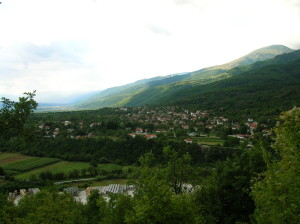
Vratnica was a village located in northwestern Macedonia at the border with Kosovo and Metohija. It had been part of Serbia after the First Balkan War in 1912. Before 1912, it had been part of the Turkish Ottoman Empire, the region known as Turkey in Europe. In 1915, it was occupied by Bulgarian troops during World War I. In 1918, it became part of the Kingdom of Serbs, Croats and Slovenes. In 1929, the name of the country was changed to Yugoslavia. Vratnica was made a part of the Vardar or Vardarska Banovina from 1929 to 1941. Vratnica was part of a region called Southern Serbia or Stara Srbija, Ancient or Old Serbia. Claims were made on the area by Serbia and Bulgaria who fought three wars over the region, in 1913, 1915, and 1941. After 1945, Vratnica was part of the Republic of Macedonia created by the new Communist regime under Josip Broz Tito. In 1992, Macedonia seceded from Yugoslavia. A dispute remains with Greece over the name of the country because there is a region in Greece called “Macedonia”. Greece, thus, objects to the use of the name. Internationally, the country is officially known as the Former Yugoslav Republic of Macedonia (FYRM).
During World War II, Vratnica was occupied by Bulgarian troops who seized large swaths of territory in Macedonia which were annexed. Albanian nationalists and separatists also seized Vratnica and incorporated the village and surrounding area into the Nazi-fascist Greater Albanian state for a brief period during World War II. During the 2001 Albanian insurgency, Vratnica was again attacked and besieged by Albanian separatists of the so-called National Liberation Army.
The U.S. Army Air Force launched its attack on Ploesti from bases in Bari, Italy. The Liberator crew that crashed in Vratnica was part of the 15th Air Force, 455th Bomber Group, 732 Bomber Squadron, based in Bari, Italy.
The captain of the bomber crew was 1st Lt. Edwin Carl Kieselbach of Ravenna, Oklahoma. The rest of the crew was made up of eight members: 2nd Lt. John T. Edwards, the co-pilot, from of Gleason, Tennessee, 1st Lt. Richard T. McCauley, the bombardier from Providence, Rhode Island, T/Sgt. Edward Ambrosini, the radio operator and gunner from Brooklyn, New York, Sgt. David C. Koblitz, the engineer and gunner from Erie, Kansas, S/Sgt. Willis C. Stephenson, the assistant radar operator and Ball Turret gunner from Topeka, Kansas, S/Sgt. Bruce B. Tuthill, the assistant engineer and gunner from Seaford, New York, S/Sgt Harold L. Viken, the armorer and nose gunner from Denver, Colorado, and S/Sgt William M. Rhodes, the tail gunner from Cray Court, South Carolina. Their aircraft was a Consolidated B-24 Liberator heavy bomber named “Our Love” with the Airframe designation #42-78240.
Their bombing objective on August 26, 1944 was a train depot marshaling yard in Bucharest, Romania from where oil was shipped. It was also a hub for troop movements and weapons transports. Four squadrons participated in the attack. Each squadron had up to nine bombers. The bomb payload was three tons for every plane.
Over the target, the Our Love Liberator crew was attacked by anti-aircraft. The plane was hit. One of the engines was damaged. This resulted in the plane losing speed and falling behind while the rest of the squadron headed for the Bari base. The bomber was now descending and vulnerable to attack by German fighter planes. Five German Messerschmitt ME 109 fighters attacked the plane with machine guns. The tail and waist gunners were hit. The co-pilot was also injured and died from his wounds.
As the plane flew lower, it sought to avoid the Shar Planina range of mountains by flying over valleys. This allowed anti-aircraft batteries to zero in on the plane. The captain ordered the crew to bail out. The bomber’s two vertical tail assembly rudders were struck which put the plane in a spin. The crew used the bomb bay door to jettison equipment and ammunition and to parachute out of the badly crippled plane.
The captain hit a tree but managed to land safely on the heavily wooded mountainside just over the village of Vratnica. He had suffered a shoulder injury. The turret gunner, however, was killed when he struck the mountain. Both Tuthill and Koblitz had been ejected from the plane and had died instantly on impact. The body of Koblitz was found in a tree still strapped in the harness.
Two Bulgarian soldiers spotted the captain hiding in the woods. He was able to shoot them and flee into the mountains.
Vratnica residents carrying shotguns and pitchforks located him. One of the Vratnica residents could speak English. He told the captain that he had lived in Detroit, Michigan. The captain recalled that Bulgarian and German troops soon arrived and took him prisoner. He was taken to the Bulgarian prison camp at Shumen in northeastern Bulgaria. With Russian troops advancing on Bulgaria, the guards fled, allowing the captain to escape. He managed to get to Greece, Turkey, Syria, and Cairo from where he was returned to the air base in Italy.
There were three survivors of the crash, Kieselbach, the captain, Richard McCauley, the bombardier, and Edward Ambrosini, the radar operator. The rest were killed. Vratnica residents were able to bury those who were killed in the village cemetery. From here they were moved to Belgrade and finally returned to the U.S.
On Wednesday, November 26, 2014, on the 70th anniversary of the crash, a memorial plaque was placed in the Vratnica cemetery to commemorate the crew. The U.S. Ambassador to Macedonia, Paul Wohlers, commended the residents of Vratnica at the unveiling:
“The residents of this small village risked their lives when they decided to bury the killed airmen and help the survivors. The United States of America and the families of the US pilots will be eternally grateful for what they did.
Today we honor the memory of those who perished in the fight for freedom and we honor the friendship between the people of Macedonia and the USA. The Americans and the residents of Vratnica were close friends and allies back in 1944 and the USA and Macedonia are even more so today.”
Bibliography:
Bassemir, June Tuthill, “A Case For Peace”. 2013. The More Stories Place.
Fields, Spencer. “Unearthing History. Discovery of fallen WWII bomber unleashes memories.” Cerignola Connection. Fall, 2014. 455th Bomb Group Association Newsletter, pp. 17-18. Reprinted from State Magazine, December, 2013.
Kieselbach, Captain Edwin C. “The Last Flight”. 2013. The More Stories Place.
We would like to ask you to consider a small donation to help our team keep working. We accept no advertising and rely only on you, our readers, to keep us digging the truth on history, global politics and international relations.
The American media specializes in fake news. Indeed, since the Clinton regime the American media has produced nothing but fake news. Do you remember the illegal US bombing and destruction of Yugoslavia? Do you remember “war criminal” Slobodan Milosevic, the Serbian president branded “the butcher of the Balkans,” who was compared to Hitler until Hillary passed the title on to the President of Russia? Milosevic, not Bill Clinton, was arrested and placed on trial at the International Criminal Tribunal. He died in prison, some say murdered, before he was cleared of charges by the International Criminal Tribunal. http://www.globalresearch.ca/milosevic-and-the-destruction-of-yugoslavia-unpleasant-truths-no-one-wants-to-know/5540873 Do you ...
While the typical narrative of American history positions the United States as a supporter of democracy and opponent of fascism which helped to defeat the Nazis, key figures in Washington also supported dangerous dictators in Italy and Germany in their early days of power.Noam Chomsky, the renowned political philosopher, historian and scholar, examined the flip side of U.S. opposition to dictatorship in a conversation with Zain Raza, a senior editor at the independent media outlet acTVism Munich. An excerpt from the conversation was published Sept. 30 as part of acTVism Munich’s “Reexamining History” series.Speaking to Raza about Italian dictator Benito ...
Part IEthnolinguistic SerbdomSerbia’s Prince Miloš’s schemes to solve the „Serbian Question“ were based exclusively on the historical (state) rights of the Serbs. However, during his reign, a new and cardinal dimension on an understanding of Serbian national identity and, therefore, the idea of the creation of the national state of the Serbs was introduced into Serbian political thought by Vuk Stefanović Karadžić (1787–1864) who framed the concept of a linguistic Serbdom.In his brief essay “Срби сви и свуда” (“Serbs All and Everywhere”),[1] V. S. Karadžić established the linguistic criteria for determining Serbian national self-identity and reformulation of the whole concept ...
“Fool me once, shame on you; but fool me twice, shame on me.”Ancient proverb, (sometimes attributed to an Italian, Russian or Chinese proverb) “Any intelligent fool can make things bigger, more complex, and more violent. It takes a touch of genius, and a lot of courage to move in the opposite direction.” Ernst F. Schumacher (1911-1977) (in ‘Small is Beautiful’, an essay, in The Radical Humanist, Aug. 1973, p. 22). “The powers-that-be understand that to create the appropriate atmosphere for war, it’s necessary to create within the general populace a hatred, fear or mistrust of others regardless of whether those others belong ...
The focal political aims of current anti-Serb propagandaThe current Serbophobic propaganda to abolish Republika Srpska (RS) and to create a unitary Bosnia-Herzegovina (a neo-Ottoman Muslim Bosnian province) is coming from the ranks of the Bosnian Muslim Party of Democratic Action (Stranka Demokratske Akcije - SDA) and its Western sponsors. The propaganda, however, coincides with the final phase of The Hague war crimes trial, following so-called "arrests"[1] and express deportations for the Netherlands by at that time pro-Western Serbian Government of former wartime commander of the Army of the Republika Srpska (Vojska Republike Srpske - VRS), General Ratko Mladic, and the ...
Origins of images: Facebook, Twitter, Wikimedia, Wikipedia, Flickr, Google, Imageinjection, Public Domain & Pinterest.Read our Disclaimer/Legal Statement!Donate to Support UsWe would like to ask you to consider a small donation to help our team keep working. We accept no advertising and rely only on you, our readers, to keep us digging the truth on history, global politics and international relations.
"If the American people ever find out what we have done, they would chase us down the street and lynch us" George H.W. Bush, 1992In early fall of 1976, after a Chilean government assassin had killed a Chilean dissident and an American woman with a car bomb in Washington, D.C., George H.W. Bush’s CIA leaked a false report clearing Chile’s military dictatorship and pointing the FBI in the wrong direction.The bogus CIA assessment, spread through Newsweek magazine and other U.S. media outlets, was planted despite CIA’s now admitted awareness at the time that Chile was participating in Operation Condor, a cross-border campaign ...
A strange spy affair broke out in Balkan Casablanca, aka Serbia, on Wednesday. Were NATO “advisers” and liaison personnel embedded in the Serbian army command finally caught red-handed by vigilant Serbian counter-intelligence operatives, purloining secrets? Not this time. (Something along those lines actually did happen in 2002; it was when former armed forces chief of staff Momcilo Perisic was caught on camera in a Belgrade restaurant handing over secret information for cash to CIA’s Johnny-on-the-spot, John Neighbor.) But what allegedly occurred this time was not a boring rerun of the Perisic affair, although the basic contours of the unimaginative scenario ...
The corporate media presents Russia as militaristic but ignores Canada’s invasion of that country.100 years ago today a popular revolt ousted the Russian monarchy. Enraged at Nicholas II’s brutality and the horror of World War I, protests and strikes swept the capital of Petrograd (Saint Petersburg). Within a week the czar abdicated. Later in the year the Bolsheviks rose to power in large part by committing to withdraw from the war.The English, French and US responded to the Bolshevik’s rise by supporting the Russian monarchists (the whites) in their fight to maintain power. Six thousand Canadian troops also invaded. According ...
At the dawn of the so-called Arab Spring in 2011, diplomats, politicians, and intellectuals debated a fresh question: what role can Islamist political parties play in a fledgling democracy?It wasn’t an esoteric or academic debating point. In the tumult that followed the collapse of dictatorial governments in Libya, Egypt, and Tunisia, groups of radical Islamists had organized themselves into political parties and attempting to use the ballot box to get them to where the cartridge box could never take them—control of national governments. This was a new strategy on the part of Islamists. Ever since their emergence in the 1940s and their ...
President Donald Trump Monday, April 3, 2017, welcomed the Egyptian military dictator, General Abdel Fattah el-Sisi, who assumed the title of Field Marshal after arresting and deposing the democratically elected President Mohamed Mursi in July 2013.After the meeting Trump told the press: “We agree on so many things. I just want to let everybody know, in case there was any doubt, that we are very much behind President el-Sisi. He’s done a fantastic job in a very difficult situation.”By “a fantastic job” Trump was apparently referring to the massacre of hundreds of innocent Egyptians in the aftermath of US-endorsed coup ...
General Draza Mihailovich with the people during WWII. Contrary to General Mihailovich, Communist leader "Marshall" Josip Broz Tito posses no one photograph with the people of Yugoslavia from the wartime In 1971, the movie Klopka za generala, A Trap for the General, was released in Yugoslavia directed by Miomir “Miki” Stamenkovic starring Rade Markovic, Ljuba Tadic, and Bekim Fehmiu. The screenplay was by Dragan Markovic and Luka Pavlovic. The film was produced by the Sarajevo-based company Bosna Film of Yugoslavia and featured a cast made up of Serbian, Bosnian Muslim, and Albanian Muslim actors. The film was released in Serbian ...
Up to June 1967, a border separated Jews living in Israel and Palestinians residing in the West Bank and Gaza. The Six Day War, which occurred exactly fifty years ago, erased that line. Israel has been occupying these territories ever since. This has been the source of an endless conflict between Jews and Arabs. Who started that war? Having won the war, Israel set out to give an answer to that question which would suit its needs.To cement its hold over the new territories Israel had sought to mold the story of the Six Day. The attempt to frame the ...
Author’s noteThe following article focussing on the jihadist terrorist insurgency in Macedonia was first published by antiwar.com in July 2001, barely two months before the September 11, 2001 attacks on the WTC and the Pentagon.Known and documented, since the Soviet-Afghan war, recruiting Mujahedin (“holy warriors”) to fight covert wars on Washington’s behest had become an integral part of US foreign policy. A report of the US Congress had revealed how the US administration – under advice from the National Security Council headed by Anthony Lake – had “helped turn Bosnia into a militant Islamic base” leading to the recruitment through ...
What is conflict about? The Zionist Israeli-Arab Palestinian conflict today is one of if not the most significant global security problems to be dealt with.[1] However, this conflict is historically not much old as it is a pretty modern issue, dating, in fact, since the First Zionist Congress in 1897. The focal question is: What is conflict about? In other words: What are those two different groups fighting for?At first glance, it can be understood that behind the conflict reasons is a confession as those two peoples are of different denominations: the Jews are predominantly Judaists while the Palestinian predominant confession ...
On October 12 the British media gave prominence to a three-hour foreign affairs debate that had taken place in the House of Commons the previous day. The Commons’ proceedings centred on allegations that Russia had committed war crimes in Syria and there were many insulting and purposefully offensive statements about Russia and its president made by almost all members of parliament who took part. The final speech was made by the foreign secretary, Boris Johnson, and can be taken as reflecting the policy of the British government towards Russia.The Guardian newspaper reported that “Making his frontbench debut as foreign secretary ...
During the 1973 Arab-Israeli War, Syrian forces had surprised Israel and were fast approaching the edge of the steep Golan Heights, captured by Israel during the 1967 war. It seemed as if Syrian armor and infantry would retake Golan, then pour down into Israeli Galilee.Soviet recon satellites observed Israel moving its nuclear-armed, 500km-range Jericho missiles out of protective caves and onto their launch pads. At the same time, Israel was seen loading nuclear bombs on their US-supplied F-4 fighter-bombers at Tel Nof airbase.Believing Israel was about to use nuclear weapons against Syria and Egypt, Moscow put huge pressure on both ...
Missing from corporate media accounts is what causes the Democratic People’s Republic of Korea (DPRK aka North Korea) to be singled out for opprobrium for what, essentially, is developing a deterrent against any entity that would attack it.A comparison with how the United Nations deals with North Korea vis-à-vis another member state state, Israel, is instructive.Israel occupies Palestinian territory; destroys Palestinian olive groves and poisons Palestinian sheep; sprays Palestinian homes with sewage; sabotages Palestinian water supplies; cuts off power to Palestine; terrorizes Palestinians for hours at checkpoints, including the sick, infirm, and pregnant women, some who are forced to give birth ...
One of the negative characteristics of the Israeli “Left” is how it terms the military rule over the West Bank and Gaza “The Occupation.” Part of the Left even accuses Palestinians who claim there is no difference between Petah Tikva and Ariel of being like the Right, because “that’s what the Israeli Right claims.” For most Palestinians, however, this exaggerated and Orwellian talk of “The Occupation” blurs Israel’s real shame, and the skeleton buried deep in the closet: The brutal and criminal occupation of 1948.Ethnic cleansing and massive land expropriation, and then settlement of that land, are the mother of ...
PrefaceIn order to appreciate the situation and events leading to the bloody destruction of the Socialist Federal Republic of Yugoslavia (the SFRY), or better to say Titoslavia, in 1991−1995 followed by the Kosovo War in 1998−1999 and NATO aggression on the Federal Republic of Yugoslavia (Serbia and Montenegro), it has to be made an overview of the general situation in the SFRY after the death of Josip Broz Tito (1892−1980).[1] It is assumed that the post-Tito’s leaders of Croatia (Franjo Tuđman), Bosnia-Herzegovina (Alija Izetbegović), and Serbia (Slobodan Milošević) who won elections in their republics in 1990 mostly personally contributed to ...