

Views: 1584
The latest issue of Foreign Policy magazine, one of the leading journals in its field, offers a two-page photo essay on “what to see, do, and buy” in Lviv, a picturesque city in the Western Ukraine. “Amid the turmoil that has rocked Ukraine over the past two years,” the article gushes, “Lviv has stood firmly as a stronghold of national culture, language, and identity.”
That’s one way of putting it. Another, less charitable way would be to note that Lviv has for nearly a century been a breeding ground of extreme Ukrainian nationalism, spawning terrorist movements, rabid anti-Semitism, and outright pro-Nazi political organizations that continue to pollute the country’s politics.
 On the lovely cobblestone streets admired today by tourists flowed the blood of some 4,000 Jews who were massacred by locals in 1941, during the German occupation. They were egged on by the radical Organization of Ukrainian Nationalists (OUN), whose founder and wartime leader is today a national hero to many of his countrymen.
On April 28, 2011, the 68th anniversary of the formation of a Ukrainian Waffen-SS division, hundreds of people marched through Lviv, with support from city council members, chanting slogans like “One race, one nation, one Fatherland!”
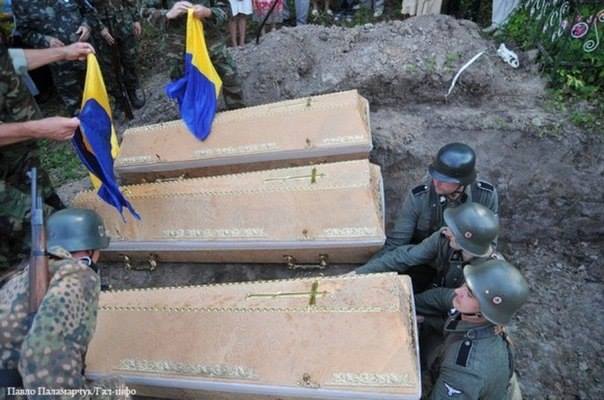
Two months later, residents celebrated the 70th anniversary of the German invasion “as a popular festival, where parents with small children waived flags to re-enactors in SS uniforms,” according to the noted Swedish-American historian Per Anders Rudling.
Later that year, extreme right-wing deputies at a nearby town in the Lviv district “renamed a street from the Soviet-era name Peace Street to instead carry the name of the Nachtigall [Nightingale] Battalion, a Ukrainian nationalist formation involved in the mass murder of Jews in 1941, arguing that ‘Peace’ is a holdover from Soviet stereotypes.’”
Such inconvenient truths rarely get aired in Western media, but they are important for at least two reasons. They help explain the recent violent, anti-democratic upheavals that have made Ukraine the battleground of a dangerous new cold war between NATO and Russia. And they should inspire Americans to reflect on our own country’s contribution to recent political extremism in the Ukraine — going back to the early post-World War II era, when the CIA funded former Nazi collaborators to help destabilize the Soviet Union.
The revolutionary, ultra-nationalist OUN was founded in 1929 to throw off Polish rule and establish Ukraine as an independent state. It burned the property of Polish landowners, raided government properties for funds, and assassinated dozens of intellectuals and officials, including the Polish interior minister in 1934.
A particularly radical faction, known as OUN-B, split off in 1940 under the leadership of the young firebrand Stepan Bandera, who studied in Lviv. It enjoyed support during World War II from a Gestapo-supported secret police official, Mykola Lebed. Lebed had earlier been convicted with Bandera by Polish authorities for the 1934 murder of their interior minister, and would become notorious for his involvement in the wartime torture and murder of Jews.
Bandera’s OUN-B collaborated closely with the German foreign intelligence service, the Abwehr, to form a German-led Ukrainian Legion. On June 30, 1941, just days after Hitler’s invasion of the USSR, OUN-B declared an independent Ukrainian state with Lviv as its capital. Lebed served as police minister of the collaborationist government.
In the days that followed, OUN-B’s Nachtigall Battalion and its civilian sympathizers apparently slaughtered several thousand Jews and Polish intellectuals before moving on to join German forces on the Eastern Front. Another 3,000 Jews in Lviv were soon murdered by an SS death squad outside the city. OUN publications called these “exhilarating days.”
Although the OUN, in a letter to Adolf Hitler, officially welcomed the “consolidation of the new ethnic order in Eastern Europe” and the “destruction of the seditious Jewish-Bolshevik influence,” the Nazi leader rejected their nationalist ambitions and eventually banned the OUN.
The Germans imprisoned Bandera. His organization went underground, forming the Ukrainian Insurgent Army (UPA). There were no neat sides in the violent conflict that ensued. UPA units clashed with the Nazis on occasion, fought the Red Army much more often, and engaged in “ethnic cleansing” of thousands of Poles and Jews. (More rarely, OUN members saved local Jews as well.)
They also killed tens of thousands of fellow Ukrainians in a bid to dictate the region’s political future. Many OUN members also directly joined police and militia groups sponsored by the Waffen-SS. Bandera himself was released by the Germans in 1944 and provided with arms to resist the advancing Red Army.
After the war, the OUN continued its losing battle for independence. Soviet forces killed, arrested, or deported several hundred thousand members, relatives or supporters of the UPA and OUN. Bandera was assassinated by the KGB in Munich in 1959. But right-wing nationalism enjoyed a resurgence after Ukraine won its independence in 1990-91, stoked by emigrés in the West who were loyal to OUN-B and to Bandera’s memory.
The city of Lviv in particular led the revival of Bandera worship. In 2006 it transferred his tomb to a special area of the town’s cemetery dedicated to victims of Ukraine’s national liberation struggles. It erected a statue dedicated to him and established an award in his honor.
Finally, in 2010, Ukraine’s president, Viktor Yushchenko (who came to power in the U.S.-backed Orange Revolution), named Bandera a Hero of Ukraine for “defending national ideas and battling for an independent Ukrainian state.” The Simon Wiesenthal Center and other anti-fascist groups condemned the honor, which was annulled a year later by a Ukrainian court.
One of Bandera’s legacies was the creation of the ultra-nationalist Social National Party in Lviv in 1991.
“As party symbol, it chose a mirror image of the so-called Wolfsangel, or Wolf’s hook, which was used by several SS divisions and, after the war, by neo-Nazi organizations,” notes Rudling. “It organized a paramilitary guard and recruited skinheads and football hooligans into its ranks.”
In 2004 it rebranded itself as Svoboda and dispensed with its SS imagery. Nonetheless, Svoboda’s new leader lauded the OUN and UPA for having resisted “Jews and other scum, who wanted to take away our Ukrainian state.” He was decorated by veterans of a Ukrainian Waffen-SS division and championed the cause of Ukrainian death camp guard Ivan Demjanjuk. His ideological adviser organized a think tank called the “Joseph Goebbels Political Research Center” in 2005.
Svoboda became the largest party in Lviv in 2010 and today enjoys strong influence at the national level. It has also extended its influence by allying itself with other far-right and fascist parties in Europe.
Most important for understanding today’s East-West crisis, Svoboda supplied many of the shock troops who turned the protests in Kiev’s Maidan Square into a violent confrontation with government forces and eventually precipitated the putsch against President Viktor Yanukovych in early 2014. Svoboda leaders took important posts in the post-Yanukovych government, including the head of national security.
 Svoboda militants from Lviv played an important role in the violent putsch. In a story for Consortiumnews.com, journalist Robert Parry cited a “human interest profile” in the New York Times of a Ukrainian protestor named Yuri Marchuk, a Svoboda leader from Lviv who was wounded at Maidan Square. Parry continued,
“Without providing . . . context, the Times does mention that Lviv militants plundered a government weapons depot and dispatched 600 militants a day to do battle in Kiev. Marchuk also described how these well-organized militants, consisting of paramilitary brigades of 100 fighters each, launched the fateful attack against the police on Feb. 20, the battle where Marchuk was wounded and where the death toll suddenly spiked into scores of protesters and about a dozen police.
“Marchuk later said he visited his comrades at the occupied City Hall. What the Times doesn’t mention is that City Hall was festooned with Nazi banners and even a Confederate battle flag as a tribute to white supremacy.”
Svoboda’s cause was championed during the Maidan protests by Republican Sen. John McCain of Arizona, who egged on the crowds while standing under banners celebrating Stepan Bandera. McCain’s appearance was no accident. Since World War II, the Republican Party has been closely allied with pro-Nazi exile leaders from Eastern Europe. Many of them were recruited and paid by the CIA — and given secret legal exemptions to emigrate to the United States despite their history of war crimes.
For example, the OUN-B Gestapo collaborator and mass murderer Mykola Lebed made his way incognito to the United States after World War II. The CIA, which valued his help in organizing resistance movements against the USSR, exercised its veto power over anti-Nazi immigration laws to legalize his residence.
The CIA provided similar assistance to General Pavlo Shandruk, described by historian Christopher Simpson as “the chief of the Ukrainian quisling ‘government-in-exile’ created by the Nazi Rosenberg ministry in 1944.” Despite his pro-Nazi past, he received large CIA stipends to help organize intelligence networks against the Soviet Union after the war.
The CIA and Pentagon also earmarked millions of dollars’ worth of arms and other military aid to anti-Soviet Ukrainian guerrillas in the late 1940s, despite their record of atrocities against Jews and other civilians.
As Simpson concludes in his 1988 book Blowback, “In hindsight, it is clear that the Ukrainian guerrilla option became the prototype for hundreds of CIA operations worldwide that have attempted to exploit indigenous discontent in order to make political gains for the United States. …
“Instead of rallying to the new ‘democratic’ movement, there is every indication that many of the ordinary people of the Ukraine gave increased credence to the Soviet government’s message that the United States, too, was really Nazi at heart and capable of using any sort of deceit and violence to achieve its ends.”
Simpson also observes that CIA assistance to pro-Nazi Ukrainian and other East European ethnic leaders created powerful political lobbies in the United States that backed hard-line “liberationist” policies toward the Soviet Union and its “captive nations.” One such political group was the Ukrainian-dominated, neo-Nazi Anti-Bolshevik Bloc of Nations, which enjoyed support from Sen. Joseph McCarthy, among many other U.S. politicians.
“Before the decade of the 1950s was out,” Simpson writes, “the activities of extremist European emigre organizations combined with indigenous American anticommunism to produce seriously negative effects on U.S. foreign policy and domestic affairs under both Republican and Democratic administrations. …
“U.S. clandestine operations employing Nazis never did produce the results that were desired when they were initiated, but they did contribute to the influence of some of the most reactionary trends in American political life. … Working together with corporate-financed lobbies such as the pro-armament American Security Council, Captive Nations leaders have acted as influential spoilers capable of obstructing important East-West peace initiatives undertaken by both Republican and Democratic administrations. They continue, in fact, to play that role today.”
Simpson offered that powerful observation before the latest crisis in the Ukraine — precipitated in large measure by extreme rightists inspired by the OUN — plunged NATO and Russia into a series of military and economic confrontations that resemble the Cold War of old. But even today, the American political impulse to support anti-Russian agitation in the Ukraine reflects Cold War-era policies that forged an ugly alliance between the United States and Nazi mass murderers.
You won’t see that point made in the New York Times, or in a fluffy promotion for Lviv in Foreign Policy magazine. But it’s clearly written in history that Americans would do well to study.

Originally published on 2016-01-28
About the author: Jonathan Marshall is an independent researcher living in San Anselmo, California. Some of his previous articles for Consortiumnews were “Risky Blowback from Russian Sanctions”; “Neocons Want Regime Change in Iran”; “Saudi Cash Wins France’s Favor”; “The Saudis’ Hurt Feelings”; “Saudi Arabia’s Nuclear Bluster”; “The US Hand in the Syrian Mess”; and “Hidden Origins of Syria’s Civil War.”
Source: Consortium News
Origins of images: Facebook, Twitter, Wikimedia, Wikipedia, Flickr, Google, Imageinjection, Public Domain & Pinterest.
Read our Disclaimer/Legal Statement!
Donate to Support Us
We would like to ask you to consider a small donation to help our team keep working. We accept no advertising and rely only on you, our readers, to keep us digging the truth on history, global politics and international relations.
[wpedon id=”4696″ align=”left”]

FOLLOW US ON OUR SOCIAL PLATFORMS