
An article originally published by The Guardian, UK on March 14th, 2003. Tributes to Zoran Djindjic, the assassinated prime minister of Serbia, have been pouring in. President Bush led the way, praising his “strong leadership”, while the Canadian government’s spokesman extolled a “heralder of democracy” and Tony Blair spoke of the energy Djindjic had devoted to “reforming Serbia” […]
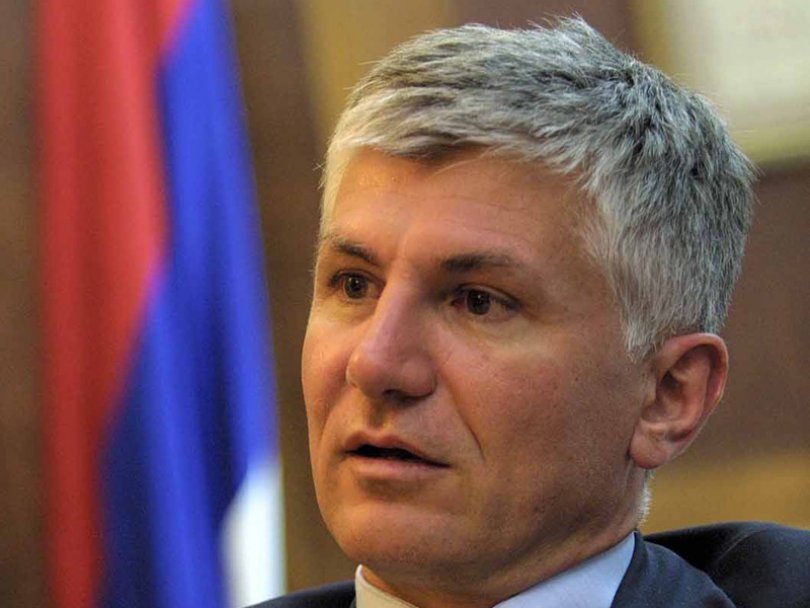
09.03.2001, Berlin, Berlin, Germany – Zoran Djindjic, serbischer Ministerpraesident der Bundesrepublik Jugoslawien. 00M112016CARO.JPG GT, Image: 141207614, License: Rights-managed, Restrictions: , Model Release: no, Credit line: Profimedia, Alamy
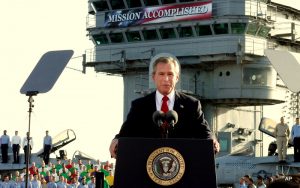
Tributes to Zoran Djindjic, the assassinated prime minister of Serbia, have been pouring in. President Bush led the way, praising his “strong leadership”, while the Canadian government’s spokesman extolled a “heralder of democracy” and Tony Blair spoke of the energy Djindjic had devoted to “reforming Serbia”.
In western newspaper obituaries Djindjic has been almost universally acclaimed as an ex-student agititator who bravely led a popular uprising against a tyrannical dictator and endeavoured to steer his country into a new democratic era.
But beyond the CNN version of world history, the career of Zoran Djindjic looks rather different. Those who rail against the doctrine of regime change should remember that Iraq is far from being the first country where the US and other western governments have tried to engineer the removal of a government that did not suit their strategic interests. Three years ago it was the turn of Slobodan Milosevic’s Yugoslavia.
In his recent biography of Milosevic, Adam LeBor reveals how the US poured $70m into the coffers of the Serb opposition in its efforts to oust the Yugoslav leader in 2000. On the orders of Secretary of State Madeleine Albright, a covert US Office of Yugoslav Affairs was set up to help organise the uprising that would sweep the autocratic Milosevic from power.
At the same time, there is evidence that underworld groups, controlled by Zoran Djindjic and linked to US intelligence, carried out a series of assassinations of key supporters of the Milosevic regime, including Defence Minister Pavle Bulatovic and Zika Petrovic, head of Yugoslav Airlines.
With Slobo and his socialist party finally toppled, the US got the “reforming” government in Belgrade it desired. The new President Vojislav Kostunica received the bouquets, but it was the State Department’s man, Zoran Djindjic, who held the levers of power – and he certainly did not let his Washington sponsors down.
The first priority was to embark on a programme of “economic reform” – new-world-order-speak for the selling of state assets at knockdown prices to western multinationals. Over 700,000 Yugoslav enterprises remained in social ownership and most were still controlled by employee-management committees, with only 5% of capital privately owned. Companies could only be sold if 60% of the shares were allocated to workers.
Djindjic moved swiftly to change the law and the great sell-off could now begin. After two years in which thousands of socially owned enterprises have been sold (many to companies from countries which took part in the 1999 bombing of Yugoslavia), last month’s World Bank report was lavish in its praise of the Djindjic government and its “engagement of international banks in the privatisation process”.
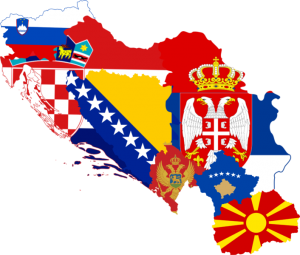
But it wasn’t just state assets that Djindjic was under orders to sell. Milosevic had to go too, for a promised $100m, even if it effectively meant kidnapping him in contravention of Yugoslav law, and sending him by RAF jet to a US-financed show trial at the Hague. When a man has sold his country’s assets, its ex-president and his main political rivals, what else is there to sell? Only the country itself. And in January this year Djindjic did just that. Despite the opposition of most of its citizens, the “heralder of democracy” followed the requirements of the “international community” and after 74 years the name of Yugoslavia disappeared off the political map. The strategic goal of its replacement with a series of weak and divided protectorates had finally been achieved.
Sometimes, though, even the best executed plans go awry. Despite the western eulogies, Djindjic will be mourned by few in Serbia. For the great majority of Serbs, he will be remembered as a quisling who enriched himself by selling his country to those who had waged war against it so mercilessly only a few years earlier. Djindjic’s much lauded reforms have led to soaring utility prices, unemployment has risen sharply to over 30%, real wages have fallen by up to 20% and over two-thirds of Serbs now live below the poverty line.
It is still unclear who fired the shots that killed Zoran Djindjic. The likelihood is that it was an underworld operation, his links to organised crime finally catching up with him. But, harsh though it sounds, there are many in Serbia who would willingly have pulled the trigger. On a recent visit to Belgrade, I was struck not only by the level of economic hardship, but by the hatred almost everyone I met felt towards their prime minister, whose poll ratings had fallen below 10%.
The lesson from Serbia for today’s serial regime changers is a simple one. You can try to subjugate a people by sanctions, subversion and bombs. You can, if you wish, overthrow governments you dislike and seek to impose your will by installing a Hamid Karzai, General Tommy Franks or a Zoran Djindjic to act as imperial consul. But do not imagine that you can then force a humiliated people to pay homage to them.
About the author: Neil Clark is writing a book about the recent history of Yugoslavia.
We would like to ask you to consider a small donation to help our team keep working. We accept no advertising and rely only on you, our readers, to keep us digging the truth on history, global politics, and international relations.
Seventeen years have passed and many people have already forgotten that the U. S. and a number of other NATO countries collectively waged one of the most destructive wars on the European continent since the end of World War II–the modern aerial bombing campaign against the Serbian people. In the tradition of the New World Order, this “intervention” wasn’t called “war.” It was argued by various Western politicians and the corporate media that the bombing campaign was directed against the late Serbian President Milošević and his “propaganda machine.”[i] In fact, the NATO bombs loaded with depleted uranium[ii] were falling on ...
The real question is not whether the status of Kosovo and Metohija should be negotiated; the actual questions to be asked are: On which basis? About what? Whom with?The sole legitimate basis is that Kosovo and Metohija is an integral part of Serbia currently placed under UN mandate, pending a Security Council decision ending it. In other words, this is mandate cannot be terminated either by the EU, or NATO, the USA, Germany, or France and, should this idea ever occurred to anyone, Serbia cannot end it, either.International law (the UN Charter, the OSCE Final Act) and the Constitution of ...
Prisoners earning 23 cents an hour in U.S. federal prisons are manufacturing high-tech electronic components for Patriot Advanced Capability 3 missiles, launchers for TOW (Tube-launched, Optically tracked, Wire-guided) anti-tank missiles, and other guided missile systems. A March article by journalist and financial researcher Justin Rohrlich of World in Review is worth a closer look at the full implications of this ominous development. (minyanville.com)The expanding use of prison industries, which pay slave wages, as a way to increase profits for giant military corporations, is a frontal attack on the rights of all workers.Prison labor — with no union protection, overtime pay, ...
The details are supplied in an exhaustive 1,000-page biography of Jean Monnet by Éric Roussel, which was published only in France in 1996, and which seems to have been successfully suppressed. It has never been translated, and has no reviews even at Amazon. However, Ambrose Evans-Pritchard of UK's Telegraph newspaper has provided some of the core information from it. Furthermore, Richard J. Aldrich's 2003 The Hidden Hand also provides key details, such as by Aldrich's saying, on page 366, about the American Committee for a United Europe: ACUE, more than any other American front organization of the Cold War, was a ...
How can it be that in virtually all of the Presidential-candidate head-to-head Democratic versus Republican polling that was done of both Democratic and Republican candidates during the primaries, the preferred Democratic candidate against any one of the Republican candidates was Bernie Sanders, but he almost certainly won’t be that Party’s nominee (and there’s more on that here); and the preferred Republican candidate against either one of the Democratic candidates was John Kasich, but he certainly won’t be the Republican nominee?Sanders and Kasich also scored the highest in his respective Party for net favorability rating, but almost certainly neither candidate will ...
With a general election looming in the United Kingdom and Spain possibly following Greece’s revolt against austerity later this year, we need to think, not just who or what we are voting for, but why we should vote at all.People are suffering from a deficiency which is as unbalancing as a hormone or vitamin deficiency. What we are severely lacking in is democracy. Many of those pondering on the state of politics feel unhappy and somehow depleted. They haven’t yet realised it is democracy that’s lacking because they have believed what so many politicians have told them, over and over ...
The recent arrest of 40 alleged Islamic radicals in Kosovo together with the arrest of one of the Kosovo Imams suspected of being an inspirer of jihad in the region brought serious questions about the radicalisation of Islam and terrorism in Kosovo, in the Balkans and in Europe. Even though the issue of Kosovo Albanian volunteers or mercenaries fighting alongside the anti-Bashar forces in Syria and supporting the radical leadership of the Islamic State (earlier the Islamic State of Iraq and Syria) has been present in the public debate in Kosovo for at least a year, the debate itself was ...
Daniel Goldhagen blamed the Holocaust on «the Germans» (by which he meant the German people), and said that they perpetrated the Holocaust because they positively enjoyed murdering «the Jews». But, as has long been well understood by historians (except when they fail to point to it as being a disproof of Goldhagen’s bigoted and indefensible anti-German thesis), Hitler had to work long and hard in order to bring about a consensus, first amongst his own leadership group, and then in the population as a whole, favoring the extermination-option. Hitler, Der Fuehrer, «The Leader», clearly was the catalyst turning the chemical ...
PrefaceIt is the 30th anniversary of the first post-WWII democratic elections in Serbia and the rest of the ex-Yugoslavia.My aim in this article is to elaborate on the feature of the multi-party elections in Serbia in 1990 and to give an answer to the crucial question why did Slobodan Miloshevic with his SPS party win? After the investigation of the case we found that critical reasons for Miloshevic’s/SPS absolute electoral parliamentary and presidential victory in 1990 have been: 1) The countryside and small urban settlements voted for SPS due to the informative blockade; 2) Old population voted for SPS; 3) ...
The grossest thing in American society is the reactionary sentimentality that fill our gossip infected hearts with a chemical reaction every time one of our supposed war heroes moves on to a more peaceful place. The carefully rehearsed statements from useless political figures numb our minds as all those who are sane must collectively wonder what on earth has a fusty bag of bones like John McCain ever done for us? Donald Trump was once new to the political scene and was still capable of burning bridges that were worth burning. It was Mr. Trump’s finest moment when he said ...
Serbs: Basic factsEthnic location: Central and western part of the Balkan Peninsula (South-East Europe)Population: 10.2 million (1.8 million Serbs live outside their ethnic location)Language: SerbianReligion: Eastern Orthodox Christians1 Introduction Serbs belong to the Southslavonic group of Indo-European peoples. As their tradition, culture, language, beliefs, and customs show, the ethnogenesis of Serbs goes far back into the past. Serbian ancestors, Protoslavs and Old Serbs, were described in the 5th century BC by Herodotus, under the names of Neuri and Budini, living north of the Danube in the region between Dniepar and north-eastern Carpathian Mountains.The first mention of the name “Serbs” appears ...
How many times have we seen this before?The President of the United States is on TV telling us horror stories. Some innocent people in some corner of the world are being crushed, he tells us. They face some monstrously evil oppressor, he says. While the United States doesn’t like war, what choice is there? Sacrifices must be made, cruise missiles must be unleashed, to protect the poor and innocent. The world is the set of an action movie, and the US is the tragic hero, forced to rescue the innocent.This is the script we heard in former Yugoslavia. Bill Clinton ...
Russian President Vladimir Putin put it succinctly when he recently warned that prospects for peace in Ukraine were negligible as long as the current authorities in Kiev remain in power. Worse, given a new rash of provocations by the Kiev regime, the entire region is being threatened with conflict, and even all-out war.It seems clear – and criminally reprehensible – that the Kiev regime and its President Petro Poroshenko are intent on dragging the United States and the NATO military alliance into a war with Russia. The incendiary conduct of Ukrainian politicians and their military is that of a regime ...
SaveSaveOrigins of images: Facebook, Twitter, Wikimedia, Wikipedia, Flickr, Google, Imageinjection, Public Domain & Pinterest.Read our Disclaimer/Legal Statement!Donate to Support UsWe would like to ask you to consider a small donation to help our team keep working. We accept no advertising and rely only on you, our readers, to keep us digging the truth on history, global politics and international relations.[wpedon id="4696" align="left"]
For even the greatest of empires, geography is often destiny. You wouldn’t know it in Washington, though. America’s political, national security, and foreign policy elites continue to ignore the basics of geopolitics that have shaped the fate of world empires for the past 500 years. Consequently, they have missed the significance of the rapid global changes in Eurasia that are in the process of undermining the grand strategy for world dominion that Washington has pursued these past seven decades.A glance at what passes for insider “wisdom” in Washington these days reveals a worldview of stunning insularity. Take Harvard political scientist ...
While the numbers are not as high as Auschwitz or Treblinka, Jasenovac was notorious for its cruelty and the high number of young children who were victims.April 22 is a date that binds two groups of people who shared the same tragic fate. It is the date that commemorates the revolt of the prisoners of Jasenovac, the death camp that claimed the lives of hundreds of thousands of Jews, Serbs and Roma.While the numbers are not as high as Auschwitz or Treblinka, Jasenovac was notorious for its cruelty and the high number of young children who were victims. The saddest ...
A former U.S. President Bill Clinton's: Past, Present, Future:Origins of images: Facebook, Twitter, Wikimedia, Wikipedia, Flickr, Google, Imageinjection, Public Domain & Pinterest.Read our Disclaimer/Legal Statement!Donate to Support UsWe would like to ask you to consider a small donation to help our team keep working. We accept no advertising and rely only on you, our readers, to keep us digging the truth on history, global politics and international relations.[wpedon id="4696" align="left"]
As the contemporary Corona virus hysteria narrative continues to collapse (here and here) another dubious narrative, launched a quarter of a century ago – Srebrenica genocide – comes to mind. The common thread of both narratives is that they have just enough genuine elements to provide a seemingly plausible foundation for a vastly exaggerated tale. The Covid-19 virus can endanger health, and even be lethal, to certain classes of the population, but how much more than that is it? In Srebrenica in July of 1995, about a thousand Muslim prisoners were executed by a rogue outfit of the Serb army. ...
2006-Present07 February 2018: Israel advances a plan to build a walkway though the Mount of Olives in East Jerusalem to connect two settler residential compounds in the Palestinian At-Tur neighbourhood07 February 2018: During a Knesset report on the policy of refusing to return the bodies of Palestinians killed by Israeli forces to their families for burial, officials are urged to ‘throw it into the sea’, ‘we should not return bodies. We should demolish homes’, others say05 February 2018: A number of Israeli politicians, including coalition government members, call for ‘practical moves’ to be taken to annex settlements in the occupied West Bank while Donald ...
I won’t ever forget hearing the news – working in Pittsburgh as a marketing analyst, returning from lunch with colleagues when it was announced.November 22, 1963, was a Friday. The working day ended once the news broke, everyone in my department stunned, unable to focus on anything else.It was too early to know what evidence later revealed. Lee Harvey Oswald was a convenient patsy, uninvolved in what happened, a state-sponsored assassination, CIA, and secret service dirty hands likely responsible.Killing him mattered. Things might have been different had he lived, at least for a time. November 22, 1963, remains a stain ...