

Views: 357040

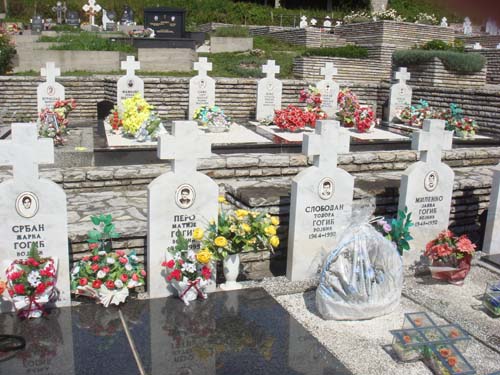
Last month was the 18th anniversary of the attack on the Serbian village of Kravica committed by Moslem forces from Srebrenica under the command of Naser Orić on Orthodox Christmas day, January 7, 1993. Several dozen villagers were killed in the attack, the remaining Serbian population was forced to flee to safety, and many homes were pillaged, demolished and torched during the several weeks that Kravica was forcibly occupied by neighbours from nearby Srebrenica. Regardless of arcane debates of who started the war in Bosnia and Herzegovina, on a human level the attack on the village of Kravica and the ensuing slaughter and expulsion of its inhabitants was a crime, just as the firebombing of Dresden and the slaughter of that city’s citizens, without any apparent military purpose and at the very end of World War II, was also a crime.
The position taken by many Western institutions and even human rights monitoring organisations toward the destruction of Kravica says a great deal about their honesty and helps to put in perspective the Serbian public’s unyielding skepticism about Western even-handedness. We shall use the anniversary of Kravica to cite a few examples.
[1] On the occasion of the acquittal of Naser Orić, the Srebrenica Moslem warlord, in 2006, Human Rights Watch [HRW],[1] had also some comments to make concerning Kravica. This is what HRW said about Kravica in its statement published on 11 July, 2006:
“The ultra-nationalist Serbian Radical Party launched an aggressive campaign to prove that Muslims had committed crimes against thousands of Serbs in the area. The campaign was intended to diminish the significance of the July 1995 crime, and many in Serbia were willing to accept that version of history.
But as the Oric judgment makes clear, the facts do not support the equivalence thesis. Take the events in the village of Kravica, on the Serb Orthodox Christmas on January 7, 1993, for example. The alleged killing of scores of Serbs and destruction of their houses in the village is frequently cited in Serbia as the key example of the heinous crimes committed by the Muslim forces around Srebrenica. In fact, the Oric judgment confirms that there were Bosnian Serb military forces present in the village at the time of attack.”[2]
One is tempted to ask: What does HRW see as its essential task? Is it to focus attention on human rights violations or to haggle about them? The presence of Bosnian Serb military forces in the village Kravica (even if true, that hardly would be a surprise or require excuses given the preceding seven-month campaign of destruction and slaughter by Moslem forces from Srebrenica against the surrounding Serbian villages) does not relieve Human Right Watch of the obligation to address the fate of Kravica’s civilian inhabitants during the Christmas Day attack and to hold the perpetrators “accountable for their crimes,” exactly as its Mission Statement promises that it would.
[2] Unfortunately, the United Nations were scarcely more forthright in dealing with the general issue of attacks on Serbian villages from Srebrenica. In UN Secretary-General’s 1999 report on the “Fall of Srebrenica” we read the following:
“The Serbs repeatedly exaggerated the extent of the raids out of Srebrenica as a pretext for the prosecution of a central war aim: to create geographically contiguous and ethnically pure territory along the Drina, while freeing their troops to fight in other parts of the country.”[3]
But as with the HRW comment, this analysis begs the question. Even if the speculation about Serbian war aims were correct, as an organisation endowed with a humanitarian and peacekeeping mission the UN is obliged to take a clear stand on the murder and mistreatment of civilians, because under international law they continue to enjoy protection even if they happen to be ethnically affiliated with the “wrong“ side. Even if we grant, for the sake of argument that the extent of Moslem army raids from Srebrenica was “exaggerated,” something must have happened to begin with in order to be exaggerated. Has the UN anything morally relevant to say about the factual core of these “exaggerated” Serbian reports? Do the innocent human casualties that they refer to matter, once conscientious UN investigators have stripped the “exaggerated” reports of their hyperbole and reduced them to a more credible level? Apparently not.
[3] The judgment that was rendered by the International Criminal Tribunal for the Former Yugoslavia at The Hague in the Naser Orić case, where the attack on Kravica played a prominent role, was also very discouraging to the Serbian public as a means of building trust in the conclusions of international institutions. With regard to the Kravica attack, its background, and consequences, the ICTY chamber issued the following surrealistic findings:
“The fighting intensified in December 1992 and the beginning of January 1993, when Bosnian Muslims were attacked by Bosnian Serbs primarily from the direction of Kravica and Ježestica. In the early morning of the 7 January 1993, Orthodox Christmas day, Bosnian Muslims attacked Kravica, Ježestica and Šiljkovići. [par. 662] Convincing evidence suggests that the village guards were backed by the VRS [Bosnian Serb Army], and following the fighting in the summer of 1992, they received military support, including weapons and training. A considerable amount of weapons and ammunition was kept in Kravica and Šiljkovići. Moreover, there is evidence that besides the village guards, there was Serb and Bosnian Serb military presence in the area. [par. 664,665] The Trial Chamber is not satisfied that [the destruction of homes in the village] can be attributed solely to Bosnian Muslims. The evidence is unclear as to the number of houses destroyed by Bosnian Muslims as opposed to those destroyed by Bosnian Serbs. In light of this uncertainty, the Trial Chamber concludes that the destruction of property in Kravica between 7 and 8 January 1993 does not fulfill the elements of wanton destruction of cities, towns or villages not justified by military necessity. [par. 671]”[4]
Setting aside the chamber’s professed dilemma about the extent of destruction that Bosnian Serbs might have inflicted on their own village, and its consequent inability to lay the charge of “wanton destruction” of Kravica at the door of the Moslem attackers from Srebrenica, it is evident that the chamber views with disfavor the fact that weapons and ammunition were kept in the village and that there was “Serb and Bosnian Serb military presence in the area.” Would leaving the village utterly disarmed and defenceless have pleased the chamber more and helped it to conclude that, after all, Kravica was devastated in contravention of the laws and customs of war and without a semblance of military necessity?
But more to the point: Are Serb civilian victims of Kravica, however few or many, of any concern to the chamber at all?
[4] It is, of course, technically true that a court cannot in its deliberations exceed the scope of the indictment and that its findings are confined to the evidence that is offered to it in the course of trial. But that is also a huge reason why a verdict convenient to Naser Orić was a foregone certainty even before the opening of his trial. Orić was charged with but a small and relatively insignificant fraction of his actual crimes. It is as if Hitler had been arrested in 1945 and put on trial in Nuremberg on the charge of traffic violations. It should have been expected that under the circumstances he would have been acquitted or merely fined with a suspended sentence. That was essentially the verdict that was read out to Naser Orić.
Trivialising the indictment was one efficient method that the prosecution used to ensure that the result would be maximally indulgent to Orić, thus avoiding the embarrassing prospect of a comparative scrutiny of both sides’ Srebrenica crimes. The other, equally efficient method of making inconvenient facts disappear, was to define Serbian Srebrenica victims (in this specific instance in Kravica) away.

The way that system works was described in ample detail and with salutary candour by long-time ICTY Prosecution porte-parole, Florence Hartman in one of her weekly press briefings:[5]
“First of all, the OTP is always very careful in the use of the word ‘victim’. Military or Police casualties from combat should not be considered victims in a criminal investigation context, in the same way people are victims from war crimes, such as summary executions.”
Fair enough, that is an accurate summary of the applicable principles. She then goes on to erect a straw man:
“Before speaking about the whole area of Podrinja, including at least the municipalities of Srebrenica, Bratunac, Vlasenica and Skelani, I would comment on the various figures circulating around the Kravica attack of January 1993. The figures circulating of hundreds of victims or claiming that all 353 inhabitants were ‘virtually completely destroyed’ do not reflect the reality.”
There is of course no expectation that the Prosecution would charge Orić, or anyone else, with crimes that are not based on realistic figures. So what would be a realistic number for Kravica victims?
“During the attack by the BH army on Kravica, Jezestica, Opravdici, Mandici and the surrounding villages (the larger area of Kravica), on the 7th & 8th January 1993, 43 people were killed, according to our information. Our investigation shows that 13 of the 43 were obviously civilians. Our findings are matching with the Bratunac Brigade military reports of battle casualties which are believed in the OTP to be very reliable because they are internal VRS reports.”
But even conceding that the actual number of Serbian Kravica victims can be whittled down to 13, that is still a war crime and someone must still be held accountable for their death. It is the job of ICTY Prosecution to see to it that this happens. What is the purpose of conducting a trial if in the end responsibility is not imputed to anyone at all? But that precisely is what happened at ICTY.
“For the whole region,” Ms. Hartman went on in her briefing, “i.e the municipalities of Srebrenica, Bratunac, Vlasenica and Skelani, the Serb authorities claimed previously that about 1400 people were killed due to attacks committed by the BH Army forces for the period of May 1992 to March 1995, when Srebrenica was under the control of Naser Oric. Now the figure has become 3,500 Serbs killed. This figure may have been inflated. Taking the term ‘victims’ as defined previously, these figures just do not reflect the reality.”
It goes without saying that both victims and perpetrators on all sides need to be identified with meticulous precision and great care. It is indeed a point well taken in Ms. Hartman’s remarks that a careful eye should be kept out for “inflated” numbers. Some exuberant figures certainly need to be dismissed, but that should not apply only to figures proposed by Serbs. The figure of 8,000 executed prisoners claimed by Moslems, asserted by the Prosecution, and adjudicated without proper evidence by ICTY chambers, also must be carefully re-examined in order to determine how consistently it “reflects the reality”. To decline to do so would be an exercise in gross hypocrisy.
 This brief survey should make it clear, using the example of the razed and decimated Serbian village of Kravica that, on the international level, the treatment of Serbian victims, even when by perfidious haggling their numbers are diminished to the barest minimum, still amounts to a parody of justice. It is a situation which paraphrased Orwell still encapsulates the best: Some victims are more (in this case apparently less) equal than others.
The hypocritical arguments of Western “jurists” and humanitarians which aim to rationalize the systematic trivialization of Serbian victims of Kravica are sufficient to shock any normal conscience. But for the dimensions of their insolence to be unmistakably clear it is worth studying this document which contains the report of General Rasim Delić, BiH army chief of staff during the war. Delić says very clearly (p. 3) that BiH authorities had managed to deliver about 23 tons of arms to “demilitarized” Srebrenica and (p. 4) he gives a breakdown of these illegal shipments by category. If a few shotguns in Kravica justify the slaughter that was visited upon the villagers in January of 1993, then following the same logic what are we to say about this dramatic post festum admission in relation to the events of July of 1995?
This document was hardly unknown to the Hague Tribunal. It is in fact in its electronic database, number 01854595.
SKUP_TINA RBIH – VOJNI IZVJE_TAJ O RAZLOZIMA PADA SREBRENICE
____________________
References:
[1] It describes itself as “one of the world’s leading independent organizations dedicated to defending and protecting human rights. By focusing international attention where human rights are violated, we give voice to the oppressed and hold oppressors accountable for their crimes.” http://www.hrw.org/en/about
[2] http://www.scribd.com/doc/31231969/Naser-Oric-Srebrenica-Genocide-and-Serbian-Lies
[3] Report of the Secretary-General pursuant to General Assembly resolution 53/35, The Fall of Srebrenica, section: B, par. 479.
[4] All paragraph references are to the trial judgment in Prosecutor v. Orić.
[5] ICTY Weekly Press Briefing,: 06.07.2005.

Source: Srebrenica Historical Project ^ | February 2011 | Srebrenica Historical Project
Origins of images: Facebook, Twitter, Wikimedia, Wikipedia, Flickr, Google, Imageinjection & Pinterest.
Read our Disclaimer/Legal Statement!
Donate to Support Us
We would like to ask you to consider a small donation to help our team keep working. We accept no advertising and rely only on you, our readers, to keep us digging the truth on history, global politics, and international relations.