
Syria and the Project to Balkanize the Middle East
A coalition of the US, Saudi Arabia, the Gulf states, Turkey and Israel exploited those initial challenges to the Syrian regime, seeing them as an opening. They did not do so to help democracy activists but to advance their own, largely shared agendas [...]
A decade ago I published a book, Israel and the Clash of Civilisations, that examined Israel’s desire to Balkanize the Middle East, using methods it had refined over many decades in the occupied Palestinian territories. The goal was to unleash anarchy across much of the region, destabilising key enemy states: Iran, Iraq, Syria and Lebanon.
The book further noted how Israel’s strategy had influenced the neoconservative agenda in Washington that found favour under George Bush’s administration. The neocons’ destabilisation campaign started in Iraq, with consequences that are only too apparent today.
My book was published when efforts by Israel and the neocons to move the Balkanisation campaign forward into Iran, Syria and Lebanon were stumbling, and before it was clear that other actors, such as ISIS, would emerge out of the mayhem. But I predicted – correctly – that Israel and the neocons would continue to push for more destabilisation, targeting Syria next, with disastrous consequences.
Today, Israel’s vision of the region is shared by other key actors, including Saudi Arabia, the Gulf states, and Turkey. The current arena for destabilisation, as I predicted, is Syria. But if successful, the Balkanisation process will undoubtedly move on and intensify against Lebanon and Iran.
Although commentators tend to focus on the “evil monsters” who lead the states targeted for destruction, it is worth remembering that before their disintegration most were also oases of secularism in a region dominated by medieval sectarian ideologies, whether the Wahhabism of Saudi Arabia or the Orthodox Judaism of Israel.
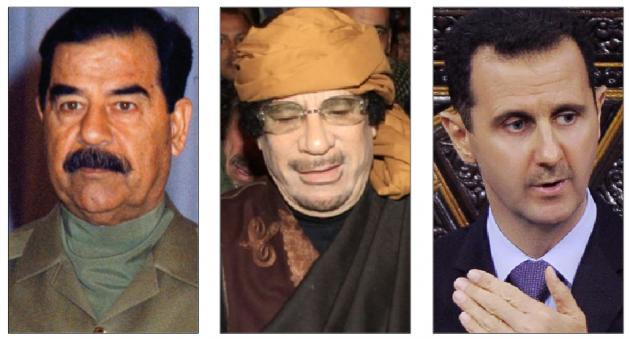
Syria’s Bashar Assad, Iraq’s Saddam Hussein and Libya’s Muammar Gaddafi are or were ruthless and brutal in the way all dictators are, against opponents who threaten the regime. But before their states were targeted for “intervention”, they also oversaw societies in which there were high levels of education and literacy, well-established welfare states, and low levels of sectarianism. These were not insignificant achievements (even if they are largely overlooked now) – achievements that large sections of their populations appreciated, even more so when they were destroyed through outside intervention.
These achievements were not unrelated to the fact that the regimes were or are more independent of the US than the US and Israel desire. The rulers of these states, which comprise disparate sectarian groups, had an interest in maintaining internal stability through a carrot and stick approach: benefits for those who submitted to the regime, and repression for those who resisted. They also made strong alliances with similar regimes to limit moves by Israel and the US to dominate the region. Balkanisation has been a powerful way to isolate and weaken them, so the process can be expanded to other renegade states.
This is not to excuse human rights violations by dictatorial regimes. But it is to concentrate on an even more important issue. What we have seen unfolding over the past 15 years is part of a lengthy process – often described in the West as a “war on terror” – that is not designed to “liberate” or “democratise” Middle Eastern states. If that were the case, Saudi Arabia would have been the first state targeted for “intervention”.
Rather, the “war on terror” is part of efforts to violently break apart states that reject US-Israeli hegemony in the region, so as to maintain US control over the region’s resources in an age of diminishing access to cheap oil.
Although it is tempting to prioritise human rights as the yardstick for which sides we prefer, by now there should be little doubt that the conflicts unfolding in the Middle East are not about the promotion of rights.
Syria offers all the clues we need.
The agents trying to overthrow Assad in Syria are no longer civil society groups and democracy activists. They were too small in number and too weak to bring about change or threaten the Assad regime. Instead, whatever civil war there may initially have been has transformed into a proxy war. (In a closed society like Syria, it is of course almost impossible to know what drove the initial opposition – was it a fight for greater human rights, or growing dissatisfaction with the regime concerning other issues, such as food shortages and population displacements that were themselves a consequence of long-term processes triggered by climate change?)
A coalition of the US, Saudi Arabia, the Gulf states, Turkey and Israel exploited those initial challenges to the Syrian regime, seeing them as an opening. They did not do so to help democracy activists but to advance their own, largely shared agendas. They used Sunni jihadist groups like al-Qaeda and ISIS to advance their interests, which depend on the break-up of the Syrian state and its replacement by an anarchy that empowers them while disempowering their enemies in the region.
Saudi Arabia and the Gulf states want Iran and its Shia allies weakened; Turkey wants a freer hand against Kurdish dissident groups in Syria and elsewhere; and Israel wants to foster the forces of sectarianism in the Middle East to undermine pan-Arab nationalism, thereby ensuring its regional hegemony will go unchallenged.
The agents trying to stabilise Syria are the regime itself, Russia, Iran and Hizbollah. Their concern is to use whatever force is necessary to repel the agents of anarchy and restore the regime’s dominance.
Neither side can be characterised as “good”. There are no “white hats” in this gunfight. But there is clearly a side to prefer if the yardstick is minimising not only the current suffering in Syria but also future suffering in the region.
The agents of stability want to rebuild Syria and strengthen it as part of a wider Shia bloc. In practice, their policy would achieve – even if it does not directly aim for – a regional balance of forces, similar to the stand-off between the US and Russia in the Cold War. It is not ideal, but it is far preferable to the alternative policy pursued by the agents of anarchy. They want key states in the Middle East to implode, as has already happened in Iraq and Libya and has been partially achieved in Syria.
We know the consequences of this policy: massive sectarian bloodspilling, huge internal population displacement and the creation of waves of refugees who head towards the relative stability of Europe, the seizure and dispersal of military arsenals that spur yet more fighting, and the inspiration of more militant and reactionary ideologies like that of ISIS.
If Syria falls, it will not become Switzerland. And if it falls, it will not be the end of the “war on terror”. Next, these agents of anarchy will move on to Lebanon and Iran, spreading yet more death and destruction.
We would like to ask you to consider a small donation to help our team keep working. We accept no advertising and rely only on you, our readers, to keep us digging the truth on history, global politics and international relations.
In this photo taken on Sunday, April 20, 2014, and released on the official Facebook page of the Syrian Presidency, Syrian President Bashar Assad, right, checks a damaged church during his visit to the Christian village of Maaloula, near Damascus, Syria. Assad visited on Sunday a historic Christian village his forces recently captured from rebels, state media said, as the country’s Greek Orthodox Patriarch vowed that Christians in the war-ravaged country “will not submit and yield” to extremists. The rebels, including fighters from the al-Qaida-affiliated Nusra Front, took Maaloula several times late last year. (AP Photo/Syrian Presidency via Facebook)
The Axis powers invaded Yugoslavia on 6 April 1941. Vladko Maček, the leader of the Croatian Peasant Party (HSS) which was the most influential party in Croatia at the time, rejected offers by the Nazi Germany to lead the new government. On 10 April the most senior home-based Ustaša, Slavko Kvaternik, took control of the police in Zagreb and in a radio broadcast that day proclaimed the formation of the Independent State of Croatia (Nezavisna Država Hrvatska, NDH). The new Independent State of Croatia" was established as a pro-Nazi government. It was dedicated to a clerical-fascist ideology influenced both by ...
The origins of Czechoslovakia (1918−1920)Czechoslovakia gained its independence from the Austro-Hungarian Empire in 1918. Even though the Austrian-Hungarian Empire was one political entity, the Austrian part and the Hungarian part existed under a Dual Monarchy. Each half of the empire had a large amount of control over their area independent of the other half of the country. The differing policies of the Austrians and the Hungarians had a strong impact on the state of what is now the Czech Republic and the Slovak Republic. In particular, the Czech industry was developed, while Slovakia remained a mostly agrarian area managed by ...
The focal political aims of current anti-Serb propagandaThe current Serbophobic propaganda to abolish Republika Srpska (RS) and to create a unitary Bosnia-Herzegovina (a neo-Ottoman Muslim Bosnian province) is coming from the ranks of the Bosnian Muslim Party of Democratic Action (Stranka Demokratske Akcije - SDA) and its Western sponsors. The propaganda, however, coincides with the final phase of The Hague war crimes trial, following so-called "arrests"[1] and express deportations for the Netherlands by at that time pro-Western Serbian Government of former wartime commander of the Army of the Republika Srpska (Vojska Republike Srpske - VRS), General Ratko Mladic, and the ...
While much is said in some American media outlets about “fake news” in the US, the smallness of the matters being discussed might come into focus when compared with Ukraine, which is of late producing rather much fake news about the Holocaust and elementary points in World War II history.As we reported back in October, Ukrainian media outlet Radio Svoboda — the Ukrainian arm of the US Government-funded arm of RFERL — posted a picture from the US Holocaust Museum. It is an image of Polish Jews being deported to a death camp. There was just one problem. Radio Svoboda claimed the picture ...
This weekend 75 years ago, the German city of Dresden was razed to the ground by British and American aerial bombardment. At least 25,000 mainly civilians were destroyed in raid after raid by over 1,200 heavy bombers, indiscriminately dropping high explosives and incendiaries. It took seven years just to clear the rubble.The destruction of Dresden, a world-famous cultural center of Baroque majesty, has been long dogged by controversy. Official British and American military accounts claim it was necessary to hasten the collapse of the Third Reich; with a reasoning that resonates with US claims for dropping the atomic bombs on ...
Russia and its President, Vladimir Putin, a little more than a year ago, in July 2014 were the focus of attention in Europe and North America, accused, without a shred of forensic evidence, of shooting down an unarmed civilian Malaysian airliner over eastern Ukraine. The Russians were deemed out to restore the Soviet Union with their agreement to the popular referendum of Crimean citizens to annex into the Russian Federation and not Ukraine. Western sanctions were being thrown at Russia by both Washington and the EU. People spoke of a new Cold War. Today the picture is changing, and profoundly. ...
For the Serbs as Christians, their loss of state independence and fall to the Ottoman Empire’s kind of theocratic state, was a terrible misfortune. With the advent of the Turks and establishment of their rule, the lands of Serbs were forcibly excluded from the circle of progressive European states wherein they occupied a prominent place precisely owing to the Byzantine civilization, which was enhanced by local qualities and strong influences of the neighboring Mediterranean states. Being Christians, the Serbs became second-class citizens in Islamic state. Apart from religious discrimination, which was evident in all spheres of everyday life, this status ...
Because this article states so many things that might be likely to contradict what most people in Western countries have been led to believe, readers here are especially strongly encouraged to click onto any allegation which seems at all questionable, in order to get to the sources behind any given questionable allegation. And wherever a clicked-onto source turns out to be another article, one is encouraged similarly to do the same there, so that the reader will be able, in this way, to probe down to the ultimate sources, which are the sources upon which this article is finally based.After ...
The Vlachs in GreeceMany researchers and scholars judge that the largest part of the Balkan Vlachs is concentrated in Greece. The census of 1935 recorded 19,703 Vlachs in Greece, but according to the last census in Greece that allowed people to express their ethnic identity (in 1951), there were 39,855 Vlachs in this state.[1] However, a real number of the Vlachs in Greece today is up to 120,000.[2]The Vlachs in a post-war Greece are not acknowledged as an ethnic or national group for the very reason that Greece from the mid-1950s does not recognize an existence of any national or ...
A year ago, at a closed-doors meeting between the USA and EU officials and the leaders of the four major parties of FYROM in Strasbourg, a route map for the resolution of the protracted political crisis was agreed on (or rather imposed). The roots of this political crisis are to be found outside FYROM: it is actually more a confrontation by proxy between “the West”, which supports the opposition, and Russia, which is trying to maintain its influence in the region. In conjunction with the public discontent at government policies and the escalating corruption, the negotiations have contributed to sharpening ...
Chris Deliso of Balkanalysis points out the latest travesty of the Western media: 59,000 stories on Auschwitz, three on Jasenovac. As if the third-largest death camp in Nazi-occupied Europe simply never existed. Franjo Tudjman certainly thought so, and it appears the current Croatian leadership shares his "historical" perspective.Contemporary German estimates of Serbs murdered by the Ustasha (in Jasenovac and elsewhere) ranged as high as 750,000. Wiesenthal center uses the number of 600,000. Serbian researchers have spoken of up to 700,000 victims. Modern revisionists, Croat and otherwise, talk of 30-100,000, at most. Among them is the U.S. Holocaust Memorial Museum, which ...
In an interview for the German news magazine Zuerst! (April 2015) Srdja Trifkovic considers the significance of Otto von Bismarck’s legacy, 200 years after his birth.Dr. Trifkovic, how would Bismarck react if he could see today’s map of Europe?Trifkovic: He would be initially shocked that the German eastern border now runs along the Oder and Neisse rivers. Otto von Bismarck was a true Prussian. In his view, cities such as Königsberg, Danzig or Breslau were more properly “German” than those in the Rhineland. His first impression therefore would be that Germany has “shifted” to the West, and that an important social and ...
In the thousand year long-history of Serbs, Kosovo and Metohia were for many centuries the state center and chief religious stronghold, the heartland of their culture and springwell of its historical traditions. For a people who lived longer under foreign rule than in their own state, Kosovo and Metohia are the foundations on which national and state identity were preserved in times of tribulation and founded in times of freedom.The Serbian national ideology which emerged out of Kosovo’s tribulations and Kosovo’s suffering (wherein the 1389 St. Vitus Day Battle in Kosovo Polje occupies the central place), are the pillars of ...
Recommended alternative reading list on the Yugoslav studies not used by mainstream corporative Western mass-media and top Western universities dealing with global security, world politics and international relations. Reading proposed readers below you can complete picture on the Yugoslav studies out of the official Western approach.March Pogrom 2004 Book and Photo EvidenceKOSOVSKA GOLGOTA Intervju 198820 Principal Misconceptions on Kosovo IssueThe Srebrenica Massacre Evidence Context Politics Edward S Herman Phillip CorwinLista Diane Budisavljevic 1941 Do 1945 by Владислав Б. Сотировић/Vladislav B. SotirovićJosip Broz Tito Bez Maske! by Владислав Б. Сотировић/Vladislav B. SotirovićHayden Mass Killings and Images of Genocide in Bosnia by ...
The historical background of the Israeli-Palestinian conflict goes back to 1917 (the Balfour Declaration) and the establishment of the British protectorate over Palestine (the Palestine Mandate) after WWI with its provision for a national home for the Jews, although formally not to be at the expense of the local inhabitants – the Palestinians. Nevertheless, it became in practice the focal problem to keep an appropriate balance between these stipulations to be acceptable to both sides – the Jews and the Palestinians.The people and the land Since the time of the Enlightenment followed by Romanticism, in Western Europe emerged a new trend ...
For all the attention paid to the emergence of homegrown Islamist terrorists in Belgium, France and other European countries, one of the continent’s biggest radicalization problems is taking place on its fringes.Kosovo, the tiny Muslim-majority Balkan nation of just 1.8 million, has produced more foreign fighters per capita than any other Western nation since ISIS declared its now-defunct caliphate in 2014. Some 413 Kosovo citizens, including women and children, have joined that group and other Islamist extremist factions since the war in Syria began in 2012.As it attempts to join the European Union, Kosovo has been under pressure to stamp ...
Is your money that good? Will it buy you forgiveness? Do you think that it could?” (Bob Dylan, b. 1941, Masters of War)On Tuesday 6th of September, twenty-four hour monitoring by Yemen’s Legal Centre for Rights and Development (LCRD) recorded the bombings by the Saudi led “coalition”, armed by the US and UK and advised by their military specialists, thus collusion and co-operation of both countries render them equally culpable for the carnage.Yemen has a population of just 24.41 million (2013 figure) and according to the Rural Poverty Portal:“ … is one of the driest, poorest and least developed countries in ...
The ‘mainstream’ Western media is, almost by definition, the last place to consult for honest reporting of Western crimes. Consider the appalling case of Yemen which is consumed by war and an ongoing humanitarian catastrophe.Since March 2015, a ‘coalition’ of Sunni Arab states led by Saudi Arabia, and supported by the US, Britain and France, has been dropping bombs on neighbouring Yemen. The scale of the bombing is indicated in a recent article by Felicity Arbuthnot – in one year, 330,000 homes, 648 mosques, 630 schools and institutes, and 250 health facilities were destroyed or damaged. The stated aim of ...
On February 5, Military Times published a report stating that Washington has failed to publicly disclose potentially thousands of lethal airstrikes conducted over several years in Iraq, Syria and Afghanistan. The investigation reveals that in Afghanistan in 2016 alone, the U.S. air force carried out at least 456 bombings. The open-source report published by the Air Force Command doesn’t include these figures.According to the Military Times, the information was obtained from “Congress, American allies, military analysts, academic researchers, the media and independent watchdog groups” and it shows that much of what the Pentagon has disclosed may be misleading or simply ...
IntroductionThis article deals with the question of political and human/minority rights in the region of Kosovo & Metohija twenty years after the „2004 March Pogrom“ and twenty-five years after NATO's military aggression on Serbia and Montenegro and occupation of the region. An importance of this research topic is in fact that for the first time in European history, a terrorist-style and mafia-ruled (quasi)independent state was created by a full diplomatic, political, economic, military, and financial sponsorship by the West under the umbrella of the NATO's and the EU's protective administration. The precedence of Kosovo's self-proclaimed independence in February 2008 already ...