
When I was a schoolchild in the US a couple of short decades ago, I spent my time acquiring important life skills, ranging from how to fake a wrist fracture in order to obtain a purple cast, to how to craft a teepee replica out of a paper bag.
The latter art was perfected in accordance with the holiday of Thanksgiving, which arrived each November to great fanfare, and which, in addition to teepee replication, required my classmates and I to mass-produce turkey drawings, paper Pilgrim hats, and modified, feathered headdresses.
These materials were then incorporated into our reenactments of the “original” Thanksgiving feast: that mythologised, gastronomic encounter of 1621 between Pilgrims and Native Americans that now serves as a cornerstone of the fairytale version of US history.
On the surface, it may seem that there’s not much to criticise about a holiday based on gratitude and eating – especially when it’s accompanied by absurd spectacles like the presidential turkey pardon.
But a glance at the historical context of Thanksgiving reveals a thoroughly nauseating affair.
Land grabs and massacres
For starters, as University of Texas journalism professor Robert Jensen reminds us in a dispatch on the AlterNet website, the very term “thanksgiving” is saturated with disgrace.
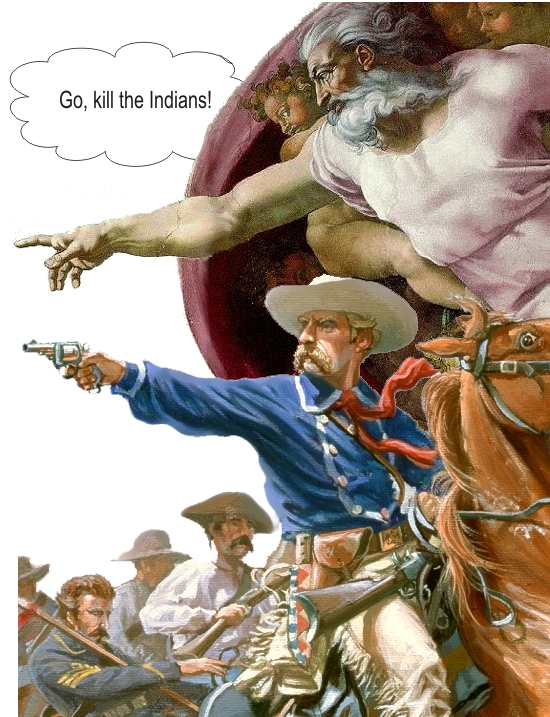
By 1637, Jensen writes, Massachusetts Bay Colony governor John Winthrop “was proclaiming a thanksgiving for the successful massacre of hundreds of Pequot Indian men, women and children” – a bloody pattern that would “repeat itself across the continent until between 95 and 99 percent of American Indians had been exterminated”.
The work of historian Roxanne Dunbar-Ortiz, author of An Indigenous Peoples’ History of the United States, serves up plenty of additional food for thought, on why Thanksgiving perhaps shouldn’t inspire too many warm-and-fuzzy feelings.
In a 2015 paper on the indisputable genocide of Native Americans, Dunbar-Ortiz explained point blank that settler colonialism in general “requires a genocidal policy” and that “Euro-American colonialism, an aspect of the capitalist economic globalization, had from its beginnings a genocidal tendency.”
Among the many, obvious financial perks of land theft, Dunbar-Ortiz noted that the seizure of Native American trade routes also prompted acute shortages of food and other necessities, thereby “weaken[ing] populations and forc[ing] them into dependency on the colonisers, with European manufactured goods replacing indigenous ones.”
So much for bountiful harvests.
In his book, A People’s History of the United States, late historian Howard Zinn outlined other mechanisms of capitalist dispossession. An 1814 “treaty” with the Creek nation, for example, functioned by “splitting Indian from Indian, breaking up communal landholding, bribing some with land, leaving others out – introducing the competition and conniving that marked the spirit of Western capitalism.”
Furthermore, US “land grabs” of Native American territory “laid the basis for the cotton kingdom, the slave plantations.”
In short, with such a sinister past on their plate, it’s no wonder US mythmakers prefer to focus on pumpkin pie and cranberry sauce.
Predatory capitalism
In recent remarks headlined “I am tired of being invisible to you all,” rural development economist and indigenous rights activist Winona LaDuke summed up the logic underpinning the United States’ vigorous campaign to whitewash its criminal history vis-a-vis the Native Americans: “If you make the victim disappear, there is no crime.”
But how, exactly, to go about making victims disappear when US crimes are far from said and done with, and the ramifications of genocidal policy are ongoing?
There are, it seems, several possible approaches. Consider the fact that, as late as the 1970s, the forced sterilisation of Native American women in the US was not uncommon.
In other, even more literal instances of physical elimination, as CNN reported earlier this month, data from the US Centres for Disease Control and Prevention shows that “Native Americans are killed in police encounters at a higher rate than any other racial or ethnic group.”
Case in point: just a few days prior to the CNN report, a 14-year-old Native American boywas gunned down by a US law enforcement official on a reservation in the state of Wisconsin.
Last year, meanwhile, the Independent observed that, of 29 Native Americans killed by US police between 1 May 2014 and 31 October 2015, “27 of those deaths received no coverage” in the media.
Talk about disappearing acts.
As it turns out, many of those killed suffered from mental illness. And indeed, one can easily argue that the prevalence of mental health conditions among Native American groups isn’t enormously surprising in light of continuous antagonism by US authorities and society, often in the form of socioeconomic ostracisation and environmental destruction – not to mention food insecurity.
It’s pretty clear, then, that a lot of people in the United States won’t have much to be thankful for this Thanksgiving. But at least there’s Black Friday to look forward to: the ode to gross overconsumption that directly follows the supposed day of gratitude (and that has been known to result in news headlines like “Wal-Mart worker killed in Black Friday shopping stampede”).
To be sure, the Black Friday phenomenon only befits a nation built on predatory capitalism – where material excess is rendered sacred, obscene inequality is the name of the game, and communal bonds are systematically obliterated along with any remaining potential for human symbiosis with the physical environment.
In the end, you don’t need to gorge yourself on turkey and stuffing to see that the United States itself is positively sick.
Originally published on 2017-11-23
About the author: Belen Fernandez is the author of The Imperial Messenger: Thomas Friedman at Work, published by Verso. She is a contributing editor at Jacobin Magazine.
We would like to ask you to consider a small donation to help our team keep working. We accept no advertising and rely only on you, our readers, to keep us digging the truth on history, global politics, and international relations.
How can it be that in virtually all of the Presidential-candidate head-to-head Democratic versus Republican polling that was done of both Democratic and Republican candidates during the primaries, the preferred Democratic candidate against any one of the Republican candidates was Bernie Sanders, but he almost certainly won’t be that Party’s nominee (and there’s more on that here); and the preferred Republican candidate against either one of the Democratic candidates was John Kasich, but he certainly won’t be the Republican nominee?Sanders and Kasich also scored the highest in his respective Party for net favorability rating, but almost certainly neither candidate will ...
In late November 2013, the 'Euromaidan' in Kiev began as a popular protest against a generalized state of corruption and cronyism in Ukraine. The spark that ostensibly ignited the protests was the inability of then President Yanukovych to sign an EU Association Agreement that would cut Ukraine's economic and military ties to Russia in favor of a closer relationship with the EU and NATO.The EU had made the release of former Ukrainian prime minister and "gas princess" Tymoshenko a precondition for signing the agreement. But the fact that Tymoshenko was/is a convicted embezzler of state funds, combined with the rather ...
Protesters have called for all statues of the former imperial ruler to be removed in recognition of his massacres in the Congo. As 10,000 people took to the streets of Brussels on Sunday (7 June) to protest as part of the Black Lives Matter movement, there was one landmark which drew their ire more than any other: the equestrian statue of King Leopold II outside Belgium’s royal palace.“Murderer!” the protesters cried as they climbed the statue and waved the flag of the Democratic Republic of Congo. Had the statue been flimsy enough to pull down they would have done it, just as fellow BLM protesters toppled ...
The negotiations on Brexit are attracting a lot of attention. In particular, the possible erosion of the rights of around three million EU-27 citizens living in Britain is a major cause for concern.The European Parliament resolution adopted on 3 October states that “the withdrawal agreement must incorporate the full set of rights citizens currently enjoy, such that there is no material change in their position”.The main author of this text, Mr Guy Verhofstadt, the EP Brexit Coordinator, argues that such an approach – not to lower the level of citizens’ rights – is “the goal of democracy”. But why was ...
A weakened leader in a powerful country can be a recipe for danger. Donald Trump's encroaching legal troubles might prove just the time for a seriously big international crisis, even a bit of a war. The obvious choice is Iran, and Trump may well have been heading that way even before his latest problems with Michael Cohen, Paul Manafort and potentially special investigator Robert Mueller.Trump may be confident of holding firm to his support base and thus ensuring the loyalty of Republican candidates in the mid-term Congressional elections. But as pressure grows on him, a conflict with Iran – encouraged ...
On February 24th, Medea Benjamin and Nicolas S.J. Davies headlined "What Planet Is NATO Living On?", and documented that the U.S. Government and NATO are preparing to invade and conquer both Russia and China, and that this goal is opposed by vast majorities of Europeans, which means that this decision by NATO does not reflect democracy in Europe, but instead it reflects Europe's being vassal-nations in the U.S. empire:As Michael Klare explains in a NATO Watch report on NATO 2030, every step the U.S. is taking with NATO is "intended to integrate it into U.S. plans to fight and defeat ...
The Senate Report’s revelations of CIA torture of suspects following the 9/11 bombing is only the tip of the iceberg. The Report omits the history and wider scope of violent activity in which the CIA has been and continues to be involved. CIA organized large scale death squad activities and extreme torture in Vietnam (Phoenix Project); multiple assassinations of political leaders in the Congo, Chile, Dominican Republic, Vietnam, the Middle East, Central America and elsewhere; the kidnapping and disappearance of suspected activists in Iraq and Afghanistan; massive drug-running and narco-trafficking in the “Golden Triangle” in Southeast Asia and Central America (the Iran-Contra war).The Senate Report fails to locate ...
“Workers of my country, I have faith in Chile and its destiny. Other men will overcome this dark and bitter moment when treason seeks to prevail. Keep in mind that, much sooner than later, the great avenues will again be opened through which will pass free men to construct a better society. Long live Chile! Long live the people! Long live the workers!” President Salvador Allende’s farewell speech, 11 September 1973.“It’s hard to find someone with the fighting spirit, courage and the story of Allende. He was a man who actually had the branded name in history: democratically the left came ...
If you wanted to identify, with confidence, the very worst president in American history, how would you go about it? One approach would be to consult the various academic polls on presidential rankings that have been conducted from time to time since Harvard’s Arthur M. Schlesinger Sr. pioneered this particular survey scholarship in 1948. Bad idea.Most of those surveys identify Warren G. Harding of Ohio as the worst ever. This is ridiculous. Harding presided over very robust economic times. Not only that, but he inherited a devastating economic recession when he was elected in 1920 and quickly turned bad times ...
Will the election of Republican George W. Bush as President usher in changes in foreign policy with regard to Serbia, Yugoslavia, and the Balkans? Will there be a continuation of „humanitarian interventionism“, „military humanism“, „economic globalism“ and „globalization“?The Bush Administration foreign policy team has rejected the selective humanitarian interventionism of the Bill Clinton/Al Gore Administration, as espoused by Madeleine Albright and James Rubin. John Hulsman, Balkans adviser to Bush, announced that Bush was concerned about „imperial overstretch“ and has rejected a foreign policy that uses the US military in „nation building“. Hulsman has announced a „philosophical sea change“ in Balkans ...
‘Blowing from a Gun’ depicted by Vasily Vereshchagin in his painting ‘Suppression of the Indian Revolt by the English’ on the rebellion of 1857. Queen Victoria’s agent bought this painting, in an attempt to suppress it. ‘Blowing from the Gun’ was a means of execution where the prisoner is tied to the muzzle of a cannon, which is then fired, popping the victim’s head about 15 meters (50 feet) into the air, apparently a sort of juvenile entertainment for the colonizers.Following colonization, along came ‘decolonization’ and what do you suppose happened with colonial borders? They mostly remained as laid down ...
On Mar. 24, US president Barack Obama announced that all 9,800 US troops currently stationed in Afghanistan will remain until the end of 2015. This generated a fair amount of criticism: it was, after all, Obama’s promise that the last American troop would leave the country in 2014.How have Obama’s plans for pulling out of Afghanistan fared so far?Those expecting the US to leave Afghanistan, however, should take a minute to consider this: the US still hasn’t left Germany. In fact, there are quite a few places the US hasn’t left, and while certainly most of them don’t pose a threat to American soldiers, ...
Croatia's President Kolinda Grabar-Kitarovic with Croatian diaspora in Canada holding the flag of WWII Nazi-Ustashi Independent State of CroatiaCroatia’s president, the former deputy NATO secretary general for public diplomacy Kolinda Grabar-Kitarovic, decided to pay homage to Nazis of the Ustasha Nazi puppet regime of Croatia shot by Yugoslav partisans at the end of World War II. Grabar-Kitarovic’s tone deafness in choosing Victory in Europe week to honor dead Nazis shocked the Balkans and the rest of Europe.The Ustasha, along with their Slovenian and Serb loyalists to the Nazi puppet regime, were killed by the partisans under the command of anti-fascist ...
How many people have been killed in the wars in Afghanistan, Iraq, Syria, Yemen and Somalia? On Nov. 18, a UN press briefing on the war in Yemen declared authoritatively that it had so far killed 5,700 people, including 830 women and children. But how precise are these figures, what are they based on, and what relation are they likely to bear to the true numbers of people killed?Throughout the U.S.-led war in Afghanistan, the media has cited UN updates comparing numbers of Afghans killed by “coalition forces” and the “Taliban.” Following the U.S. escalation of the war in 2009 and 2010, a report by McClatchy in ...
Western media is becoming unhinged as its anti-Russia propaganda struggles to keep a hold on its consumers. Two recent examples provide evidence.Pro-peace conspiracy emanating from MoscowOn August 28, the New York Times published an article by its Moscow bureau chief about the troubling news (from the Times‘ viewpoint) that the people of Sweden are not happy with their government’s wish to join up with the NATO military alliance.The ruling elites in Sweden and Finland have been quietly pushing for NATO membership for years. In May, the Swedish government pushed through the Riksdag a proposal for a ‘cooperation agreement’ with NATO, ...
Magnum Crimen the book about clericalism in Croatia from the end of 19th century until the end of the Second World War.The book, whose full title is Magnum crimen – pola vijeka klerikalizma u Hrvatskoj (The Great Crime – a half-century of clericalism in Croatia), was written by a former Catholic priest and professor and historian at Belgrade University, Viktor Novak (1889–1977). The book was first published in Zagreb in 1948.Immediately after the book was published, the Vatican Curia placed this book on the Index Librorum Prohibitorum (English: List of Prohibited Books) and pronounced anathema against the author.BackgroundNovak wrote a ...
Ever since the end of World War II, the United States, rightly or wrongly, but most of the time, wrongly, has fancied itself as the «world’s policeman». Even a disastrous and costly military intervention in Southeast Asia did not deter the United States from acting as the chief arbiter of what governments were «in» and which were «out» as evidenced by Central Intelligence Agency interloping in Nicaragua, El Salvador, Angola, Haiti, and Colombia. Two military interventions in Iraq and a U.S.-led military campaign directed against Yugoslavia were not enough to pry the United States from its self-appointed role as the ...
A NATO defense ministers meeting that took place in Brussels on November, 8-9 resulted in the new and very important decisions for the future of Europe.Speaking at a meeting, Secretary General Jens Stoltenberg said it is vital that European roads, ports, bridges and rail networks are able to carry tanks and heavy military equipment. Stoltenberg also added that NATO countries have agreed to cooperate to improve civil infrastructure objects to make them usable for military needs. What does it mean in practice for Europe in general and for the Baltic States in particular?Lithuanian authorities, for example, will for sure try ...
"The West" is the nations that are essentially controlled, basically dictated-to, by America's approximately 600 billionaires, who control the U.S. Government, by coordinatedly funding (through their news-media and political donations, and also by their members-only private conferences) the careers of cooperative politicians, and who thereby defeat the politicians who act against increasing the percentage of the nation's wealth that these few people hold, and against increasing their extractions from everybody else. (Those non-compliant politicians are derisively called "socialists" and equated with the communist Joseph Stalin instead of with the democratic socialist FDR and the leaders of the democratic socialist Scandinavian ...
It seems clear now that the West wants to defeat Russia in Syria at all costs. This latest protracted confrontation in the Middle East can be understood as a proxy war of the US and NATO against Putin’s resurgent Russia. But Syria is just one zone of engagement in a much wider war against Russia that has been taking place since Putin started to stand up to the West. The same confrontation also occurs in Ukraine and formerly in Georgia, where Russia successfully halted, albeit temporarily, the Western advance. This amounts to a new Cold War or an undeclared war ...