
This was thus a historic U.S. election: finally, the U.S. government will turn away from the path toward war against Russia, upon which path the United States has been leading the world ever since 1990. I am shocked, and enormously relieved, at the result — even if Trump turns out to be a bad (i.e., a conservative, the opposite of a progressive) President on all other matters (including the Supreme Court) [...]
CNN explained well “5 surprising lessons from Trump’s astonishing win”, and the historic crushing failure of traditional Presidential-year American politics, but it really boils down to one simple fact: In the battleground states, where most of the advertising dollars and get-out-the-vote money was being spent, the Trump organization made use of the Republican-Party organization in those portions of the campaign-operation that benefited from those established contacts and its tried-and-tested methods and techniques, but not in the portions of the campaign-operation that needed to be improved and to function better than in all prior U.S. Presidential elections.
The simple fact is that Trump’s understanding of U.S. national politics was transcendent, better even than that of the candidate whom all of the polls during the political primaries showed to be the most preferred by the most people and thus to be able to beat any of the other contestants in a one-on-one electoral choice against any of the others: Bernie Sanders. (See this and this for the evidence on that).
(And if there were any remaining doubt as to why he was, consider this report from Reuters near 3AM on Wednesday November 9th, right after the voting: “U.S. voters want leader to end advantage of rich and powerful – Reuters/Ipsos poll”. For example, this poll of 10,000 people leaving their polling-places showed: “75 percent agree that ‘America needs a strong leader to take the country back from the rich and powerful.’” That had been Bernie Sanders’s message, too. Trump’s campaign brought people like that out to vote.)
Sanders may have been right to think that highest net approval-rating is generally the biggest single predictive factor determining a Presidential candidate’s winning the White House (and he had the highest net-approval rating), but he (like his opponent Hillary Clinton) missed the importance of the emotional-intensity factor, which Trump made virtuosic use of. (This can be seen clearly when you look further at the exit-poll results: the actual people who went to the polls — the people sampled in the exit-polling — were fundamentally different from the cross-section of America’s ‘likely voters’ that were sampled in the pre-election polling! Trump trumped all traditional politics. This achievement is simply astounding.)
Whereas Sanders failed to recognize that in Democratic Party primaries there was more emotional intensity for the existing, Clinton-Obama, anti-FDR, Democratic Party, than there was for ideological progressivism (FDR’s legacy, which dominated the Democratic Party prior to Bill Clinton’s win in 1992) (and Hillary’s understanding of that turned out to have been correct), and so the incompetent but aristocracy-backed politician Hillary Clinton was able to steal the Democratic Party nomination from him, Trump was able easily to garner the most primary votes in a crowded 17-candidate field and so to become the nominee of one of the two major political Parties and go on to face the incompetent Hillary in the general election.
From Bernie Sanders’s standpoint, such a general-election contest, between two candidates both of whom had hugely net-negative approval-ratings, couldn’t have made much political sense, and so he chose to endorse the thief Hillary and become a non-entity in the post-1992 and profoundly corrupt Democratic Party, instead of to found an authentically independent political movement — not political Party but political movement — which would honestly and without partisanship cherry-pick which candidates, from which of the two political Parties, will, on balance, as against the given candidate’s opponent, provide the highest benefit and least harm toward advancing the progressive cause. (That was the only constructive path forward for him after Hillary robbed him.) He chose the stick-in-the-mud route.
Sanders opted to become just a cog in an ugly greasy pro-aristocracy machine, the Democratic Party wing of the U.S. aristocracy.
After the Republican Party’s nomination was won by Trump (which he did honestly), he went on to build on that success an authentic anti-aristocracy (or ‘anti-Establishment’) movement, beside and outside the Republican Party. His basic anti-aristocracy message remained unchanged, and he, as the Republican nominee, faced the biggest decision-point in his entire campaign: whether now to reach out to the millions of Sanders’s voters (i.e., the largest of all voting-segments) by joining with now Hillary’s — the post-1992, Bill Clinton’s, Democratic Party’s — emphasis upon both race and gender over economic class as what’s posing the biggest barrier to achieving equality of economic opportunity in America (in which case, Trump would have adopted Hillary Clinton’s basic campaign message), or, instead, to stay with his original message that economic class (and the elite’s “corruption” behind that) poses the biggest barrier against achieving “the equal-opportunity society.”
Trump — wisely, as it now turns out — chose the latter path (the original Bernie Sanders’ basic message): he was determined to retain the intensity-advantage (the ‘populist’ thrust), so as to be able to bring the largest numbers of voters to the polls on Election Day in the toss-up states and crush his opponent who was looking to win a ‘coalition’ of voting-segments: women, Blacks, Hispanics, Muslims, etcetera. She thought that those people’s personal group-identification would sufficiently surmount any negative feelings they might have regarding her long history of corrupt use of public office to advantage her financial supporters, so that she would beat ‘the bigot’, Donald Trump; she turned out to be wrong.
What will be the important consequences of Trump’s win?
I, a Bernie Sanders voter, voted for Trump against Hillary, for the reasons that I have earlier stated, describing the consequences that a Trump win would have. (See: “I’m a Bernie Sanders Voter: Here’s Why I’ll Vote Trump”.) I summed up, on that occasion:
Trump is rapidly moving America’s political center in the opposite direction from the direction that Bill Clinton, Barack Obama, and Hillary Clinton, did, which was toward conservatism, away from progressivism: those conservative Democratic Presidents and (now) would-be President, have moved America’s political center considerably toward the right (the international-corporate agenda). A President Trump would reverse the political direction that this country has been heading in ever since 1993.
If we progressives don’t help Trump to do that, we shall be throwing away the only such opportunity that the U.S. oligarchy [slipped-up and] allowed us to have. A President Hillary Clinton would have the support of almost all congressional Democrats no matter how right-wing her proposals are, and her big-money financial backers will buy enough congressional Republicans to make her the most effective most conservative Democratic President in decades if not centuries. The prospect is chilling.
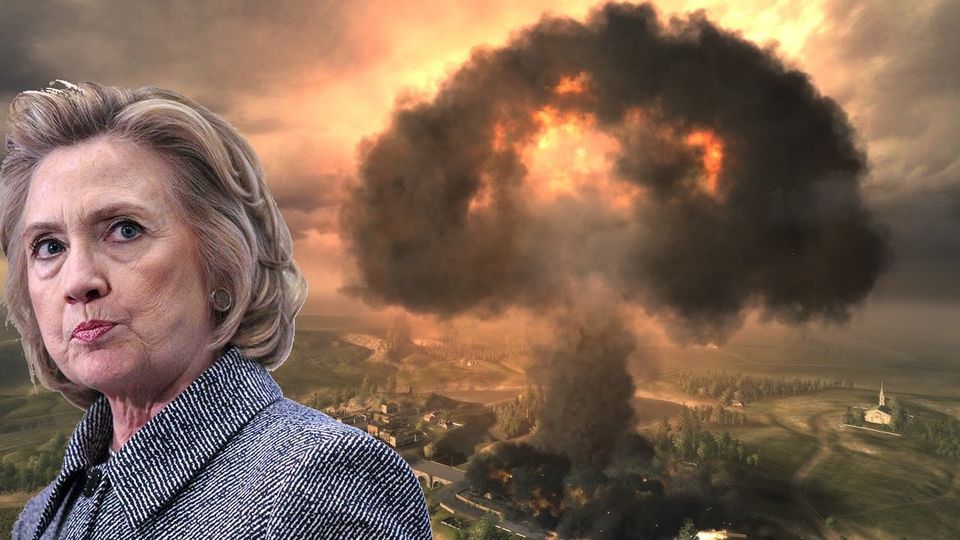
The biggest objection I hear to that from my fellow progressives is: “But think of the people he’ll appoint to the U.S. Supreme Court!” And my answer to that is: “This Is No ‘Cold War’; It’s Far Worse Than That.” Hillary Clinton has been intensely committed to completing Barack Obama’s drive toward nuclear war against Russia, and even the question of the Supreme Court is trivial in comparison to that. Furthermore, as I argued in “I’m a Bernie Sanders Voter: Here’s Why I’ll Vote Trump”, Trump might actually turn out to be a far more progressive President than he is expected to be. But, even if that turns out not to be the case, Trump is thoroughly committed to halting America’s aggression against Russia: the biggest loser in this Presidential election is George Herbert Walker Bush, the person who in 1990 secretly established the U.S. plan to conquer Russia, which plan every U.S. President since has been carrying out, and Hillary Clinton was expecting to complete that operation.
This was thus a historic U.S. election: finally, the U.S. government will turn away from the path toward war against Russia, upon which path the United States has been leading the world ever since 1990. I am shocked, and enormously relieved, at the result — even if Trump turns out to be a bad (i.e., a conservative, the opposite of a progressive) President on all other matters (including the Supreme Court).
Even in the worst-case scenario, Trump will be a much better President than would the neoconservative, Hillary Clinton.
Origins of images: Facebook, Twitter, Wikimedia, Wikipedia, Flickr, Google, Imageinjection, Public Domain & Pinterest.
Read our Disclaimer/Legal Statement!
Donate to Support Us
We would like to ask you to consider a small donation to help our team keep working. We accept no advertising and rely only on you, our readers, to keep us digging the truth on history, global politics, and international relations.
1917 was not a good year for any of the belligerent countries, but for the members of the Entente – France, Britain, and Russia – it was nothing less than catastrophic. The main reasons for that were the mutinies in the French army, which made the situation on the western front extremely precarious, as well as the revolution in Russia, which raised the spectre of Russia exiting the war, leaving Britain and France bereft of the ally that forced Germany to fight on two fronts. Add to this the fact that civilians as well as soldiers in France and Britain ...
The full extent of the damage to international peace and security caused by the US-led Syrian strikes will take some time to become clear. But its impact on the very concept of legality in international affairs is already evident.Simply put, the most powerful county in the world and its chief satellites, the UK and France, have thrown the rule of law into the trash can. The only "law" now is the law of the jungle. There is no going back.Ironically, the attack itself was claimed by its perpetrators as enforcement of legality, not of its obliteration. For example, NATO Secretary-General ...
In the early morning hours of April 1-2 Azerbaijan launched a major military offensive into the disputed region Nagorno-Karabakh (NK) that’s been controlled and defended by NK Armenian forces since the Russian brokered truce ended a bloody three year war in 1994. While Azeri President Ilham Aliyev was flying back to Baku after meeting 24 hours earlier with John Kerry in Washington who claimed “an ultimate resolution” had been reached, Azerbaijan was already once again at war with the NK Armenians.The surprise element combined with the full scale major military operation spearheading a three pronged attack on Nagorno-Karabakh contact line from the southern, ...
One of rock's greatest albums is Pink Floyd's 1973 Dark Side of the Moon.This somber, surrealistic album paints a picture of what society has become, both 44 years ago and now. Such is this present American Empire, replete with our phony wars, excessive militaristic mindset and of course the drive for super wealth by greedy corporations and equally greedy individuals.Those of us who "knew better" foresaw the economic bubble burst of 2008 years before it occurred. So many of our friends and neighbors cared not a damn about the phony wars on Iraq and Afghanistan, and later on against Libya and now proxy ...
"If we see that Germany is winning we ought to help Russia and if Russia is winning we ought to help Germany, and that way let them kill as many as possible…”Harry S. Truman, 33rd POTUS, 1941Since the end of the Second World War, the bourgeois historiography has tried to distort various incidents in order to vilify Socialism and the USSR. One of these incidents- which has been a “banner” of imperialism’s apologists and other anticommunists- is the so-called “Molotov-Ribbentrop Pact“* which was signed in 1939. In it’s unscientific, unhistorical effort to equate Communism with Nazism, the bourgeois propaganda presents ...
Origins of images: Facebook, Twitter, Wikimedia, Wikipedia, Flickr, Google, Imageinjection, Public Domain & Pinterest.Read our Disclaimer/Legal Statement!Donate to Support UsWe would like to ask you to consider a small donation to help our team keep working. We accept no advertising and rely only on you, our readers, to keep us digging the truth on history, global politics and international relations.
One of the most steadfast beliefs regarding the United States is that it is a democracy. Whenever this conviction waivers slightly, it is almost always to point out detrimental exceptions to core American values or foundational principles. For instance, aspiring critics frequently bemoan a “loss of democracy” due to the election of clownish autocrats, draconian measures on the part of the state, the revelation of extraordinary malfeasance or corruption, deadly foreign interventions, or other such activities that are considered undemocratic exceptions. The same is true for those whose critical framework consists in always juxtaposing the actions of the U.S. government ...
The president of Turkey, Recep Tayyip Erdogan, speaking at a conference entitled the “The Spirit of Turkey’s New Security,” referring to the Treaty of Lausanne, said:“The Turkish Republic is the last state that we founded with whatever was left over from all the self-sacrifices we were able to make... We are heirs of a nation that saw its territory expand to 22 million kilometers. Shortly before the Republic was founded, we had 3 million kilometers which kept diminishing until all we had left was 780,000 kilometers. Some may be offended at my mention of Lausanne. But why does it bother ...
Some of those currently advocating bombing Syria turn for justification to their old faithful friend “humanitarian intervention”, one of the earliest examples of which was the 1999 US and NATO bombing campaign to stop ethnic cleansing and drive Serbian forces from Kosovo. However, a collective amnesia appears to have afflicted countless intelligent, well-meaning people, who are convinced that the US/NATO bombing took place after the mass forced deportation of ethnic Albanians from Kosovo was well underway; which is to say that the bombing was launched to stop this “ethnic cleansing”. In actuality, the systematic forced deportations of large numbers of people from Kosovo ...
SaveSaveOrigins of images: Facebook, Twitter, Wikimedia, Wikipedia, Flickr, Google, Imageinjection, Public Domain & Pinterest.Read our Disclaimer/Legal Statement!Donate to Support UsWe would like to ask you to consider a small donation to help our team keep working. We accept no advertising and rely only on you, our readers, to keep us digging the truth on history, global politics and international relations.[wpedon id="4696" align="left"]
IntroductionAfter the catastrophic attacks of September 11 2001 monumental sorrow and a feeling of desperate and understandable anger began to permeate the American psyche. A few people at that time attempted to promote a balanced perspective by pointing out that the United States had also been responsible for causing those same feelings in people in other nations, but they produced hardly a ripple. Although Americans understand in the abstract the wisdom of people around the world empathizing with the suffering of one another, such a reminder of wrongs committed by our nation got little hearing and was soon overshadowed by ...
For decades former Nazis and German war criminals served at the highest echelons of NATO.Most of them were highly decorated Nazis, who later served in top positions in the Western German army, and were later promoted to serve as Commander and Chief of all NATO forces in Europe.This was not a unique event, but a very common phenomenon in post-WW2 Western Europe and especially in Western Germany.Nazi war criminals and people who supported and helped Hitler to carry out the holocaust and other war crimes, genocides, and crimes against Humanity were almost never put on trial for their crimes against ...
When great powers fade, as they inevitably must, it’s normally for one of two reasons. Some powers exhaust themselves through overreach abroad, underinvestment at home, or a mixture of the two. This was the case for the Soviet Union. Other powers lose their privileged position with the emergence of new, stronger powers. This describes what happened with France and Great Britain in the case of Germany’s emergence after World War I and, more benignly, with the European powers and the rise of the United States during and after World War II.To some extent America is facing a version of this—amid ...
A few months ago I received a message from a professor at the Khomeini Institute for Education and Research in Tehran, Iran, informing me that my 2010 book “War and Empire: The American Way of Life” (London, Pluto Press) had been translated into Farsi. He requested that I write an Introduction for Iranian readers. What follows is that Introduction. Two years ago the Xinhua Peoples’ Press in Beijing, China also published a translation in Mandarin.In the aftermath of Saddam Hussein’s 1991 attempt to annex Kuwait, the U.S. deliberately destroyed much of Iraq’s water and sewer infrastructure. The Pentagon even admitted ...
Fresh calls for a Greater Albania, incorporating the southern Serbian province of Kosovo, have led to an angry backlash from politicians in Belgrade.Sputnik Radio’s Mark Hirst talked to Marko Djuric, Director of the Government Office for Kosovo and Metohija.Such a move by Albania, if acted upon, could plunge the entire region back into a bloody and costly war on a scale not seen since the 1990s.Marko Djuric said that Serbia will not allow the creation of a Greater Albania in its southern province and that it is not alone in opposing the idea, which stems from the times of Nazi occupation of Yugoslavia.When asked whether this inflammatory statement by Albanian ...
The crumbling “liberal” West is in a desperate hurry in the Balkans. More than a quarter century since the first Western states, pushed by Germany, unilaterally recognized the secession of the former Yugoslav federal republics of Slovenia, Croatia and Bosnia-Herzegovina and about 19 years since NATO’s air and land attack against what had remained of the country (the Federal Republic of Yugoslavia, comprising Serbia and Montenegro) resulting in NATO’s occupation and subsequent forced amputation of Serbia’s Kosovo and Metohija province (by way of recognition of its unilaterally declared independence of February 2008 by the main Western powers, some – but not all Muslim ...
The title page of Rūta Vanagaitė’s best-known book contains two pictures of young men. “This one is a Jew,” she said, pointing at the picture on the left. “He was a bicycle-racing champion. Good enough to represent Lithuania in international competitions, but not good enough to live.” He was executed during the Holocaust. The man in the picture on the right was a Lithuanian executioner. “They are both us,” Vanagaitė explained. “But Lithuanians don’t like to think of them as ‘us,’ because one is a Jew and the other is a killer.” Her book is called “Us.” (The title has ...
Ema Miljkovic-Bojanic, M. A.Institute of History ofSerbian Academy of Sciences and ArtsBelgrade, 2000Malcolm’s Apology of the “Pax Ottomana” (Ab)using of historiography and historical facts for political ends is not a novelty introduced towards the end of the twentieth century. Its instances have been known throughout history, so that “practically there is not a single epoch of human history that was not controlled – by the Church, state, nation, party, leadership…” But precisely at a time when historiography seemed to be getting rid, at least partly, of the grip of “supervision” and when a critical approach was getting the upper hand, the ...
The ongoing crisis in Ukraine and unseemly role of Poland in its instigation and development makes us take another look at the historical context of the Polish-Ukrainian relations. We will focus on dramatic repressions of the Ukrainian minorities in Eastern Poland in 1921-1939 at the territories annexed by Jozef Piłsudski’s government from the Soviet Russia according to Peace of Riga 1921, which eventually triggered ultra-Nationalist Ukrainian terror against the Poles during the WWII (culminating in massacres in Volhynia and Eastern Galicia in 1943-1944).Poland, which used to be a part of the Russian Empire, emerged at the European political map in November ...
The December 17 UN Security Council meeting, on the announced creation of a Kosovo armed forces, featured some noticeable contrasts.In accordance with Kosovo not being a UN member state and the Serb position on UN Security Council Resolution 1244 (recognizing Kosovo as a continued part of Serbia), the disputed former Yugoslav territory wasn't formally represented at the discussion as a nation. Kosovo's leader, Hashim Thaci, sat with a nameplate having his name, as opposed to Kosovo. Countries recognizing Kosovo's independence made it a point to state Thaci as the president of Kosovo and Aleksandar Vučić as president of Serbia. Nations not ...
The magazine is covering the research gaps uncovered by global Western hoax mainstream media platforms and academic teaching & research institutions.
This is an alternative information & academic research digest platform with the purpose to offer an alternative “another side of the truth”.
The magazine is independent, private, and free of any influence by any institution, organization, government, or pressure group. URL: www.global-politics.eu