
In practice, a very illustrative example of asymmetric warfare was when on March 20th, 2003, US-led coalition forces invaded (made aggression) Iraq of Saddam Hussein with the objective of locating and disarming suspected (and not existing) Iraqi weapons of mass destruction (WMD) [...]
At least from the very academic viewpoint, war is a condition of armed conflict between at least two sides (but, in fact, states). There are, historically, several types of warfare as conventional warfare, civil war, lightning war (blitzkrieg in German), total war, hegemonic war, liberation war, war on terrorism, etc. However, according to the used warfare technique, there is, for instance, little war (guerrilla war in Spanish) or according to the (counter)balance of warfare sides, there is asymmetric war as an example.
Asymmetric warfare exists in the case when two sides of combat forces (two states, two blocs, a state vs. one military bloc, etc.) are very or even extremely different regarding their military and other capacities to fight each other. They are as well as very different in the terms of their areas of comparative strategic advantage, Therefore, the confrontation between such two different sides is coming to turn on one belligerent side’s ability/capacity to force the other side to fight on their own terms and conditions.
Another feature of asymmetric warfare is that the strategies that the weaker side has consistently adopted against the stronger side (enemy) often involve targeting the enemy’s domestic political base as much as its forward military capabilities. Nevertheless, in essence, usually, such strategies involve inflicting pain over time without suffering unbearable retaliation in return.
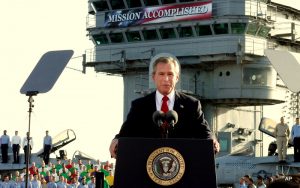
In practice, a very illustrative example of asymmetric warfare was when on March 20th, 2003, US-led coalition forces invaded (made aggression) Iraq of Saddam Hussein with the objective of locating and disarming suspected (and not existing) Iraqi weapons of mass destruction (WMD). The coalition forces lead a very fast and overwhelmingly successful military campaign with the occupation of the Iraqi capital Baghdad. Consequently, the Iraqi military forces collapsed and finally surrendered to the occupants. US President Bush Junior declared the official end of major fighting operations in Iraq on May 2nd, 2003. On one hand, historically speaking, the casualties during the conventional part of the war were low for major modern and contemporary military conflicts. However, on other hand, the fighting soon has been evolved into an insurgency in which the combination of guerrilla/terrorist attacks on both Western coalition forces and the civilians of Iraq became the everyday norm. Therefore, by the spring of 2007, the coalition had suffered some 3.500 men and around 24.000 wounded. Some independent sources estimate that total Iraqi war-related deaths are up to 650.000 (the minimum is 60.000). The 2003 Iraqi War is an example of how the asymmetric war can be transformed into guerrilla warfare with unpredictable consequences for the originally victorious side. The same happened with the war in Afghanistan in 2001 which started as an asymmetric war but was finished twenty years later with the victory of Taliban guerrilla forces over the Western coalition.
Nevertheless, the 2003 Iraqi War illustrated several themes that have been prominent in the talks regarding the future development of warfare including the question of asymmetric war as well. In this particular case, one of the focal features of asymmetric warfare was the fact that the fast military victory of the US-led coalition saw the Iraqi armed forces overrun by the technological superiority of the advanced weapons and information systems of the West, particularly of the US. It simply suggested that military revolution was on the way (RMA – revolution in military affairs).
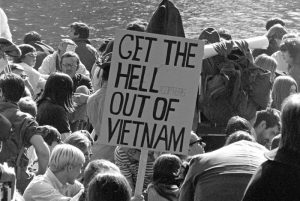
Another feature of asymmetric warfare in Iraq in 2003 was that US-employed military (operational) doctrine has been as well as of focal importance. In other words, the military success of the Western coalition forces was not only the result of pure technological supremacy, but it was as well as the result of superior operational doctrine. A very fast and comparatively bloodless victory for the US-led coalition launched the view that in the post-Cold War 1.0 strategic environment, there were few inhibitions on the use of force by the US Army as at that time still being a hyper-power in global politics and international relations. Therefore, it was not the threat from the time of Cold War 1.0 that some regional conflict or war would escalate into nuclear warfare between two superpowers. In addition, Washington was healing the trauma of Vietnam through asymmetric wars against Yugoslavia in 1999, Afghanistan in 2001, and Iraq in 1991/2003.
It can be said that in the case of the asymmetric war against Iraq in 2003, a focal point was US dominance of information warfare in both the military sense (using satellite systems for communication, weapons targeting, reconnaissance, etc.) and civilian sense (manipulation of the civilian communications and global media images of the warfare). Consequently, Washington succeeded at least in the West to produce an understanding of the war as pro-democratic and preemptive (against the use of WMD by Iraqi forces, in fact, against Israel).
Nevertheless, the point was that this conflict did not end with the surrender of the regular forces (army) of Iraq. It, actually, confirmed some arguments of those who supported the idea of “post-modern” warfare (or “new” wars) out of the regular (standard) type of wars (army vs. an army). On other hand, the ability to operate using complex informal military networks allowed the Iraqi rebels after the regular phase of the war in 2003 to conduct effective asymmetric warfare, regardless of the overwhelming superiority of Western military technology. The insurgents, as well as, have been able to use the global media in order to present their warfare as a liberation war against Western neo-imperialism. However, the techniques used by the rebels were brutal (terrorism), ruthless, and in many cases targeted against the civilian population, in a campaign supported by outside structures (both governmental and non-governmental) and finance. It is sustained by an overtly identity-based campaign and reflects at the same time the features of the concept of the “post-modern” or “new” wars.
Dr. Vladislav B. Sotirovic
Ex-University Professor
Research Fellow at Centre for Geostrategic Studies
Origins of images: Facebook, Twitter, Wikimedia, Wikipedia, Flickr, Google, Imageinjection, Public Domain & Pinterest.
Read our Disclaimer/LegalStatement!
DonatetoSupportUs
We would like to ask you to consider a small donation to help our team keep working. We accept no advertising and rely only on you, our readers, to keep us digging the truth on history, global politics, and international relations.

It is coming clear these days that many university professors are increasingly fat-cat and lazy, not doing any research once they get tenure. It is a system-wide corruption of the academy, so entrenched that central administrations have only led the corruption in multiplying salaries and offices with no committed function to advancement of learning and dissemination of knowledge – the constitutional and statutory objective of the academy the best are devoted to everywhere.This deep-structural degeneration is not confined to any one place or region. Regular contacts from other universities report a similar decadence. The solution is straightforward, but unspoken: (1) ...
World War II marked the apogee of industrialized “total war.” Great powers savaged one another. Hostilities engulfed the globe. Mobilization extended to virtually every sector of every nation. Air war, including the terror bombing of civilians, emerged as a central strategy of the victorious Anglo-American powers. The devastation was catastrophic almost everywhere, with the notable exception of the United States, which exited the strife unscathed and unmatched in power and influence. The death toll of fighting forces plus civilians worldwide was staggering.The Violent American Century addresses the U.S.-led transformations in war conduct and strategizing that followed 1945—beginning with brutal localized ...
On March 24th, 1999, NATO launched its 78-day round the clock aerial assault on the Federal Republic of Yugoslavia without the approval of the United Nations Security Council. Over a thousand NATO warplanes delivered over 2,000 airstrikes in nearly 40,000 sorties, dropping over 20,000 bombs over the former Yugoslavia, killing thousands of civilian men, women, and children, as well as upwards of a thousand Yugoslav soldiers and police.[1] [2] [3] NATO employed weapons considered criminal by international law such as depleted uranium and cluster bombs.[4] [5] [6] [7]The popular narrative is that is that the Western powers dropped these bombs ...
The 1775−1783 American War of IndependenceThe American Revolution or the American War of Independence against British colonial lordship started in 1775 when the Thirteen Colonies began to fight for their political independence from London. In fact, fighting began at Lexington and Concord, Massachusetts, in April 1775. In June the colonies’ Continental Congress created a Continental Army under General George Washington. However, despite several defeats, and the loss of New York (former New Amsterdam) in September 1776, Washington hung on, and at Christmas 1776, with the successful crossing of the Delaware, won several battles. The campaign culminated in Saratoga in 1777. ...
Kosovo(stan) Parliament announced "independent" state of the "Republic of Kosovo" on February 17th, 2008 as a democratic and multicultural political community.Here we present two photos from November 2015 on which you can see heavily damaged Serbian Orthodox church and totally destroyed Serbian Orthodox tombstones in the southern part of the town of Kosovska Mitrovica inhabited by the Muslim Albanians. Kosovo(stan) ISIS is doing its job profoundly.Enjoy Kosovo(stan) "independence"!P.S. Today (February 17th, 2018) on the 10-years anniversary of Kosovo(stan) "independence", Burundi canceled its previous recognition of it. Just guess why?Read our Disclaimer/Legal Statement!Donate to Support UsWe would like to ask you ...
Magic, and tragic years, tend to fill the calendar of commemoration for central European patriots. There are religious intercessions; guiding symbols; omens. Then there are the calamities, the crushing battles that empty entire classes and countries.For Hungary, a country ever dreamy and mournful about such events, there are two notable disasters of rollicking value. There is Mohács 1526, where a good deal of the country’s aristocratic elite fell before the relentless Ottoman advance. The event effectively gave the Hapsburgs the ascendency to the west, assuming the role of defender against the Turkish advance into Europe.Then there is 1956, where the invaders ...
Years ago, the terms “false flag” and “conspiracy theory” went hand in hand. Suggesting that a government would stage an attack on its own people or attack an ally and blame it on a “third party” was unthinkable.This is despite the glaring fact that “false flags” have been going on since before biblical times and have been a part of every nation’s policy. Intelligence agencies exist to do little else, they plan and execute false flag attacks to influence policy and set the course of events, based on analysis. This is, in fact, their greatest single tool, and one used ...
Wednesday, May 30th, was Memorial Day in the United States. The commemoration began in 1868 shortly after the American Civil War, when townsmen in several communities came together to decorate the graves of the fallen on the last Monday in May. The practice began in the northern states but soon spread to the south and the annual remembrance ceremony soon took on the name Decoration Day. As wars proliferated in the twentieth century the commemoration eventually lost its association with the Civil War and was increasingly referred to nationally as Memorial Day, eventually becoming a federal holiday.The American Civil war ...
They could be found on the outskirts of Sirte, Libya, supporting local militia fighters, and in Mukalla, Yemen, backing troops from the United Arab Emirates. At Saakow, a remote outpost in southern Somalia, they assisted local commandos in killing several members of the terror group al-Shabab. Around the cities of Jarabulus and Al-Rai in northern Syria, they partnered with both Turkish soldiers and Syrian militias, while also embedding with Kurdish YPG fighters and the Syrian Democratic Forces. Across the border in Iraq, still others joined the fight to liberate the city of Mosul. And in Afghanistan, they assisted indigenous forces in various missions, just as they have ...
Origins of images: Facebook, Twitter, Wikimedia, Wikipedia, Flickr, Google, Imageinjection, Public Domain & Pinterest.Read our Disclaimer/Legal Statement!Donate to Support UsWe would like to ask you to consider a small donation to help our team keep working. We accept no advertising and rely only on you, our readers, to keep us digging the truth on history, global politics and international relations.[wpedon id="4696" align="left"]
Here are before-and-after pictures, at https://twitter.com/MAL0mt/status/701077438525263873/photo/1, of what the U.S. government has achieved, in the Middle East:What’s especially interesting there, is that in all of these missions, except for Iraq, the U.S. was doing it with the key participation of the Saud family, the royals who own Saudi Arabia, and who are the world’s largest buyers of American weaponry. Since Barack Obama came into the White House, the operations — Libya, Yemen, and Syria — have been, to a large extent, joint operations with the Sauds. ‘We’ are now working more closely with ‘our’ ‘friends’, even than ‘we’ were under George W. Bush.As President Obama instructed his military, ...
The armed conflict between the Kosovo Liberation Army (KLA) and Serbian forces started in 1992 with the KLA attacks on Serbian police officers, non-Albanians that lived in Kosovo and Albanians loyal to Serbia (Johnstone, 2002; Kozyris, 1999). This low level conflict escalated in 1996 with the KLA attacking refugee camps as well as other civilians and policemen resulting in dozens of innocent deaths (Johnstone, 2002; Kozyris, 1999). At this point of time and all up to late 1998, the KLA was regarded as a terrorist organisation (Gelbard, cited in Parenti, 2000:99; Jatras, 2002; Johnstone, 2002; Kepruner, 2003; Rubin, cited in ...
“I believe the perception caused by civilian casualties is one of the most dangerous enemies we face.”– U.S. General Stanley A. McCrystal in his inaugural speech as ISAF Commander in June 2009.The dust had hardly settled on Russian airstrikes on ISIS positions in Syria before Western media reports claimed that ‘civilians’ had been killed “including women and children”.Leaving aside the dubious nature of these allegations – the first of which was made before Russian airstrikes had even begun, according to Putin – Western propaganda outlets and the politicians they serve are in no position to point the finger at Russia ...
The world is at a dangerous crossroads. The United States and its allies have launched a military adventure which threatens the future of humanity. Major military and covert intelligence operations are being undertaken simultaneously in the Middle East, Eastern Europe, sub-Saharan Africa, Central Asia and the Far East. The US-NATO military agenda combines both major theater operations as well as covert actions geared towards destabilizing sovereign states.America’s hegemonic project is to destabilize and destroy countries through acts of war, covert operations in support of terrorist organizations, regime change and economic warfare. The latter includes the imposition of deadly macro-economic reforms ...
I was trying to think a few hours ago – after his shameful, outrageous, insane breaking of a solemn international treaty – just who Donald Trump reminded me of. I used to think about the boastful, gung-ho racist Theodore Roosevelt, the ‘Rough Rider’ who enjoyed war (and threats). But Theodore Roosevelt actually did win the Nobel Peace Prize. And then I realised.The political leader who most resembles Trump is the late Colonel Gaddafi of Libya.The parallels are quite creepy. Gaddafi was crackers, he was a vain, capricious peacock of a man, he was obsessed with women, he even had a ghost writer invent a ‘Green Book’ ...
With rare exception, the question of whether the atomic bombs were necessary to end World War Two is debated only deep within the safety of academic circles.Could a land invasion have been otherwise avoided? Would more diplomacy have achieved the same ends without the destruction of two cities? Could an atomic test on a deserted island have convinced the Japanese? Was the surrender instead driven primarily by the entry of the Soviets into the Pacific War, which, by historical accident, took place two days after Hiroshima—and the day before Nagasaki was immolated?But it is not only the history of the ...
How many people have been killed in the wars in Afghanistan, Iraq, Syria, Yemen and Somalia? On Nov. 18, a UN press briefing on the war in Yemen declared authoritatively that it had so far killed 5,700 people, including 830 women and children. But how precise are these figures, what are they based on, and what relation are they likely to bear to the true numbers of people killed?Throughout the U.S.-led war in Afghanistan, the media has cited UN updates comparing numbers of Afghans killed by “coalition forces” and the “Taliban.” Following the U.S. escalation of the war in 2009 and 2010, a report by McClatchy in ...
Origins of images: Facebook, Twitter, Wikimedia, Wikipedia, Flickr, Google, Imageinjection, Public Domain & Pinterest.Read our Disclaimer/Legal Statement!Donate to Support UsWe would like to ask you to consider a small donation to help our team keep working. We accept no advertising and rely only on you, our readers, to keep us digging the truth on history, global politics and international relations.SaveSaveSave
America is coming to the rescue of Al Qaeda under a humanitarian mandate. The unspoken agenda is to undermine the Liberation of Aleppo. The pretext and justification for these actions are based on America’s “responsibility to protect” (R2P) the “moderates” in Aleppo from Syrian and Russian attacks and bombing raids.On October 3, the US State Department announced the suspension of bilateral relations with Russia pertaining to Syria (see document below), in response to which, France’s foreign Minister Jean Marc Ayrault was called upon to intermediate at the diplomatic level. Pointing his finger at Russia’s Foreign Minister Sergei Lavrov, Jean Marc Ayrault casually accused Moscow ...
One way to understand the effect of 9/11, in most general terms, is to see that it allowed the agenda developed in the 1990s by neoconservatives—-often called simply “neocons”—to be implemented. There is agreement on this point across the political spectrum. From the right, for example, Stefan Halper and Jonathan Clarke say that 9/11 allowed the “preexisting ideological agenda” of the neoconservatives to be “taken off the shelf . . . and relabeled as the response to terror.”1 Stephen Sniegoski, writing from the left, says that “it was only the traumatic effects of the 9/11 terrorism that enabled the agenda ...