Muhaxheri has a history in Kosovo of supporting extremists in Syria. On May 12, the Kosovo daily web-portal Express, in a reportage signed by its intrepid investigator of radical Islam, Visar Duriqi, said that Muhaxheri had worked in the official Kosovo Islamic Community apparatus in Kacanik, a city near the southern Kosovo border with Macedonia [...]
U.S. air strikes continue against the terrorists of the so-called “Islamic State” — formerly the “Islamic State of Iraq and Syria” or ISIS — in the borderlands of Iraqi Kurdistan. American military action has been impelled by the genocidal ISIS threat to Christians and various small Kurdish and other religious minorities, including Yazidis, whose faith is linked to Zoroastrianism, and the ancient monotheistic community of Mandaeans. Meanwhile, questions about the extremist movement and its foreign recruits have spread throughout the Muslim lands and the Muslim minority communities in the West, from Belgium to Australia.
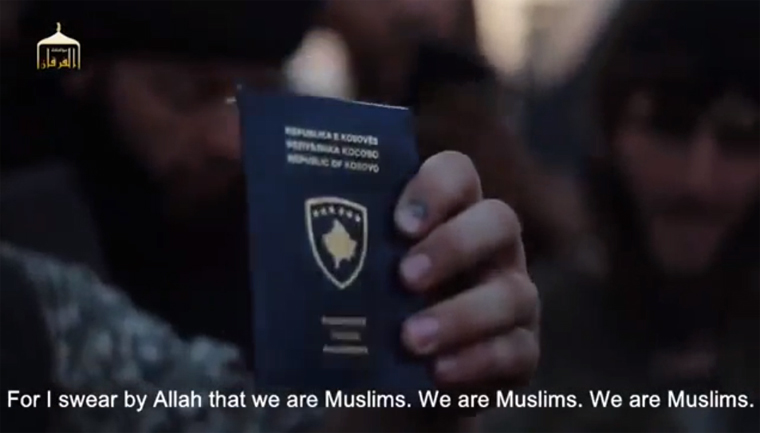
On Monday, August 11, authorities in the Kosovo Republic — among the most pro-Western Muslim-majority states in the world — announced the detention of 40 Kosovar citizens suspected of participation in terrorism in Iraq and Syria. The arrests came after raids at 60 locations in the Balkan country, and were carried out under procedures established by the Kosovo Penal Code protecting “constitutional order and security in the Republic.”
The individuals jailed were identified only by initials and ages, and comprised eight in the Kosovo capital, Prishtina; seven in the eastern town of Gjilan, near the Serbian border; 11 from Ferizaj in the southeast; five from Prizren in the south; four from Peja in the northwest, and five from Mitrovica in the extreme north. The latter city is divided between Albanians and Serbs. Dates of birth ranged from 1962 to 1994.
Evidence seized included explosives, weapons and ammunition. Kosovo police noted that 16 Kosovar Albanians have been reported killed in fighting in Syria.
According to the Kosovar newspaper of record, Koha Ditore (Daily Times), police said the sweep followed a two-year investigation, which is ongoing. Koha Ditore quoted Sevdije Morina, Kosovo’s acting chief special prosecutor, who declared that several local Muslim clerics are also under scrutiny. The same newspaper cited Blerim Isufaj, the prosecutor of the case, saying the majority of the suspects were affiliated with ISIS or Jabhat Al-Nusra, rival splinter groups from al Qaeda.
In Western Europe, alarm over ISIS and its appeal to the local Muslim diaspora emerged after the Brussels attack on the city’s Jewish Museum on May 24. Four people were killed in that incident, allegedly by Mehdi Nemmouche, a French Muslim who had fought in Syria. French interior minister Manuel Valls had warned in January that the return of jihadists from distant combat zones to Europe is “the greatest danger that we must face in the coming years.” Valls referred to ISIS influence in Muslim minorities as “a phenomenon of unprecedented size.”
On August 11, Australia was shocked as its media reported that Khaled Sharrouf, a convicted terror conspirator in that country, who went to Syria last year, had posted an image on his Twitter account of a child believed to be Sharrouf’s son holding the severed head of a Syrian soldier.
In between, both in time and space, Albanians were repelled when, on July 31, a Kosovar in the ranks of ISIS, Lavdrim Muhaxheri, posted photographs on his Facebook page of himself decapitating a Syrian soldier.
Muhaxheri has a history in Kosovo of supporting extremists in Syria. On May 12, the Kosovo daily web-portal Express, in a reportage signed by its intrepid investigator of radical Islam, Visar Duriqi, said that Muhaxheri had worked in the official Kosovo Islamic Community apparatus in Kacanik, a city near the southern Kosovo border with Macedonia. In Facebook posts before his atrocity photo was posted, Muhaxheri claimed he controlled the appointment of the imam at the Central Mosque in Kacanik, which has become a center of conflict between Islamist radicals and local traditional Muslims.
Muhaxheri threatened to kill Kacanik clerics as well as politicians and public figures in Kosovo who denounced incitement of young Albanian Muslims to fight in Syria.
As described by the Balkan Investigative Reporting Network (BIRN) on its portal, Balkan Insight, for July 31, Kosovo president Atifete Jahjaga summoned a meeting with security officials of the Balkan republic the day Muhaxheri’s Facebook images appeared. She called for “treating this threat to the security of Kosovo as a priority.” Jahjaga said, “It is our responsibility as institutions and as a society to condemn these ugly phenomena. We must distance ourselves from these brutal acts of criminals, and we must denounce and treat them as such.”
Kosovo justice minister Bajram Rexhepi stated that an international arrest warrant had been issued for Muhaxheri.
The involvement of Albanians in ISIS has not escaped the attention of more influential global commentators. On August 7, David Gardner, a Middle East expert and reporter for the London Financial Times, pointed out that when, at the beginning of the Muslim fasting month of Ramadan, corresponding with the end of June, the “Islamic State” proclaimed its authority over all the Sunni Muslim believers in the world, the text was “translated into English, French, German, Turkish, Russian – and Albanian.” Gardner asked, “Why… take the trouble?”
Gardner attributed the appeal of the “Islamic State” for Albanian Muslims to penetration of the Muslim communities in the Western Balkans by Wahhabism, the fundamentalist doctrine originating in Saudi Arabia.
Radio Free Europe reported on August 8 that Naim Maloku, a prominent veteran of the Kosovo Liberation Army (KLA) in the 1998-99 war for the territory, and now a military and security expert, said that Kosovo legal institutions must prevent local citizens from fighting abroad and that the official Islamic Community must be more involved in countering jihadist propaganda. “In their preaching, [Muslim] religious leaders should be more active in their statements,” Maloku said.
During the fighting in Gaza, radical voices were heard in Kosovo demanding that Albanians support Hamas. On August 1, the “Islamic Movement to Unite,” also known as “Join!,” and by its Albanian initials as LISBA, was supported by fewer than 100 people in a pro-Gaza protest held in Prishtina.
Kosovar Albanians are sympathetic, within limits, to the Palestinians. Many Kosovars are bitter about close relations between Serbia and Palestine. Muhammad Nabhan, ambassador of the Palestinian Authority in Belgrade, the Serbian capital, since 1974, has stated repeatedly that Palestinians support Serbian claims to rule in Kosovo and has even denied that Serbia – which invaded and annexed Kosovo in 1912 — ever “occupied” Kosovo. In 1999, the Palestinian Authority invited the late Slobodan Milosevic to visit Bethlehem for Orthodox Christian Christmas in January 2000. Israel then warned that if the Serbian dictator attempted to cross its borders, he would be arrested and sent to the International Criminal Tribunal for Former Yugoslavia at The Hague. The visit never took place.
Originally published on 2014-10-12
About the author: Stephen Schwartz, Executive Director, Center for Islamic Pluralism.
Origins of images: Facebook, Twitter, Wikimedia, Wikipedia, Flickr, Google, Imageinjection, Public Domain & Pinterest.
Read our Disclaimer/Legal Statement!
Donate to Support Us
We would like to ask you to consider a small donation to help our team keep working. We accept no advertising and rely only on you, our readers, to keep us digging the truth on history, global politics and international relations.
One sharp and interesting analysis of situation in Serbian province of Kosovo Metohija came last week from Andrew Korybko, program host at Radio Sputnik.Mr. Korybko speaks on how the whirlwind of geopolitics, military interests and global giants of business, as well as the change of US administration, could impact the fragile peace in Balkans and what’s behind the latest tensions:”Serbia’s NATO-occupied province of Kosovo has been up to its old tricks lately in trying to provoke Belgrade into another military confrontation conveniently timed to coincide with Trump’s inauguration.The former so-called “Prime Minister” of Kosovo, Ramush Haradinaj, was detained in France ...
The recent announcement by United States President Donald Trump that the US will recognise Israel’s sovereignty over the Golan Heights draws attention yet again to the double standards applied by NATO and its satraps including Australia to the issues of territorial integrity, the right to self-determination, and international law. Three cases illustrate the duplicity and double standards of the Western nations. They may be reviewed chronologically.A picture taken on July 4, 2018 from the Israeli-annexed Syrian Golan Heights shows displaced Syrians from the province of Daraa staging a protest (top L) calling for international protection, in the Syrian the ...
The topic to be addressed in this text is the basic misconception on the question of the Balkan Albanian ethnogenesis and national identity that was framed by extremely geo-politically coloured German-based “Illyrian” theory of the Albanian ethnic and cultural origin. This (quasi)theory, unfortunately, has very deep and negative regional political-security consequences. The implementation of the “Illyrian” theory of the Albanian ethnogenesis was accepted firstly by the Rilindja, (the Renaissance) – the Albanian nationalistic and chauvinistic political movement in 1878–1913 for the sake to create the ethnically pure Greater Albania as a national state of all Balkan Albanians composed by self-interpreted ...
The international community is accustomed to the so-called “checkbook diplomacy” that has been used by China and Taiwan to pilfer each other’s diplomatic allies by exchanging diplomatic recognition for generous financial assistance packages. However, this same battle for diplomatic recognition and de-recognition is being played out between Serbia and its breakaway province of Kosovo. The United States and much of NATO has not only granted Kosovo diplomatic recognition over the objection of Serbia but has also pressured other countries to recognize Kosovo’s independence. This process has hit a major stumbling block amid charges from various parties that fake diplomatic letters ...
Iraq and Kosovo may be thousands of miles apart, but they share the dubious distinction of contamination with radioactive residue from depleted uranium (DU) bullets used in American air strikes. After several years of silence, US officials finally admitted that 340 tons of DU were fired during the Gulf war. In Kosovo, American delays in providing details of quantities and target points have frustrated international efforts to assess health risks. Despite repeated requests, NATO waited almost a full year after the start of bombing in March 1999 to say that 31,000 DU bullets–a fraction of the number fired in Iraq–were ...
This list of shrines is based on a study by Milan Ivanovic, Crkveni spomenici XIII-XX veka (Church Monuments from 13th to 20th century) from Zaduzbine Kosova (The Foundations of Kosovo), Prizren-Belgrade 1987, and other recent publications. Dragan Jovanovic, researcher, compiled the major part of this list.AAJKOBILA (in the Middle Age Prozdrikobila, Pristina): demolished church in the vicinity of the present-day mosque.AJNOVCE (in the Middle Ages Hainovci, K. Kamenica): 1. ruins of the Tamnica monastery with the church built and frescoed in the 14C on the foundations of an older Byzantme basilica; 2. remains of a church in the old cemetery ...
Save... and many more pictures!Origins of images: Facebook, Twitter, Wikimedia, Wikipedia, Flickr, Google, Imageinjection, Public Domain & Pinterest.Read our Disclaimer/Legal Statement!Donate to Support UsWe would like to ask you to consider a small donation to help our team keep working. We accept no advertising and rely only on you, our readers, to keep us digging the truth on history, global politics and international relations.[wpedon id="4696" align="left"]
Origins of images: Facebook, Twitter, Wikimedia, Wikipedia, Flickr, Google, Imageinjection, Public Domain & Pinterest.Read our Disclaimer/Legal Statement!Donate to Support UsWe would like to ask you to consider a small donation to help our team keep working. We accept no advertising and rely only on you, our readers, to keep us digging the truth on history, global politics, and international relations.[wpedon id="4696" align="left"]
“Now that the global circumstances have changed, and when the United States and NATO are losing their influence, and while the powers that are in favor of preserving Kosovo and Metohija – such as Russia and China – are strengthening, we are nevertheless pursuing a policy of complete surrender.”The aim of the internal dialogue conducted by the Serbian President Aleksandar Vucic, should be to distribute responsibilities and to be the cover for the final surrender of Kosovo and Metohija.The government constantly assures us that it will never recognize Kosovo as an independent State, but here we must point out the ...
Prof. Djordje Jankovic, Ph.DFaculty of PhilosophyBelgrade UniversityMiddle Ages in Noel Malcolm’s Kosovo: A Short History and Real FactsBefore presenting the interpretations of the mediaeval past of Kosovo and Metohija in Noel Malcolm’s work, one should be aware of the tasks set by the author before writing the book. That way, the acrobatic handling of the evidence which he uses or does not use will become clearer. In the introductory text, ten pages long, he clearly presents his political and ideological position. They are as follows (p. XXXIV-XXXV): “Kosovo” is one of the cultural crossroads of Europe – which is wrong; ...
United Nations Security Council Resolution 1244 (1999) guaranteeing sovereignty and territorial integrity of Serbia and the autonomy of Kosovo and Metohija within Serbia, is the highest binding legal document that obliges all UN members, including the member states of the EU, NATO, the OSCE, the OIC, the African Union.Resolution 1244 is the only reliable basis and the framework for any negotiations concerning status. Owing to grave mistakes made by the former Serbian authorities, the UN system has produced certain damaging documents of advisory and non-binding character. It is vital that no similar or even greater mistakes are made either presently ...
The Kosovo Question recently once again became an important issue of global politics and international relations for two reasons: 1) The Albanian “government” of the “Republic of Kosovo” announced to officially proclaim the existence of the Kosovo Army (that is a violation of the 1244 UN Resolution in 1999), and 2) The “president” of the “Republic of Kosovo”, a war criminal Hashim Tachi, participated on November 11th (2018) in Paris to the world leaders’ celebration of a centenary anniversary of the end of the WWI (the signed armistice with Germany) as the official representative of an “independent” Kosovo. He was ...
During and after the the Kosovo conflict in 1998-1999, the KLA abducted and kidnapped over 2,000 Kosovo civilians, Serbs, Roma, and Albanians that opposed the KLA, who were tortured and murdered. Ten years after the conflict, these 2,000 remain missing. Approximately 1,000 to 1,3000 Kosovo Serbs are missing and presumed dead. How did they die? UNMIK occupation forces have been reluctant to investigate these mass murders of Kosovo civilians. What happened to them? Evidence has emerged that the KLA ran a series of prison camps, in Kosovo and in Albania itself, where they tortured and murdered Kosovo Serbs, Roma, and ...
US-NATO military control of Kosovo serves several purposes for Washington’s greater geo-strategic agenda. First it enables greater US control over potential oil and gas pipeline routes into the EU from the Caspian and Middle East as well as control of the transport corridors linking the EU to the Black Sea.It also protects the multi-billion dollar heroin trade, which, significantly, has grown to record dimensions in Afghanistan according to UN narcotics officials, since the US occupation. Kosovo and Albania are major heroin transit routes into Europe. According to a 2008 US State Department annual report on international narcotics traffic, several key ...
A National traumaA national trauma which the Serbs after the fall of the Serbian national state and the Ottoman occupation experienced after June 20th, 1459[i] can be compared with that felt by Judea’s Jews after the fall of Jerusalem and the destruction of the Temple in 70 AD.[ii] Since Serbia soon found herself well within the Ottoman Sultanate and the European Christian states were on defense from the victorious Muslim Ottoman Turks, no light at the end of the historical tunnel was seen and the whole nation sank into deep despair for the next four centuries. In a sense, the ...
Joe Biden is an American president and politician with extensive experience. He has been a long year member of the US Senate Foreign Relations Committee. In his political career so far, he has not had a good opinion about Russia, and the same was with other Slavic states in Eastern Europe, which have cultivated close relations with Russia.After the collapse of the USSR, his most significant engagement was in the Balkans. During the 1990, he often visited the Balkans. In his biography, Biden describes himself as a leading figure in defining the US policy in the Balkans, as he helped ...
“What we are really talking about is a humanitarian disaster precipitated by the cold political calculus of an autocratic leader who has pursued a political strategy against his own citizens,” said U.S. Gen. Wesley Clark, supreme allied commander in Europe.Gen. Clark’s target was Slobodan Milosevic. Yet his words might have been used by another American general named Robert E. Lee, about another “autocratic leader” named Abraham Lincoln.The day Clark made his statement bolstering the case for air strikes in Kosovo, the fall issue of Independent Review arrived. In a piece on Lincoln, “micromanager of the war effort,” scholar Thomas DiLorenzo ...
The Working Group for the Chapter 35 of the Serbian National Convention on the European Union (EU) has called for the authorities in Serbia and Kosovo to create a cooperation to reduce the spread of the coronavirus pandemic.“We witness the coronavirus pandemic (COVID19) representing a great danger everywhere in the world and the health systems increasingly burdened with the number of infected patients. The pandemic has shown that the spread of the disease goes beyond borders, national and ethnic origin or religion of the affected, and can only be combatted through joint action, cooperation and solidarity. Cooperation is necessary primarily ...
“Just rubble, a ruin, completely destroyed.” - @lindseyhilsum reveals the full scale of destruction in Palmyra.— Channel 4 News (@Channel4News)Video: April 2, 2016Read our Disclaimer/Legal Statement!Donate to Support UsWe would like to ask you to consider a small donation to help our team keep working. We accept no advertising and rely only on you, our readers, to keep us digging the truth on history, global politics and international relations.[wpedon id="4696" align="left"]
The 2004 “March Pogrom” in Kosovo: A book of photo evidence! (Making ISIL of a Greater Muslim Albania). Such books you will not find at any kind of the Western mass-media or university teaching programme's reading list.Origins of images: Facebook, Twitter, Wikimedia, Wikipedia, Flickr, Google, Imageinjection, Public Domain & Pinterest.Read our Disclaimer/Legal Statement!Donate to Support UsWe would like to ask you to consider a small donation to help our team keep working. We accept no advertising and rely only on you, our readers, to keep us digging the truth on history, global politics, and international relations.Save
The magazine is covering the research gaps uncovered by global Western hoax mainstream media platforms and academic teaching & research institutions.
This is an alternative information & academic research digest platform with the purpose to offer an alternative “another side of the truth”.
The magazine is independent, private, and free of any influence by any institution, organization, government, or pressure group. URL: www.global-politics.eu



 On Monday, August 11, authorities in the Kosovo Republic — among the most pro-Western Muslim-majority states in the world — announced the detention of 40 Kosovar citizens suspected of participation in terrorism in Iraq and Syria. The arrests came after raids at 60 locations in the Balkan country, and were carried out under procedures established by the Kosovo Penal Code protecting “constitutional order and security in the Republic.”
 In between, both in time and space, Albanians were repelled when, on July 31, a Kosovar in the ranks of ISIS, Lavdrim Muhaxheri, posted photographs on his Facebook page of himself decapitating a Syrian soldier.
 Radio Free Europe reported on August 8 that Naim Maloku, a prominent veteran of the Kosovo Liberation Army (KLA) in the 1998-99 war for the territory, and now a military and security expert, said that Kosovo legal institutions must prevent local citizens from fighting abroad and that the official Islamic Community must be more involved in countering jihadist propaganda. “In their preaching, [Muslim] religious leaders should be more active in their statements,” Maloku said.