
Recognize the Genocide that Happened—And the One Now Beginning
A lot has been written about Nagorno (Mountainous) Karabagh, or Artsakh; people have different opinions of it. But the simplest and most irrefutable narrative is this: For as long as we know, since the ancient Armenian kingdoms, Mountainous Karabagh has been an Armenian cultural cradle. Even when Josef Stalin and his Bolshevik entourage, in order to placate nationalist Turkey, unilaterally transferred these lands from Soviet Armenia and subjected them as an autonomous region to Soviet Azerbaijani rule in 1923, Mountainous Karabagh—unlike Nakhichevan to its west—managed to keep its majority Armenian population [...]
The United States, Europe, and their partners must officially recognize the Mountainous Karabagh Republic within its constitutional frontiers.
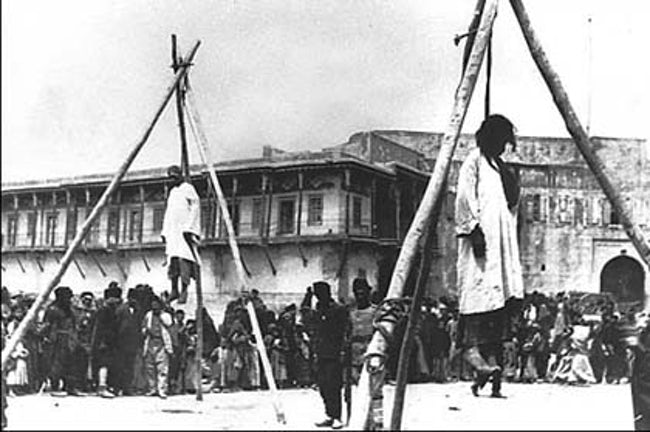
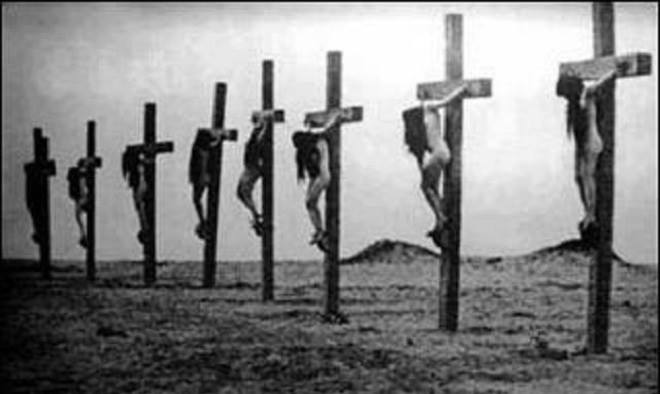
Stepanakert, Mountainous Karabagh — I no longer know what to do on April 24—or where to go. This is the day Armenians across the globe commemorate the genocide in 1915 that destroyed the Armenian people and its homeland of thousands of years.
Those killing fields, the homes of my grandparents, are located in historic western Armenia—now eastern Turkey. But a century later, this very region has erupted in all-out war. Turkish forces are on the offensive again, this time, Armenians having been eliminated, against an empowered Kurdish majority. For an Armenian, it is a difficult place to travel to on April 24—to assert our memory amid the bombshells and havoc of another people’s national struggle.
In Washington earlier this April, I was taking several meetings with the Department of State and at other offices. As it is known, official Turkey still denies that genocide was ever committed. And it expects its “strategic partners,” such as the United States, not to call it by that name.
In the past week, respected national newspapers shamefully published Turkish ads denying the Armenian Genocide. Denialist billboards went up, too. And in his address this April, President Obama called the events of 1915 everything but “genocide.” You can see why Washington, too, is also a difficult place to be on April 24.
So I decided to return to Yerevan, Armenia, for April 24. To be clear this is modern-day Armenia—just a sliver of the great homeland which survived 1915, was absorbed into the Soviet Union, and eventually declared independence in 1991. This is Armenia, whose foreign minister I was and whose flag I raised at the United Nations. Here millions of Armenians and their guests—this year George Clooney, Charles Aznavour, and others—march up to the Eternal Flame of 1915 and lay flowers every April 24.
But even Yerevan, this year, was a difficult place to be on April 24. Because the minds of Armenians were elsewhere. They were drifting a couple hundred miles southeast—where, even as we commemorated the victims of the Armenian Genocide, the groundworks of a new genocide against us were being laid.
A lot has been written about Nagorno (Mountainous) Karabagh, or Artsakh; people have different opinions of it. But the simplest and most irrefutable narrative is this: For as long as we know, since the ancient Armenian kingdoms, Mountainous Karabagh has been an Armenian cultural cradle. Even when Josef Stalin and his Bolshevik entourage, in order to placate nationalist Turkey, unilaterally transferred these lands from Soviet Armenia and subjected them as an autonomous region to Soviet Azerbaijani rule in 1923, Mountainous Karabagh—unlike Nakhichevan to its west—managed to keep its majority Armenian population.
As the USSR collapsed and the people of Artsakh voted by lawful referendum to declare their own independence from Azerbaijan, Baku in turn unleashed all-out war—and lost. As sovereign Armenia’s foreign minister, I helped launch the peace process in Helsinki in March 1992.
Twenty years later, this April, Turkey-allied Azerbaijan launched its largest campaign of racist aggression since the Russian-brokered ceasefire that had been signed in 1994 among Azerbaijan, Mountainous Karabagh, and Armenia. For four days, Azerbaijan’s drones and helicopters bombed peaceful Christian Armenian civilians. Soldier and villager alike were taken captive and, ISIS-style, beheaded alive in such inhumanity that even transcends the definition of a war crime.
From Stepanakert, the capital of Mountainous Karabagh, I can now report the following. Azerbaijan’s belligerent conduct, a hell-bent design developed over the years to wipe out not only Karabagh but Armenia in toto, renders a negotiated settlement no longer possible, and it is imperatively time for the international community to take a stance in equivalent application of international law and, yes, in pursuit of guaranteeing strategic security interests.
The United States, Europe, and their partners to the east and south must officially recognize the Mountainous Karabagh Republic within its constitutional frontiers. It is no less deserving of recognition, under the 1933 Montevideo Convention on the Rights and Duties of States, than Kosovo, East Timor, Eritrea, or South Sudan.
It gives no consolation that Azerbaijan is a blatant clan-based dictatorship or that official Ankara is in the throes of realizing xenophobic rhetoric domestically and in foreign affairs, but it would help along the way if the Republic of Armenia itself, naturally among the first to recognize, put its own democratic house in order, rooting out the corruption of its own authorities, systemic fraud and falsification, stolen elections and political prisoners.
This is a complicated issue indeed; let us not pretend otherwise. But on the verge of a new genocide this April, let us also not mince words and find pretext for inaction.
Armenians living peacefully in Mountainous Karabagh were murdered this April. They will be murdered again. Do you recognize a genocide when you see it?
Originally published on 2016-05-06
About the author: Raffi K. Hovannisian is independent Armenia’s first minister of foreign affairs, currently chairs the opposition Heritage Party and directs the Armenian Center for National and International Studies in Yerevan.
Origins of images: Facebook, Twitter, Wikimedia, Wikipedia, Flickr, Google, Imageinjection, Public Domain & Pinterest.
Read our Disclaimer/Legal Statement!
Donate to Support Us
We would like to ask you to consider a small donation to help our team keep working. We accept no advertising and rely only on you, our readers, to keep us digging the truth on history, global politics and international relations.
Media across the world are literally transfixed by the spectacle of US elections. The Donald Trump-Hillary Clinton, Republicans vs. Democrats battle is captivating enough to distract public attention from other issues.Democracy promotion has been a centerpiece of US foreign policy for over half a century since the days when President Woodrow Wilson crafted a new foreign policy that involved active democracy promotion. The implementation of the «beacon on the hill» concept presupposes that the United States would act as a model of excellence for others to follow is analogous to contemporary soft-power democracy promotion efforts. Lecturing on democracy is a ...
Unlike America under Donald Trump, who is proudly psychopathic and went so far as to blurt out that his followers would accept his leadership even if he were to shoot someone on Fifth Avenue, the European Union is so rabidly hypocritical (Trump would probably call it "politically correct") that its leaders routinely moralize about 'human rights and democracy' even while their governments indiscriminately rob and slaughter people in foreign lands (as will be documented here). EU leaders assist U.S.-led atrocities while using prettier language to describe their alleged motivation for these policies. Though the U.S. Government also occasionally employs such ...
Louis XVI needed a revolution, Napoleon needed two historic military defeats, the Spanish Empire in the New World needed multiple revolutions, the Russian Czar needed a communist revolution, the Austro-Hungarian and Ottoman Empires needed World War I, Nazi Germany needed World War II, Imperial Japan needed two atomic bombs, the Portuguese Empire in Africa needed a military coup at home, the Soviet Empire needed Mikhail Gorbachev … What will the American Empire need?I don’t believe anyone will consciously launch World War III. The situation now is more like the eve of World War I, when great powers were armed and ...
“To Hell and Back” is a phrase that can bear a pretty heavy metaphorical load when it comes to talking about the atomic bombings of Nagasaki and Hiroshima. It’s also the title of a book by Charles Pellegrino.Pellegrino’s book is a moving and grueling close-up look at the horrors experienced by the people of Hiroshima and Nagasaki both on the day of the bombing and in the days and years afterward. I have the heart of a dried-up raisin but even I got a little teary in places.There are few opportunities for inspiring “triumph of the human spirit” narratives amid ...
More than a decade and a half after the US-NATO- under international law illegal – war aggression against Yugoslavia using highly toxic and radioactive uranium projectiles, the enormity of this war crime becomes clear: In Serbia, aggressive cancer among young and old has reached epidemic proportions.The suffering of the people cries out to heaven. Particularly affected is the south of Serbia and Kosovo. According to the Serbian Ministry of Health, every day a child suffers from cancer. The entire country is contaminated. By harming the genetic material (DNA) generation after generation, malformed children will be born. Knowingly and willfully, a genocide ...
Stepan Bandera’s 106th birthday celebration passed on New Year’s day 2015 and the question of what it means in Ukraine is front and center again. Are there really nazis in Ukraine today? When the Prime Minister of Ukraine Arseni Yatsenyuk can say on German News “We cannot allow Russia to attack Ukraine and Germany again like the Soviet Union did in 1941” – Isn’t that case closed regarding ideology?Yet history and the facts are clear that the Bandera legacy has little to do with Ukrainian history except mass murder.Instead history shows the mass murderer and torturer Bandera’s greatest impact on the ...
The amount of bombs dropped by Americans on the innocent citizens of tiny French Indochina was more than twice the amount of bombs dropped in Europe, Africa and Asia during the Second World War, and this includes bombs dropped on the cities of Hanoi and Haiphong by American hero Senator John McCain, who proudly ran for president on his military record in spite of Nuremberg Counsel for Prosecution General Telford Taylor having said he would have been proud to have prosecuted US flyers shot down while bombing in Vietnam.[3] What mastery of fake news, blacked out news, selected news and outrageously ...
This April 4th will be 100 years since the U.S. Senate voted to declare war on Germany and 50 since Martin Luther King Jr. spoke out against the war on Vietnam (49 since he was killed on that speech’s first anniversary). Events are being planned to help us try to finally learn some lessons, to move beyond, not just Vietnam, but war.That declaration of war on Germany was not for the war that makes up the single most common theme of U.S. entertainment and history. It was for the war that came before that one. This was the Great War, ...
Americans are outraged by allegations that Russian President Vladimir Putin ordered an intelligence service to hack email accounts of the Democratic National Committee. How inexpressibly heinous that one country, Russia, would try to influence elections in another sovereign country, in this case the United States! How unprecedented! How diabolical! How uniquely Russian!In response, the Obama administration has expelled Russian diplomats, hinted at economic sanctions, and promised further retaliation using America’s “world-class arsenal of cyber weapons.” (NYT Dec. 16, 2016) Obama’s Republican opponents, for their part, have demanded “rocks” instead of Obama’s “pebbles.”But does the USA meddle in the presidential elections ...
The brutal destruction of ex-Yugoslav Federal state-system was in a form of the civil wars or, in another word, a chain of violent conflicts from 1991 to 1995. From the spring of 1992, the SFRY already did not exist as a state and, therefore, the conflicts were turned into the Wars of the Yugoslav Succession.The Yugoslav civil wars can be comprised of the three closely related armed conflicts:1) War in Slovenia in 1991.2) War in Croatia from 1991 to 1995.3) War in Bosnia-Herzegovina from 1992 to 1995.[i]In the year of 1990, the real potential for the armed conflict became quite ...
Despite the popular belief that because of D-Day, the US and the western allies won WW2 in Europe, the truth is that WW2 had already been won in Europe by Soviet Russia when it defeated the German army in the eastern front. By 1944, Nazi Germany had already lost the war to the Soviet Union, which had basically annihilated the Wehrmacht in the eastern front and the Red Army was racing its way towards Berlin, with the German army unable to hold it off, and barely able to offer up any meaningful resistance.Just to put things into perspective, while ...
The German occupation forces were those who have been the first to create and recognize a short-lived state’s independence of Ukraine in January 1918 during the time of their-own inspired and supported anti-Russian Bolshevik Revolution of 1917−1921. As reoccupied by the Bolshevik Red Army, the eastern and southern parts of the present-day territory of (a Greater) Ukraine joined in 1922 the USSR as a separate Soviet Socialist Republic (without Crimea). According to the 1926 Soviet census of Crimea, the majority of its population were the Russians (382.645). The second-largest ethnic group were the Tartars (179.094). Therefore, a Jew V. I. ...
The Independent State of Croatia (NDH) was a World War II puppet state of Germany and Italy, which was established in parts of Axis-occupied Yugoslavia. The NDH was founded on 10 April 1941, after the invasion of Yugoslavia by the Axis powers.A poster from the WWII Nazi Ustashi Independent State of Croatia with the state flag (Source: Instagram)The NDH consisted of modern-day Croatia and most of Bosnia and Herzegovina, as well as some parts of modern-day Serbia and Slovenia. The regime targeted Serbs, Jews, Roma people and anti-fascist or dissident Croatians and Muslims, as part of a large-scale genocide campaign ...
Future war “may see attacks via computer viruses, worms, logic bombs, and trojan horses rather than bullets, bombs, and missiles” [Steven Metz, Armed Conflict in the 21st Century: The Information Revolution and Post-Modern Warfare, Carlisle, PA: Strategic Studies Institute, 2000, xiii].First partThe facilities of the Internet in politicsThe Internet or the WWW (World Wide Web) became massively widespread around the globe since the late 1980s or more precisely since 1989 – in the same year when the Berlin Wall collapsed and, therefore, enabled the Cold War 1.0 to enter the final stage of its end. That is why both of these ...
This weekend 75 years ago, the German city of Dresden was razed to the ground by British and American aerial bombardment. At least 25,000 mainly civilians were destroyed in raid after raid by over 1,200 heavy bombers, indiscriminately dropping high explosives and incendiaries. It took seven years just to clear the rubble.The destruction of Dresden, a world-famous cultural center of Baroque majesty, has been long dogged by controversy. Official British and American military accounts claim it was necessary to hasten the collapse of the Third Reich; with a reasoning that resonates with US claims for dropping the atomic bombs on ...
The reason Hillary Clinton was crushed in the electoral college during this election is because she lost Wisconsin, Michigan, and Pennsylvania . The reason behind the unprecedented loss can be summed up in two sentences. We will not forget. We will not forgive.These three states are home to the Serbian-American community. For most of them, their traditionally Democratic ticket vote turning Republican was a clear repudiation of Hillary Clinton's role in the Balkan genocide."An American Serb generally doesn't vote FOR anyone, but AGAINST a Biden, a Clinton, a McCain, against whoever Madeleine Albright supports, against whoever bombed Serbia, recognized Kosovo... Wait, was Dubya a ...
The creation of the First Balkan Alliance against the Ottoman Empire in 1866–1868 in the light of territorial requirements of the Balkan states and nations at the expense of the decreasing power of the Ottoman authorities and the Ottoman state integration was the first political-military treaty on the mutual cooperation by the Christian Balkan states and nations. The secret paragraphs of bilateral military-political contracts between Greece and Serbia and Serbia and Montenegro in regard to territorial inheritance of the Ottoman Empire in the Balkans are the most important points of the treaty.Serbia became a leader of the Balkan coalition and ...
What you can see here, as the example: Serbian shrine Bogorodica Ljeviška (Virgin Mary of Ljevishka) is a cathedral church in the city of Prizren in the western part of Kosovo & Metohija region. The city was a capital of medieval Serbia. This church is built by Serbian king Milutin between 1307-1309. This church belongs to one of four masterpieces of Serbian sacral architecture in the Middle Ages in Kosovo & Metohija that was a central part of Serbian medieval state. The video is in the Serbian language.Rachak Village in Kosovo 1999- Lies and the truth from Vladislav B. Sotirovic ...
Preface At the beginning of the 20th century the Great European Powers,[i] divided into two totally antagonistic political-military alliances, were preparing themselves for the final settling of accounts among each other concerning the new division of political-economic spheres of influence and the redistributing the colonies around the world. Their different interests overlapped upon the territory of South-East Europe, much more look down at the other parts of the globe, for the reason of the exploitation of the regional natural wealth and to take advantage of the military-strategic importance of South-East Europe as the strategic hinterland of East Mediterranean and the most ...
Note: This article was original published by GR in May 2003“It is easy. All you have to do is tell the people they are being attacked, and denounce the peacemakers for lack of patriotism and exposing the country to danger.” - Hermann GoeringGenocide used to be a crime without a name. Although the most heinous of all crimes, the concept was not introduced into international language until after World War 2. Until then, military invasion and destruction of other peoples and cultures masqueraded under such slogans as progress and spreading civilisation.I was shocked many years ago when I heard Noam ...