
In August 1492, Columbus departed Spain with three ships – the Santa Maria, the Pinta, and the Santa Clara (nicknamed “the Nina”). After two months on the high seas, land was spotted. Now, before they had left, King Ferdinand and Queen Isabella had promised to whoever spotted land first a reward of a silken jacket and an annuity of ten thousand maravedis [...]
“In fourteen hundred and ninety-two, Columbus sailed the ocean blue….”
Today, Christopher Columbus is celebrated as a mythical hero by some – complete with songs, poems, and fictional tales about his great adventure across the Atlantic to explore the majestic land that would eventually be known as the Americas. There are fifty-four communities named after the explorer in the United States, including the District of Columbia. “Hail, Columbia” was the United States’ unofficial national anthem until 1931. A federal holiday, “Columbus Day,” is celebrated every second Monday in October.
Despite all of this, historians have begun to tear down the Columbus myth: That he discovered America. That he proved the world wasn’t flat. (That had been well-known for more than a millennium in Columbus’ time. In fact, scholars had a pretty good idea of what the circumference of the Earth was, which was part of the dissent against Columbus making his trip- Columbus thought Asia was bigger than it is and the world much smaller, leading one of the scholars commissioned by the monarchy to investigate the plausibility of Columbus’ journey succeeding to say, it was “impossible to any educated person”). That he came to America in the name of exploration. And, finally, that he came in peace.
Quite simply, most of these “facts” are unequivocally false or half-truths. Columbus sailed the ocean blue to look for wealth and, officially, in the name of Christianity. What he mostly did, though, was enslave and rape the natives he met, sold girls (as young as nine by his own account) into prostitution, and committed numerous acts so heinous that he was forcibly removed from power and sent back to Spain in chains. Christopher Columbus was brutal, even by the standards of his age, leading Bartolome de las Casa, who accompanied Columbus on one of his voyages, to write in his The History of the Indies, “Such inhumanities and barbarisms were committed in my sight as no age can parallel… My eyes have seen these acts so foreign to human nature that now I tremble as I write.”
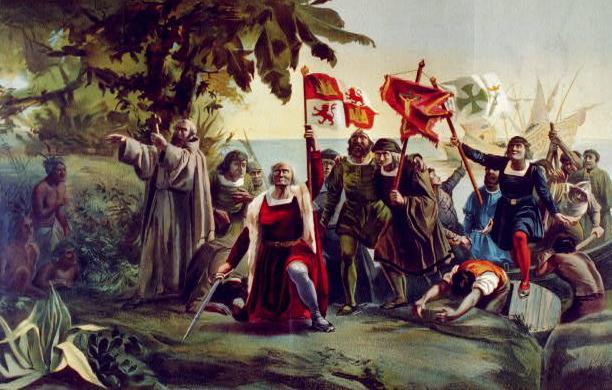
In August 1492, Columbus departed Spain with three ships – the Santa Maria, the Pinta, and the Santa Clara (nicknamed “the Nina”). After two months on the high seas, land was spotted. Now, before they had left, King Ferdinand and Queen Isabella had promised to whoever spotted land first a reward of a silken jacket and an annuity of ten thousand maravedis. The lookout on the Pinta was Rodrigo de Triana and he was the first to spot land. He shouted to the rest of the crew down below, and the Pinta’s captain announced the discovery with cannon fire. When it came time to receive the reward though, Columbus claimed he actually saw a light in the distance several hours prior to Triana’s shout, “but it was so indistinct that I did not dare to affirm it was land.” The reward reportedly went to Columbus.
Upon landing on the island, which he would call San Salvador (present-day Bahamas), Columbus immediately went to work finding gold and enslaving the native populations. Specifically, Columbus, upon seeing the Arawaks (the peoples of the region) come out of the forests frightened of the men with swords, but bearing gifts, wrote in his journal,
They do not bear arms, and do not know them, for I showed them a sword, they took it by the edge and cut themselves out of ignorance. They would make fine servants . . . with fifty men we could subjugate them all and make them do whatever we want.
As other European visitors would observe, the Arawaks were legendary for their hospitality and their desire to share. Again saying Columbus about the Arawaks, “are so naive and so free with their possessions that no one who has not witnessed them would believe it. When you ask for something they have, they never say no. To the contrary, they offer to share with anyone.”
Columbus quickly took advantage of this. Seeing that they wore gold studs in their ears, he rounded up of a number of Arawaks and had them lead him to where gold was. The journey took them to present day Cuba and Haiti (but Columbus thought it was Asia), where they found specks of gold in the river, but not the enormous “fields” Columbus was expecting. Nonetheless, he wrote back to Spain saying that, “There are many spices, and great mines of gold and other metals.” This report earned him financing for a second voyage, this time with 13 ships and twelve hundred men. While he never ended up filling up these ships with gold, he filled them with another “currency” and one that would have a horrendous effect on the world going forward – slaves.
In 1495, Columbus arrived back in the New World and immediately took 1500 Arawaks as prisoners. Of those 1500, he picked 500 to be shipped back to Spain as slaves (about two hundred died on the journey back), starting the transatlantic slave trade. The rest were forced to find what little gold existed in the region. According to noted historian Howard Zinn, anyone over 14 had to meet a gold quota. If they didn’t find enough gold, they would have their hands cut off.
Eventually, when it was realized there wasn’t much gold in the region, Columbus and his men just took the rest as slaves and put them to work on their newly established estates in the region. Many natives died and their numbers dwindled. In the 15th century, modern historians believe there were about 300,000 Arawaks. By 1515, there were only 50,000 left. By 1531, 600 and by 1650, there were no longer any full-blooded Arawaks left on the islands.
The way Columbus and his men treated the women and children of these populations was even worse. Columbus routinely used the raping of women as a “reward” for his lieutenants. For example, here’s an account from one of Columbus’ friends and compatriots, Michele de Cuneo, who accompanied Columbus on his second journey to the New World, on what Michele did to a native “Carb woman.” Michele wrote that,
While I was in the boat I captured a very beautiful Carib woman, whom the said Lord Admiral [Columbus] gave to me, and with whom, having taken her into my cabin, she being naked according to their custom, I conceived desire to take pleasure. I wanted to put my desire into execution but she did not want it and treated me with her finger nails in such a manner that I wished I had never begun. But seeing that (to tell you the end of it all), I took a rope and thrashed her well, for which she raised such unheard of screams that you would not have believed your ears. Finally we came to an agreement in such manner that I can tell you that she seemed to have been brought up in a school of whores…
Going further, Columbus wrote in a letter from 1500,
A hundred castellanos are as easily obtained for a woman as for a farm, and it is very general and there are plenty of dealers who go about looking for girls; those from nine to ten are now in demand.
As illustrated in a recently discovered 48 page report found in the Spanish archives written by Francisco De Bobadilla (charged with investigating Columbus’ rule at the behest of Queen Isabella and King Ferdinand, who were troubled by allegations of some of Columbus’ acts), a woman who verbally insulted Columbus’ family was stripped naked and made to ride around the colony on a mule. After the trip was done, her tongue was cut out by the order of Columbus’ brother, Bartolomé, who Columbus then congratulated for successfully defending the family’s honor. Needless to say, these and numerous other such acts ultimately resulted in De Bobadilla having Columbus removed from power and sent back to Spain in chains.
After Columbus came, and was forced out, the Spaniards continued his policy of enslavement and violence. In 1552, the Spanish historian and friar Bartolome de las Casas published multiple volumes under the title The History of Indies. In it, he described the collapse of the non-European population. Casas writes that when the men were captured and forced to work in mines looking for gold, rarely if ever returning home, it significantly impacted the birth rate. If a woman did give birth, she would be so overworked herself and malnourished, that she often could not produce enough milk for the baby. He even reported that some of the women “drowned their babies from sheer desperation.”
There are lot more examples, writings, and research that points to one fact – Christopher Columbus was a lamentable individual. Nobody’s perfect- if we restricted celebrated individuals to those who didn’t have any major flaws, we’d have few humans to celebrate- and it’s extremely important to view things in the context of the time individuals lived in. But even in his age, many of his acts were considered deplorable by his peers, which is in no small part why Columbus was arrested for his conduct in the New World. Combined with his truly historic and widespread impact being incidental to what he was actually trying to do (so a little hard to celebrate him for even that side of his life), maybe it is time that we let go of the myths we learned about Christopher Columbus in elementary school and stop celebrating Columbus, the man.
Not surprisingly, due to these many sexual encounters with the natives, STDs ran rampant in the region in Columbus’ time. Further, while it is still somewhat up for debate if Columbus and his crew brought syphilis to the New World or if they brought it from the New World to Europe (the latter generally being the favored theory), what isn’t argued is that Columbus inadvertently quickened and widen the spread of these dangerous diseases on both sides of the Atlantic. Syphilis became a huge problem, historians nicknaming it the “scourge of the Renaissance,” throughout the Americas and Europe. For more on this, see: Why Native Americans Didn’t Wipe Out Europeans With Diseases
Originally published on 2015-01-26
Author: Matt Blitz
Origins of images: Facebook, Twitter, Wikimedia, Wikipedia, Flickr, Google, Imageinjection, Public Domain & Pinterest.
We would like to ask you to consider a small donation to help our team keep working. We accept no advertising and rely only on you, our readers, to keep us digging the truth on history, global politics and international relations.
The missile attack on a US ship off the coast of Yemen was a major news event, but the subsequent follow up story, that it may never have happened, was either ignored by mainstream media or intentionally covered up. The whole thing has the same odor as the Gulf of Tonkin incident that never occurred.Does history repeat itself? Sure does seem like it. That is if you compare America’s entry into the Vietnam civil war, with America’s latest entry into the war in Yemen.Don’t be mistaken, we have been at war with Yemen for a year now. America sided with ...
The contemporary Lithuania uses the official interpretation of bloody events that took place in Vilnius on January 13, 1991 as an ideological foundation for Russophobia-based confrontation with its eastern neighbor. It says “the Soviet soldiers committed an intentional murder of 13 unarmed people and one special operations serviceman”. The truth about what really happened, as well as the doubts over the official interpretation, are punishable crimes.The Lithuanian authorities have been trying to get Algirdas Paleckis condemned by court for some years. He is a young politician and a diplomat, the leader of Lithuanian Socialist People’s Front (SPF), a holder of ...
Prisoners earning 23 cents an hour in U.S. federal prisons are manufacturing high-tech electronic components for Patriot Advanced Capability 3 missiles, launchers for TOW (Tube-launched, Optically tracked, Wire-guided) anti-tank missiles, and other guided missile systems. A March article by journalist and financial researcher Justin Rohrlich of World in Review is worth a closer look at the full implications of this ominous development. (minyanville.com)The expanding use of prison industries, which pay slave wages, as a way to increase profits for giant military corporations, is a frontal attack on the rights of all workers.Prison labor — with no union protection, overtime pay, ...
Many innocent civilians were killed in American military interventions around the world – from Vietnam and Serbia to Iran and Afghanistan, because of the alleged “errors” or “collateral damage” – without consequences for civil and military leadership. In addition to political, military and every other power, Americans secured itself with legal mechanisms.Twenty-two civilians, wounded and doctors, among them three children, were killed in the American bombing of a hospital in the Afghan city of Kunduz. Americans acknowledged the error and apologized. The President of the United States expressed his condolences, the military leadership announced three independent investigations. “Doctors without borders” ...
It seems that the recent developments in Europe, and in particular the rising secessionism (Catalonia, Flandreau, Corsica, Veneto, Scotland), rings a bell, or rather is reminiscent of certain events. The ensuing ones are shedding more light on the roles of the EU (EEC), the USA, Great Britain and Germany. One wonders to what extent those democracies have been guided by the principles of international law and democracy pertaining to the Kosovo crisis.How much did they appreciate the reports of their (expensive) missions in Kosovo and Metohija (КDОМ, КVМ, ЕCMM) depicting the realities on the ground?To what extent have they been ...
After the Donald Trump administration’s decision to recognize the disputed city of Jerusalem as Israel’s capital and move the US embassy there from Tel Aviv, the national aspirations of the Palestinian people to live in their own state have been severely dashed by Washington’s move. Ever since the formation of the United States, it has been American policy to destroy aspirant nations like the internationally-recognized State of Palestine.The first nation destroyed by the United States was the Cherokee Nation, or Tsalagihi Ayeli, which, beginning in 1794, was slowly decimated by forced removals from territory in Georgia, the Carolinas, Tennessee, Alabama, ...
IntroductionThis article deals with the question of political and human/minority rights in the region of Kosovo & Metohija twenty years after the „2004 March Pogrom“ and twenty-five years after NATO's military aggression on Serbia and Montenegro and occupation of the region. An importance of this research topic is in fact that for the first time in European history, a terrorist-style and mafia-ruled (quasi)independent state was created by a full diplomatic, political, economic, military, and financial sponsorship by the West under the umbrella of the NATO's and the EU's protective administration. The precedence of Kosovo's self-proclaimed independence in February 2008 already ...
No matter where you grew up in the United States, there’s a good chance you’ve seen the Confederate flag. Perhaps on a bumper sticker or license plate, or hanging outside a home or government building. You may have seen it at school, like 15-year-old Aleah Crawford, when in 2019, she led a protest to ban the rebel flag as part of the dress code. If you haven’t seen it, and don’t know much about it, now is the time to be informed. That’s because this flag has a particularly controversial place in US history.“People find the flag offensive because they ...
March 16, 2017, was the 49th anniversary of the My Lai Massacre, located in Quang Ngai Province, Vietnam. It was Saturday morning, March 16, 1968, when approximately 115 U.S. Army soldiers of the Americal Division’s Charlie Company, 1st Battalion, 20th Infantry, landed in helicopters just outside the village of My Lai 4. Over the course of the next four hours, these American soldiers, and their Military High Command, who were flying overhead in helicopters observing the massacre, took part in a horror show far beyond the human imagination. They took the term, “War Crimes,” and added a butcher shop to ...
It is now fully five years since the greatest upheavals in the modern history of the Arab World started in Tunis. Always impressed by the latest events, we tend to forget the deep roots of the current violent struggle. But unless we confront the causes, there is little chance that the symptoms will be healed.(A partial version of this article in Spanish was published earlier in Free Haifa)The wave of refugees that has reached Europe and the terror attacks in Paris reminded many people in Europe and beyond of the crisis in our region – but at the same time ...
Wednesday, December 5, 2012, the Albanian Prime Minister Sali Berisha advocated granting Albanian citizenship to all Albanians, wherever they reside. This statement was made during a visit of the city of Vlora where the independence of the Albanian state was declared, only 100 years ago. At the time Albania had just liberated itself from Ottoman rule.This declaration follows a separate statement, collective this time, that Sali Berisha had made with his Kosovar counterpart Hashim Thaci a few weeks ago, promising the union of all Albanians. The place was, I must say, well chosen since the vast majority of the inhabitants ...
Grenada is an independent state, a member of the U.N., located in the southern portion of the Caribbean Sea very close to the mainland of the South America (Venezuela). The state is composed by southernmost of the Windward Islands combined with several small islands which belong to the Grenadines Archipelago, populated by almost 110,000 people of whom 82% are the blacks (2012 estimations). The state of Grenada is physically mostly forested mountains’ area (of volcanic origin) with some crater lakes and springs. In the valleys are bananas, spices and sugar cane grown. The country is out of any natural wealth ...
Due to the international media’s continued claims about the «annexation of Crimea», it’s been difficult for the citizens of the US and Europe to make sense of the details of the peninsula’s recent history. Exactly three years ago, on March 16, 2014, the Crimeans were offered a choice: to rejoin Russia or to return to the constitution of 1992 that proclaimed Crimea a legal, democratic, secular state whose relationship with Ukraine was based on bilateral agreements. That constitution was unilaterally abolished by Kiev on March 17, 1995, and here’s what’s surprising: no one at that time in the West demanded that the Ukrainian ...
After the Russian military victory over the Ottoman Empire in the 1877−1878 Russo-Ottoman War it was signed the San Stefano Treaty between these two states on March 3rd, 1878. According to the treaty, a Greater “San Stefano” Bulgaria, under the direct protection by Russia, had to be established within the borders of the Ottoman Empire. However, an idea of “San Stefano Bulgaria” directly affected three Balkan nations: the Serbs, Greeks and Albanians as some of their ethnic and historical territories had to become part of a Greater Bulgaria. The “San Stefano Bulgaria” was projected by the Russian authorities to cover ...
The U.S. military base in Kosovo was constructed in 1999 without consulting with the government of Serbia and is the largest U.S. military base built outside of the U.S. since the Vietnam War. The site was apparently used for extraordinary renditions and has been referred to as a “little Guantanamo”. This is a very little known fact as NATO, the U.S., the European Union and the West are in the process of forcing Serbia to effectively give up Kosovo, and indicates the real motive for the West’s support of the Kosovo Liberation Army which it had deemed a terrorist organization ...
What do you think of when you hear the name Colonel Gaddafi? Tyrant? Dictator? Terrorist? Well, a national citizen of Libya may disagree but we want you to decide.For 41 years until his demise in October 2011, Muammar Gaddafi did some truly amazing things for his country and repeatedly tried to unite and empower the whole of Africa.So despite what you’ve heard on the radio, seen in the media or on the TV, Gaddafi did some powerful things that are not characteristic of a “vicious dictator” as portrayed by the western media.Here are ten things Gaddafi did for Libya that you may not know about…1. In Libya a home is ...
United Nations Security Council Resolution 1244 (1999) guaranteeing sovereignty and territorial integrity of Serbia and the autonomy of Kosovo and Metohija within Serbia, is the highest binding legal document that obliges all UN members, including the member states of the EU, NATO, the OSCE, the OIC, the African Union.Resolution 1244 is the only reliable basis and the framework for any negotiations concerning status. Owing to grave mistakes made by the former Serbian authorities, the UN system has produced certain damaging documents of advisory and non-binding character. It is vital that no similar or even greater mistakes are made either presently ...
Some of those currently advocating bombing Syria turn for justification to their old faithful friend “humanitarian intervention”, one of the earliest examples of which was the 1999 US and NATO bombing campaign to stop ethnic cleansing and drive Serbian forces from Kosovo. However, a collective amnesia appears to have afflicted countless intelligent, well-meaning people, who are convinced that the US/NATO bombing took place after the mass forced deportation of ethnic Albanians from Kosovo was well underway; which is to say that the bombing was launched to stop this “ethnic cleansing”. In actuality, the systematic forced deportations of large numbers of people from Kosovo ...
If the danger of the anti-Putin, anti-Russian disinformation propaganda campaign out of the Pentagon and promoted by the US corporate media weren’t so serious, the effort itself might be laughable. I did laugh.In fact, listening last night to a discussion by an NPR host with a government spokesperson about the latest propaganda effort to blame the downing of a Malaysian jumbo jet over Ukraine on July 17, 2014 on Russia. After hearing the government official, whose name I didn’t catch, say that Dutch prosecutors had found “solid evidence” that it was a “Russian-made” BUK antiaircraft missile launched from “pro-Russian” rebel ...
Seventeen years ago today, on March 24, 1999, NATO began a 78-day deadly and devastating U.S.-backed intervention of Yugoslavia. It was the first time in history that the North Atlantic Treaty Organization decided they would attack a country without the approval of the U.N. Security Council.Nineteen countries took part in the aggression led by the United States that was supposed to stop the repressive activities of the Slobodan Milosevic government and to establish a framework for its Southern province, Kosovo, under international law. Milosevic was president of Serbia from 1989 to 1997, and of Yugoslavia from 1997 to 2000.The attack was ...
The magazine is covering the research gaps uncovered by global Western hoax mainstream media platforms and academic teaching & research institutions.
This is an alternative information & academic research digest platform with the purpose to offer an alternative “another side of the truth”.
The magazine is independent, private, and free of any influence by any institution, organization, government, or pressure group. URL: www.global-politics.eu