
The Baltic States, a long dormant political issue, reactivated itself following the Ukrainian coup of 2014, as the leaders of these states believed that they could benefit from fanning the flames of conflict. In that they were likely mistaken, as the status of the Baltics in the future of the European order is far from certain [...]
The political and, in some cases, military stand-off between the West and Russia that has unfolded over Ukraine and Syria also includes a number of secondary fronts in which the two actors’ interests clash.
The Baltic States, a long dormant political issue, reactivated itself following the Ukrainian coup of 2014, as the leaders of these states believed that they could benefit from fanning the flames of conflict. In that they were likely mistaken, as the status of the Baltics in the future of the European order is far from certain.
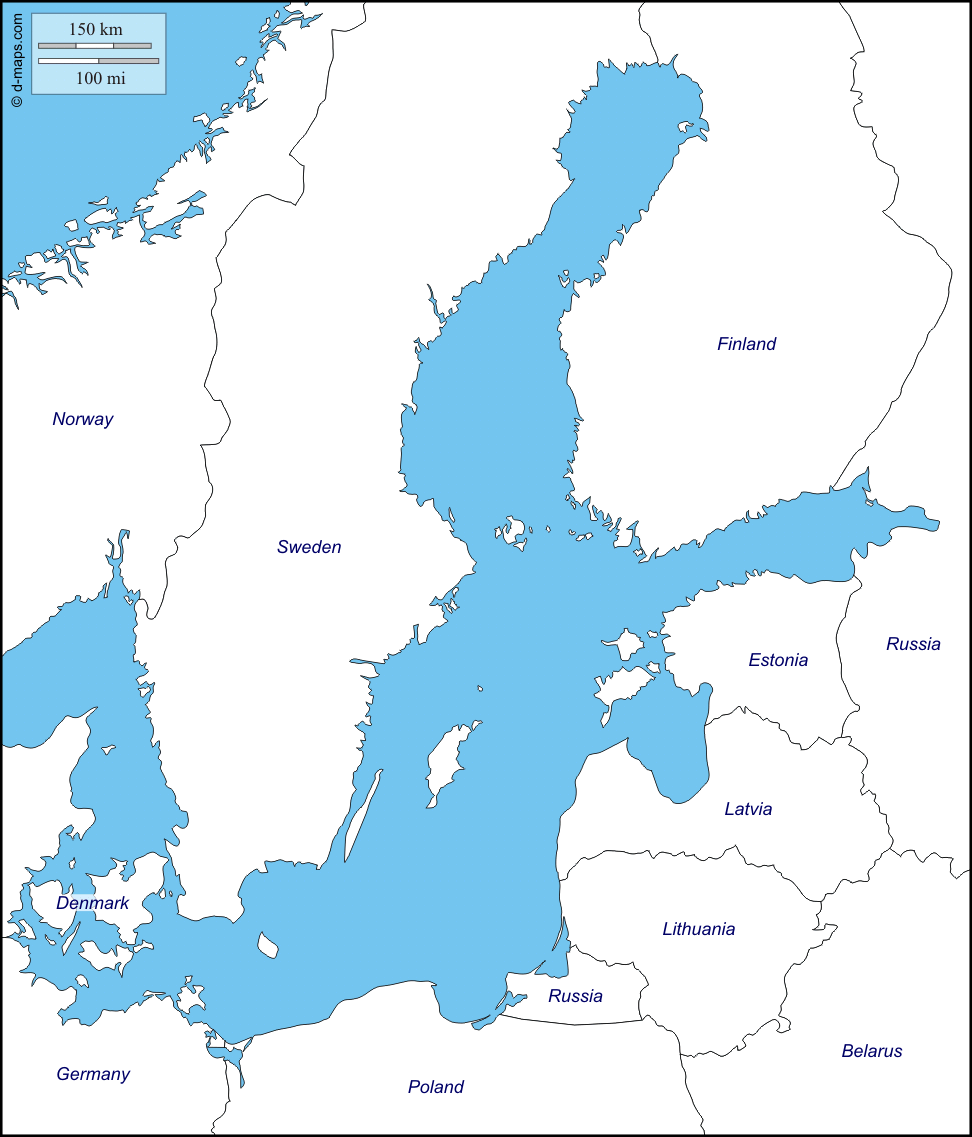
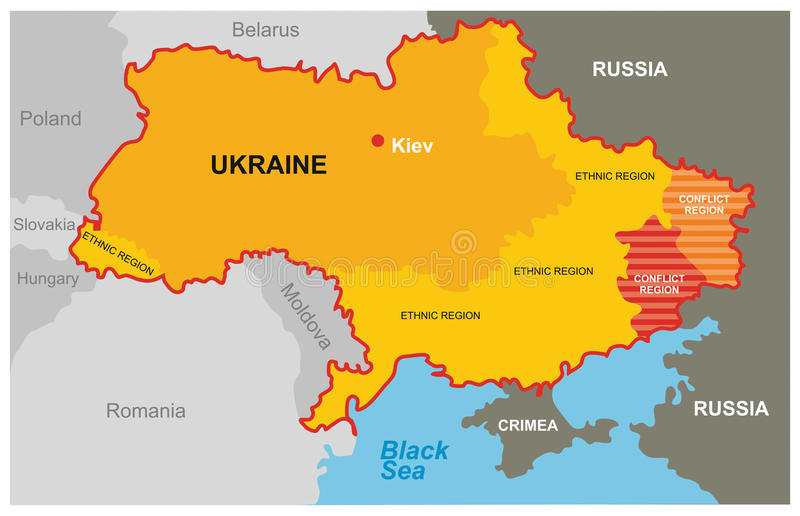
The coup in Ukraine and the subsequent defection of Crimea from Ukraine to Russia followed by the attempted secession of the Donbass prompted the leaders of the Baltic States to claim that they were the next target of the “resurgent Russian imperialism” that sought to restore the USSR via a variety of “hybrid war” measures. Perfectly normal peacetime activities, such as Russian military maneuvers in the European part of Russia, Baltic Fleet exercises, or military flights over the Baltic Sea were suddenly depicted as somehow illegitimate and aggressive. This approach had a twofold rationale: first, it sought to delegitimize ethnic Russian organizations and parties in the Baltics which counter the worst discrimination regime in Europe, one that deprives many ethnic Russians of citizenship in countries in which they reside. Secondly, the “look, look, Russia is attacking us too” card was intended at securing economic and military assistance from EU and NATO that, in 2014, seemed to pour to the front-line states for their new “Cold War” against Russia.
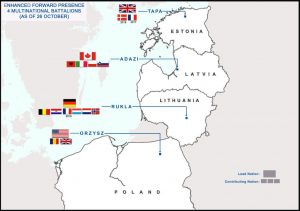
These hopes so far look misplaced. While NATO maneuvers on the Baltic Sea and on the territories of its “eastern flank” states make headlines, so far, they are far less than what meets the eye. NATO’s bark is still considerably worse than its bite. The most significant indicator of NATO intentions is the construction of permanent bases and logistical infrastructure. Thus far, the eastern-most permanent NATO presence appears to be in Poland, in the form of expanded logistical presence and a Polish-led divisional headquarters that, in the event of war, would coordinate the actions of Polish and Baltic States military formations. However, even the supposedly “permanent” US troop presence in Poland is limited to brigade rotations, deployed away from their permanent bases in Germany or even the United States. Those rotating brigades then spin off battalions on forays into the Baltics where they make use of local bases and training grounds, but with no indication of intent to settle for the long run. Other NATO countries have also contributed units to exercise in the Baltics, and the three countries still benefit from NATO air policing mission, which collectively makes them a significant security drain for NATO member-states. All in all, NATO actions are a response the shock at Russia’s ability to mount major surprise operations with hardly a warning from NATO’s intelligence services. They are unlikely to be a real effort in bolstering the Baltics’ defense posture, which, in any event would be a very expensive proposition.
The center of gravity of Baltic States politics are their economics. During the Soviet era, the three countries were significant manufacturing centers, well integrated into the overall economy of USSR. Following independence and the eventual EU integration, their economies have deteriorated to the point, that the single most important economic activity is transit of goods between the EU to Russia (and, to a lesser extent, China) and vice versa. In that respect, they are no different from Ukraine, whose economy also heavily depends on transit of goods between the East and the West. The closest Western European equivalent would be the Netherlands and Belgium, whose economies by themselves would not justify the existence of Rotterdam and Antwerp as the largest and second largest sea-ports in Europe. By the same token, Estonia has the ice-free port of Muuga, Latvia boasts of Riga, Liepaja, and Ventspils, and even Lithuania’s economy benefits heavily from the port of Klaipeda. All of these facilities were built by the USSR in order to provide commercial links to the rest of the world, and now they are the cornerstones of these countries’ economies. Imagine for a minute what will happen to the economies of the Netherlands and Belgium, if they decide to declare a “hybrid war” on the EU. This gives a glimpse of the effect that the Russia-West confrontations have on the economic viability of the Baltic states. Even though they are members of the EU and, in the case of Estonia, they have not succeeded in reorienting their economies westward, toward the EU which, frankly, has a very limited need for these countries. Russia’s response in the form of expanding maritime infrastructure in its own Baltic regions, and more recently, requesting that Belarus refrain from using Baltic States’ terminals to export its refineries’ and products from processing Russian petroleum, therefore represents a very effective means of political pressure particularly since the EU, is already planning to limit the structural adjustment subsidies for its Eastern European members, can hardly be expected to come up with the billions of euros necessary to offset the cost of losing Russian transit business. Even in the best of times, the “Baltic Tigers” have experienced major demographic problems due to the rise in emigration and the decline in birth rates, with the resulting aging of the population likely to place a major strain on the countries’ finances.
If anything, the Baltic States are expected to stop being net subsidy recipients and become active energy consumers from the West which will make the dilemma facing the Baltic States even more acute. Nowhere is this more evident than in the construction of LNG terminals in Klaipeda, Lithuania, and Swinoujscie, Poland, and the plans to construct the “Baltic Pipe” gas pipeline linking Poland with the natural gas deposits in the North Sea. Collectively, and consistent with the at least decade-old US aim to achieve dominance of the global energy markets, these efforts are supposed to “wean” the Baltic States off Russian oil and natural gas and replace them with more costly Western imports. In a way, this makes the Baltics’ the victim of their own policies because, as Donald Trump made clear on a number of occasions, buying US LNG is the price these countries must pay for protection provided by the US troops against “Russian aggression”.
However, the US is not the only country with designs on the Baltics. Poland has reactivated its interest in these countries, all of which at some point where part of the Polish-Lithuanian Commonwealth. The fact that Baltic Pipe would run through Poland appears to be part of the effort to recreate a Polish “sphere of influence” expanding into the Baltics. Sweden, whose sovereignty also used to expand into the Baltics, is also seeking a greater political role through the Nordic Council, in which the Baltic States all possess observer status, and whose activities have been endorsed by recent US administrations.
It is not clear whether the current Baltic governments can easily reverse course, given the empowerment of nationalists in each of the three countries. However, the combination of Russia-West conflict, EU retrenchment and renewed focus on integration among its core states, the political pressure exerted by Poland and the US, and the continued loss of Russia-Baltic economic ties may lead to a rapid deterioration of these countries economies with entirely unpredictable political and even military consequences.
We would like to ask you to consider a small donation to help our team keep working. We accept no advertising and rely only on you, our readers, to keep us digging the truth on history, global politics, and international relations.
Part IPart IIThe Grand Duchy of Lithuania in Vitezović’s anthropological-political ideologyOne of the most significant questions of our interest, which needs a satisfactory answer, is: Why P. R. Vitezović considered Lithuania as a Croato-Slavonic land, and therefore, Lithuania’s inhabitants as the Croato-Slavs?The most possible and realistic answers to this question are:1) Because of the historical development of the Grand Duchy of Lithuania, which brought the ethnic Lithuanians into very closer cultural relations with the Slavs (the Eastern and the Western) that resulted in the graduate process of Slavization of Lithuania’s cultural life and Lithuania’s ruling class. This historical fact influenced ...
I am a Lithuanian, but I leave abroad and I am not going back. At least now, at least until the Government does not pay attention to its people. According to some authoritative research institutes, during 2017 Lithuania population is again projected to decrease (by 45 677 people!) and reach 2 758 290 in the beginning of 2018. (http://www.worldometers.info/world-population/lithuania-population/). As of 1 January 2017, the population of Lithuania was estimated to be 2 803 967 people. This is a decrease of 1.63 % (46 433 people) compared to population of 2 850 400 the year before. In other words, our ...
Foti, a 60-year-old high school teacher from Chicago, made the pledge to her dying mother 18 years ago. She has spent a long time studying the life of her grandfather, Jonas Noreika, as well as acquiring the writing skills necessary for chronicling it and finding a publisher.Barring unexpected delays, Silvia Foti is months away from fulfilling an old promise that’s become her life’s work: to write a biography of her late grandfather, who is a national hero in his native Lithuania.But rather than celebrating Noreika’s legacy as her mother requested, the biography that Foti wrote confirms and amplifies the findings ...
Latvia is actively preparing for one of the most important political events of the year. Parliamentary elections will take place on October 6, 2018. Submission of the lists of candidates for the 13th Saeima elections will take place very soon – from July 18 to August 7, 2018. But the elections campaign as well as all political life in the country face some problems which require additional attention from the authorities. And these problems spoil the image of Latvia as a democratic state which respects the rights of its people.This is a well-known fact, that the image of the state ...
On August 9 [2020], presidential elections were held in Belarus with five candidates bidding to be head of state. According to the Central Election Commission, the incumbent president, Alexander Lukashenko, won in the first round with over 80% of the votes. Mass protests began in Belarus right after the announcement of the preliminary election results. People went to the streets, expressing their dissatisfaction with the results of the elections that they believe were unfair. Mass protests turned into riots and there were clashes between rioters and the police. Many people were detained and injured, and two protestors died.Representatives of the ...
The stars came out in Hollywood on November 2nd, or at least some of them did. The gala event celebrated the Israel Defense Forces (IDF) and raised funds to support its mission in Israel itself and on the occupied West Bank. The organization being fêted was the Friends of the Israel Defense Forces (FIDF), which has fourteen regional offices in the United States and operates under the slogan “Their job is to look after Israel. Our job is to look after them.” In attendance were Arnold Schwarzenegger and actor Gerald Butler. Entertainment was provided by the singer Seal.Hollywood Jewish royalty ...
Yet again, a conference here in the Lithuanian capital dedicated to combating fascism and antisemitism is announced, without there having been a public call for papers, without a single speaker from among those who actually combat fascism and antisemitism in the country, with nobody from the democratically elected Vilnius Jewish community (not even the long-time editor of Jerusalem of Lithuania who has exposed and combated antisemitism for decades). No Holocaust survivors. None of the nationally relevant questions of the day can be found on the conference program. As ever, outstanding academic personalities from abroad are recruited to lend the gravitas and provide serious papers ...
I am surrounded by sea of people, all marching with torches. A chant begins: Lye Tu Vah! Lye Tu Vah! Lye Tu Vah! The chant becomes a roar and then dies away. It is patriotic Lithuanians shouting out the name of their country as they march through the streets of their capital city, Vilnius. We are celebrating the 101st anniversary of the restoration of Lithuania as an independent state. I feel a great surge of emotion as I join the chanting, swept away by the love these people feel for each other and for their land.We march to Cathedral Square, ...
The logical question is whether Putin's military action of pacification of NATO extremists and denazification of Eastern Europe will stop in Ukraine (called by some commentators on social networks Nazikraine) or will the action continue in the direction of the west, i.e., to Central Europe and/or the Baltic States?Of course, at this moment, it is difficult to predict what the development of events will be in the next period, especially when this current operation in Ukraine is not completely finished. However, one thing is certain: analogous to the case of Ukraine, it can be predicted that Russia's next step depends ...
For the 11th year running, the center of Lithuania’s beautiful capital, Vilnius, was gifted in the high afternoon hours this past Sunday, March 11th, to far-righters and neo-Nazis on the annual holiday cherished by the free world for its historic importance, in 1990, in the series of events that toppled the Soviet Union’s hated misrule. The Defending History community, all resolute admirers of Lithuania who celebrate its success, has monitored this event annually. The international outcry after the 2008 event, which featured “Juden raus” and a throng of swastikas had led to curious “compromises” each year between organizers and the municipality ...
The contemporary Lithuania uses the official interpretation of bloody events that took place in Vilnius on January 13, 1991 as an ideological foundation for Russophobia-based confrontation with its eastern neighbor. It says “the Soviet soldiers committed an intentional murder of 13 unarmed people and one special operations serviceman”. The truth about what really happened, as well as the doubts over the official interpretation, are punishable crimes.The Lithuanian authorities have been trying to get Algirdas Paleckis condemned by court for some years. He is a young politician and a diplomat, the leader of Lithuanian Socialist People’s Front (SPF), a holder of ...
Kaunas, Lithuania, June 1941 (before Germans arrived): Killing of the Jews by local LithuaniansFor the tiny village of Sukioniai in western Lithuania, the exploits of General Storm, a local anti-Communist hero executed by the Soviet secret police in 1947, have long been a source of pride. The village school is named after him, and his struggles against the Soviet Union are also honored with a memorial carved from stone next to the farm where he was born.All along, though, there have been persistent whispers that General Storm, whose real name was Jonas Noreika, also helped the Nazis kill Jews. But ...
The title page of Rūta Vanagaitė’s best-known book contains two pictures of young men. “This one is a Jew,” she said, pointing at the picture on the left. “He was a bicycle-racing champion. Good enough to represent Lithuania in international competitions, but not good enough to live.” He was executed during the Holocaust. The man in the picture on the right was a Lithuanian executioner. “They are both us,” Vanagaitė explained. “But Lithuanians don’t like to think of them as ‘us,’ because one is a Jew and the other is a killer.” Her book is called “Us.” (The title has ...
Lithuania’s Foreign Minister Linas Linkevicius is no ordinary diplomat. He is more a diplomatic hitman whose ideological mission is to blow holes in European-Russian relations at every opportunity.One of his recent “jobs” was to write an op-ed for the Irish Times in which he castigated the European Union for appeasing Russian President Vladimir Putin. Linkevicius used a hoary old historical analogy comparing the EU with British leader Neville Chamberlain and his appeasement in 1938 of Nazi Germany’s Hitler.Apart from the ignorant historical waffling, the other curious thing about Linkevicius’ op-ed piece in Ireland’s so-called “paper of record” was the timing. It was ...
DELFI, which is the major Internet portal in the Baltic States providing daily news, stated on September, 10 that the number of emigrants from Lithuania exceeds that of immigrants by 1,000 in August. Shocking statistics shows that the country has registered a negative migration balance. Some 4,382 people left Lithuania in August. Thus, Lithuanians are leaving the country despite authorities’ claims on economic growth, stability and favorable perspectives.On the one hand, according to “Lithuanian economy review – 2017”, the GDP growth in Lithuania accelerated. In 2017, as compared to the previous year, Lithuania`s GDP increased by 3.8%. (http://ukmin.lrv.lt/en/economy-review/lithuanian-economy-review-2017) On the ...
The term “security” is a very multifaceted one. But today’s geopolitical situation forces us to think about its military aspect above all.Our attention is completely absorbed by news about wars, conflicts, military exercises and increasing defence capabilities. An average European reader has no chances to skip this kind of news while looking through news feeds of popular media.Even planned further militarization of the European region and Russia pose the real threat today. A whole generation of European children is growing in the firm belief that the war is approaching. We destroy ourselves by our fears. We notice everything concerning military ...
Yom HaShoah/Holocaust Remembrance Day: A state-sponsored institution in Vilnius rewrites history to the delight of Europe’s new ultranationalistsThis past winter here in Vilnius, the charming capital of Lithuania, was much like any other. During long solid weeks of subzero temperatures, as the flow of tourists and roots-seekers slowed to a trickle, I adjusted the route of my daily walk to pass by up to a dozen top tourist sights. Day after day, there was one constant: The most popular, winter-defying “must-visit” for foreigners is “The Museum of Genocide Victims.” Perhaps there is something grotesquely sexy about “genocide.” Maybe the promise ...
On March 29 Latvia, Lithuania and Estonia will celebrate 15 years of becoming NATO member states. The way to the alliance membership was not simple for newly born independent countries. They have reached great success in fulfilling many of NATO demands: they have considerably increased their defence expenditures, renewed armaments and increased the number of military personnel. In turn, they get used to rely on more powerful member states, their advice, help and even decision making. All these 15 years they felt more or less safe because of proclaimed European NATO allies’ capabilities.Unfortunately, now it is high time to doubt. The ...
Congratulations to the city of Kaunas, Lithuania, once known also as Kovno (in Yiddish Kóvne) on its selection as Europe’s “Capital of European Culture” in 2022, sharing the title with Esch-sur-Alzette in Luxembourg.The city’s leaders now have a splendid opportunity to take the moral high road in dealing with a number of ghosts from the present and the past. To start with the present, will the city’s officials now act rapidly to avoid a public perception disaster by moving this year’s neo-Nazi parade away from the city center during the February 16th Independence Day celebrations? Previous years’ marches have on occasion glorified actual Kaunas Holocaust collaborators, causing deep pain to Survivors ...
In June and July 1941, detachments of German Einsatzgruppen, together with Lithuanian auxiliaries, began murdering the Jews of Lithuania. Groups of partisans, civil units of nationalist-rightist anti-Soviet affiliation, initiated contact with the Germans as soon as they entered the Lithuanian territories. A rogue unit of insurgents headed by Algirdas Klimaitis and encouraged by Germans from the Sicherheitspolizei and Sicherheitsdienst, started anti-Jewish pogroms in Kaunas (Polish: Kovno) on the night of 25–27 June 1941. Over a thousand Jews perished over the next few days in what was the first pogrom in Nazi-occupied Lithuania. The most infamous incident occurred in what was ...