
How to Combat Croatian Revisionists’ Culture of Lies
Stories of resistance to Croatia’s fascist Ustasa can help counter revisionists’ attempts to rehabilitate the World War II regime and whitewash the truth about its concentration camp at Jasenovac and its role in the Holocaust [...]
In early 1944, Mirjana Babunovic-Dimitrijevic, a 22-year-old middle-class woman living in Sarajevo, was arrested by the Ustasa police. After she was arrested along with her mother and aunt, they were all deported to the Jasenovac concentration camp, for refusing to convert to Catholicism. All three women died there in late 1944.
These women were among more than 80,000 victims who perished at Jasenovac between 1941 and 1945. While we don’t know precisely how they died nor what happened during their short lives in the camp, two things are certain.
First, their deaths were the direct result of deliberate political decisions. Second, they died not because of anything they had done but because of what they were. They died because they were different in a state which not only criminalised difference but considered it legitimate grounds for extermination.
The Jasenovac death camp
To listen to Igor Vukic, a guest on the popular afternoon chat show ‘Dobar Dan Hrvatska’ (‘Good Day Croatia’) on Croatian Radio-Television, HRT last week, was to enter a parallel universe in which Jasenovac was not a concentration camp but rather a ‘labour and collection camp’ for opponents of the regime, in which inmates like Mirjana were offered opportunities to learn new professions and skills, given access to drama clubs and sporting facilities and treated with compassion by Ustasa guards.
The furore caused by the appearance of Vukic, a former journalist and the secretary of the Society for Research of the Threefold Jasenovac Camp, on a popular afternoon show, is, in some ways, hard to understand. After all, Vukic and other revisionists have been making the rounds of television shows for years, promoting their theories.
Yes, it’s true there was something slightly shocking about how normalised the set up was: the hosts even thoughtfully plugged the society’s book about Jasenovac to viewers at the end of the segment.
But leave aside the prime-time kitsch, and the episode only seems outrageous if you ignore the past 25 years of public discourse in Croatia about the Holocaust and the Ustasa regime.
Which isn’t to say that people shouldn’t be alarmed by what’s happening now: they should.
I would argue there are two reasons why last week’s programme has cuased such a stir. First, unlike the revisionists of the Tudjman era who tended to minimise the crimes of the Ustasa regime or only rehabilitate only certain aspects of it, the new cohort of revisionists are, by their own admission, aiming to rehabilitate the regime in its entirety.
Second, revisionism in the 1990s had its strongholds in the academy and mainstream politics which had a constraining effect on all but the most committed acolytes.
Now, in an age of mass media it has migrated to media platforms. Revisionism hence seems more prevalent and dangerous now because it has essentially become a branch of the entertainment industry, amplified by the ubiquity of social media.
But no one should be so naïve as to think the current wave of revisionism began last week or even two years ago. The problem goes much deeper than that.
Arguably, Croatia’s leaders have never really known how to deal with the legacy of the Ustasa regime and Jasenovac, the most enduring symbol of its terror.
The narrative offered by the victorious Partisans provided a useable model, initially at least, emphasising the mass participation of Croats in the Partisan movement and the marginality of the Ustasa movement while placing most of the blame on the German occupiers. This was not exactly false but it was a simplified and idealised version of the truth.
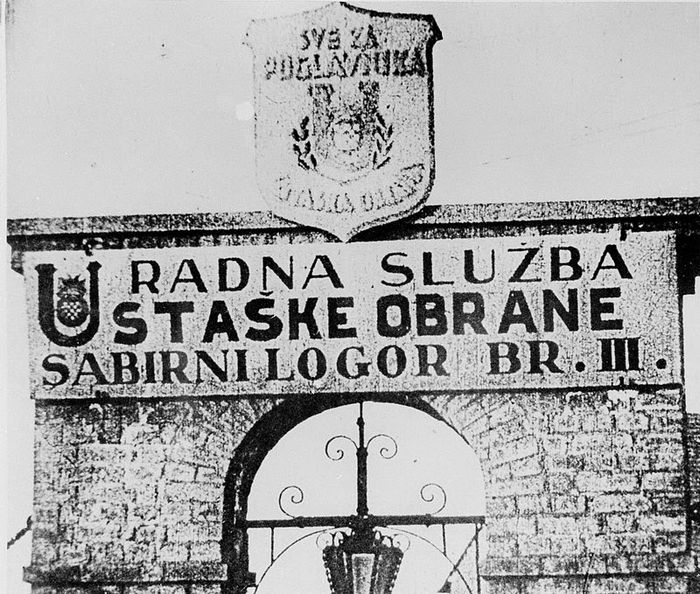
The entrance gate to the Jasenovac death camp
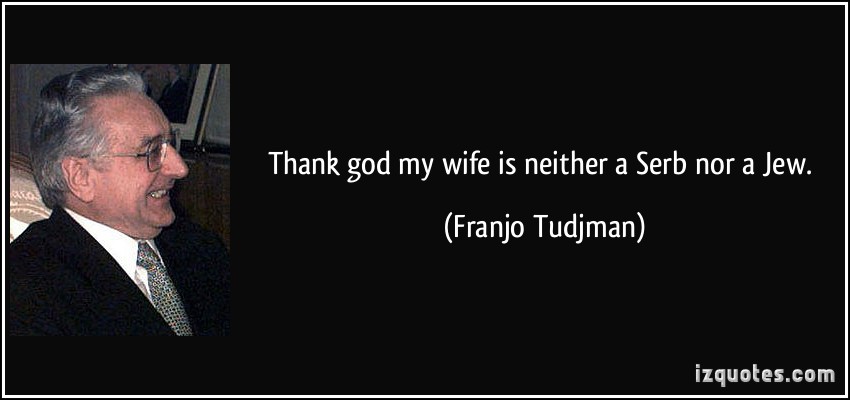
The government of Franjo Tudjman, by contrast, offered a different kind of resolution, combining Ustasa nostalgia and Holocaust minimisation with a much more ambitious project to reconcile Croatian fascists and anti-fascists on the basis of their supposed shared fight for an independent Croatian state.
It also linked Croatia’s struggle for independence in the 1990s to the Croatian ‘independence struggle’ of the 1940s under the Ustasa movement.
In the post-Tudjman years, especially during Croatia’s application to join the European Union, Holocaust memory was Europeanised. As Ljiljana Radonic has written, memory culture transformed Jasenovac into a universal story in which the specifically Croatian identity of the perpetrators was pushed to the margins and the role of the Nazi occupation stressed.
At the same time, the narrative emphasised the specifically Croatian role in the ‘good’ parts of the story, in particular the political oppression of the Croats in inter-war Yugoslavia and the mass participation of Croats in the resistance.
The continued ambivalence regarding the Holocaust in Croatia was apparent at the opening of the Jasenovac Memorial Museum permanent exhibition in 2006 which, as a matter of policy, de-emphasised the national identity of both the victims and the Ustasas as well as their crimes.
Natasa Jovicic, the director of the museum, wrote that the exhibition aimed to restore the individuality of the victims, arguing that the collective identity of the victims and perpetrators had been manipulated in the cause of Serbian nationalism in the early 1990s to generate new hatred.
But this argument was misleading. The people who died in Jasenovac, while they were individuals, were incarcerated in Jasenovac precisely because of their perceived collective identity.
Moreover, in linking the World War II and the wars of the 1990s, the museum exhibition actually legitimated a narrative which has become a leit motif of revisionist forces in Croatia in recent years: namely, that commemorating the crimes of the Ustasa movement constitutes an attempt to blacken the name of Croatia, declare the Croats a genocidal people and criminalise the Homeland War.
On the surface, a narrative which implicated not just ordinary Croats but Croatian identity itself in the crimes of the Ustasa movement through linking defence of the Ustasa regime to patriotism should have permanently discredited revisionists.
After all, when it came to power in 1941, the Ustasa movement enjoyed no popular mandate and was very quickly rejected by a large number of Croats. Still today, the majority of Croats reject the legacy of the Ustasa movement.
Moreover, the constitution of the Republic of Croatia states unambiguously that it is founded on the principles of anti-fascism.
That revisionists have seen their influence actually grow in Croatia is a reflection of the weakness of civil society, a testament to the failure of institutions such as the Catholic Church in Croatia to confront their role in the horror of the 1940s and evidence of the increasingly receptive political climate in which groups such as these are operating.
As the recent controversy about the location of the commemorative plaque for fallen Homeland defenders (1990s Croatian war veterans) in Jasenovac illustrates, invoking the sacrosanct Homeland War has become an increasingly profitable strategy for revisionists and Ustasa nostalgists.
It is no coincidence that Vukic has been a frequent guest on right-wing veteran television shows nor that some of the loudest revisionist voices belong to right-wing war veterans.
At the same time, the growing reach of revisionists would not be possible without the funding and support they have received from the Ministry for Veterans.
In 2017, for example, Vukic’s society was awarded 6,700 euros by the ministry to conduct research on archives related to the Jasenovac camp. Meanwhile, a veterans’ group was awarded 2,700 euros for the publication of a collection of revisionist essays about the Ustasa children’s camp at Jastrebarsko, as part of a scheme which awards funds for applications which “promote the values of the Homeland War.”
What can be done? On the one hand, revisionism and Ustasa nostalgia in Croatia is a problem only Croats themselves can resolve. As the protests of 2016 demonstrated, when large numbers of people come onto the streets across Croatia to say enough is enough, politicians notice.
But there are also more modest actions that can be taken. Paradoxical as it might seem, denying crimes against entire groups of people is much easier than negating crimes against individuals.
As much as anything, perhaps, the Holocaust is made up of small stories and the personal lives of the victims, perpetrators and bystanders. In that sense, the failure of Yugoslav historiography to individualise the victims or perpetrators has been a gift to Holocaust minimizers since it has enabled them to dismiss the official history as an anti-Croatian conspiracy and reframe the victims as opponents of Croatian independence.
One of the reasons, I would argue, why Holocaust denial has tended to be marginal in Austria is because there are reminders of the victims of the Holocaust in every neighbourhood where Jews once lived.
Walk down any street in the old Jewish quarter of Praterstern in Vienna, for example, and there are countless street plaques memorialising the dead, many of them right under your feet.
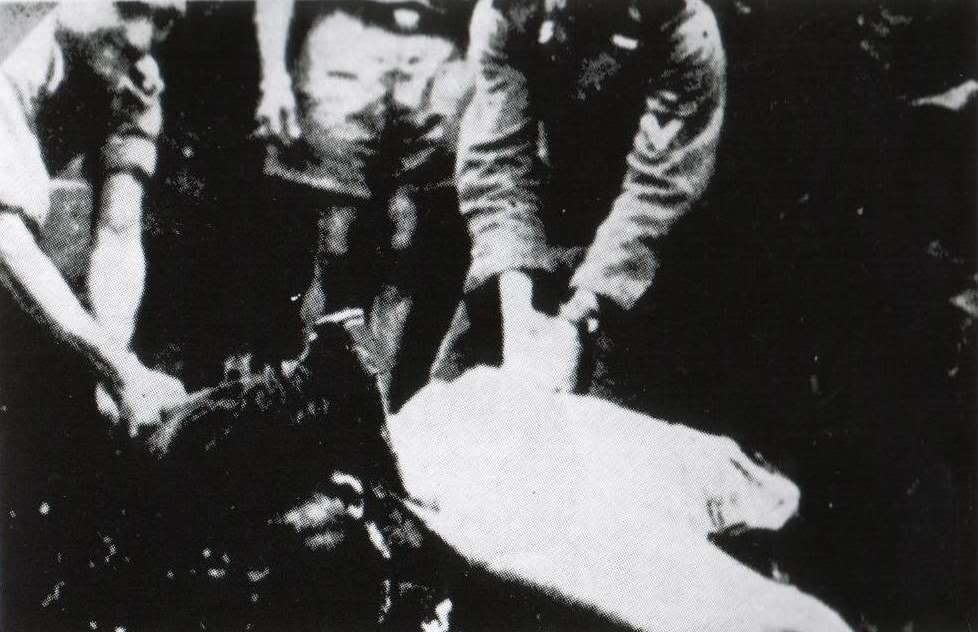
The Jasenovac death camp
By contrast, the buildings in the Derecinova district of downtown Zagreb or Tuskanac are unmarked.
If such an initiative is unthinkable in Croatia at the moment, journalists, researchers and activists can play their part in restoring to the victims of the Holocaust their individuality while emphasising the collective reasons for their fate.
By the time Mirjana Babunovic-Dimitrijevic was arrested by the Ustasa police in 1944, her familiy was scattered: her husband was in Macedonia, her father had long since been detained, one brother was in Dachau, another was a refugee in Serbia. Her identity was the one thing she had which the regime could not take from her.
Her story and the thousands of similar small, personal stories are not only the history of Jasenovac and the Holocaust, but universal stories of resistance and courage.
They are perhaps the most powerful weapon we have in the preservation of a culture of memory and truth against the revisionist culture of lies.
We would like to ask you to consider a small donation to help our team keep working. We accept no advertising and rely only on you, our readers, to keep us digging the truth on history, global politics and international relations.
Most veteran observers, including Israeli security authorities and Palestinian leadership, were dumbfounded by recent events in Jerusalem, where tens of thousands of Palestinians mobilized non-violently in response to the Israeli closure of the Old City and placement of metal detectors at the entrance of the Dome of Rock and Al-Aqsa Mosque. What was the secret ingredient that made such a mass action take place and be a successful example in Palestinian non-violent resistance to the 50 years of Israeli military occupation? How did it happen so spontaneously, non-violently and with seemingly no leadership?A new report by the group, titled, Relations Between Palestinians Across ...
While it is certainly true that the Jewish people have relatively deep roots in the land that is today known as Palestine and Israel, this area has been a crossroads since the origins of the human species. In fact the oldest known Homo sapiens fossil outside of Africa was recently found in modern-day Israel, dated at approximately 180,000 years old. Neanderthal bones have also been found in the Levant.In historical times the Palestine region or parts of it have been controlled by numerous different peoples and regional powers, including the Canaanites, Amorites, Ancient Egyptians, Israelites, Moabites, Ammonites, Philistines, Assyrians, Babylonians, ...
As was expected, President Trump has decertified Iran’s compliance with the nuclear deal or, to give it its full name, the Joint Comprehensive Plan of Action (JCPOA), despite the fact that he certified it twice before. As recently as 14 September 2017, Trump also waived certain sanctions against Iran as required under the terms of the deal. Yet, in an extremely belligerent and hostile speech, he put out his new policy towards Iran.The certification of the deal is not part of the agreement, but as anti-Iranian hawks in both parties wanted to undermine President Barrack Obama and create obstacles on ...
Origins of images: Facebook, Twitter, Wikimedia, Wikipedia, Flickr, Google, Imageinjection & Pinterest.Read our Disclaimer/Legal Statement!Donate to Support UsWe would like to ask you to consider a small donation to help our team keep working. We accept no advertising and rely only on you, our readers, to keep us digging the truth on history, global politics and international relations.
In the thousand year long-history of Serbs, Kosovo and Metohia were for many centuries the state center and chief religious stronghold, the heartland of their culture and springwell of its historical traditions. For a people who lived longer under foreign rule than in their own state, Kosovo and Metohia are the foundations on which national and state identity were preserved in times of tribulation and founded in times of freedom.The Serbian national ideology which emerged out of Kosovo’s tribulations and Kosovo’s suffering (wherein the 1389 St. Vitus Day Battle in Kosovo Polje occupies the central place), are the pillars of ...
America is coming to the rescue of Al Qaeda under a humanitarian mandate. The unspoken agenda is to undermine the Liberation of Aleppo. The pretext and justification for these actions are based on America’s “responsibility to protect” (R2P) the “moderates” in Aleppo from Syrian and Russian attacks and bombing raids.On October 3, the US State Department announced the suspension of bilateral relations with Russia pertaining to Syria (see document below), in response to which, France’s foreign Minister Jean Marc Ayrault was called upon to intermediate at the diplomatic level. Pointing his finger at Russia’s Foreign Minister Sergei Lavrov, Jean Marc Ayrault casually accused Moscow ...
Up to June 1967, a border separated Jews living in Israel and Palestinians residing in the West Bank and Gaza. The Six Day War, which occurred exactly fifty years ago, erased that line. Israel has been occupying these territories ever since. This has been the source of an endless conflict between Jews and Arabs. Who started that war? Having won the war, Israel set out to give an answer to that question which would suit its needs.To cement its hold over the new territories Israel had sought to mold the story of the Six Day. The attempt to frame the ...
As a matter of historical fact, a separate Macedonian ethnonational identity did not exist until the second half of the 19th century. This is partly due to the fact that Macedonia was ruled by Ottoman Empire for a longer period of time: from 1371 to 1912. It is known that Ottoman authorities did not recognize any kind of ethnonational or ethnolinguistic identities but rather only the confessional (millet-system). Therefore, the Christians of Macedonia were not differentiated between themselves on the ethnic bases. Furthermore, Macedonian territories were inhabited by different ethnic, linguistic and religious groups (Slavic- and Greek-speaking Christians, Turkish- and ...
Donald Trump with Larry King on the occasion of the anniversary of the bombing of Serbia criticized Bill Clinton and criminal attack on Serbs, the ally of America in both wars.“The Clintons have made a mess in the Balkans and Kosovo. Look what we did to Serbia in an aerial bombardment from a safe height. Those same Serbs rescued American pilots in World War II.It is a mistake that we bombed a nation that has been our ally in two world wars. The Clintons believe that was a success, and I find it shameful.I extend an apology to all the ...
One of the most complicated and frustrating aspects of operating a global capitalist empire is maintaining the fiction that it doesn’t exist. Virtually every action you take has to be carefully recontextualized or otherwise spun for public consumption. Every time you want to bomb or invade some country to further your interests, you have to mount a whole PR campaign. You can’t even appoint a sadistic torture freak to run your own coup-fomenting agency, or shoot a few thousand unarmed people you’ve imprisoned in a de facto ghetto, without having to do a big song and dance about “defending democracy” ...
The controversy over the canonization of Pope Pius XII concerns whether he spoke out enough against the slaughter of Jews during World War II. But that question is a red herring when trying to grasp the big picture of the Vatican's role during the war. The real question is whether the Vatican supported the world order, or at least aspects of it, that the Third Reich promised to bring, a world order in which dead Jews were collateral damage - which Pius indeed regretted. The answer can be found in a region of Europe that is generally ignored despite being ...
Ante Pavelic - a leader of the Independent State of Croatia with the Roman Catholic clergy Scattered over almost two centuries across the globe – in Germany, the US, Canada, Argentina and Australia – most members of the Croatian diaspora are still closely linked to their homeland.The Croatian state responds in kind; it pledges to take “special care” of Croats living abroad, a pledge outlined in the country’s 1990 constitution. Subsequently, Croatia has set up the Central State Office for Croats Abroad, as well as a government body, the Council for Croats Abroad.More controversially, some in the diaspora maintain close ...
The following text was written in the immediate wake of the 1999 NATO bombings of Yugoslavia and the invasion of Kosovo by NATO troops.It is now well established that the war on Yugoslavia was waged on a fabricated humanitarian pretext and that extensive war crimes were committed by NATO and the US.In retrospect, the war on Yugoslavia was a “dress rehearsal” for subsequent US-NATO sponsored humanitarian wars including Afghanistan (2001), Iraq (2003), Libya (2011), Syria (2011), Ukraine (2014).Who are the war criminals? In a bitter irony, the so-called International Criminal Tribunal for the former Yugoslavia (ICTY) in The Hague is controlled ...
Šį straipsnį paskatino parašyti JAV specialiųjų tarnybų bei Lietuvos politinio elito sukelta ir eskaluojama plataus masto karo su Rusija propaganda ir tautinės nesantaikos kurstymas visame pasaulyje ir ypač Lietuvos viešoje erdvėje. Masinės Vakarų informacinės agresijos prieš Rusiją pretekstu tapo globalinė JAV-NATO karo nusikaltėlių gaujos klastotė 2014-03-16 Krymo pusiasalio gyventojų referendumo rezultatai ir jų pagrindu įvykęs Krymo prisijungimas prie Rusijos, savo istorinės, etninės Tėvynės. Vakarų reakcija į šį absoliučiai teisėtą Krymo gyventojų pasirinkimą, Vakarų inicijuotas ekonominis karas prieš Rusiją yra absoliučiai neteisėti tarptautinės teisės požiūriu – Vakarų sankcijos Rusijai už Krymo prisijungimą yra tik dar vienas globalinis JAV-NATO valstybių tarptautinis nusikaltimas. ...
Calling criticism of Zionism and Israel anti-Semitic turns truth on its head. One has nothing to do with the other.Anti-Semitism reflects hostility or discrimination against Judaism as a religion. Israel is a nation-state. Criticizing its ruthlessness is essential to challenge what’s clearly intolerable. Equating it to anti-Semitism is a bald-faced lie.On Wednesday, proposed House legislation disgracefully conflating the two was introduced in deference to Israel and its US lobby – called the Anti-Semitism Act of 2018.It cites Title VI of the 1964 Civil Rights Act, prohibiting discrimination on the basis of race, color, or national origin.It says nothing about religion, ...
Dietmar Hartwig, former head of the EU (EEC) Monitoring Mission in Kosovo and Metohija (ECMM) in his 2007 warning letter:“MERKEL RESPONSIBLE FOR KOSOVO PRECEDENT AND DIVIDING SERBIAN PEOPLE”It seems that the recent developments in Europe, and in particular the push of secessionism (Catalonia), rings a bell, or rather is reminiscent of certain events. The ensuing ones are shedding more light on the roles of the EU (EEC), the USA and Germany. To what extent have they been guided by the principles of the international law and democracy in the Kosovo crisis? How much did they appreciate the reports of their ...
“And you know, we have this mad guy [Kim Jong-un], I guess he’s mad, either he’s mad or he’s a genius, one or the other, but he’s actually more unstable, even than his father, …” (Donald Trump, August 2016 during election campaign)What was indelible about it [the Korean War of 1950-53] was the extraordinary destructiveness of the United States’ air campaigns against North Korea, from the widespread and continuous use of firebombing (mainly with napalm), to threats to use nuclear and chemical weapons, and the destruction of huge North Korean dams in the final stages of the war. …. (Bruce ...
“To Hell and Back” is a phrase that can bear a pretty heavy metaphorical load when it comes to talking about the atomic bombings of Nagasaki and Hiroshima. It’s also the title of a book by Charles Pellegrino.Pellegrino’s book is a moving and grueling close-up look at the horrors experienced by the people of Hiroshima and Nagasaki both on the day of the bombing and in the days and years afterward. I have the heart of a dried-up raisin but even I got a little teary in places.There are few opportunities for inspiring “triumph of the human spirit” narratives amid ...
Arrest and detention of three days for Joanikije, Bishop of Budimlye and Niksic, and eight priests of the Orthodox Cathedral of St. Basil of Ostrog in Nikšić has sparked tensions in Montenegro again. Namely, after the prayer procession that had been held in Nikšić on May 12th, on the feast-day of St. Basil of Ostrog, a 72-hour detention was ordered for Bishop Jonikije, Fr. Slobodan Jokic, Fr. Danilo Zirojevic, Fr. Zeljko Rojevic, Fr. Ostoja Knezevic, Fr. Mirko Vukotic, Fr. Vasilije Brboric, Fr. Dragan Krusic and Fr. Nikola Marojevic.Protests in support of those arrested have taken place in several cities across ...
The World of ArabsThe world of Arabs (the WoA), as a distinctive part of the globe, is of extreme significance for both global politics and the global economy. On the other hand, this region is featured by slow democratic development, political instability, religious extremism (Islamic fundamentalism), and many reasons for long-time inter-ethnic conflicts especially on the Israeli-Arab relations and regional insecurity. It is quite obvious that the WoA needs comprehensive political, social, and economic reforms which the Arab Spring’s protesters clearly requested in 2010−2013. The crucial issues of reforms are about national development and governance, a succession of political authority, ...