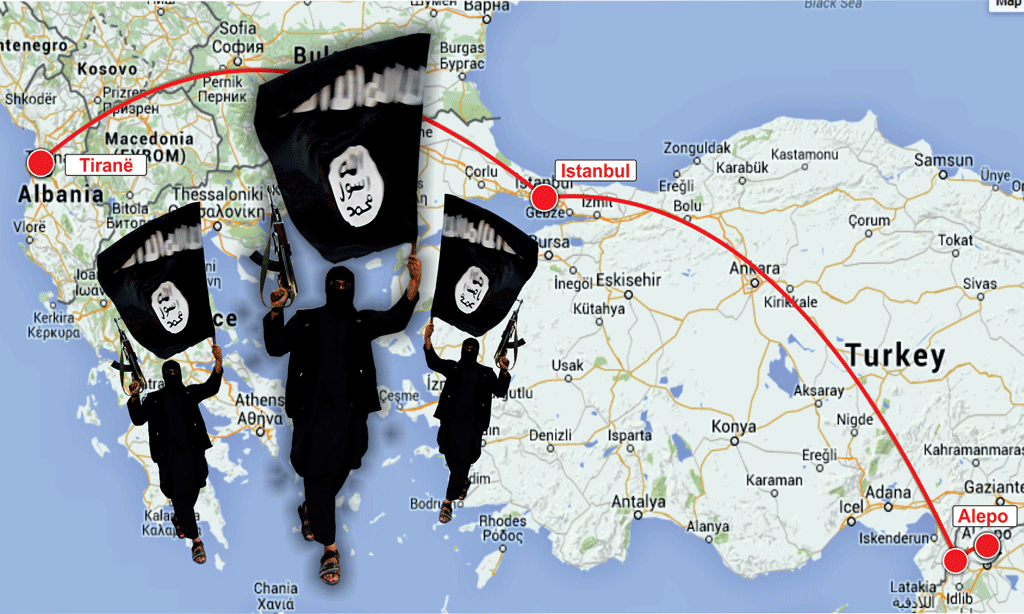

The unexpectedness of the developments is personified by the self-declared commander of the ethnic Albanian fighters in the Islamic State, Lavdrim Muhaxheri, who used to work in Camp Bondsteel, the Kosovo base for the US Military, and later joined the American mission in Afghanistan. Today, he is fighting in the Middle East, streaming his call for jihad in Arabic on YouTube and posting photos of him cutting off a man’s head on Facebook […]
The recent arrest of 40 alleged Islamic radicals in Kosovo together with the arrest of one of the Kosovo Imams suspected of being an inspirer of jihad in the region brought serious questions about the radicalisation of Islam and terrorism in Kosovo, in the Balkans and in Europe. Even though the issue of Kosovo Albanian volunteers or mercenaries fighting alongside the anti-Bashar forces in Syria and supporting the radical leadership of the Islamic State (earlier the Islamic State of Iraq and Syria) has been present in the public debate in Kosovo for at least a year, the debate itself was rather shallow and trivial.
The constant development of Islamic influences in Kosovo remained unnoticed for a long time by most observers. But it was not invisible. The ignorance perfectly represents the power of discourse and clichés in the politics in the Balkans. Kosovo has always been perceived as a secular state with a liberal Muslim majority. Kosovo Islam was meant to be moderate. Kosovo was supposed to be the example of a Muslim state in the middle of Europe that does not struggling with religious and cultural challenges. Kosovo may have problems with trafficking, organised crime and corruption; but not Islam.
Kosovo Albanian Islam is different both from the Arab Gulf Islam, the Islam of the East Bank of the Mediterranean See and Islam in the other Balkan states. It was strongly influenced by the Yugoslav ideas and values, evolved under both socialism and cosmopolitism and is deeply mixed with the Albanian culture, a culture very different from the surrounding Slavic cultures in the region. Until the 1980s, religion in Kosovo was a private thing. Under pressure from the Slobodan Milošević regime, it transformed into a nation-building and freedom-fighting issue.
Finally after 1999, and especially after the 2008 independence, Kosovo Albanian Islam once again became private and non-political. The evolution makes the Kosovo Islam very difficult to frame and control, the changes are happening at the kitchen tables inside homes, just as – in Jeffrey Goldfarb’s words – the dismantling of the Soviet bloc was run by “the politics of small things” initiated in discussions around kitchen tables in Warsaw, Prague and Bucharest.
The growth of importance of religion in Kosovo is happening casually en passant and on a very grassroots level; and so is the social base for recruitment of potential Islam fighters. Several years ago, the holy month of Ramadan was unnoticeable in Kosovo’s capital, Pristina. Today the group of people fasting from dawn to dusk is clearly visible in the city. The usually full cafeterias and restaurants in the main boulevard, boulevard of Mother Theresa, are empty during the day, the city becomes peaceful and quite until the Iftar dinner time comes. The status of traditional Albanian national heroes like Mother Theresa or Skandenberg is now being questioned, as they were Catholics not Muslims. Unlike just a few years ago covered women and men with a beard wearing pants above his ankles is a common sight nowadays in Pristina, not to mention the conservative cities and regions such as Kaçanik or Hani i Elezit.
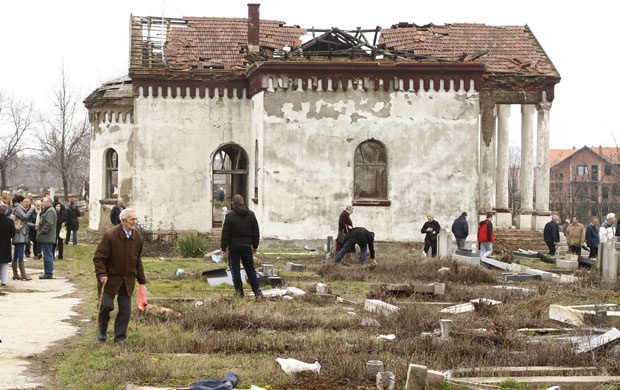
It’s becoming common practice to pay people in their initial phase of religiosity for regular visits to mosques, wearing a hijab or a beard. Several hundreds of euros are frequently donated to parents, or even more preferably to single mothers, for their daily expenses or education of their kids as a payoff for making the children follow the ahadith, the traditions.
As fasting and hijabs are clearly apparent, the recruitment of volunteer freedom fighters to Syria and the Islamic State remains out of sight. The recruitment and indoctrination is happening deep in the society, mostly in its lower classes and among people who are often unaware of the process they are participating in. Recent arrests show that the authorities are capable of identifying individuals who have already been actively involved in the Middle East conflicts, but they do very little in order to fight the cause of the problem. In March 2014, the Kosovo Assembly passed a draft law on the prohibition of Kosovo citizens of joining armed conflicts outside Kosovo; however the dissolution of the Parliament in May, early elections held in June and the inability of the political parties to form a new government undermine the future of the bill.
The specific number of Kosovo Albanians fighting in Iraq and Syria is unknown, the authorities claim to have information about several dozen of them, but most analysts suggest that the number definitely exceeds 100. Until now 16 of them died in combat. The ones arrested last week are accused of supporting the Islamic State and the al-Nusra Front, and together with the arrests a significant number of weapons, explosives and electronic equipment have been confiscated. Even though these are men who constitute the vast majority of “freedom fighters”, women are sent from the Balkans to the Middle East in order to “fulfil their duty in Jihad Al-Nikah – thesex jihad”.
The recruitment process itself is rather flexible and also therefore difficult to track down. The crucial part of the process is the selection of potential candidates and identification of individuals vulnerable and susceptible to influence. Even though the economic situation in Kosovo is bad and the unemployment rate is almost 50 per cent of the whole population, and over 70 per cent among the youth, the economic promises seem not to be a decisive factor.
The bad economic situation should be regarded, rather, as an indirect factor which creates an advantageous environment for recruitment. The lack of opportunities, lack of occupation and simply an excess of free time are some of the reasons that push young people into the radicals’ arms. Another crucial reason – an identity crisis – is a more complex one. Kosovo Albanians, or Kosovars, experience trouble with defining who they are. They are not emotionally attached to the blue and yellow Kosovo flag, so they use the Albanian red flag with a silhouetted black double-headed eagle in the centre. They are Albanians but they feel distinguished from the Albanians in Albania. They fought for independence and sovereignty, but they feel their country is run by foreign embassies. Religion offers a clear identity and a sense of belonging.
There is still a strong belief in the Kosovo society that religion and state should be separated. When the Macedonian Albanians were protesting in July against the authorities in Skopje, the protests enjoyed strong support from the Kosovo Albanians, but faced a critique regarding the strong religious component of the protest, including the use of the green Muslim flags and organisation of the demonstrations in front of mosques. At the same time, terrorism has a long tradition in Kosovo and it is difficult to distinguish Islamic terrorism from the general phenomenon of terrorism in the country executed by paramilitary organisations or other politically driven groups.
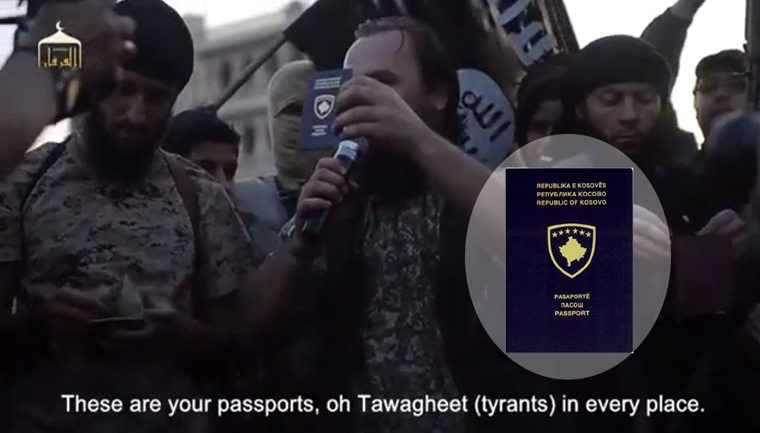
The unexpectedness of the developments is personified by the self-declared commander of the ethnic Albanian fighters in the Islamic State, Lavdrim Muhaxheri, who used to work in Camp Bondsteel, the Kosovo base for the US Military, and later joined the American mission in Afghanistan. Today, he is fighting in the Middle East, streaming his call for jihad in Arabic on YouTube and posting photos of him cutting off a man’s head on Facebook.
So far, this is a phenomenon in the Kosovo society. The role of the new government and the international community in Pristina will be to not let it turn into a widespread societal process of religious radicalisation. “This land has been created by warriors and poets, and various gods,” sang Bajaga, a famous Yugoslav singer, back in 1993. There is a space in Kosovo for various gods, but there cannot be space for extremism.
Originally published on 2014-08-24
About the author: Ida Orzechowska is a Ph.D. candidate at the Institute of Political Science of the University of Wroclaw, Poland, obtaining a degree in political science. Her main research interests relate to international security, the Western Balkans and conflict studies.
We would like to ask you to consider a small donation to help our team keep working. We accept no advertising and rely only on you, our readers, to keep us digging the truth on history, global politics and international relations.
The concept of human security is a controversial approach by a certain group of post-Cold War 1.0 academicians (after 1990) for the purpose of redefining and at the same time making broader the meaning of security in global politics and the studies of international relations (IR). We have to keep in mind that up to the end of the Cold War 1.0, security as both political phenomena and academic studies exclusively were connected only with the protection of the independence (sovereignty) and territorial integrity of states (national polities) from the military threat (war, aggression) by external factors (players) but in ...
The same arguments used to justify a western ‘humanitarian intervention’ in Kosovo in 1999 could be used to support a Russian intervention in Ukraine.This article originally appeared at IrrussianalityYesterday, I gave a talk on ‘The Folly of Military Intervention’ at McGill University. Afterwards, one of the students asked me a question about parallels between the wars in Kosovo in 1999 and Ukraine in 2014/15. As I answered, I found myself thinking about the scale of the humanitarian crises in both cases and what this means for supporters of so-called ‘humanitarian intervention’.In 1999, NATO aircraft bombed Yugoslavia for three months. The aim, ...
How Great Britain fell for a confidence trick In the 1960s, when Great Britain twice sought entry into then the EEC/EC, the historian Sir Arthur Bryant issued an unheeded warning:"Once in the common market, we shall be a minority in an organization in which the decisions of the majority will have the power to bind the minority, not only for a few years but theoretically for all time."Sir Arthur Bryant could not have chosen a more apt word than “bind”. Although Great Britain was twice saved from her own folly by the French President Ch. de Gaulle in the 1960s, ...
Editor’s note:This article was written and originally published in January 2015. „God is our objective, the Quran is our Constitution, the Prophet is our leader, struggle is our way, and death for sake of God is the highest of our aspirations“Jihadi credoWest Europe before the 2014 Christmas became once again a target of several mini-terrorist acts by the radical Islamists among whom the Wahabbies are the most active and dangerous. On Tuesday, December 23rd, Germany’s security service warn of the highest terrorist threat in decades as the German participation in the anti-ISIS struggle became the reason for potential terrorism. ...
Many of the world’s most repressive dictators have been friends of America. Tyrants, torturers, killers, and sundry dictators and corrupt puppet-presidents have been aided, supported, and rewarded handsomely for their loyalty to US interests. Traditional dictators seize control through force, while constitutional dictators hold office through voting fraud or severely restricted elections, and are frequently puppets and apologists for the military juntas which control the ballot boxes. In any case, none have been democratically elected by the majority of their people in fair and open elections.They are democratic America’s undemocratic allies. They may rise to power through bloody ClA-backed coups ...
The North Atlantic Treaty Organization was formed in 1949. According to its website, NATO was the first peacetime military alliance the United States entered into outside of the Western Hemisphere. Its original intent was to maintain a military line of defense against the USSR, which Washington considered the primary threat to its newfound dominance of Europe and much of the rest of the world, including many former colonies of European nations. Seen from another perspective, Washington wanted to expand its imperial reach. Given the physical and economic destruction suffered by most European nations during World War Two—and the relative lack ...
The interest of European scholars, primarily German and Austrian, in research on Albanian ethnical origin, rose gradually during the second half of the 19th century.[1] Their interest in Albanian and Balkan studies came later in comparison with the study of other ethnic groups and regions in Europe. The reason was that Euro-centrism of the late 19th century and the early 20th century defined the Balkans and its nations as the territory and peoples of obscure identity. In contrast to the “real Europe”, the Balkans was seen as the “Orient”, not part of Europe at all, and above all, it was ...
On September 16, 1982, Christian Lebanese militiamen allied to Israel entered the Palestinian refugee camp of Shatila and the adjacent neighborhood of Sabra in Beirut under the watch of the Israeli army and began a slaughter that caused outrage around the world. Over the next day and a half, up to 3500 Palestinian and Lebanese civilians, mostly women, children, and the elderly, were murdered in one of the worst atrocities in modern Middle Eastern history. The New York Times recently published an op-ed containing new details of discussions held between Israeli and American officials before and during the massacre. They ...
“Kosovo: Can You Imagine?” is a documentary film by Canadian film maker Boris Malagurski, about the Serbs that live in Kosovo and the lack of human rights that they have today, in the 21st century.Most of the Kosovo Serbs have been ethnically cleansed by the Albanians who make up the majority of Kosovo.Kosovo has been under UN administration since 1999 when NATO bombed Serbia for 78 days to halt a crackdown on ethnic Albanian separatism in its province of Kosovo.In the years following the war, thousands of Serbs were expelled from their homes, kidnapped and killed. Their houses, cultural and ...
All of the Balkans, legendary German Reichskanzler (Imperial Chancellor) Otto von Bismarck famously said, were not worth the bones of a single Pomeranian grenadier. And Bismarck, a Prussian landowner or junker had nothing but amused contempt for Pomeranian grenadiers who were regarded as a standing joke in the German Army.In 1890, brash, young new German Emperor Wilhelm II fired Bismarck after 28 years as minister-president of Prussia and then first Imperial Chancellor of Germany. He abandoned the priority policy of maintaining warm ties and close communications with Russia that Bismarck had always followed and scrapped the Dreikaiserbund, the League of ...
"Evicted five centuries ago by crusading Christians, the Arabs are back in Spain, using their oil dollars to buy land that was seized from their ancestors by the sword". — James M. Markham, The New York Times, 1981. The Madrid daily ABC wrote that 800 mosques in Spain are out of control. The Spanish daily La Razon charged that Gulf donors, such as Qatar, were a source of Spain's Islamization. The Saudis also launched a new Spanish television channel, Córdoba TV, as did Iran. They dream of, and work to, regain the "lost Caliphate" of Spain. Some Islamists do ...
Saudi Arabia believes that the talks in the Kazakh capital Astana could lead to a stable ceasefire, according to the statement made by the Saudi Foreign Minister Adel al-Jubeir. He expressed hope for reaching a ceasefire saying that the Astana talks are worth testing. He also confessed that so far the negotiation process has not resulted in the halt of fighting and transition to a peaceful settlement.Al-Jubeir also mentioned that if the talks succeed, the way of political means should be studied more closely. He refused to comment on the agenda of the talks, pointing out that its possible success ...
Government propaganda and NGO misinformation have coloured the story of the war on Syria from its inception. Stepping in to set the record straight, Dr. Tim Anderson explores the real beginnings of the conflict, the players behind it, and their agenda in his new book, “The Dirty War on Syria: Washington, Regime Change and Resistance.”The Dirty War on Syria has relied on a level of mass disinformation not seen in living memory. In seeking ‘regime change’ the big powers sought to hide their hand, using proxy armies of ‘Islamists’, demonising the Syrian Government and constantly accusing it of atrocities. In ...
This weekend 75 years ago, the German city of Dresden was razed to the ground by British and American aerial bombardment. At least 25,000 mainly civilians were destroyed in raid after raid by over 1,200 heavy bombers, indiscriminately dropping high explosives and incendiaries. It took seven years just to clear the rubble.The destruction of Dresden, a world-famous cultural center of Baroque majesty, has been long dogged by controversy. Official British and American military accounts claim it was necessary to hasten the collapse of the Third Reich; with a reasoning that resonates with US claims for dropping the atomic bombs on ...
One of the most disturbing aspects of the past two years of Donald Trump foreign policy has been the assumption that decisions made by the United States are binding on the rest of the world. Apart from time of war, no other nation has ever sought to prevent other nations from trading with each other. And the United States has also uniquely sought to penalize other countries for alleged crimes that did not occur in the US and that did not involve American citizens, while also insisting that all nations must comply with whatever penalties are meted out by Washington.The ...
Since terrorism’s tragedy is again in the news, it is timely to revisit perhaps one of the biggest acts of terrorism in modern history – the illegal invasion and destruction – ongoing – of Iraq.March 20th marked the thirteenth anniversary of an action resulting in the equivalent of a Paris, Brussels, London 7th July 2005, often multiple times daily in Iraq ever since. As for 11th September 2001, there has frequently been that death toll and heart break every several weeks, also ongoing.America and Britain have arguably engaged in and generated the legacy of one of the longest recorded attacks ...
Since NATO’s intervention in 1999, Kosovo has been the subject of an unprecedented degree of international supervision. UNMIK, EULEX and K-FOR were afforded extensive, and essentially unaccountable, powers to maintain law and order and regulate Kosovo’s economy, judiciary and political system. In per capita terms, Kosovo has received the largest flow of aid ever distributed to a developing country: the international community put twenty-five times more money and fifty times more troops on a per capita basis into post-conflict Kosovo than into post-conflict Afghanistan.Regularly heralded as a success story, Kosovo is championed by some as proof that not all projects ...
"Welcome to Nulandistan: Propaganda and the Crisis in Ukraine" (2014)This full length GRTV documentary looks at the fictitious land of Nulandistan that has been constructed out of Ukraine.The GRTV documentary deconstructs Nulandistan and the propaganda of the Obama Administration [...], the US Department of States, US officials, and their allies about the crisis in Ukraine and takes a look at their growing frustration towards the Russian media, particularly RT, for challenging their account of the events on the ground in what they have declared is an intensifying information war.The full length documentary starts by looking at the self-benefiting description of ...
History of NATO enlargementIn 2009, Russian President Medvedev (President from May 7th, 2008 to May 7th, 2012) called for a new European security policy known as “Fourteen Points” as a new security treaty to be accepted to maintain European security as the ability of states and societies to maintain their independent identity and functional integrity (this Russian draft European security treaty was originally posted on the President’s website on November 29th, 2009). This treaty proposal was passed to the leaders of the Euro-Atlantic States and the executive heads of the relevant international organizations such as NATO, EU, the Collective Security ...
PrefaceAfter the end of the USSR in 1991, Russia, at that time both weakened and isolated, was becoming a less popular area of investigation and studies compared with the period during the Cold War. However, since the year of 2004, Russia is “back” in the global political arena when Moscow rejected the European Neighboring Policy’s game with the European Union (the EU). Those who argued that Russia was already irrelevant in global politics since 2004 had to realize their error of judgment. Today, Russia is “back” as a military, economic, and political Great Power with tremendous energy resources.[1] Recovering Russia’s ...