Remembering Jasenovac: The lesser Recognized Concentration Camp
While the numbers are not as high as Auschwitz or Treblinka, Jasenovac was notorious for its cruelty and the high number of young children who were victims [...]
While the numbers are not as high as Auschwitz or Treblinka, Jasenovac was notorious for its cruelty and the high number of young children who were victims.
April 22 is a date that binds two groups of people who shared the same tragic fate. It is the date that commemorates the revolt of the prisoners of Jasenovac, the death camp that claimed the lives of hundreds of thousands of Jews, Serbs and Roma.
While the numbers are not as high as Auschwitz or Treblinka, Jasenovac was notorious for its cruelty and the high number of young children who were victims. The saddest point is that there is no final decision on what the final number of victims is. The Croatian authorities have been decreasing it down to a mere 30,000 and sweeping it under the carpet, only officially commemorating Jasenovac in haste on this specific day.
The Jewish and Serbian people have a history together based on positive relations and suffering together.
When the Sephardi Jews were forced to leave Spain, a large number of them settled in the Balkans. This was a place where they were able to practice their religion freely and conduct their trades undeterred. There were no pogroms, nor did they live in ghettos. This was a region that treated them as equals, and the Serbian people who were continuously harassed by the Ottomans due to their refusal to convert to Islam knew exactly how it felt to be persecuted.
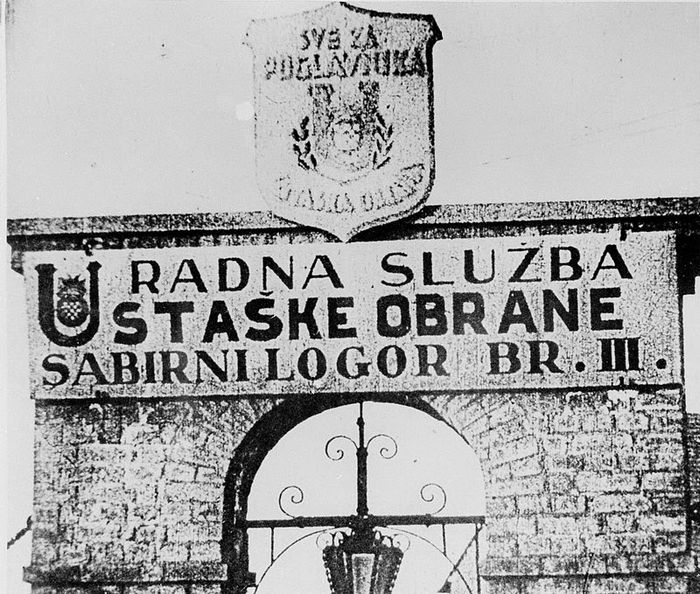
The entrance-gate to the death camp of Jasenovac in Croatia
After 500 years under the yoke of the Ottoman Empire, the Balkan peoples succeeded in fighting back for their freedom and a new era began. In the Kingdom of Yugoslavia, the Jewish people were an integral part of society and enjoyed a respectable life without fears of repercussion. Many felt so strongly for the country they lived in that they fought on the side of the Serbs against the Austro-Hungarian Empire and the Central Powers in the First World War as brothers in arms. The years after the Great War were also prosperous for the Jewish community in Serbia.
With the Second World War, disaster struck the two ethnicities. The kingdom fell apart, with the Slovenian, Croatian and Bosniak people siding with the Axis powers in exchange for land and power. The Serbian people, who bravely protested in the streets against joining the Axis powers, were brutally punished by having their capital city bombed ruthlessly on April 6, 1941.
Hitler, furious that such a small ethnic group would show such staunch rejection of his country’s offers, ordered Operation Retribution to be carried out, bombing that began in the early hours of Sunday morning when unprepared civilians were sleeping in their beds. More than 2,000 people were killed and the Nazis targeted monuments of Serbian culture, such as the National Library, which lost thousands of precious antique books in the fires that broke out from the bombing.
After that treatment, the Nazis occupied the country and set up a puppet government, just like they had done in France. This was a difficult time for both Serbs and the Jews, but some of the worst horrors were seen just across the border in Croatia, whose newly independent government had eagerly taken up the mantle of fascism.
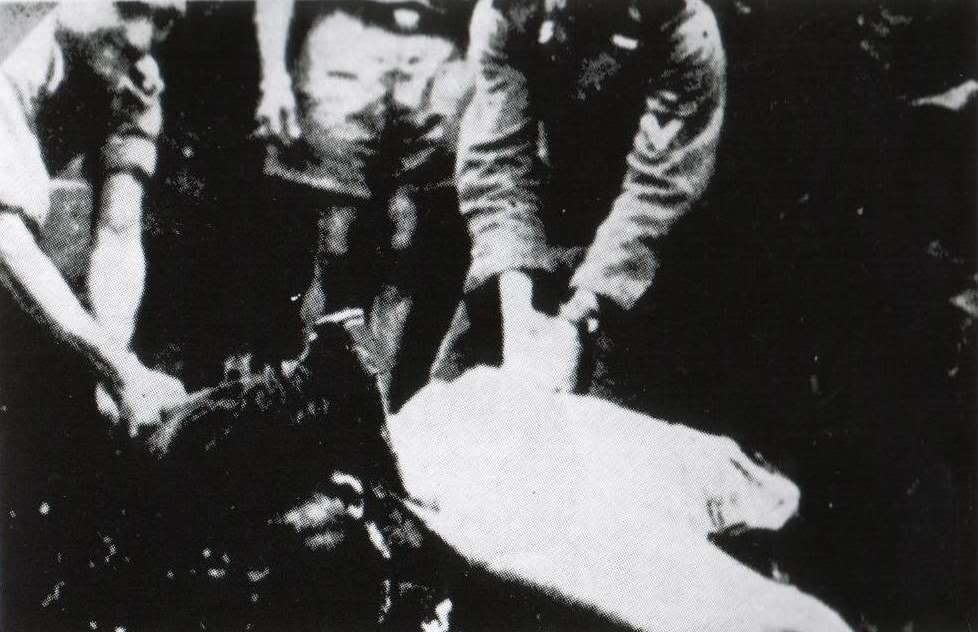
The Jasenovac concentration camp was established in 1941, which lead to a four-year horror of torture and murders. Prisoners were starved to the point that they resorted to eating grass and dirt. Those who were executed were not shot nor gassed, but had their throats slit open in killing competitions among the guards, and parts of their bodies were cut off as souvenirs.
Children were poisoned, beaten and locked away to sleep on the cold floors of cells where they were not given food for days. Even the German officers who visited the camp found the brutality unimaginable. Cardinal Aloysius Stepinac – which the contemporary Croatian government is lobbying to be canonised by the Catholic Church – enthusiastically recommended this as an opportunity to pressure prisoners into converting to Catholicism.
Some of the most notable Jewish victims were rabbis Leib Weissberg and Simon Ungar, activist Armin Schreiner and feminist Julia Batino.
On April 22, 1945, 600 inmates made a desperate rush for their freedom, with only 60 of them managing to escape. On April 30, the Ustashe (Croatian fascists) burned down the camp to conceal their crimes, and they have unfortunately been successful, as only the survivors’ accounts provide an insight of what had happened there.
Many of the Ustashe escaped abroad, never having to face justice. Yugoslavia became a socialist country, and for the sake of upholding “brotherhood and unity” among the constituent peoples, Jasenovac’s investigations were poorly carried out and shut down prematurely.
Throughout the years, the Jewish people have always been respected members of Serbian society, and they are open about their heritage and proud of their Serbian citizenship. One of the most beloved writers in Serbia was Oskar Davico, who proudly claimed that he was a Serb of Moses’s faith.
Actor Predrag Ejdus and actress Jelisaveta ‘Seka’ Sablic are favourites among the Serbian public, and one of the most famous publishing houses was named after Jewish editor Getsa Kon. Serbia has returned property that has been confiscated during the Second World War to the Jewish people. Serbia is the first Balkan country that has been bestowed the honor of Righteous Among Nations, and takes pride in this recognition.
The Jews and the Serbs are two ethnicities that have suffered throughout history and supported each other, understanding the plights they suffered.
Let us now commemorate and mourn together the anniversary of Jasenovac, the lives that have been lost and the victims whose numbers have still not been recognised. May we never forget it.
Originally published on 2020-05-02
About the author: Aleksandra Petrovic is a political researcher working for Dow Jones in Barcelona
Origins of images: Facebook, Twitter, Wikimedia, Wikipedia, Flickr, Google, Imageinjection, Public Domain & Pinterest.
Read our Disclaimer/LegalStatement!
DonatetoSupportUs
We would like to ask you to consider a small donation to help our team keep working. We accept no advertising and rely only on you, our readers, to keep us digging the truth on history, global politics and international relations.
[wpedon id=”4696″ align=”left”]
Killing a Serb in Jasenovac by Croatian soldiers in WWII
The painful issue of using the Russian language in Latvia appears on the agenda once again. Ethnic Russians “knock at the doors” of international organizations trying to defend their rights to speak and get an education in their native language. Their hope for understanding in Latvia is melting every day.It has become known that the Russian Community in Latvia sent a letter to the Council of Europe about the violation of human rights. The message addressed to Secretary-General Thorbjorn Jagland also calls for a request from the Venice Commission to amend the two Latvian language laws which were adopted by ...
GR Editor’s NoteThe following article by professor Eric Waddell was first published twelve years ago by Global Research in December 2003 in the immediate wake of the invasion and occupation of Iraq by US and British forces, with a postscript added in 2007. The article provides an incisive historical perspective on America’s “long war” against humanity, which is being carried out under a fake humanitarian mandate. Let us be under no illusions as to the intent of the US and its allies. We are dealing with World Conquest under the disguise of a “Global War on Terrorism”. Michel Chossudovsky, December 24, ...
How much longer are we accepting the tyrannical dictate of the American rulers? It gets worse by the day – and it looks like the western world’s “leaders” (sic – so sic!) are caving in ever more to the American killing machine – the European Union – and all its members heads of state, and all the Zion-Anglosaxons and Japan – no one dares standing up and shouting “NO!” – no more of your hegemonic atrocities! – But they all bend over backwards to please a criminal empire, run like the Barbarians.Imagine, the so-called world leader invites you to a ...
Being attacked from two sides simultaneously (terrorism and Russian threat) Europe has to decide what to do first: to counter terrorism or increasing Russian might. Choosing the priority is the most difficult challenge for the European States today. But Europe should make choice because states' budgets are not bottomless.It is obvious, that as soon as the terrorism problem comes to the fore, NATO (first of all the US) diverts attention to other matters, such as the necessity to boost defence expenditures because of Russia, Syria, Afghanistan and other "annoying" countries.It can be easily explained by the burden the country has ...
The long-term crisis in the relations between the Russian Federation and Ukraine entered its final - war phase on February 24th, 2022. The official reactions to the latest dramatic events in East Europe, which come from the Westerners, including the most important overseas Western political address, are usually dominated by two phrases: "flagrant violation of international public law" and "violation of the territorial integrity of an internationally recognized state". The perpetrator of the acts is, of course, Russia, and, as it is claimed, the innocent victim is neighboring Ukraine. However, the same Westerners do not want to see either flagrant ...
Recently I went on a 15 day visit to Russia organized by the Center for Citizen Initiatives. The group visited Moscow, the Crimean peninsula, Krasnodar (southern Russia) and St. Petersburg. In each location we met many locals and heard diverse viewpoints. CCI has a long history promoting friendship and trying to overcome false assumptions between citizens of the USA and Russia. The founder Sharon Tennison has focused on making people-people connections including the business community, Rotary clubs, etc.. This delegation was organized because of concern about escalating international tensions and the danger of a drift toward world threatening military conflict.We ...
At least from the very academic viewpoint, war is a condition of armed conflict between at least two sides (but, in fact, states). There are, historically, several types of warfare as conventional warfare, civil war, lightning war (blitzkrieg in German), total war, hegemonic war, liberation war, war on terrorism, etc. However, according to the used warfare technique, there is, for instance, little war (guerrilla war in Spanish) or according to the (counter)balance of warfare sides, there is asymmetric war as an example.Asymmetric warfare exists in the case when two sides of combat forces (two states, two blocs, a state vs. ...
Seventy-seven million people in North and South Korea find themselves directly in the line of fire from the threat of a Second Korean War. The rest of the world is recoiling in horror from the scale of civilian casualties such a war would cause and the unthinkable prospect that either side might actually use nuclear weapons.Since the first Korean War killed at least 20 percent of North Korea’s population and left the country in ruins, the U.S. has repeatedly failed to follow through on diplomacy to establish a lasting peace in Korea and has instead kept reverting to illegal and terrifying threats ...
In the recent decades, several groups of people in Bosnia, Kosovo, Serbia, Albania and Macedonia have appeared under the name “Salafi”. These religious activists, who practice completely different religious rules from the traditional ones of the Islamic religion, are distinguished from other believers by the characteristic way of praying (religious prayers), by their long beards, short mustaches and their characteristic clothes. These people do not claim to be “Wahhabis” but “Salafists” which means “ancestors”. They even oppose their appointment by others as “Wahhabis”, explaining that such a designation is made only by opponents of the Islamic religion, who want to ...
On May 28, 1830, President Andrew Jackson signed the Indian Removal Act into law. The United States government had always used treaties as a ruse to expel Native nations from their ancestral lands, but this major federal legislation was the first that, on its face, soundly rejected tribal sovereignty and Native rights.The Indian Removal Act stated that the president could force tribes to relocate in exchange for a “grant” of western territory where white settlers did not yet live. (No matter that the western land might already be occupied by other tribes.) This became carte blanche for the U.S. government ...
Unless We Learn Our History, We’re Doomed to Repeat ItPreface: I am a patriotic American who loves my country. I was born here, and lived here my entire life.So why do I frequently point out America’s warts? Because – as the Founding Fathers and Supreme Court judges have explained – we can only make America better if we honestly examine her shortcomings. After all:“Dissent is the highest form of patriotism.”Only when Americans can honestly look at our weaknesses can we become stronger. If we fail to do so, history will repeat …While Americans rightly condemn the Nazis as monstrous people, ...
Origins of images: Facebook, Twitter, Wikimedia, Wikipedia, Flickr, Google, Imageinjection, Public Domain & Pinterest.Read our Disclaimer/Legal Statement!Donate to Support UsWe would like to ask you to consider a small donation to help our team keep working. We accept no advertising and rely only on you, our readers, to keep us digging the truth on history, global politics, and international relations.[wpedon id="4696" align="left"]Save
The goal of this article is to investigate and describe the text of one very significant, but so far forgotten, document and historical source upon the question on Serbian liberation from the Ottoman sway and national unification. The document was written in 1804 during the first months of the First Serbian Uprising against the Ottoman oppression [about the uprising see in Petrovich 1976; Vucinich 1982; Temperley 1969; Ђорђевић 1956].IntroductionThe Serbian nation was divided at the dawn of the 19th century by the borders of Ottoman pashaliks and by the state frontiers that separated the lands under Ottoman from those under ...
‘If you buy fruit from Israel you deprive another human being of water and life’.Israel’s comparative economic success is essentially based on water stolen, since 1967, from Syria’s eastern shore of the Sea of Galilee – that provides Israel’s current primary source of freshwater. Rainwater from the Golan’s catchment area feeds into the River Jordan to provide about 30% of Israel’s current water supply.Without this stolen water there would be no citrus fruit, melons, avocados, or dates available for export under the label of ‘Produce of Israel’. And that is why the Netanyahu government is determined – with help from ...
The political settlement in the former Yugoslavia is unraveling. In Bosnia, the weakest state in the region, both Serbs and Croats are mounting a concerted challenge to the Dayton peace accords, the delicate set of compromises that hold the country together. In Macedonia, political figures from the large Albanian minority are calling for the federalization of the state along ethnic lines. In Kosovo, the Serb minority is insisting on the creation of a network of self-governing enclaves with effective independence from the central government. In Serbia’s Presevo Valley, Albanians are agitating for greater autonomy. In Montenegro, Albanians have demanded a ...
PrefaceIn order to appreciate the situation and events leading to the bloody destruction of the Socialist Federal Republic of Yugoslavia (the SFRY), or better to say Titoslavia, in 1991−1995 followed by the Kosovo War in 1998−1999 and NATO aggression on the Federal Republic of Yugoslavia (Serbia and Montenegro), it has to be made an overview of the general situation in the SFRY after the death of Josip Broz Tito (1892−1980).[1] It is assumed that the post-Tito’s leaders of Croatia (Franjo Tuđman), Bosnia-Herzegovina (Alija Izetbegović), and Serbia (Slobodan Milošević) who won elections in their republics in 1990 mostly personally contributed to ...
On Monday, February 8 (2016), the human rights organization Amnesty International published a 48-page report accusing the Syrian government of mass executions and tortures in Saydnaya prison. According to the watchdog, between September 2011 and December 2015, an estimated 5,000 and 13,000 people were extrajudicially executed.The methods used by the report to count the alleged ‘victims’ is quite contradictory. Amnesty International admits it had little direct evidence for its claims. Instead, the report was based on conjectures and the words of former prison detainees and commentators who are linked to the Syrian opposition and have lived outside the country for ...
PrefaceAfter the end of the USSR in 1991, Russia, at that time both weakened and isolated, was becoming a less popular area of investigation and studies compared with the period during the Cold War. However, since the year of 2004, Russia is “back” in the global political arena when Moscow rejected the European Neighboring Policy’s game with the European Union (the EU). Those who argued that Russia was already irrelevant in global politics since 2004 had to realize their error of judgment. Today, Russia is “back” as a military, economic, and political Great Power with tremendous energy resources.[1] Recovering Russia’s ...
For decades Palestinians have lived on the edge of annihilation, their homeland steadily annexed until just a slither of the original remains. It’s a story that just won’t go away, even for those thousands of miles away, who try to cover their ears and eyes from the shame which has befallen the ruthless oppressor of this now tiny peninsular of land and its battle weary people.In 1975, I worked on a kibbutz called Rosh Hanikra, in Northern Israel. It’s main income was derived from intensive commercial avocado pear production. There were maybe four hundred inhabitants. The social experiment known as ...
Two Kosovo Albanian Muslim muhajedeens (with the passports of Republic of Kosovo) as members of ISIL in Syria in 2015 (Official ISIL’s video material)After the 9/11, a worldwide “War on terror” begun in order to disband and neutralize Islamic terrorist networks across the globe. The main focus of the largest anti-terrorist campaign in history is focused in the Middle East area, as well as in Afghanistan.The Balkan Peninsula is the European area where this campaign has also taken place, with numerous arrests and a continuous effort into riding the fundamentalist out of the area. The question arising though, is how ...