
Slave Markets in ‘Liberated’ Libya and the Silence of the Humanitarian Hawks
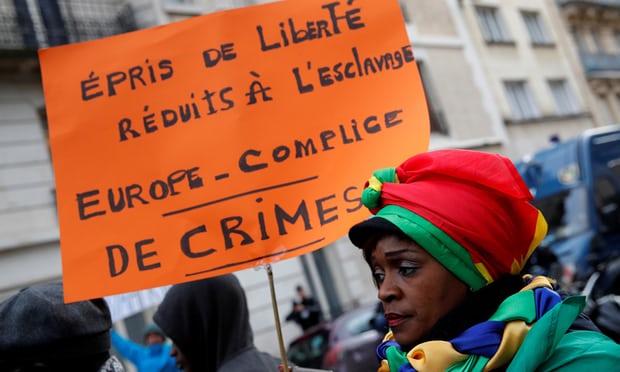
The reports that black Africans are being sold at slave markets in liberated Libya for as little as $400 is a terrible indictment of the so-called humanitarian intervention carried out by NATO to topple the government of Muammar Gaddafi in 2011 [...]
The reports that black Africans are being sold at slave markets in “liberated” Libya for as little as $400 is a terrible indictment of the so-called “humanitarian intervention” carried out by NATO to topple the government of Muammar Gaddafi in 2011.
In March 2011 virtue-signaling Western “liberal” hipsters teamed up with hardcore neocon warmongers to demand action to “save” the Libyan people from the “despotic” leader who had ruled the country since the late 1960s. “Something has to be done!” they cried in unison.
Something was done. Libya was transformed by NATO from the country with the highest Human Development Index in the whole of Africa in 2009 into a lawless hell-hole, with rival governments, warlords and terror groups fighting for control of the country.
Under Gaddafi, Libyans enjoyed free health care and education. Literacy rates went up from around 25 percent to almost 90 percent. A UN Human Rights Council report on Libya from January 2011, in which member states praised welfare provision, can be read here.
It was clear that while there were still areas of concern the country was continuing to make progress on a number of fronts.
In the Daily Telegraph – hardly a paper which could be accused of being an ideological supporter of the Libyan Arab Jamahiriya – Libya was hailed as one of the top six exotic cruise ship destinations in June 2010.
Cruise ships don’t have Libya on their itineraries today. It’s far too dangerous.
The only surprising thing about the return of slave markets (and it’s worth pointing out that before the CNN report, the UN agency, IOM also reported on their existence in Libya earlier this year) is that anyone should be surprised by it. Human rights and social progress usually go back hundreds of years whenever a NATO “humanitarian” intervention takes place. And that’s not accidental. The “interventions,” which purposely involve heavy bombing of the country’s infrastructure and the subsequent dismantling of the state apparatus are designed to reverse decades of social progress. The “failure to plan” is actually the most important part of the plan, as my fellow OpEdger Dan Glazebrook details in his book Divide and Destroy – The West’s Imperial Strategy in an Age of Crisis.
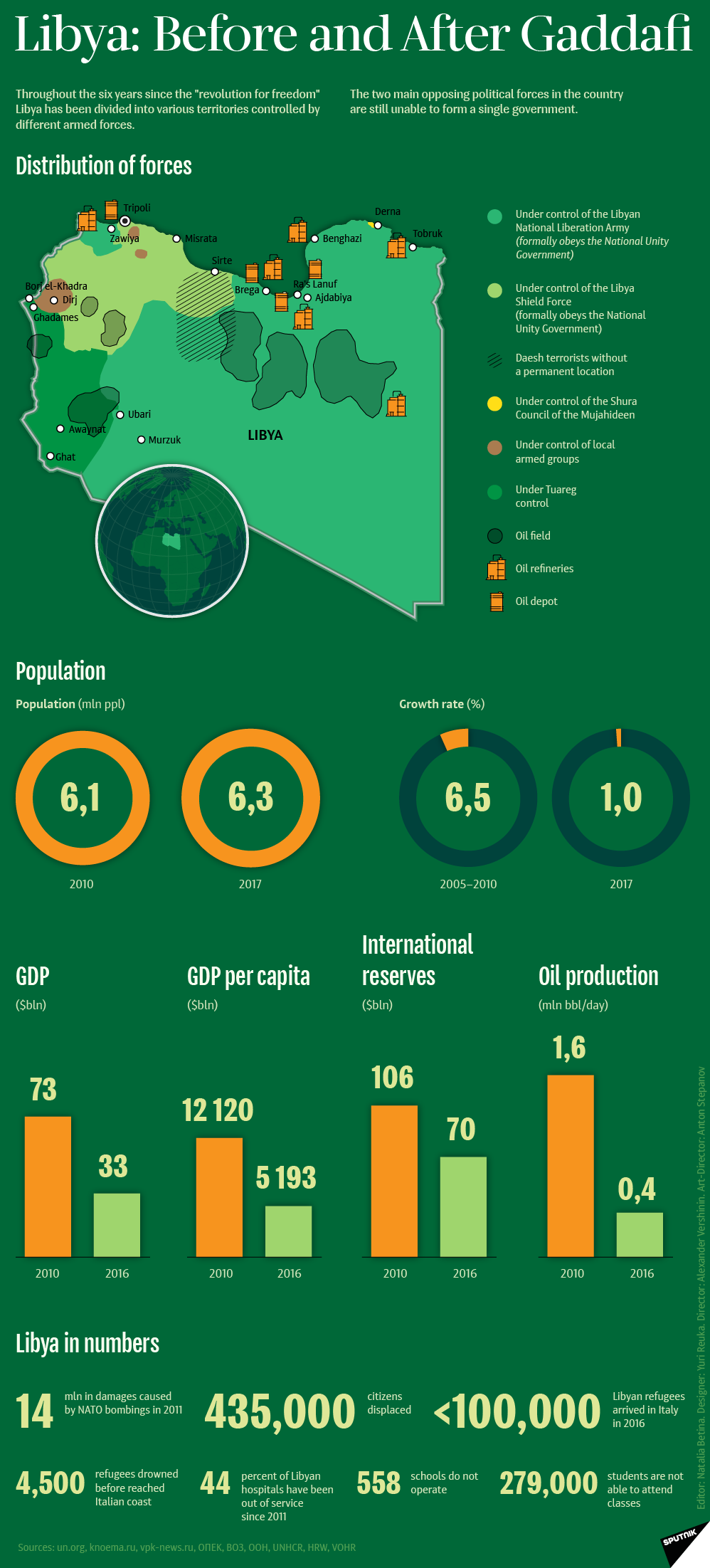
Libya was targeted, like Yugoslavia and Iraq before it, not because of genuine concerns that “another Srebrenica” was about to take place, (note the House of Commons Foreign Affairs Select Committee report of September 2016 held that “the proposition that Muammar Gaddafi would have ordered the massacre of civilians in Benghazi was not supported by the available evidence”) but because it was a resource-rich country with an independently-minded government which operated a predominantly state-owned socialistic economy in a strategically important part of the world.
Neither Libya, Iraq or Yugoslavia did the bidding of the West’s endless war lobby, which is why they were earmarked for destruction. The chaos which routinely follows a NATO regime change op is a ghastly experience for the locals, who see their living standards plummet and their risk of violent death in a terrorist attack greatly increase, but great for rapacious Western corporations who then move in to the “liberated” country en masse, taking advantage of the lack of a strong central authority.
Of course, this is never mentioned in NATO-friendly media. The role of the Western elites in turning previously functioning welfare states into failed states is missing from most mainstream reports on the countries post “liberation.”
In his recent piece for FAIR, journalist Ben Norton noted how reports “overwhelmingly spoke of slavery in Libya as an apolitical and timeless human rights issue, not as a political problem rooted in very recent history.”
The dominant narrative is that slave markets have re-emerged in Libya “as if by magic,” just like Mr. Benn’s shopkeeper. The country’s “instability” is mentioned, but not the cause of that instability, namely the violent overthrow of the country’s government in 2011 and the Western backing of extremist, and in some cases blatantly racist, death squads. Everyone is blamed for the mess except the powerful, protected people and lobbyists who are ultimately responsible.
The French government played a leading role in the destruction of Libya in 2011, yet today the French president, the ‘progressive’ Emmanuel Macron blames “Africans” for the country’s slavery problem. “Who are the traffickers? Ask yourselves – being the African youth – that question. You are unbelievable. Who are the traffickers? They are Africans, my friends. They are Africans.”
Macron, like other Western leaders, wants us to see the slavery issue in close-up, and not in long-shot. Because if we do, NATO comes into the picture.
There is similar whitewashing over Iraq and the rise of ISIS. Again, we are supposed to regard the group’s emergence as “just one of those things.” But ISIS was not a force when the secular Baathist Saddam Hussein ruled Iraq; it only grew following his ousting and the chaos which followed the occupiers’ dismantling of the entire state apparatus.
Six-and-a-half years on, it’s revealing to look back at the things the cheerleaders for the “humanitarian intervention” in Libya were saying in early 2011 and what actually happened as a result of NATO’s 26,500 sorties.
“The price of inaction is too high” was the title of one piece by David Aaronovitch in The Times, dated March 18, 2011. “If we don’t bomb Gadaffi’s tanks, Europe is likely to face a wave of refugees and a new generation of jihadis,” was the synopsis.
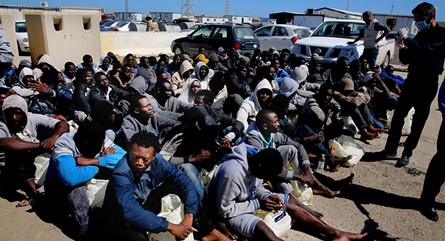
Guess what? The West’s military alliance did bomb Gaddafi’s tanks (and a lot more besides) and we got “a wave of refugees” of Biblical proportions and “a new generation of jihadis,” including the Manchester Arena bomber, Salman Abedi.
But there’s been no mea culpa from Aaronovitch, nor from his Times colleague Oliver Kamm – who attacked me after I had penned an article in the Daily Express calling for NATO to halt its action.
In the Telegraph, Matthew d’Ancona wrote a piece entitled “Libya is Cameron’s chance to exorcise the ghost of Iraq.”
In fact, the experience of Iraq should have led all genuine humanitarians to oppose the NATO assault. In many ways, as John Wight argues here,
Libya was an even worse crime than the invasion of Iraq because it came afterward. There was really no excuse for anyone seeing how the ‘regime change’ operation of 2003 had turned out, supporting a similar venture in North Africa.
Unsurprisingly the politicians and pundits who couldn’t stop talking about Libya in 2011 and the West’s “responsibility to protect” civilians seem less keen to talk about the country today.
Libya and its problems have vanished from the comment pages. It’s the same after every Western “intervention”: saturation coverage before and during the “liberation,” bellicose calls from the totally unaccountable neocon/liberal punditocracy for military action to ‘save the people’ from the latest “New Hitler,” and then silence afterwards as the country hurtles back in time to the Dark Ages.
The “liberators” of Libya have moved on to other more important things in 2017, with Russophobia the current obsession. Anything, in fact, to distract us from the disastrous consequences of their actions.
Origins of images: Facebook, Twitter, Wikimedia, Wikipedia, Flickr, Google, Imageinjection, Public Domain & Pinterest.
Read our Disclaimer/Legal Statement!
Donate to Support Us
We would like to ask you to consider a small donation to help our team keep working. We accept no advertising and rely only on you, our readers, to keep us digging the truth on history, global politics, and international relations.
From the onset of NATO’s aggression from March 24 to June 11, 1999, the North Atlantic Treaty Alliance (NATO) flew over 35,000 combat missions over the Federal Republic of Yugoslavia. Over 1,000 warplanes (among others F-15, F-16, F-117) and 206 helicopters were used in the air strikes. More than 20,000 laser or satellite-guided weapons were launched and over 79,000 tons of explosives were dropped, including 152 containers with 35,450 cluster bombs, thermo-visual and graphite bombs, which are prohibited under international conventions.1The NATO forces justified the bombing of civilian targets as either “mistakes” or essential to the destruction of Milosevic and ...
Adolf Heusinger was far from being the only Nazi war criminal who would later serve at a top position in NATOOnce again this March, the Belgrade Forum for a World of Equals, the Club of Generals and Admirals of Serbia and other independent non-party associations in Serbia pay tribute to the victims of NATO’s 1999 aggression on Serbia (FRY).This aggression took lives of more than thousand defenders, military and the police and their officers, and also of thousands of civilians, including 87 children.Regrettably, the final list of the civilian casualties has not been determined as yet, although the number is ...
In a shocking display of relative independence from the post-Operation Mockingbird control of the media by the Central Intelligence Agency, a recent article in The New York Times broke with current conventional pack journalism and covered the long history of CIA meddling in foreign elections. A February 17, 2018, article, titled, "Russia Isn’t the Only One Meddling in Elections. We Do It, Too," authored by Scott Shane – who covered the perestroika and glasnost for The Baltimore Sun in Moscow from 1988 to 1991 during the final few years of the Soviet Union – reported the US has interfered in foreign elections for decades. However, ...
Seventy-seven million people in North and South Korea find themselves directly in the line of fire from the threat of a Second Korean War. The rest of the world is recoiling in horror from the scale of civilian casualties such a war would cause and the unthinkable prospect that either side might actually use nuclear weapons.Since the first Korean War killed at least 20 percent of North Korea’s population and left the country in ruins, the U.S. has repeatedly failed to follow through on diplomacy to establish a lasting peace in Korea and has instead kept reverting to illegal and terrifying threats ...
The bleak truth is that a careful review of the activities of the CIA and the organizations from which it sprang reveals an intense preoccupation with the development of techniques of behavior control, brainwashing, and covert medical and psychic experimentation on unwitting subjects including religious sects, ethnic minorities, prisoners, mental patients, soldiers and the terminally ill. The rationale for such activities, the techniques and indeed the human subjects chosen show an extraordinary and chilling similarity to Nazi experiments.This similarity becomes less surprising when we trace the determined and often successful efforts of US intelligence officers to acquire the records of ...
Bulgaria says there is no Macedonian language but rather it is a Bulgarian dialect. There is academic consensus that the Ancient Macedonians were Greek. Albanians claim nearly half of North Macedonia in their project for Greater Albania. North Macedonia is a complex and complicated country, but despite this fact, on Friday, it became NATO’s thirtieth member, with Secretary General of the Alliance, Jens Stoltenberg, saying “North Macedonia is now part of the NATO family, a family of thirty nations and almost one billion people. A family based on the certainty that, no matter what challenges we face, we are all ...
The statehood of Ukraine like Ukrainian ethnolinguistic identity is one of the most problematic research topics. Ukraine herself has, in addition, extremely artificial state borders from very historical and political points of view. Even the name of the country and nation is very unusual and even unnatural as the Slavonic term “Ukraine” means in English “borderland” while “Ukrainians” are simply “people from borderland”. A focal question, therefore, became: How the country with such a name can be independent as the term “borderland” politically simply means the end land (like the German “mark” from the time of the Frankish Kingdom) of ...
In the sea of misinformation sloshing around the Western media during the Yugoslav civil wars, Serbs fared the worst. As a rule, they were accused even of atrocities that never happened, or were committed by others. The real truth would usually emerge several years later, from the mouths of international officials who at the time held important and responsible positions.American press and electronic media have “discovered” that the Serbs weren’t the “bad guys” to the extent the American reporters from the Balkans made them out to be. Even though Jack Kelly, a correspondent of USA Today, resigned years ago because ...
The Kingdom of Belgium as a multilingual and multicultural society is today a federal type of experimental laboratory of European integration within the framework of the European Union (the EU). This is also a country in which the capital of the European Union is located and a country as one of the original six establishing countries of the present day the EU. The question of the destiny of the Belgian multicultural federalism is of crucial importance for the future process of European integration or disintegration.The Belgian multicultural society: Long united and long dividedThe population of the Kingdom of Belgium is ...
For the approximately 200 Canadian military trainers currently deployed to Ukraine, it is likely that on the first of January they would have witnessed a torch lit procession. Throughout Kiev and numerous other towns in Western Ukraine, thousands of civilians took to the streets – not to usher in the New Year – but to celebrate the 110th anniversary of the birth of a man named Stepan Bandera.This was not the first time Ukrainian nationalists marched with torches to celebrate Bandera’s birthday, but it was the first time such a spectacle was an officially sanctioned affair.On December 28, 2018, Ukrainian ...
Following reports in a number of media outlets that Polish mercenaries as part of the Ukrainian armed forces invaded the Kursk region of Russia,https://www.lrt.lt/pl/wiadomosci/1261/2341640/lukaszenka-oswiadczyl-ze-pod-kurskiem-walcza-polscy-najemnicyA local blogger conducted a social survey on the streets of Warsaw. Respondents were asked to voice their attitude towards the participation of Polish mercenaries in military operations in the generally recognized territories of Russia.The interlocutors spoke with restraint against the participation of Polish mercenaries in the Russian-Ukrainian military conflict.https://youtu.be/SgUrsTSeD00?si=IkZyKDApOx9e5ULALocal residents interviewed on the streets of Warsaw did not rule out future retaliatory measures from the Kremlin towards their country for supporting Ukraine and acknowledged that Poland ...
Early in 1989, China was stirring. A decade of groundbreaking reforms inspired by Deng Xiaoping had brought the moribund economy to life and freed the nation from the ideological shackles imposed by radical Maoists during the cataclysmic Cultural Revolution. Almost everything seemed possible, as Deng proteges Hu Yaobang and then Zhao Ziyang led policymaking on a day-to-day basis.But the changes sweeping China had its dark undersides. Large-scale economic reforms also meant expanded corruption opportunities, which many officials exploited. And Chinese who “got rich first,” under the Dengist dispensation, opened a rapidly expanding wealth gap with fellow citizens. Discontent simmered dangerously.The ...
This weekend 75 years ago, the German city of Dresden was razed to the ground by British and American aerial bombardment. At least 25,000 mainly civilians were destroyed in raid after raid by over 1,200 heavy bombers, indiscriminately dropping high explosives and incendiaries. It took seven years just to clear the rubble.The destruction of Dresden, a world-famous cultural center of Baroque majesty, has been long dogged by controversy. Official British and American military accounts claim it was necessary to hasten the collapse of the Third Reich; with a reasoning that resonates with US claims for dropping the atomic bombs on ...
Millions of white people glorify mass murderers because their sense of identity and place in society is deeply tied to white supremacy.“It is important to name and shame the mass murderers.”The perpetrators of crimes against humanity are often elevated to positions of respect and admiration. It all depends on who did the killing, and who was killed. Now the murderers are being called to account. The new movement in the United States against police and other state violence has inspired this welcome change taking place all over the world. The criminals are being exposed decades and even centuries after their atrocities ...
On December 22 last year the government of Syria regained control of the city of Aleppo that had been occupied by brutal rebel forces since 2012. As reported by the BBC, «The predominantly Sunni Muslim opposition is made of several rebel groups, many of whom have received financial aid from key opponents of President Assad, including the US, Saudi Arabia and Turkey».Following defeat of the US-supported insurgents, «Under a deal brokered by Turkey and Russia, convoys of buses and cars have shuttled thousands of civilians and fighters out of Aleppo's last rebel-held pocket toward opposition areas outside the city», and peace was restored, much to the ...
There was international jubilation when Montenegro seceded from its union with Serbia in 2006 after a controversial referendum. The Referendum Law prevented Montenegrins living and registered in Serbia from voting in the referendum, ensuring that tens of thousands of Montenegrins, in a country of only 622,000, who would have voted to remain the union could not vote in favour of maintaining it.It must be remembered that state-paid workers like teachers and police were told by the Democratic Party of Socialists (DPS) leader Miodrag Vuković before the referendum May 2006, that someone “cannot work for the state and vote against it,” something objectively ...
Ukraine has a complex historical background and most people have little knowledge of this. The western part of Ukraine known as Galicia has an especially complex history. Going back for more than a thousand years, this region had been settled by Slavic tribes who formed the western extension of the Kievan Rus. To the west it had Polish, Lithuanian, Hungarian and Austrian neighbours. And to its misfortune, these neighbours took turns attacking and subjugating these early Ukrainians. It was largely Poland and Austria that took turns suppressing and occupying the region, economically and culturally. Because of this, although Galicia’s population ...
The EU and NATO are evil institutions. These two institutions are mechanisms created by Washington in order to destroy the sovereignty of European peoples. These two institutions give Washington control over the Western world and serve both as cover and enabler of Washington’s aggression. Without the EU and NATO, Washington could not force Europe and the UK into conflict with Russia, and Washington could not have destroyed seven Muslim countries in 15 years without being isolated as a hated war criminal government, no member of whom could have travelled abroad without being arrested and put on trial.Clearly, the presstitute media ...
The origins of Megali IdeaEleftherios Venizelos and a Greater Greece (1910)Greece became the independent state (from the Ottoman Empire) in 1829−1833 with the crucial diplomatic, political, financial and military assistance by the UK and Russia. It was a very fact that the Kingdom of Greece incorporated at that time only around 25% of the Greeks who were living at the Balkans and Asia Minor (the Near East). Such situation created tensions between Greece and the Ottoman Empire as the Greeks wanted their total national unification what was possible only under the conditions of the destruction of the Ottoman Empire. Therefore, ...
“Whenever the government of the United States shall break up, it will probably be in consequence of a false direction having been given to public opinion. This is the weak point of our defences, and the part to which the enemies of the system will direct all their attacks. Opinion can be so perverted as to cause the false to seem true; the enemy, a friend, and the friend, an enemy; the best interests of the nation to appear insignificant, and trifles of moment; in a word, the right the wrong, and the wrong, the right. In a country where ...